

Somewhere between trance and precision, Fase keeps turning.
Watching Fase, Four Movements to the Music of Steve Reich, the signature work of Belgian choreographer Anne Teresa De Keersmaeker, feels less like attending a performance and more like submitting to a condition. It is not something that easily invites a rating. It asks instead for time, attention, and a willingness to sit inside repetition—something that feels almost radical in a world calibrated to short-form, scrollable distraction.
First premiered in 1982, Fase is widely considered a landmark of contemporary dance. Set to four compositions by Steve Reich, namely Piano Phase, Come Out, Violin Phase, and Clapping Music, the work unfolds across three duets and one solo. Built on the principle of phase shifting, both music and movement begin in unison before gradually slipping out of sync through minute variations, generating an ever-evolving field of patterns. What emerges is minimalist choreography that does not simply follow the music, but exists in rigorous dialogue with it, precise, mathematical, and yet strangely alive.

At first, the demand is clear. The structure is bare, the movements minimal, the logic unyielding. Each section is introduced with stark white text on black, before the dancers, Laura Bachman and Yuika Hashimoto, enter into systems of movement that loop, repeat, and gradually shift. There are no narrative cues, no emotional handholds. And yet, somewhere in the act of watching, something changes and something lights up within our minds: the repetition begins to work on you.

The act of concentration and watching choreography on loop forces you to pay attention, and before long, you begin to notice the smallest differences. It could be a fraction of delay, a shift in alignment, or perhaps a subtle drift out of sync. What initially feels static becomes unstable, yet very alive. It is a bit like watching a real-time version of Groundhog Day play out, with the same sequence, again and again, but never precisely the same. The dancers seem locked in a quiet battle, not just of stamina, but of concentration, holding themselves inside a system where the music loops in tight cycles, offering almost no external markers. The precision required is staggering for both of them.

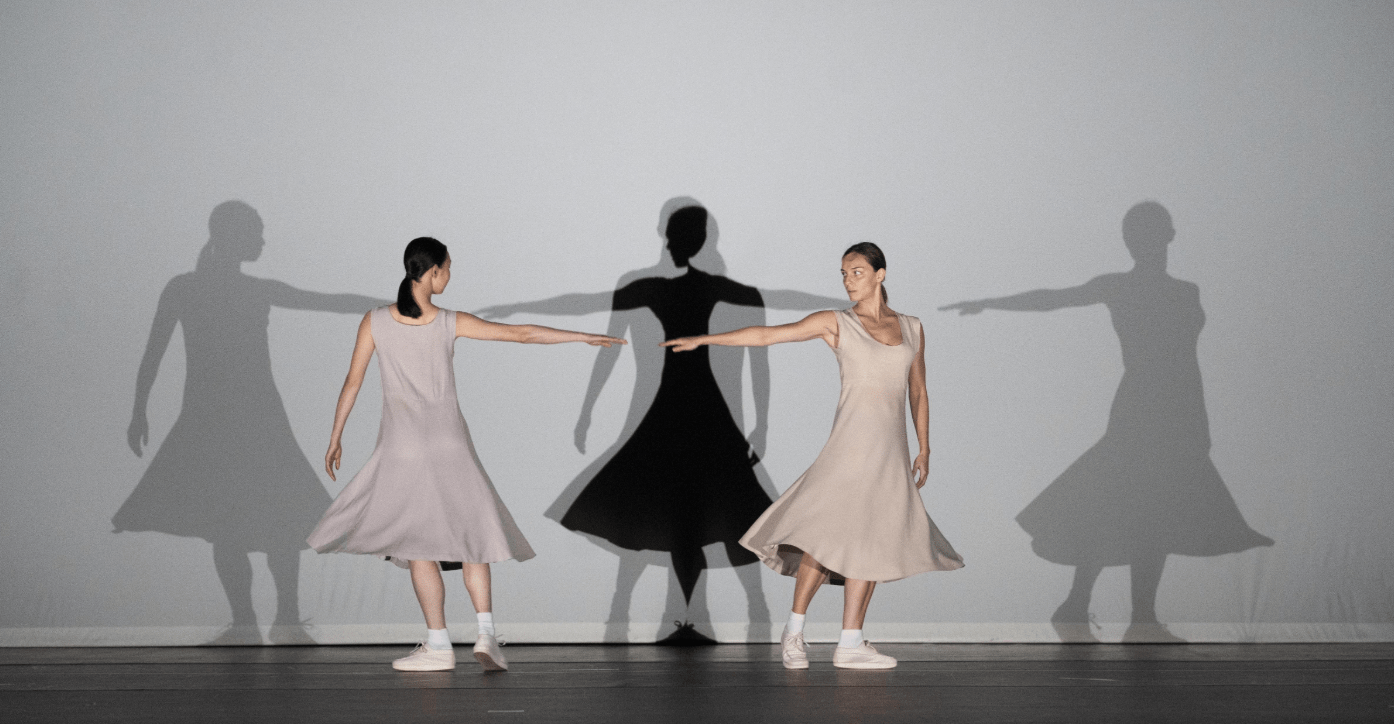
The opening Piano Phase establishes the work’s logic with clarity. The dancers, in skirts, spin against a white screen, their shadows multiplying behind them, splitting their bodies into doubles and triples. It suggests parallel realities, or perhaps time itself folding and refracting. The circling motion feels endless, like watching time made visible, with loops, turns, and incremental change. There is something ephemeral here, as if the dance is always on the verge of slipping away even as it repeats, the sense that time itself is splitting into multiple dimensions and universes.

In Come Out, the tone shifts. Seated under two lamps, dressed in boots and jumpsuits, the dancers move with sharper, more sculptural precision. They never quite meet, never fully interact. Instead, they orbit each other, as they swivel in chairs, like parallel lives running on adjacent tracks. The repeated vocal fragment begins to feel insistent, almost oppressive. Here, repetition evokes monotony, labour, routine, and yet embedded within it is also a call to break from it, a reminder that when we are caught in these cycles of work, it becomes all too easy to be trapped in the vortex, unable to leave.

The solo Violin Phase, performed by Yuika Hashimoto, offers a different texture from the last. Here it is much lighter, almost fleeting. In a circle of light, she spins, leaps, gathers invisible gestures like picking flowers, over and over again on light steps. There is something delicate, even girlish, in the quality of movement, but it is held within the same relentless structure. It reads as a kind of fragile joy, present, luminous, and already slipping as it unfolds, and the realisation that youth is fleeting, and innocence can only last so long before one is forced to grow up and leave childhood behind. Joy does not last forever, it only feels as such when in the moment.

Then comes Clapping Music, perhaps the most visibly demanding of all and an appropriate finale. Now dressed in loose blouses and pants, the dancers’ focus shifts to intricate footwork. tiptoeing, shifting weight, falling in and out of sync with each other most visibly. Behind them, the framing of light suggests windows, or perhaps a moving vehicle, an endless road. they’re commuting down. Here, the phasing becomes most apparent: they slip apart quickly, each inhabiting their own rhythm, occasionally snapping back into alignment before diverging again. Slowly, almost imperceptibly, they begin to travel, moving backwards, edging their way across space onstage, eventually reaching the same two lamps from Come Out. Change, the piece seems to suggest, does not arrive dramatically, it accumulates.

Across all four movements, what emerges is not meaning in a conventional sense, but an experience of time. The music itself shifts almost imperceptibly, and you begin to lose track of how it changed, but are fully aware at some point that it has. It recalls the idea of slow erosion, a sense of transformation unfolding through duration. Watching Fase, you begin to feel how repetition can both stabilise and undo. Perhaps strangely, there is also a festering emotional undercurrent, one that is both hopeful and sobering. Patterns return, movements persist, but nothing is ever exactly the same. Each iteration exists only once, then disappears. In this way, the work captures something essential about live performance itself: its ephemerality and its resistance to being fixed, and how delicate each staging and movement is.

What makes this even more striking is its simplicity. The movement vocabulary of turning, walking, spinning, is almost disarmingly basic. There is the sense that audiences themselves might try it themselves afterwards. There is access here, a sense that the body on stage is not entirely distant from your own, even when within that simplicity lies extraordinary rigour. Perhaps it is a master key that allows us too to become time travelers, using the body on loop as a means of meditation and transformation. What results from all this is a subtle but certain shift in perception. To sit with repetition long enough is to see differently, to notice detail, to feel duration, to enter a shared rhythm with the performers. It becomes almost trance-like, but never passive. Your attention is part of the work, and for a moment you feel completely outside of time, of space, and somehow connected to everything and all that exists, watching as the stage holds just a little piece of eternity.
Photo Credit: Anne Van Aerschot
Fase, Four Movements to the Music of Steve Reich played from 23rd to 25th April 2026 at the Singtel Waterfront Theatre. More information available here
Production Credits
| Choreography Anne Teresa De Keersmaeker Danced by Laura Bachman, Yuika Hashimoto Created with Michèle Anne De Mey, Anne Teresa De Keersmaeker Light design Remon Fromont Costumes (1981) Martine André / Anne Teresa De Keersmaeker Rehearsal Director Tale Dolven Assistant to the Artistic Director Martine Lange Artistic Coordination and Planning Anne Van Aerschot Technical Director Thomas Verachtert Technicians Pieter Kint, Bennert Vancottem Assistant Technical Director Bennert Vancottem Costumes Coordinator Veerle Van den Wouwer Costumes Coordinator assisted by Els Van Buggenhout and Chiara Mazzarolo Sewing Maria Eva Rodrigues-Reyes en Gisèle Charles Managing Director Lies Martens |

