
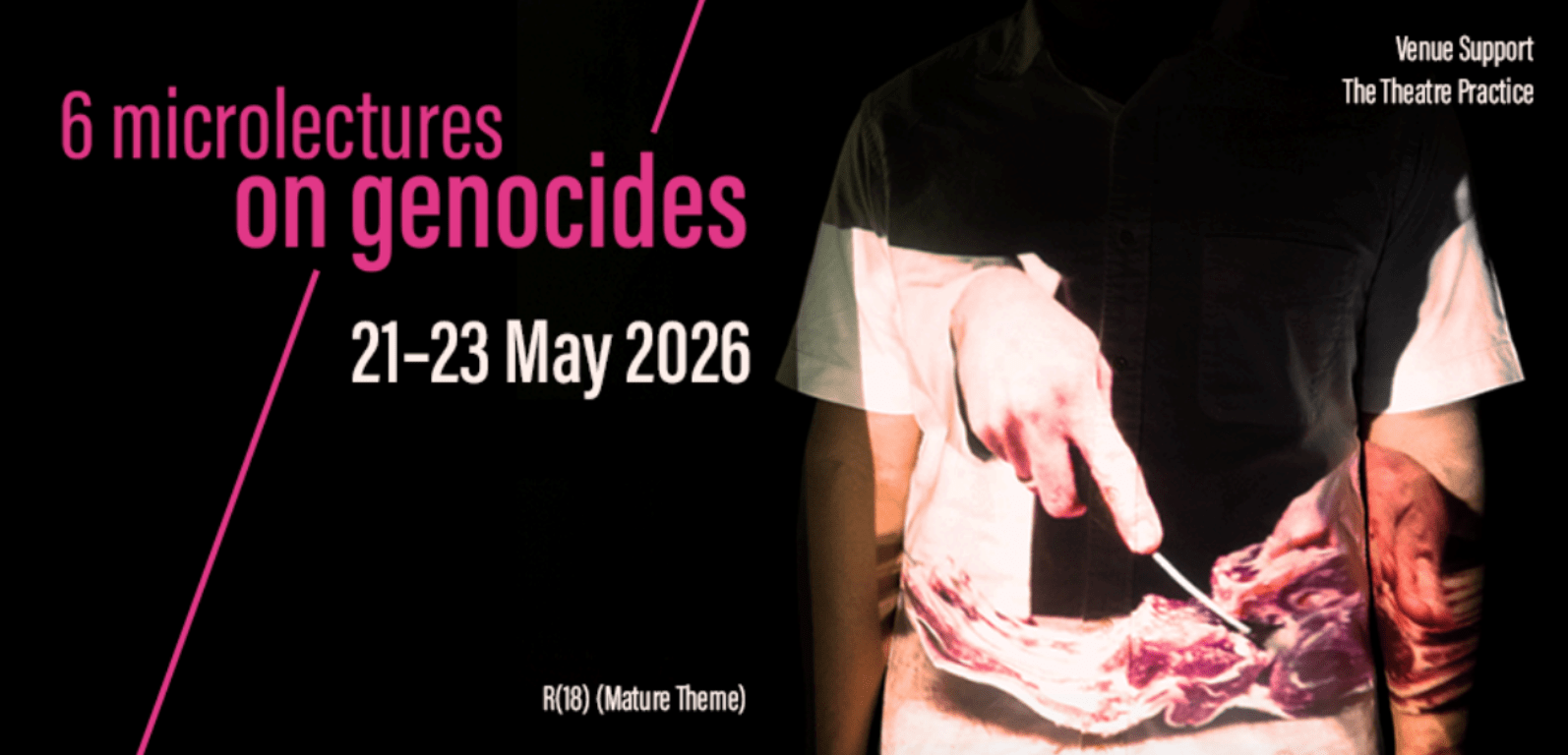
Six voices. Six short, sharp shocks of theatre. One urgent question running underneath it all: what do we do when the world is on fire and language itself starts to feel inadequate? After an initial showing earlier this year, 6 Microlectures on Genocides is back for a limited return to Singapore (21–23 May), a work that refuses easy answers and instead leans into discomfort, contradiction, and the uneasy silence around some of the most contested realities of our time. Created from an Asian perspective, 6 Microlectures on Genocides engages with global histories and present day realities of genocide, censorship, and erasure.
Structured as a series of “microlectures” (less than ten minutes each), the performance unfolds in tightly contained bursts: six theatrical texts, each under ten minutes, written by some of Singapore’s most distinctive voices, including Haresh Sharma, Nabilah Said, and Neo Hai Bin. Alongside them are contributions from Oon Shu An, Zulfadli Rashid, A Yagnya, Tamer Nigim, Amna, and Raghad, each offering a fragment, a provocation, a different angle into histories of violence, erasure, and witnessing.

At the centre of it all is a striking solo performance by Rizman Putra, whose presence holds the space as stories shift from metaphor to stark confrontation. Under the direction of Kok Heng Leun, the work moves with restraint rather than spectacle, building its force through accumulation rather than resolution.
There are no clean narratives here. Instead, the audience is pulled into a sequence of uneasy reflections: how does censorship shape what can be said? What does silence protect and what does it erase? And in a small, tightly managed civic space, what does it mean to even speak about atrocity at all?
Part of the work’s power lies in its refusal to “solve” anything. It behaves more like an open wound than a closed argument, something that continues to speak after the lights go down. Audiences from its regional tour in Nepal, Taipei, and Busan describe it as precise, unsettling, and unexpectedly persistent, the kind of theatre that doesn’t end at the theatre.
The form itself is deliberately minimal. The content is not. Each microlecture operates like a compressed signal: part testimony, part allegory, part interruption. Together, they form a fractured but insistent whole.

First premiering in March 2025 at the International People’s Theatre Festival in Nepal, 6 Microlectures on Genocides was most recently staged in Taipei in April 2026 (as part of Theatrical Reader) and Busan in May 2026 (as part of Inter Asia Performance Festival) where it was met with positive reception from audiences and collaborators alike. The work’s minimalist and modular format allows for reconfiguration, reinterpretation, and continued presentation in differing environments, while maintaining its core inquiry, thus offering strong potential for adaptability across different cultural and social contexts.
After touring regionally, the production now returns home for a short run at Practice Space @ The Theatre Practice (54 Waterloo Street). Tickets have already seen strong demand, with additional shows added due to early sell-outs. Sound design and musical composition are by Bani Haykal, with multimedia design by Pupil, adding another layer to a work that is as much about atmosphere and implication as it is about text.
Ultimately, 6 Microlectures on Genocides doesn’t ask the audience to agree. It asks them to stay with the question, even when it becomes uncomfortable, even when it refuses to resolve, and listen to the silence that becomes audible. And in Singapore where conversations about sensitive topics are occasionally discouraged, works like 6 Microlectures on Genocides offer an invaluable opportunity to broaden civic dialogue and engage in critical discourse.
Photo Credit: Choi Woochang
6 Microlectures on Genocides plays from 21st to 23rd May 2026 at Practice Space @ The Theatre Practice, 54 Waterloo Street. Tickets available from Peatix

