
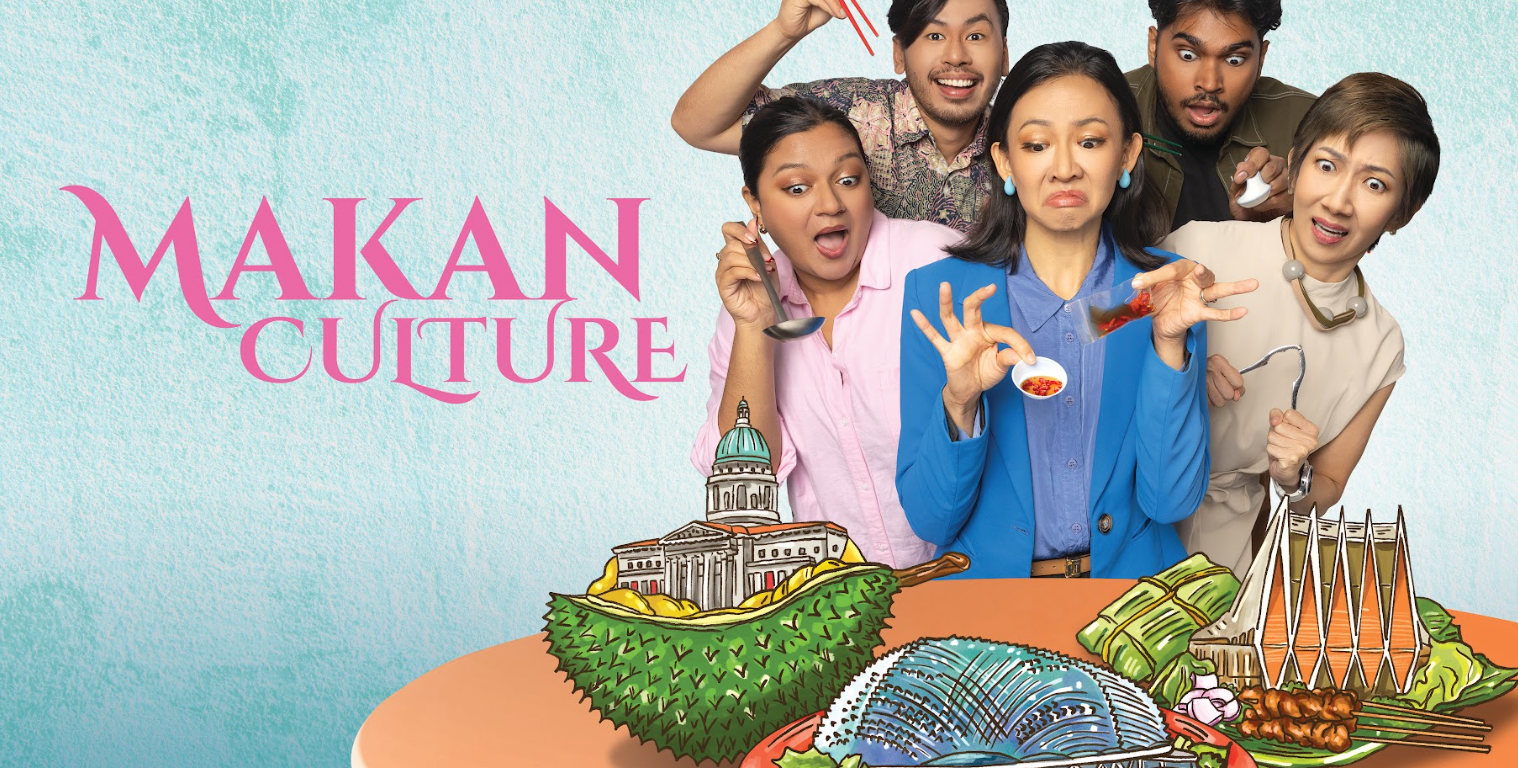
What happens when theatre stops asking audiences to sit still and instead invites them to eat, speak, and play? At the festival village of the 2026 Singapore International Festival of Arts, new experience Makan Culture unfolds as a lively, unpredictable encounter that sits somewhere between performance and gathering. Created by Jo Tan and directed by Krish Natarajan, the work brings together music, puppetry, and audience interaction over a shared meal, asking a deceptively simple question: what makes us worthy? What begins as a seemingly straightforward “community performance” quickly spirals into something more unruly, as a critic disrupts the proceedings and sparks a wider debate about taste, both culinary and cultural, and who gets to decide what is valuable.
The idea, Jo shares, grew out of both instinct and constraint. Responding to the festival’s theme of “Let’s Play” and the unique context of the festival village, she was interested in creating something that felt open, social, and grounded in everyday experience. “I wanted something dining-related,” she explains, “and then this idea was born, and the limitations shaped what it is today.” That sense of openness is intentional. Inspired in part by the looseness and unpredictability of her experiences performing at Edinburgh Fringe, where performances spill into streets and audiences move freely, Jo began to imagine a work that resisted Singapore’s usual emphasis on control. “In Singapore, everything is very controlled,” she reflects. “But in Edinburgh, it’s crazy. And I thought, let’s open it up more.”
That openness carries through into the structure of the piece. As Krish points out, Makan Culture is deliberately designed to be flexible. “There’s no need for a specific set for the idea, any eating area and it’ll work,” he says. At Empress Lawn, the performance exists within a larger ecosystem of festival activity, where ambient noise and movement are not disruptions but part of the texture. “There’s a lot of external noise, but that becomes an advantage,” he adds. “It creates a sense of a community within chaos.” Even the staging has evolved to reflect this, with a more intimate, sheltered dining setup where food (all halal) is served directly at each table, encouraging audiences to sit together, share, and interact. It’s not an “atas” dinner theatre experience, but something more casual, immediate, and grounded. As Jo puts it,“it’s a $20 ticket, so we hope people come in with that understanding”
Food, of course, is the entry point, but it is also the lens through which the work examines something deeper. “Singaporeans, because of our history, can be very quick to judge what is ‘good’ or ‘premium’ or ‘elevated’,” Jo says. The performance leans into this instinct, questioning why certain tastes are legitimised while others are dismissed, and why enjoyment so often comes filtered through self-consciousness. “Why are we ashamed of laughing at something ‘lowbrow’? Why do we feel like we have to judge before we enjoy?” For Krish, this tendency is tied to a broader cultural inheritance. “There’s a very colonial mindset around what’s considered good or palatable,” he notes. At the same time, Singapore’s relationship with food is deeply personal and layered, extending far beyond national icons. “It’s not just chicken rice or chilli crab,” he says. “It’s also these small, intimate rituals, like how my family eats prata with chutney instead of curry. Those personal food cultures are what the show is really interested in.”
This tension between judgment and enjoyment is embodied in the figure of the critic, whose presence disrupts the performance and reframes it as a site of evaluation. For Jo, the critic is less an attack on a profession than a representation of a broader impulse. “A review lasts longer than the show,” she observes. “So the critic becomes this figure that represents judgment—not just in the arts, but in how we see everything, including ourselves.” The character is intentionally exaggerated, even unlikeable at first, but not without nuance. “She has her own reasons, her own perspective,” Jo says. “But she also represents this voice, and asks how much of our opinion is really ours, and how much is learned?” Krish echoes this, suggesting that the work asks audiences to reflect on the origins of their own tastes: how much is instinctive, and how much has been absorbed from systems of value that precede them.
If the show interrogates judgment, it also challenges conventional ideas of authorship and control in theatre-making. For Jo, the process has been about stretching her own practice. “I’m trying to create a structure where the audience can play, instead of just watching me play,” she says. This requires a careful balance: too much structure, and the work becomes rigid; too little, and it risks falling apart. Krish describes this as an ongoing negotiation. “You can’t expect audiences to suddenly be fully interactive,” he explains. “You have to ease them into it; warm them up, let them feel comfortable enough to participate.” Performers move through the space, initiating conversations and gradually inviting audiences into the action, while rehearsals are designed to prepare for unpredictability. “We throw situations at the actors, get them to improvise, so they’re ready for anything,” he says. Jo laughs at the necessity of this: “Actors are such trolls when they’re audience members, and it makes for really good training.”
Behind the apparent looseness of the experience lies a complex web of logistical considerations. Each performance runs multiple times a night, with short turnaround windows, and the inclusion of food introduces an entirely new layer of complexity. “How do we clean up quickly? How do we minimise waste? What about dietary restrictions and allergies?” Jo lists. “We’re still working all of that out.” Yet these challenges are inseparable from the work’s intent. Food, after all, is one of the few things that consistently brings people together across differences. “Whether it’s a funeral, a wedding, even an election rally, people come together over food,” she says. “It creates a space where different points of view can sit together.” Krish adds that the goal is not simply to include food as a gimmick, but to make it integral to the experience: “We’ve been thinking about how the food can actually create a communal, shared moment.”
Ultimately, Makan Culture is as much about dismantling barriers as it is about creating a performance. For Jo, that includes challenging the perception that theatre is something exclusive or difficult to access. “You don’t need to study for years to understand it,” she says. “You can just come, eat, enjoy, and find meaning in something very everyday.” The work resists the idea that art must be elevated, refined, or intellectual to be valuable, instead insisting that the stories and experiences people already carry with them are worth engaging with. For Krish, the hope is that audiences leave not just entertained, but affirmed. “We want people to feel proud of Singaporean art and of Singaporean food,” he says. “If there are foreigners attending, I’d love for them to go, ‘wow, I wish I was Singaporean.’”
Set against the backdrop of Empress Lawn, in the shadow of Sir Stamford Raffles, Makan Culture becomes something quietly subversive: a space where hierarchies of taste are questioned, where audiences are invited to participate rather than observe, and where the act of sharing a meal becomes a starting point for rethinking how we value what is around us. Or, as Jo puts it with characteristic simplicity: “Makan, mayhem, and meaning.”
Photos Courtesy of The Arts House Group
Makan Culture plays from 15th to 30th May 2026 at Festival Market @ Empress Lawn. Tickets and more information available here
SIFA 2026 runs from 15th to 30th May 2026. More information and tickets available here

