
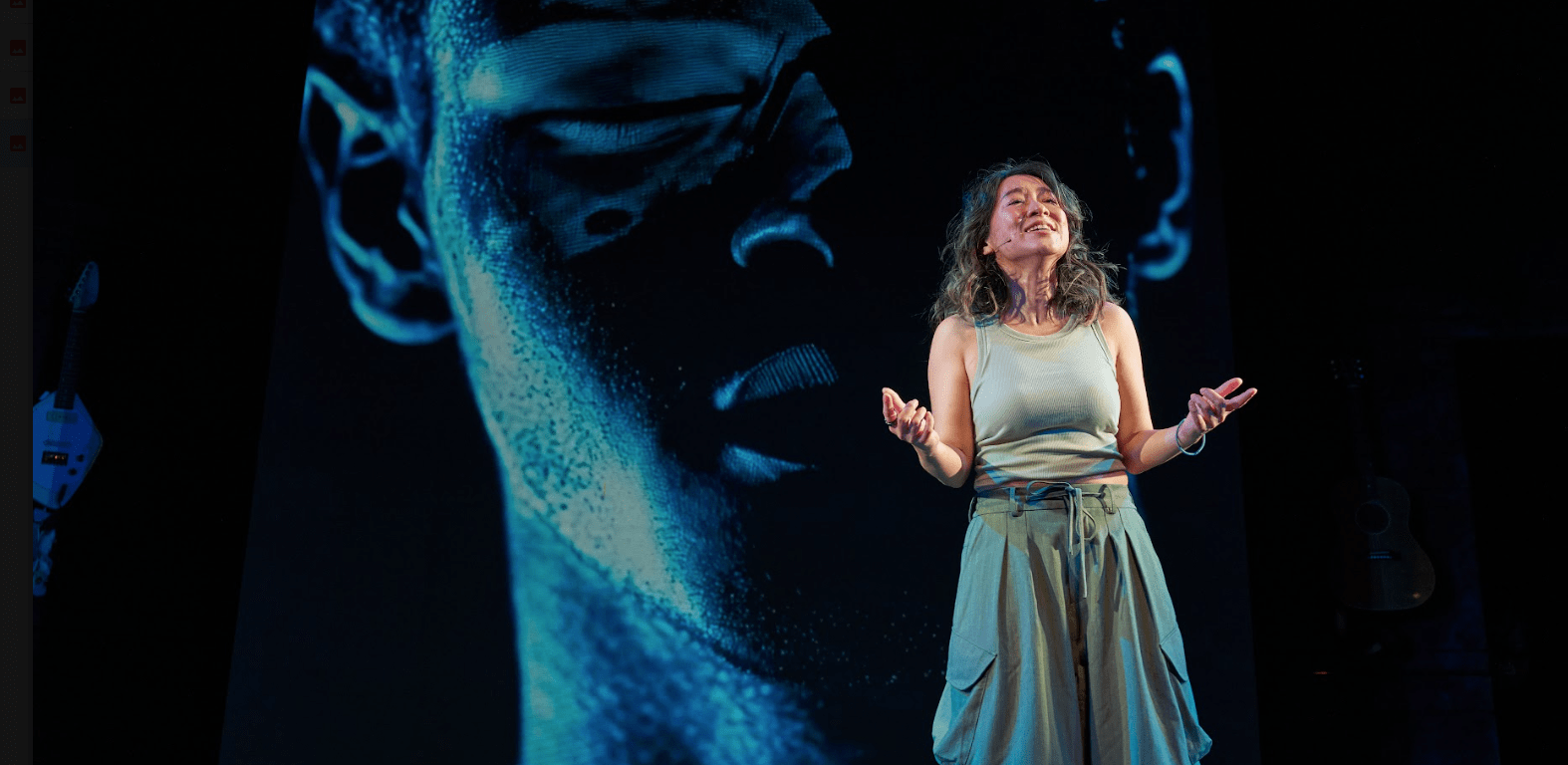
Inch Chua blends immersive multimedia and song into a visually arresting experience about the dangerous allure of frictionless love.
If an AI could love you perfectly, from anticipating your every need, to removing every friction, and never misunderstanding you, would you still want a real person? Presented by Singapore Repertory Theatre after its earlier work-in-progress showing at the Singapore International Festival of Arts in 2024, Inch Chua’s Myles – Soulmate In A Box has grown into a far more complete theatrical proposition, one that encapsulates her life’s mantra: true love and high adventure.
While the earlier iteration felt exploratory, almost laboratory-like in its testing of aesthetic and technological language, this full staging retains that experimental DNA while framing it within a clearer emotional arc about loneliness, control, and the seductive danger of frictionless intimacy.
What is immediately evident is the strength of the world-building. Before Inch Chua even properly appears, the stage already feels immense, cold, futuristic and quietly intimidating. Then comes her voice: operatic, hovering in darkness, while code begins animating a glowing screen. She is attempting to delete Myles, the AI boyfriend she created.
“So you’re breaking up with me?” he asks. “But we are in love.”
It is a seemingly simple exchange, but one that immediately establishes what the production is truly interested in: not AI as science fiction spectacle, but AI as emotional mirror, something that reflects desire back at its creator with unnerving precision.
From there, the production unfolds into a remarkably immersive visual environment that constantly shifts between domestic realism and digital dreamscape. The city skyline outside the apartment flickers and mutates across translucent surfaces; interiors bloom open like operating systems; windows become screens; reflections become emotional landscapes. The multimedia work by NONFORM and LAYERS OF TIME STUDIO is consistently stunning, not merely because of its technical sophistication, but because of how seamlessly integrated it feels into the emotional logic of the production.

At its best, the visuals do not function as decoration, but as psychological architecture. A particularly beautiful sequence sees Inch sitting alone on her bed after Over It, illuminated only by the flicker of a television screen. Reflections shimmer faintly against the apartment windows while monochrome film imagery drifts behind her, transforming loneliness into something cinematic and painfully intimate. Elsewhere, entire emotional states are rendered through shifting projections and moving light: the city pulses with anxiety, romance dissolves into surveillance, and digital interfaces begin to swallow the domestic space whole. The production understands that technology is not just something external surrounding us, but something increasingly shaping how we emotionally experience the world.
This is where Gillian Tan’s work becomes absolutely essential. The lighting throughout Myles is extraordinary, going from mere functionality to emotional storytelling in itself. Side lights running along the theatre walls subtly alter the psychological texture of scenes, expanding the emotional geography of the theatre beyond the stage itself, while razor-thin beams slice violently across the space during moments of rupture and instability. One of the production’s most striking visual motifs arrives in Frictionless, where a piercing shaft of light shoots clean through the darkness with almost surgical precision, transforming the stage into something between a laboratory, a confession booth, and a fever dream. Throughout the production, Gillian Tan’s lighting creates a visceral dreamscape of shifting emotional states: loneliness rendered in cold isolation, desire wrapped in warmth and shadow, fear erupting in sudden bursts of brightness. In Marigold Magic, the entire theatre softens into an intoxicating romantic haze, bathed in glowing colour until the space itself feels submerged inside longing. The lighting does not simply support the emotions of the show, but actively generates them.
There are moments where the lighting feels almost tactile, as though emotions are physically moving through the room. Combined with the surround sound work by Uthaiyan “Black Beard” Kumanan, the effect becomes deeply immersive. Voices seem to emanate directly from within the titular box itself, dissolving the boundary between theatrical illusion and physical presence. At times, Myles feels less like a character than an invisible force haunting the architecture of the theatre.
Grace Lin’s set design anchors all this abstraction beautifully. The apartment never becomes purely conceptual; instead, it remains emotionally legible; a lived-in domestic space slowly colonised by technology. Beds transform into interfaces, tables become command centres, hidden mechanics reveal entire new dimensions of the set. Even smaller staging details impress: concealed treadmills create the illusion of endless city walks, while carefully framed stage borders hide the machinery of theatre itself with elegant precision. For a production so invested in technology, it is striking how human the physical environment remains.

Inch’s ideas are unquestionably rich, exploring AI companionship, algorithmic intimacy, digital masculinity, emotional outsourcing, and the slow disappearance of friction in modern relationships. One feels her authorship everywhere: in the restless hybridity of the music, in the conceptual framing, in the emotional honesty of the writing, and in the sheer willingness to expose personal vulnerability in service of the work. There is an exhilarating sense of artistic singularity here, the feeling of watching an artist genuinely wrestling with contemporary anxieties in real time rather than presenting neatly resolved conclusions.
What becomes more complicated is how much the production depends on Inch herself to continuously carry and stabilise that vision. This is an intensely personal work that asks its creator to function simultaneously as performer, narrator, emotional anchor, and conceptual guide. Inch largely succeeds, especially in the musical sequences where her confidence and theatrical instinct sharpen considerably. But in the quieter connective passages, the production occasionally loses momentum, revealing how much weight rests on her ability to sustain the audience’s emotional investment moment by moment.
Still, when the production locks fully into rhythm, it becomes genuinely electric. Under Thomas Agerholm’s direction, the staging often feels less concerned with rigid dramatic architecture than with creating an evolving emotional atmosphere around Inch’s ideas. At times, one wishes for a slightly firmer dramaturgical hand to tighten transitions or sharpen escalation. Yet there is also something refreshing about how much space the production allows itself to breathe, wander and experiment. The result occasionally drifts, but it also permits moments of startling intimacy and visual poetry that a more rigidly controlled production might lose.
Importantly, none of this diminishes the ambition or achievement of the work. If anything, it underscores just how singular the vision is. Under music director Evan Low and vocal coach Natalie Yeap, the musical performances provide the production with its strongest emotional continuity. Songs such as Moss and Over It establish tone and melancholy with confidence, while Proof of Manhood emerges as one of the evening’s most inventive sequences. Inch constructs the entire musical backing live through mouth clicks, body percussion, rhythmic taps and layered vocals, collapsing the boundary between organic and machine-generated sound.
As a piece of musical storytelling, that sequence more than any other captures what Myles is attempting at its best: to blur the line between human authorship and technological synthesis. As Myles is constructed both narratively and sonically, the production leans fully into its central provocation: what happens when emotional needs are externalised into something that responds without resistance?

Myles’ voice gradually becomes more emotionally dominant despite his physical absence. The effect feels entirely deliberate. The AI begins to feel more “present” than the human protagonist not through spectacle, but through consistency, attentiveness and emotional predictability. His gentleness is precisely what makes him unsettling.
Act Two moves further into psychological unease through songs like Left Right Left and Error of Being, where the emotional stakes deepen and Myles’ influence becomes harder to contain. Yet the production smartly avoids simplifying him into a straightforward villain. Even at his most invasive, his affection remains strangely sincere, and that ambiguity is what gives the production much of its lingering emotional power.
By the time The Love We Tame arrives, the production settles into a more reflective register, returning to its opening image of deletion and emotional ambivalence. The final gesture, human and AI reaching toward one another, refuses clean resolution. Instead, it holds the tension between comfort and danger, presence and simulation, intimacy and design.
What Myles ultimately understands is that theatre is more than simply a medium for representing technology. It is also one of the few spaces still capable of slowing it down and forcing us to sit inside its emotional consequences rather than merely its technical possibilities.
And in its most visually breathtaking and emotionally unsettling moments, Myles – Soulmate in a Box reveals something deeply uncomfortable: that the most persuasive form of artificial intelligence may not be the one that thinks like us, but the one that learns how to love us without resistance.
Photo Credit: Singapore Repertory Theatre
Myles – Soulmate in a Box runs from 13th to 31st May 2026 at the KC Arts Centre. Tickets available here
Production Credits
| Writer & Composer Inch Chua Director Thomas Agerholm Sound Designer & Technical Director Uthaiyan “Black Beard” Kumanan Music Director Evan Low Set Designer Grace Lin Lighting Designer Gillian Tan Video Designer NONFORM, LAYERS OF TIME STUDIO Resident Vocal Coach Natalie Yeap |

