
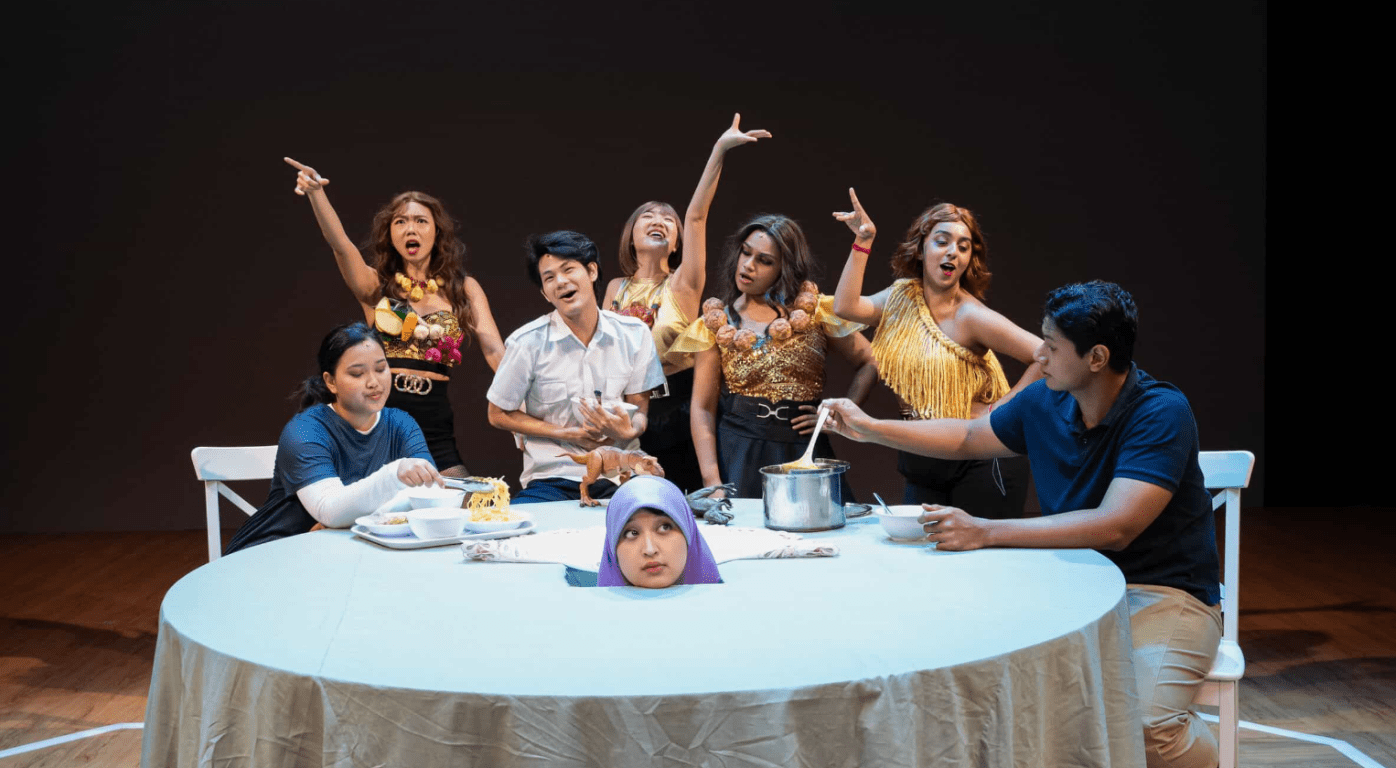
Undercooked, repetitively formulaic scripts do this promising batch of young actors a disservice.
Graduation showcases are a notoriously difficult dish to plate. A director has to decide exactly what they want audiences to leave remembering: is it an ensemble spread where every graduate gets equal time to shine? A curated tasting menu built around the strongest performers? Or a riskier selection that leans classical, experimental, or contemporary? And perhaps most importantly: is the focus meant to be on the actors, or the material itself?
With All You Can Eat, director Edith Podesta and Wild Rice attempt to serve both at once. The production functions not only as the latest Young & Wild batch’s graduation showcase, but also as a showcase for The Rice Cooker, Wild Rice’s playwriting incubation programme under its New & Now initiative. On paper, the concept is generous: emerging actors performing emerging writing, both shaped under the same institutional roof. In theory, it should feel like a carefully plated pipeline for the future of Singapore theatre.
But when one half of the meal is undercooked, it inevitably drags the rest down with it. And in this case, it is the scripts that needed significantly more time in the oven. Dramaturged by Alfian Sa’at and Joel Tan, the evening begins with Alfian’s Appetiser, where the ensemble arrives to offer brisk, lightly seasoned observations on Singapore food culture, with debates on food preferences, mispronunciations, and food-origin arguments. It is effective as an opener: energetic, accessible, and functional in warming both cast and audience into the rhythm of the evening.

After that, however, the courses begin arriving in rapid succession, and the palate never quite resets. In Timothy Yam’s Dry Martini, Qilah Rose plays a bartender attempting and repeatedly hesitating to prepare the titular drink live onstage. The monologue quickly tips into stream-of-consciousness procrastination, layering references and self-interruption until the act of making the cocktail becomes indistinguishable from avoiding it. The result is a performance that keeps shaking the glass but never actually serves anything of substance, as much as Qilah is clearly a good performer, finding her flow when she relaxes and delivers.
What follows settles into a far more exhausting rhythm: a run of two-hander playlets that all appear to follow the same dramaturgical recipe: Calm conversation, slow escalation, emotional rupture, abrupt cooling-off into hasty conclusion. Repeat. Euginia Tan’s Kacang Pool uses a bowl of bean stew as the site of estrangement between father and son, played by Shaik Nazray and Theijes Therrat Menon. Miriam Cheong’s Layer Cake, with Choo Xin Hui and Megan Ann Pang as two old friends reconnecting over coffee, slowly curdles into familiar tensions around class, body image, and self-worth. Mitchell Fang’s Kanchi places a death row inmate (Gomathi Ravindran) opposite her warden (Charmaine Teo) in the final meal before execution.
Individually, none of these premises are without potential. But stacked together, they begin to taste indistinguishable. The emotional arcs blur; the tonal shifts feel pre-programmed. Rather than a set of distinct voices, the effect is closer to a single workshop template being repeatedly reheated with different fillings. For a programme positioned as an incubator of new writing, the dominant flavour is unexpected conservatism.

The most memorable pieces then, are those that stray from this formula. Rachael Ng’s Hotpot parodies the hyper-performative hospitality of Haidilao through a lonely diner (Lee Mun Yee) subjected to relentless “care” by an overenthusiastic server played by Chai Jean Yinn, who nails the Chinese accent. Birthday songs sung by the entire staff, lamian dances, plush toys, all the recognisable excesses land clearly, and the social discomfort and taboo of solo dining under surveillance is sharply observed. Yet the satire remains slightly under-seasoned; it shows overwhelm without ever fully transmitting that same feeling to the audience, always contained onstage but never connecting outward.
Dia Hakim Khaeri’s $1 Ice Cream lands more cleanly. Two struggling small-business owners, played by Megan Ann Pang and Charmaine Teo, vent about aggressive F&B franchises encroaching on local trade, a direct potshot on cheap chains like Mixue, as they attempt to film a viral rant video. The premise is heightened and a little out there, but the dialogue and its concerns have a convincing texture, closer to overheard conversation or online commentary than written exposition. For once, the piece sounds like people speaking rather than themes being demonstrated.
On the other hand, Melizarani T. Selva’s Vadai begins with similar promise, framing a conflict between tradition and commercialisation as a heritage vadai maker’s loyal fryman clashes with her daughter over the future of the stall. But like several other pieces, it exhausts its central idea quickly, stretching its final escalation into physical comedy that lingers past its natural endpoint before concluding abruptly.

The strongest structural departure comes from Alia Alkaff, whose piece breaks the evening’s dominant two-person format. Their mee soto-centred family drama follows a stubborn child (Judah Kan) demanding the same meal again and again, while his parents, Shaik Nazray and Hinata Omura Raza, negotiate through escalating bargains, threats, and revelations. What distinguishes it is not just its humour, but its sense of escalation as genuinely unpredictable. Alliances shift, priorities mutate, and new elements arrive at unexpected moments, including a scene-stealing turn from Qilah Rose popping up as the grandmother, and a playful K-pop fantasy sequence inspired by mee soto ingredients. It is the one dish that feels freshly assembled rather than reheated, and it briefly suggests what the evening might have offered with more structural variety.
Which makes the final dish all the more complicated, as Joel Tan’s Last Course closes the evening in a completely different register. Experimental, fragmented, and formally assured, it traces a woman’s (Isabella Goh) life through food memories, from infancy to adulthood to old age to death, and finally into a hungry ghost reaching for funeral offerings. Scenes arrive in flashes, from a difficult breastfeeding, school lunches, drinking after coming of age, funeral bee hoon, romance and McDonalds, motherhood echoing her own birth, mortality in realising a plate of char kway teow could kill you. A countdown timer marks the passage of time with quiet inevitability between each scene, while in its final scene, projected text fractures across the stage as a final reflection on food and its significance.
As a standalone work, it is strikingly controlled, haunting, and emotionally precise. But placed within All You Can Eat, it raises an uncomfortable imbalance: if this level of formal ambition exists within the same ecosystem, why does so little of it appear to have filtered into the earlier works? Why is this the work, of the dramaturg, that seems intent on outshining the rest of the works that this programme should be aiming a spotlight on rather than hogging it? It begins to feel less like a finale and more like a reminder of what sharper dramaturgy might have done with the same raw ingredients.

After all, there is clearly no shortage of resources onstage. The production is visually polished, with no expense spared to carefully realise original costumes, stylised food-world signage, hawker carts, and cohesive design work. Even so, staging and direction occasionally struggles against the writing. Layer Cake, for example, is kept so far upstage that intimacy is lost and dialogue sometimes dissolves into distance. Several pieces end as soon as their escalation peaks, as though unsure how to land, while others extend beyond their natural endpoint, mistaking volume for development. Unintentionally, the anthology begins to echo a familiar structural caution of safe arcs, predictable beats, and familiar emotional rhythms, all wrapped around topical ideas that rarely develop beyond their premise.
The result is flattening, and that is particularly unfair to the actors. This Young & Wild cohort is, by and large, genuinely strong. Across the evening, the ensemble demonstrates clarity, confidence, and vocal control, consistently finding texture in roles that often do not offer much in return. Again and again, they are the most compelling thing onstage, consistently committed, often elevating material that gives them limited space to breathe, rising to the occasion.

That is not to say the playwrights themselves are to blame, after all, there is and was a mentorship and editorial component that the scripts ultimately went through. One always appreciates efforts towards nurturing and showcasing emerging talent, and it is indeed a programme with so much potential to succeed. So to see it fumbled by a professional creative team is a pity. Which brings the question back to the source. Is it the dramaturgy? The direction? Or the structural decision to merge two developmental pipelines into a single, overloaded tasting menu?
Whatever the answer, All You Can Eat ultimately feels like a banquet trying to prove abundance rather than coherence. Too many similar flavours arrive too quickly, without enough variation or contrast to let any one dish properly register. The actors do what they can to pepper each course as it arrives. But without sharper differentiation in structure, tone, and voice, the overall effect is less a feast than a long, repetitive buffet line, one where everything is edible in the moment, but little lingers beyond a heavy, indistinct aftertaste.
All You Can Eat plays from 14th to 17th May 2026 at Wild Rice @ Funan. Tickets available here
Production Credits
| Director Edith Podesta Dramaturgs Alfian Sa’at, Joel Tan Playwrights Alfian Sa’at, Joel Tan The Rice Cooker Programme Playwrights Alia Alkaff, Miriam Cheong, Dia Hakim Khaeri, Mitchell Fang, Melizarani T. Selva, Rachael Ng, Euginia Tan, Timothy Yam Cast Chai Jean Yinn, Choo Xin Hui, Isabella Goh, Gomathi Ravindran, Hemalatha Ravinthran, Judah Kan, Lee Mun Yee, Theijes Therrat Menon, Megan Ann Pang, Qilah Rose, Hinata Omura Raza, Shaik Nazray, Charmaine Teo Assistant Director Benjamin Lye Lighting Designer Yo Shao Ann Hair Designer Ashley Lim Make-Up Designer Bobbie Ng |


Hemalatha Ravinthran is one of the actors in Vadai, and she’s not mentioned in this review! I think she did a great job!
LikeLike