
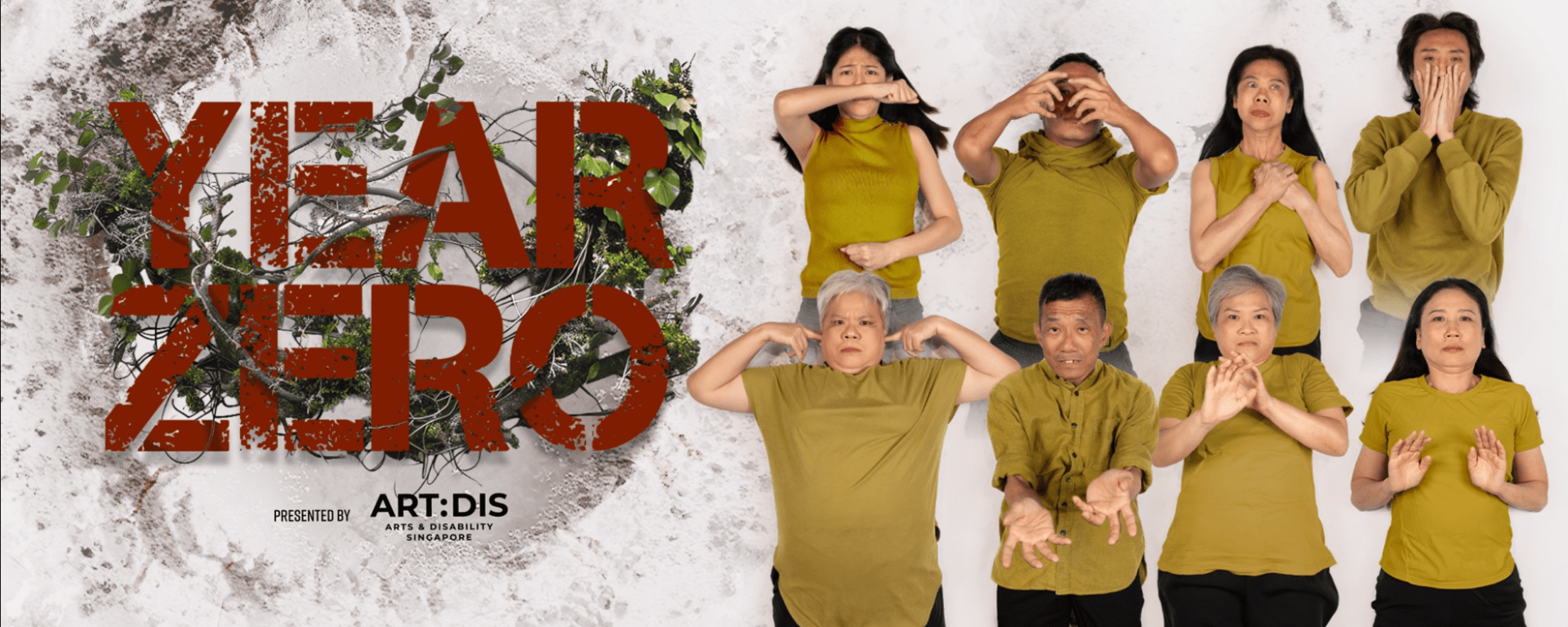
Meta-theatrical act of frustration at how difficult diversity and inclusivity is to achieve in reality, and an argument of its impossibility.
Over the years, disability arts in Singapore has grown immensely, moving beyond perceptions of charity or pity, and towards recognition of disabled artists as professionals in their own right: practitioners with formal training, artistic rigour and distinct creative voices. At the forefront of this movement is ART:DIS, whose sustained advocacy and development work has helped create meaningful opportunities for persons with disabilities both within and beyond the arts.
2026 marks a particularly significant year for the company, with multiple productions coming to fruition, including Year Zero, staged as part of the 2026 Singapore International Festival of Arts (SIFA). Co-directed by Peter Sau and Zhuo Zihao, and co-written by Sau, Jade Ow and Verena Tay, Year Zero is less interested in presenting an ideal of inclusivity than exposing how difficult, contradictory and even painful inclusivity can be in practice.
The production opens with almost performative blandness and shocking stereotypicality. Performers Tung Ka Wai, Jireh Koh, Yuki Neoh, Lim Chin Huat, Odilia Ser, Doreen Toh and Tan Beng Tian emerge onstage alongside creative narrator Verena Tay and interpreter-performer Fang Shawn, assembling themselves into a V-formation as they introduce their various identities as disabled, non-disabled, neurotypical and neurodivergent performers. “This is diversity. This is inclusive,” they proclaim. The moment feels painfully reductive, the kind of sanitised inclusivity rhetoric that already feels outdated.
But that discomfort is precisely the point. Almost immediately, the cast begin expressing dissatisfaction with the show they are performing in. A frustrated Doreen Toh, assuming a reluctant leadership role, insists they come up with something better instead. What follows is a series of increasingly experimental attempts at imagining life in “Year Zero”, a neutral ground where labels, systems and hierarchies have supposedly been erased, and where the performers must discover new ways of coexisting and communicating.
Yet every attempt collapses under the weight of difference. In one segment, communication is restricted to just eight words in sign language, only for the system to be criticised as restrictive and violent, as another framework imposed upon disabled bodies by the non-disabled. In the next segment, the performers descend into gibberish and abstract vocalisation, a sequence that becomes particularly distressing for sight-impaired performers who rely heavily on facial and physical cues to derive meaning. Even a seemingly innocent round of lao ying zhuo xiao ji devolves into friction and misunderstanding. Time and again, the performers find themselves unable to sustain the rules of this imagined society because their needs and modes of communication fundamentally differ.
What makes these moments especially striking is how close they seem to reality. Each performer adopts a name only slightly altered from their own, blurring the line between fiction and lived experience. The production increasingly feels less like speculative theatre and more like a collective airing of unresolved tensions within disability arts itself. This comes to a head in one of the production’s strongest sequences, when Yuki, a deaf performer who relies on interpretation, reveals that she is able to speak. What initially appears to be an advantage quickly becomes another source of alienation. Other performers accuse her of receiving accommodations she no longer “needs”, only for Yuki to explain how speaking would cause others to overlook her disability entirely, from struggling to lip-read, to being judged for mispronouncing words, to having her needs rendered invisible precisely because she appears to assimilate too well. The scene cuts directly to the heart of the production’s central contradiction: that accessibility itself is uneven, negotiated and deeply individual.
Hovering over all this is the unseen presence of the production’s foreign director, whose incessant calls to Doreen become a recurring source of anxiety. More than a literal authority figure, he gradually comes to embody institutional expectations, the pressure to package disability into something legible, inspirational and socially acceptable, even as the performers themselves resist such simplification. The production’s sobering finale offers no easy resolution. Attempting to regain control, Doreen urges the cast to return to the original performance structure. But Ka Wai bursts into laughter at the absurdity of what they are reverting to, and one by one, the rest of the ensemble follow suit, refusing to continue participating in what now feels like an impossible farce. Left alone onstage, Doreen crumbles beneath the weight of trying to satisfy everyone, unable to arrive at a version of inclusivity that truly accommodates all.
And perhaps that is Year Zero’s most radical gesture: its refusal to resolve the problem it presents. Despite its anger and exhaustion, the production also succeeds in showcasing the range of its performers’ abilities, from Verena Tay’s creative narration, to Fang Shawn’s agile interpretation work, to Jireh Koh’s multi-instrumental performance and throat singing. Yet rather than using these talents to construct an inspirational showcase, the production continually interrogates the frameworks through which disabled artists are expected to perform and be understood.
Ultimately, Year Zero suggests that “disability” itself may be too broad and unstable a category to neatly contain the radically different experiences, needs and modes of communication within the community. It is a difficult, uncomfortable production precisely because it refuses to flatten those contradictions into a comforting message of unity. In staging this anger so openly, Year Zero may already be taking the first meaningful step forward. Rather than smoothing over disagreement, it insists on confronting it directly, allowing disability arts to exist not as a charitable symbol of harmony, but as a space of genuine complexity, negotiation and dissent, one which will hopefully continue to be developed and wrestled with as SIFA and other institutions continue to explore this in the years to come.
Year Zero played from 20th to 22nd May 2026 at the Wayang Stage at the SIFA Festival Village on Empress Lawn. More information about Year Zero available here
Production Credits
| Director/Co-Writer Peter Sau Co-director Zhuo Zihao Researcher, Co-Writer and Creative Narrator Verena Tay Co-Researcher and Co-Writer Jade Ow Performer-Deviser Tung Ka Wai, Jireh Koh, Yuki Neoh, Lim Chin Huat, Odilia Ser, Doreen Toh, Tan Beng Tian Interpreter/Performer Fang Shawn |
 Bakchormeeboy