
Anxious, tightly constructed theatre that confronts the limits of speech, empathy, and artistic response in the face of ongoing catastrophe.
Singapore’s relationship with the Israel–Palestine conflict is shaped by a long-standing posture of official neutrality, coupled with tight constraints on public political expression. In practice, this has produced a civic environment where public commentary on the conflict is often carefully circumscribed, reflecting both domestic concerns about social cohesion and Singapore’s broader diplomatic positioning within a network of powerful international relationships, including longstanding ties with Israel and strategic alignment with Western powers. Even as criticism of excessive force and humanitarian restrictions is occasionally articulated, language around genocide remains politically and institutionally sensitive, and public discourse tends to avoid definitive framing.
As a result, for many Singaporeans who feel strongly about the issue, the effect is not just disagreement but paralysis: a sense that even articulation carries risk, and that speech itself becomes something to be managed or withheld. For artists, who may not always have material means to intervene directly in global crises, the question becomes more acute. How does one continue making work, sustaining daily life and livelihood, while carrying the psychological weight of distant violence? 6 Microlectures on Genocides responds to this impasse in the only way it can: by turning it into form.

Independently produced by theriverproduction, the work brings together six short texts by Singaporean writers, each approaching the subject of genocide from a different register, whether testimonial, allegorical, documentary, or satirical. Directed by Kok Heng Leun and performed in full by Rizman Putra, the piece was first staged earlier this year in a limited run before going on a regional tour, and now returning again for local audiences at The Theatre Practice.
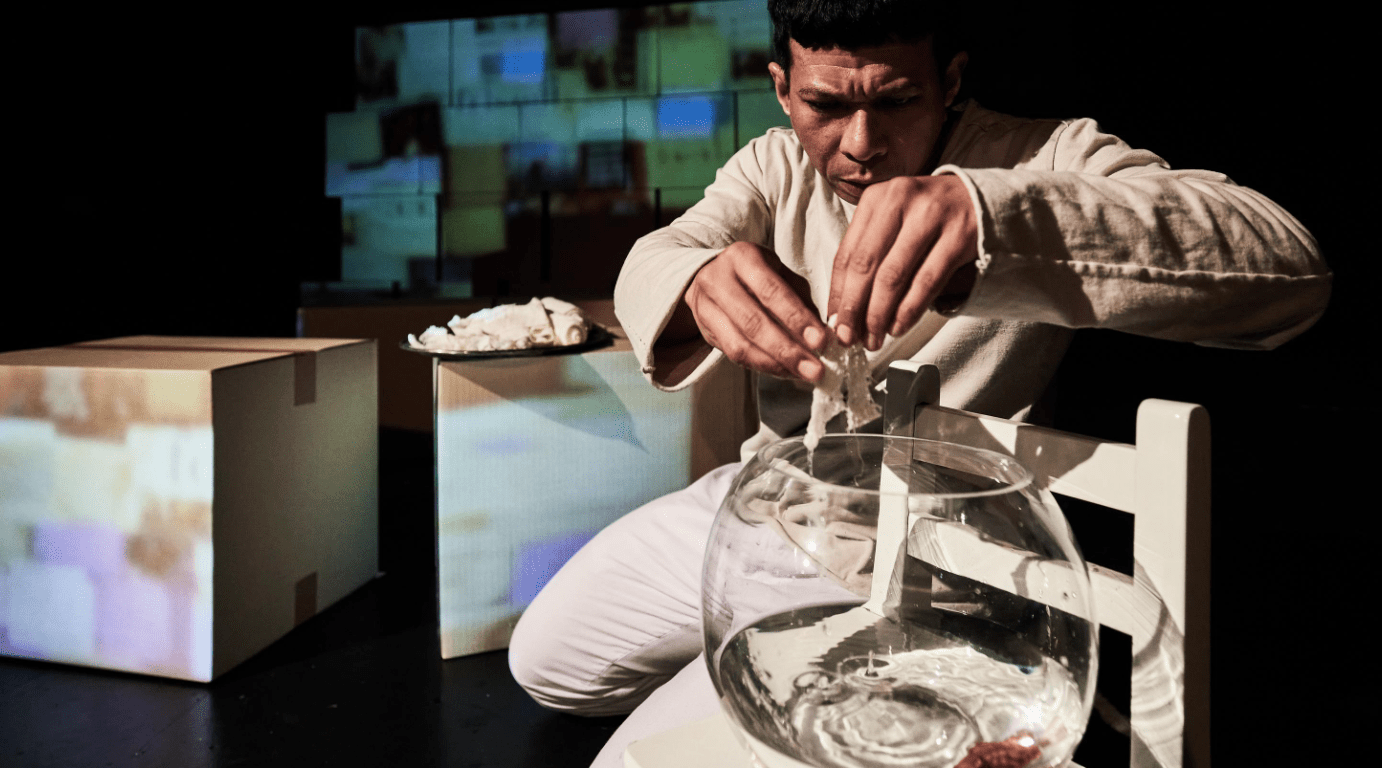
The staging is deliberately pared back: a single performer, a projector, and a sparse arrangement of objects. Rizman’s presence anchors the evening, often still, sometimes rigorously physical, at times almost mechanical, as he shifts between speaking, withholding speech, and embodying multiple perspectives. The act of cutting and handling strips of cloth is a strong physical motif, suggesting both care and constraint, construction and suppression. Behind him, a wall of cardboard boxes functions as projection surface and fragile architecture at once: a structure that suggests protection, but also its limits.

Rizman, in this configuration, operates less as a character than as a conduit, as he absorbs and transmits these voices that never quite settle into a single authoritative position. The opening section, Oon Shu An’s Dinner Conversations, establishes the production’s first tension: how easily aesthetic or intellectual discussion collapses when confronted with histories of violence that rupture polite speech. Rizman remains largely silent, his body carrying the expressive weight as language itself begins to feel interrupted, even gagged, literally so, as he stuffs the strips of cloth into his mouth in a gesture that reads as self-imposed silencing.
Neo Hai Bin’s A Single Chair expands the frame into a series of imagined correspondences and ethical provocations, placing figures such as Rwandan financier Felicien Kabuga alongside Singaporean doctor and activist Ang Swee Chai. Rather than resolving these juxtapositions, the piece holds them in tension, allowing contradiction to accumulate without synthesis, crafting an uncomfortable coexistence of moral positions that refuse easy reconciliation. A Yagnya’s Hummus then shifts the register sharply into something closer to testimony. Drawing on recorded voices and material from Gaza, including contributions from theatre practitioner Tamer Nijim and others, the work foregrounds lived experience with minimal mediation. Here, performance yields to documentation; voiceovers and footage enter the space with immediacy, and Rizman’s embodiment becomes an act of transmission rather than interpretation. The effect is sobering, as the distance between stage and reality collapses into something more direct and difficult to process.

Zulfadli Rashid’s Bangkai (Carcass) provides a disquieting tonal interruption. Built around a musical composition and sung by sound artist Bani Haykal, it begins in an almost childlike context, with drawn animals projected simply on screen, and Rizman’s body lying prone like a corpse, an uncomfortable juxtaposition. It gradually shifts into something more unsettling, as the work’s gentle surface is disrupted by sonic intrusion: references to crows no longer being shot are punctured by gunshots, and Rizman’s body reacts involuntarily, turning abstraction into visceral recoil. What initially appears innocent becomes an exploration of selective attention and uneven moral valuation.
Haresh Sharma’s The Follower turns inward, staging paranoia and the instability of speech within mediated and surveilled environments. It is structured as a fictional letter: a mother writes to praise Rizman as an inspiring drama teacher, before revealing she has reported him to the authorities for his social media posts supporting Palestine. Rizman’s performance here is strikingly naturalistic, drawing the audience into a domestic register that slowly destabilises as admiration turns into denunciation. The humour is uneasy rather than cathartic, with the absurdity of the police’s non-response sitting alongside the quiet terror of being watched and reported for expressing a point of view.
The final work, Nabilah Said’s Conjuring a Square, turns reflexively toward theatre-making itself. Revisiting an earlier piece Nabilah wrote through annotation and commentary, it tracks the inadequacy of allegory: a simple image of children in a square, gazing and pointing skyward, and the responses to that becoming increasingly violent under authoritarian response, escalating from confusion to repression to death. Yet even this escalation feels insufficient against the scale of literal genocide it attempts to gesture toward. The section ultimately reflects on the limits of theatrical representation: unstageable.

Taken together, the evening suggests a central tension: that art cannot resolve or fully represent genocide, but continues to return to it because silence is not neutral. What emerges is not argument but an accumulation of fragments that repeatedly reopen what the last momentarily holds. The work persists as exposure rather than closure, sustaining a condition of attention that refuses resolution. Rizman Putra’s sustained physical and emotional labour binds these fragments without smoothing their edges. His body becomes the site where contradictory registers meet, of testimony, irony, documentation, and allegory, absorbing them without ever fully releasing their weight. Under Kok Heng Leun’s direction, the structure remains deliberately exposed: legible, but never stabilised. Coherence is never the goal but adjacency is.
This refusal of closure is most clearly crystallised in the final image, when Rizman lifts a handheld projector and slowly steers a circular slideshow of flowers across the space. The movement is gentle but controlled, almost searching, as the audience’s gaze follows it instinctively. The flowers flicker between beauty and disappearance, something like mourning rendered as sequence rather than stillness. There is no resolution in the image, only duration, with this imposed act of looking that cannot intervene in what it sees. When the projection abruptly returns to darkness, the gesture does not conclude so much as withdraw.
The “microlecture” form, then, becomes less an instructional device, as its name might suggest, than an ethic of interruption. In a saturated cultural landscape shaped by scale and spectacle, its brevity reads as refusal rather than limitation. Each segment cuts into continuity rather than extending it, producing brief but insistent ruptures in attention. Ultimately, 6 Microlectures on Genocides does not function as resolution but as a form of artistic, urgent persistence. Its force lies in its refusal of closure, and in its insistence on remaining with what cannot be resolved. It holds itself open, deliberately unhealed, like an open wound that remains active precisely because it cannot yet be closed.
Photo Credit: Choi Woochang
6 Microlectures on Genocides played from 21st to 23rd May 2026 at Practice Space @ The Theatre Practice, 54 Waterloo Street.
Production Credits
| Devised by Rizman Putra, Kok Heng Leun Directed by Kok Heng Leun Performed by Rizman Putra Sound Design by Bani Haykal Music for Carcass Composed and sung by Bani Haykal Multi-media Design by Pupil Lighting Design by Emanorwatty Poster design by Han Xuemei Writers Oon Shu An, Neo Hai Bin, Tamer Nigim, Amna, Raghad, A Yagnya, Zulfadli Rashid, Haresh Sharma, Nabilah Said Produced by Kok Heng Leun (theriverproduction) Featuring the voices of Oon Shu Ann, A Yagnya, Neo Hai Bin and Nabilah Said Assistant Producer Denise Dolendo Technical Production Yap Seok Hui Show Operator Elle Cheng Special thanks The Theatre Practice, Drama Box, ARTFACTORY FOH Support: Shawn, Dipeeka, Shen Hao, Harissa, Ridley, Kristen, Kai Qing, Jane, Akhila Sarah and Yagnya |
 Bakchormeeboy