
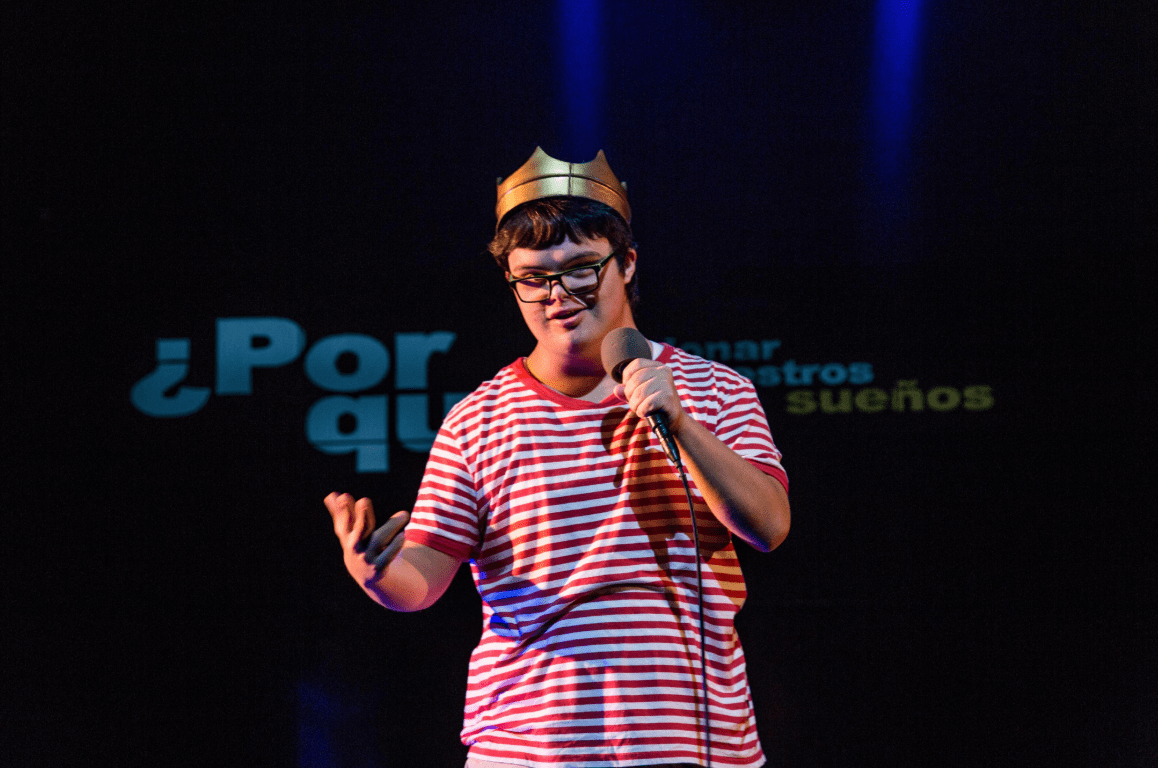

Life-affirming deconstruction of Shakespeare’s tragedy that insists on the validity of every human experience, regardless of disability or neurotypicality.
Theatre and disability have long shared an uneasy relationship. Theatre is, after all, an art form built on visibility: on bodies being watched, voices being heard, and stories being witnessed. To place atypical bodies centre stage is therefore an act of resistance against mainstream ideas of who deserves visibility, celebration, or even personhood. That is the radical proposition behind Teatro La Plaza’s Hamlet, which sees eight actors with Down syndrome reinterpret Shakespeare’s most renowned tragedy through their own lived experiences.

Directed by Chela De Ferrari and presented as part of the 2026 Singapore International Festival of Arts, Hamlet initially feels like an unusual Shakespearean choice for such a project. The role of the Danish prince carries with it centuries of theatrical prestige, often reserved for only the “greatest” actors, while the play itself remains synonymous with existential despair and inevitable tragedy. Yet it is precisely within that tragedy that Teatro La Plaza excavates meaning, shifting the focus away from death and towards the question of existence itself, and who gets to exist visibly, publicly, and unapologetically within society.

Crucially, Teatro La Plaza does not frame this as an exercise in inclusion or accessibility alone, but as an intervention into the structures of theatrical legitimacy itself. The production is less interested in asking whether actors with Down syndrome can perform Shakespeare than in interrogating why such a question exists at all. The first image we see is Jaime Cruz entering the stage in a yellow shirt emblazoned with the words “¿Quién anda ahí?” (“Who goes there?”) Before a single line is spoken, the question is already inscribed onto the body. In De Ferrari’s hands, the famous existentialism of Hamlet no longer begins with “To be or not to be”, but with recognition itself, questioning who is allowed to be seen, who is acknowledged as fully human, and what assumptions do we as audiences carry when confronted with bodies and voices historically excluded from theatrical canons.

From there, the production loosely follows Shakespeare’s structure, lifting selected scenes, monologues, and quotes from the original text while freely reinterpreting them through improvisation, testimony, and autobiographical reflection. Rather than preserving Shakespeare as sacred literature, Teatro La Plaza treats the play as something alive and malleable, allowing the actors to appropriate its language for themselves. The result is less a straightforward adaptation than a collective act of reclamation.

This is the furthest thing from the larger world’s idea of disability, and anything but a charity project though. De Ferrari’s direction is formally daring and theatrically sophisticated, constantly pushing the boundaries of what performance and production can look like. Videography blurs fiction and documentary as cameras capture the actors backstage, in rehearsal, and in moments of spontaneous conversation and conflict. Elsewhere, an aerial camera descends to frame two actors lying together in an intimate embrace, kissing tenderly while projected onto the large screen behind them. It is a quietly radical moment: an insistence that people with Down syndrome are capable of desire, sexuality, romance, and emotional complexity beyond the infantilising narratives society often imposes upon them.

The production’s inventiveness extends further still. Soliloquies veer between confessional and comic, audience members are invited onstage to participate in the play-within-the-play The Mousetrap, and at one point the cast even “consult” Sir Ian McKellen over Zoom for advice on how best to portray Hamlet. Moments traditionally considered theatrical “imperfections”, such as pauses, stutters, forgotten lines, uneven rhythms of speech, are not hidden or corrected, but absorbed into the grammar of the performance itself. In doing so, the production quietly dismantles conventional assumptions about virtuosity, polish, and what kinds of bodies or voices are permitted to signify “great acting”.

For all its exhilarating experimentation, the production occasionally risks becoming too diffuse in its deconstructed approach. Because it deliberately abandons Shakespeare’s original dramatic throughline in favour of fragments, testimony, and metatheatrical detours, certain stretches can feel emotionally uneven or overly sprawling. Some visual motifs, particularly its recurring fascination with surveillance and live-feed videography, are introduced compellingly but not always developed to their fullest thematic potential. Still, whenever the production threatens to lose focus, the sheer conviction and charisma of its ensemble pulls it firmly back into place.

What Hamlet insists upon most powerfully is that anyone can be Hamlet. The crown passes fluidly between performers as a recurring visual metaphor, transforming the prince from singular tragic hero into collective experience. Almost every actor discovers new meaning within Shakespeare’s lines by stripping them from their original context and filtering them through lived experience. In one scene, Polonius insists Ophelia is “special”, only for the sentiment to curdle into frustration and rejection, while Claudius describes Hamlet as suffering from a “terrible condition”. Shakespeare’s language suddenly becomes charged with the vocabulary of ableism and social exclusion.

One of the production’s most memorable sequences sees Jaime Cruz transform into “Jaime-let”, reclining in imitation of Laurence Olivier while footage of the legendary actor plays behind him, as the troupe’s reworked rap rendition of “To be or not to be” reverberates through the theatre. The audience cheers him on, but the moment ultimately rejects imitation altogether. Cruz is interrupted and encouraged to perform the soliloquy in his own voice rather than reproducing the ghosts of theatrical history. It becomes emblematic of the production’s larger project: dismantling the intimidating weight of cultural canon and reclaiming ownership over a role historically guarded by elitism and prestige. Here, Shakespeare is no longer a monument to preserve, but a living text open to reinvention.

Most significantly however, Teatro La Plaza ultimately refuses tragedy itself. Rather than concluding with Shakespeare’s familiar bloodbath, the lone figure of Hamlet persists, wielding a sword and cutting through the darkness, the crown deliberately worn upside down, as if defining their own version of what it means to live and exist. The production then transforms the stage into a dance floor, inviting the audience into communal celebration. It is not done merely for feel-good catharsis, but as a deeply political act of refusal. These performers reject the idea that suffering, limitation, or social prejudice must determine the narrative arc of their lives. In doing so, they reclaim not only Hamlet, but the theatrical space itself.

And that is where the production becomes genuinely profound. Theatre has always been an art form obsessed with transformation: with becoming someone else, speaking through another voice, inhabiting another life. But Teatro La Plaza reveals something even more radical beneath that tradition: the possibility that performance can also become a way of insisting upon your own existence, not despite who you are, but through it. The actors do not disappear into Hamlet. They become more fully themselves in the process of performing him. Theatre here becomes more than representation or imitation. It becomes an act of becoming. The performers are not asked to transcend their identities in order to inhabit Shakespeare, nor to erase themselves beneath the prestige of canonical performance. Instead, the act of performing Hamlet allows them to insist more fully upon their own presence, complexity, vulnerability, and humanity.

At the core of the production is a sense of freedom and irrepressible vitality, buoyed by the cast’s charisma, sly wit, vulnerability, and infinite potential. Yet beyond its joy lies something sharper and more enduring: a challenge to the structures that continue to decide which bodies are considered worthy of visibility, seriousness, artistry, or desire. By placing actors with Down syndrome at the centre of one of Western theatre’s most revered texts, Teatro La Plaza dismantles the false hierarchy between disability and artistic excellence with remarkable force. “To be or not to be” is no longer treated here as an abstract philosophical dilemma. In these performers’ voices, it becomes something urgent and tangible: a demand to exist publicly, truthfully, and fully. In that sense, it also becomes theatre’s own enduring question: who is allowed to occupy the stage, to command attention, to be recognised as worthy of art, contradiction, beauty, or depth? Teatro La Plaza’s answer is thrillingly clear: to perform is to demand recognition and insist on the validity of being.
Photo Credit: Teatro La Plaza
Hamlet plays from 21st to 23rd May 2026 at the Drama Centre Theatre. Tickets available here
SIFA 2026 runs from 15th to 30th May 2026. More information and tickets available here
Production Credits
| Production Teatro La Plaza Director and Playwright Chela De Ferrari Actors Octavio Bernaza, Lucas Demarchi, Jaime Cruz, Manuel García, Diana Gutiérrez, Cristina León Barandiarán, Álvaro Toledo, Ximena Rodríguez |
 Bakchormeeboy