
A delirious circus of near-disasters that transforms juggling into a nerve-shredding game of trust and keeps audiences holding their breath.
With Der Lauf (The Way Things Go), Belgian company Les Vélocimanes Associés has created what may be one of the most stressful circus experiences in recent memory. Presented as part of Esplanade’s Flipside 2026 programme, this deliriously inventive work transforms juggling into something stranger and more theatrical: part cabaret, part endurance test, part social experiment.
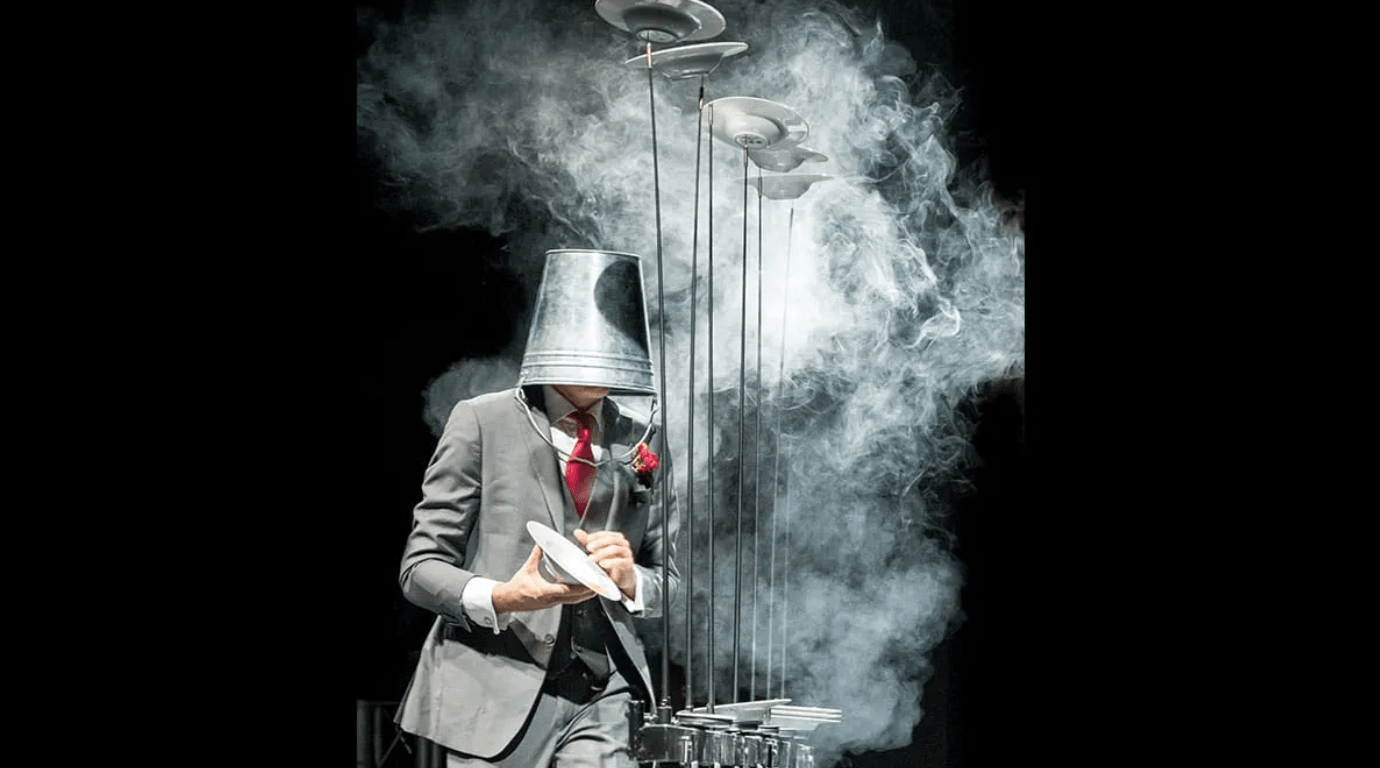
The audience enters the Esplanade Theatre Studio to find a man seated at one end of a long runway. He wears a suit, a red tie and, most conspicuously, a metal bucket over his head. A pink bear occasionally wanders into view. Muffled music drifts through the space as though heard from inside the bucket itself. Every audience member receives a sealed envelope containing an unidentified object and strict instructions not to open it.
Nothing is explained, and that refusal to provide clarity becomes central to the show’s appeal. Der Lauf operates according to a surreal dream logic, presenting bizarre images without ever unpacking them. Like something out of a David Lynch fever dream, it trusts audiences to sit with uncertainty rather than resolve it. Why the bucket? Why the bear? Why does Brenda Lee’s I’m Sorry keep returning between scenes? The production offers no easy answers.
Instead, it begins with a series of what creator Guy Waerenburgh describes as “useless experiments”, as our bucket-headed protagonist embarks upon a sequence of increasingly improbable challenges in which disaster always feels moments away.
The opening moments establish the production’s governing principle. Objects swing perilously close to the performer. Fragile structures teeter on the brink of collapse. Every success feels temporary. Every mistake carries consequences. Unlike traditional circus, where virtuosity often appears effortless, Der Lauf foregrounds uncertainty, inviting audiences to watch not simply for success but for the possibility of failure.
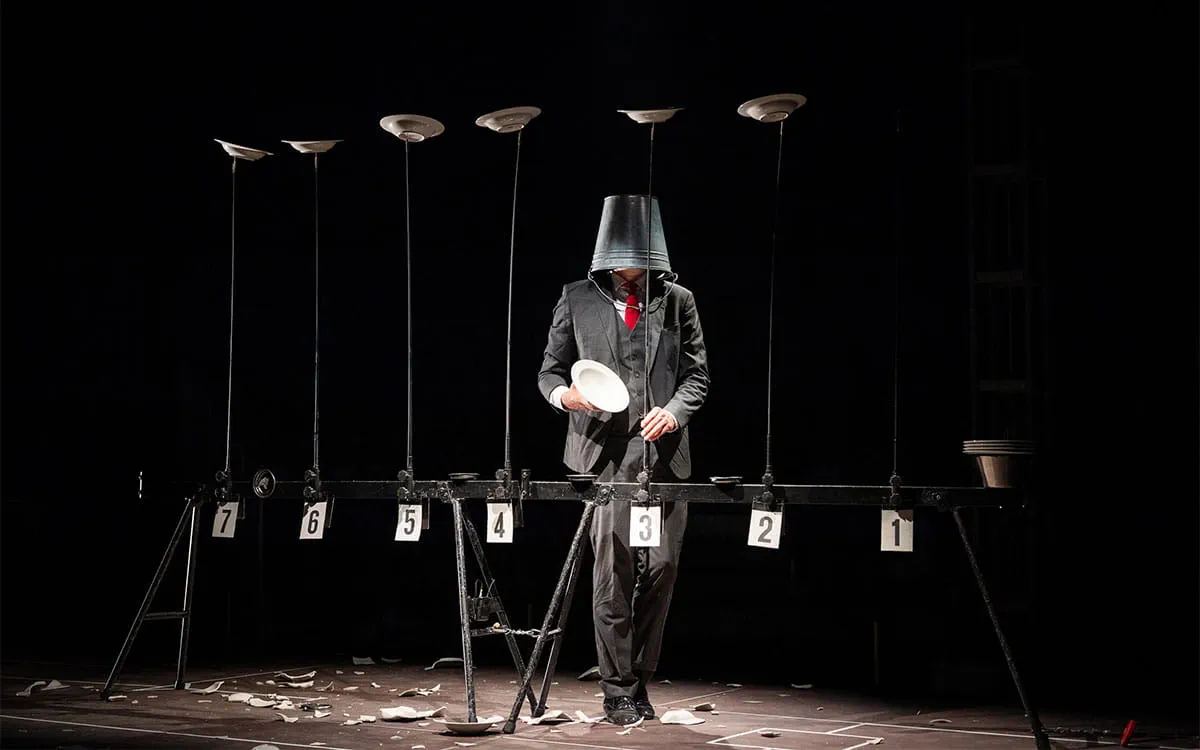
One of the earliest sequences involving spinning plates proves particularly remarkable. As the bucket man attempts to keep multiple plates spinning atop numbered poles, crashes become inevitable. When the first plate smashes spectacularly onto the floor, the audience collectively jolts. The sound echoes through the room like a gunshot. These are not stage tricks or breakaway props. The destruction is real, and suddenly the stakes feel tangible. Then comes one of the production’s most revealing moments. As a plate begins to wobble, a child instinctively shouts, “Six!” The performer immediately responds.
In that instant, the nature of the show changes. What initially appears to be a display of circus virtuosity reveals itself as something closer to a social experiment. The audience realises it is allowed to intervene. Soon the room erupts into a chorus of warnings, instructions and encouragement. Maintaining the spinning plates becomes a collective responsibility rather than an individual feat.
What makes the sequence so exhilarating is that it quietly tests a fundamental question: when confronted with someone struggling, will people choose to help? Most do. Waerenburgh has spoken about wanting to create situations where performers and audiences depend upon one another, and nowhere is that clearer than here. The bucket eventually comes to feel less like a comic prop than a condition of existence. The performer moves blindly through increasingly absurd trials, often relying on strangers to guide him through dangers he cannot fully perceive himself. The metaphor is difficult to miss. We are all navigating uncertainty with incomplete information, dependent on others more often than we care to admit.
The show continues through a succession of increasingly elaborate challenges involving balance, timing and blind trust. Among the strongest is a sequence introducing a second bucket-headed figure, a doppelgänger who initially appears as an adversary. Seated opposite one another atop an oscillating platform, the pair engage in a precarious contest involving glasses, bricks and boxing gloves.
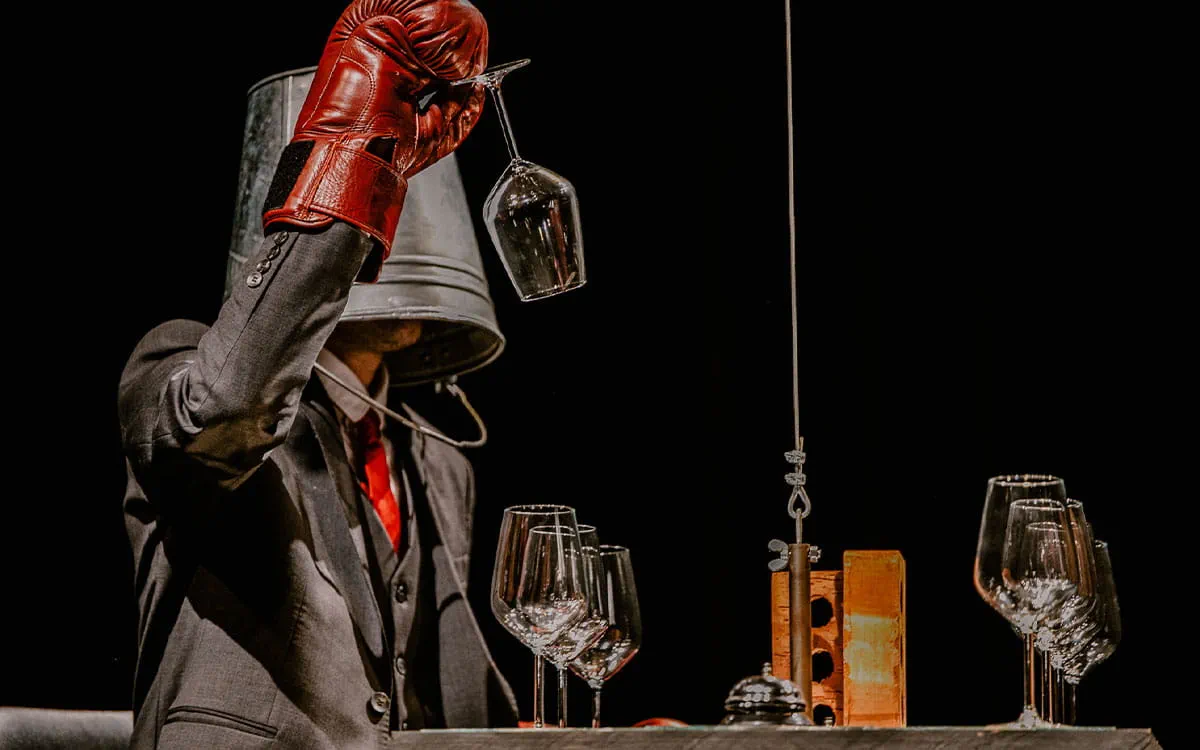
At first, audiences naturally choose sides. Yet as the challenge escalates and the structure grows increasingly unstable, rivalry gradually gives way to solidarity. The performers’ matching appearances make them feel less like opponents than mirrored versions of one another, two figures attempting to impose order upon an inherently unstable world. Before long, the audience is no longer hoping for victory but simply hoping neither man fails. That emotional shift feels emblematic of Der Lauf as a whole. Time and again, the production transforms heated competition and passive spectatorship into active cooperation, asking audiences to invest emotionally in outcomes that are, objectively speaking, entirely pointless.
Not every section achieves the same balance. One later sequence built around audience participation drifts closer to a conventional game, briefly sacrificing some of the show’s unsettling ambiguity in favour of straightforward entertainment. For a moment, the mysterious bucket man becomes less of an enigmatic figure and more of a gameshow host, and the production loses some of its peculiar edge.
Yet even here, Der Lauf remains unexpectedly thought-provoking. In another sequence, audiences find themselves invited to participate in acts of playful aggression directed towards the very performer they have spent the evening protecting. The transition is comic, but also faintly uncomfortable. Having spent an hour warning him of danger, spectators suddenly become complicit in creating it. The ease with which the audience embraces this role reveals something quietly unsettling about how quickly cruelty can be normalised when framed as play.
Throughout the evening, Brenda Lee’s I’m Sorry recurs like an unanswered question. Its familiar refrain drifts between scenes as towers collapse, plates shatter and carefully constructed systems inevitably fall apart. Given Waerenburgh’s observation that the objects represent the fragile things we build in our own lives, the song begins to feel like an apology in advance, and a melancholy acknowledgement that destruction awaits every act of creation.
By the final moments, familiar images return in altered forms. The bucket man once again stands alone. The music itself becomes distorted. Meanings seem to fold back upon themselves. The ending refuses easy interpretation, but it restores much of the eerie ambiguity that makes the production so compelling in the first place.
Perhaps that ambiguity is the point. Throughout Der Lauf, beautiful things are painstakingly assembled despite the certainty of their eventual collapse. Plates break. Towers fall. Victories prove fleeting. Yet audiences continue helping. They continue shouting warnings, offering guidance and willing success into existence even when failure appears inevitable.
What lingers most is not any particular stunt, but the memory of an audience breathing as one. Children shouting directions without hesitation while adults slowly overcome their self-consciousness and join in. Strangers collectively investing themselves in a series of gloriously futile tasks. Beneath its absurdity, surrealism and shattered porcelain lies a surprisingly hopeful belief in human cooperation. Even if everything eventually comes crashing down, Der Lauf suggests there is meaning in trying to hold it together for as long as possible, providing strange, stressful, funny and unexpectedly profound experience.
Der Lauf (The Way Things Go) played from 6th to 7th June 2026 at the Esplanade Theatre Studio. More information available here
Flipside 2026 ran from 29th May to 7th June 2026 at the Esplanade. More information and full programme available here
Production Credits
| Creation by Guy Waerenburgh Performers: Guy Waerenburgh and Baptiste Bizien Lighting design Julien Lanaud Outside eye Éric Longequel Tour Manager Anne-Agathe Prin |

