
Tracie Pang deftly handles Sam Holcroft’s puzzle box of a play-within-a-play with confidence and a stellar team to produce the theatrical event of the year.
There are theatre productions you admire and those you enjoy. And then there are productions that leave you walking out of the theatre almost hesitating to speak, not because you have nothing to say, but because you are still trying to untangle everything you have just witnessed. Pangdemonium’s latest production, A Mirror, belongs firmly in that last category.
Sam Holcroft’s Olivier Award-winning play arrives in Singapore following its acclaimed premiere at London’s Almeida Theatre, becoming the first international production of the work. It also arrives at a particularly poignant moment. As Pangdemonium enters its final season, A Mirror marks the company’s penultimate production and Tracie Pang’s final outing as director under the company she co-founded nearly fifteen years ago. Following the elegiac Force Majeure earlier this year, A Mirror feels like something altogether different: not a farewell, but a reminder of the artistic ambition, intelligence and theatrical confidence that have defined Pangdemonium at its best.
Few productions reward surrender as completely as A Mirror. Rather than inviting audiences to solve its mysteries, Holcroft asks us to embrace uncertainty, trusting that every revelation will arrive precisely when it should. There is remarkable confidence in that approach. Nothing is concealed merely for surprise, and every discovery quietly recontextualises what has come before.

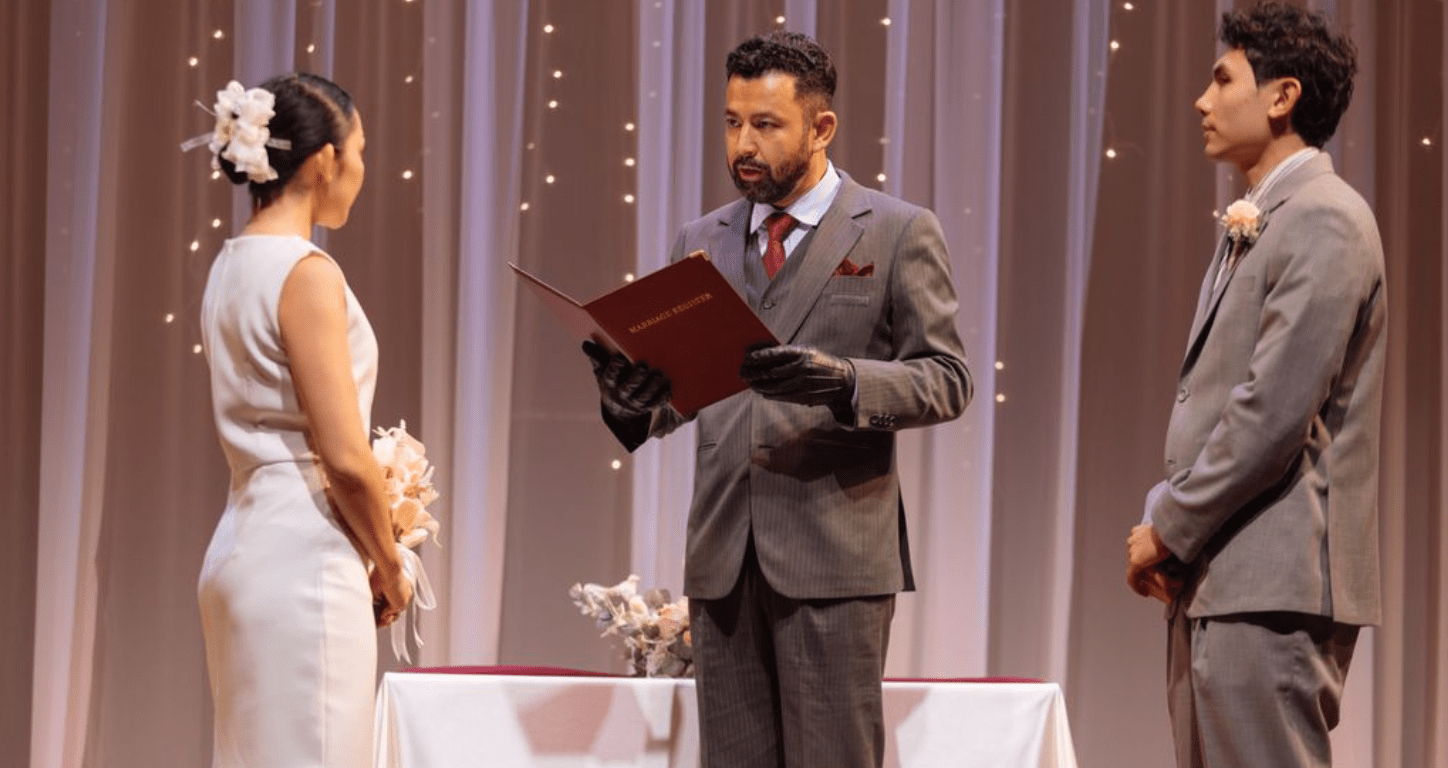
From the moment audiences enter the Singtel Waterfront Theatre, we are welcomed not into a conventional auditorium but to the wedding of Joel and Leyla. Even outside, a sign announcing the event is parked for all to see. We know, of course, that this invitation is itself a fiction; none of us actually know the couple we have ostensibly gathered to celebrate. By accepting the invitation, taking our seats and playing along with the ceremony, we have already entered into the production’s central conceit long before the play itself begins.
Ushers circulate in matching jackets and corsages, “catching up” with fellow wedding guests. Floral arrangements frame a modest ceremonial platform, while rows of banquet chairs face an aisle marked by a bright red carpet. Wedding programmes thank guests for attending the happy couple’s special day, complete with an order of service and heartfelt expressions of gratitude.
Yet the illusion is subtly unsettled from the outset. The theatre’s corrugated zinc walls are not covered up with elegant ballroom panelling, harsh industrial lighting evokes something closer to a bunker than a banquet hall, and heavy doors marked “No Entry” flank the makeshift platform for the ceremony. The bride appears without veil or bridesmaids, carrying only a simple bouquet, while the groom’s understandable nervousness gradually begins to resemble fear. Even the registrar repeatedly glances beyond the audience, as though anticipating an interruption. Buried within the wedding programme is an oath of allegiance to the “motherland”, its authoritarian language sitting uneasily beside the language of celebration.
These details register at first as little more than odd atmosphere, until they later reveal themselves to be part of careful worldbuilding, establishing a society in which ordinary rituals have become elaborate cover stories. When the audience is eventually offered one final opportunity to leave before knowingly participating in what follows, the choice feels almost illusory. Our complicity began the moment we accepted the invitation. Remaining merely acknowledges the role we have already agreed to play.

Holcroft’s title invokes the familiar notion of theatre as a mirror held up to society, but A Mirror extends that metaphor far beyond simple reflection. It asks who controls that mirror, who decides what may be seen, and whether truth can survive once filtered through institutions, ideology or performance. Crucially, these questions are embedded not only within the play’s dialogue but within its very structure. Every theatrical device serves an ethical purpose; every formal flourish reinforces the work’s central concerns without ever feeling self-conscious.
The rigour of Holcroft’s writing becomes even more apparent in retrospect. Throwaway remarks acquire unexpected significance, seemingly incidental gestures quietly return with devastating effect, and characters reveal themselves to have been telling several stories at once. It is the rare kind of writing that immediately invites a second viewing, not because anything was unclear, but because one suddenly realises just how much has been hiding in plain sight all along.
That achievement owes as much to Tracie Pang’s direction as it does to Holcroft’s script. In lesser hands, A Mirror could easily collapse under the weight of its own ambition. Its multiple realities demand extraordinary precision. Actors frequently perform characters who are themselves performing other characters, while simultaneously responding to circumstances occurring outside those performances. The slightest lapse in rhythm, tone or staging could send the audience spiralling into confusion. But what Tracie does is conduct the production with remarkable assurance. Every shift in perspective lands with complete clarity while preserving the exhilarating uncertainty that gives A Mirror its momentum. Tracie understands precisely how much to reveal at any given moment, allowing Holcroft’s revelations to arrive naturally while preserving the exhilarating uncertainty that defines the experience.
More importantly, Tracie recognises that the play succeeds not just as an intellectual puzzle, but as an emotional one. She calibrates tension with almost musical precision, allowing silence to linger until it becomes unbearable before releasing it with perfectly judged moments of humour. Ordinary gestures acquire sinister possibilities; familiar theatrical conventions become sources of psychological unease. By the end, one finds oneself listening differently, watching differently, questioning even the smallest movements onstage.

Such precision extends beyond the direction into every department of the production. If Holcroft’s script provides the blueprint, Tracie’s creative team builds a world capable of sustaining it, where every design element quietly reinforces the play’s shifting realities.
At first glance, Eucien Chia’s set appears more utilitarian than deliberately designed. Known for creating intricate designs that tell stories of their own and add layers of symbolism to the production, with A Mirror, Chia resists overt symbolism in favour of a hastily set-up wedding in a purely functional venue, in order to tell the play’s story of an underground, guerrilla-style theatre production. But beneath its makeshift appearance lies a highly adaptable theatrical space, where curtains reveal and conceal in equal measure, and platforms and everyday furniture are continually reconfigured to support the play’s shifting realities. Rather than merely containing the action, the set becomes an active participant in the play’s recurring ideas of concealment, performance and dual identities.
James Tan’s lighting works hand in glove with the set to delineate the play’s shifting realities without ever becoming overly demonstrative. Rather than announcing transitions with obvious theatrical flourishes, the lighting quietly guides the audience’s perception, subtly altering mood, focus and perspective as scenes unfold. Even the blackouts during scene changes acquire dramatic purpose, forcing us to imagine what might be unfolding beyond our sight. Throughout, the lighting keeps the audience oriented without dispelling uncertainty. We always know where to look, but always doubt what we are looking at.
Rarely has a theatrical soundscape felt so meticulously calibrated, and Jing Ng’s sound design allows even the tiniest of actions to carry weight. The clink of glass, whispered voices, the pouring of a drink, the slam of a table, each sound lands with startling clarity, amplifying the audience’s awareness of the physical space. One becomes hyper-attuned to every noise, instinctively trying to determine whether it originates onstage, beyond the walls of the theatre, or somewhere just out of sight. That heightened awareness feeds directly into the play’s atmosphere of unease, where the possibility of interruption never entirely disappears. Vick Low’s live cello accompaniment proves just as indispensable, employed with admirable restraint. Rather than underscoring emotion, the score quietly infiltrates it and further builds the tension until it becomes almost unbearable, before receding once more. Together they create an atmosphere of sustained unease that is unmistakably theatrical in its precision.
Leonard Augustine Choo’s costumes are equally integral to the production’s language of appearances. Clothing here is never merely decorative but immediately communicates status, ideology and the roles each character wishes others to perceive. Innocence is carefully constructed through crisp whites and restrained silhouettes, authority through military-inspired insignia and immaculate tailoring, while even seemingly minor figures such as the security personnel contribute to the production’s carefully realised social hierarchy. Like the play itself, the costumes continually invite us to question whether identity is something innate, or something consciously performed.

Beyond the technical sophistication, the demands Holcroft places upon her actors are extraordinary. Each performer must inhabit multiple identities simultaneously, often playing characters who are themselves performing for others while concealing entirely different truths beneath the surface. Precision alone would not suffice; the illusion only works if every emotional shift feels genuine.
Leading the company is Ghafir Akbar, who has been given a role with extraordinary complexity. Ghafir navigates its many contradictions with astonishing ease, shifting effortlessly between warmth and menace, vulnerability and authority, sincerity and manipulation. His command of language is immaculate; every line lands with deliberate intention, every pause feels earned, every subtle modulation of his rich, resonant voice carrying profound dramatic weight. He possesses the rare ability to dominate a stage without ever appearing to demand attention, drawing audiences and other characters towards him through sheer presence alone. It is a performance of immense intelligence, remarkable control and emotional depth, operating at the very top of his craft.
Audiences familiar with Andrew Marko’s natural comic instincts will find much to enjoy here, but A Mirror also affords him opportunities to explore considerably darker emotional territory. He negotiates the play’s tonal shifts with impressive confidence, balancing moments of levity against increasingly unsettling psychological complexity. What initially appears to be a relatively straightforward character gradually reveals hidden depths, and Marko embraces each revelation with admirable restraint, never pushing beyond what the script requires, and allowing him to continue expanding his already considerable range.
Among the younger performers, Coco Wang Ling and Zachary Pang continue their impressive ascent. Coco handles one of the evening’s most technically demanding roles with remarkable assurance, deliberately embracing stiffness before gradually allowing carefully constructed performances to fracture into something more truthful and emotionally affecting. Zachary meanwhile, has grown from strength to strength, and now steps confidently into a role carrying significantly greater dramatic responsibility. There is an appealing earnestness to his performance that makes his character immediately sympathetic, yet beneath that sincerity he continually hints at motivations and uncertainties that only gradually emerge. Together, both actors demonstrate impressive maturity in navigating Holcroft’s constantly shifting realities.

What ultimately distinguishes the company is not any single performance but the collective precision with which they negotiate Holcroft’s constantly shifting realities. Every glance, pause and interruption carries meaning, with each performer responding instinctively to changes in rhythm or perspective. It is ensemble acting of an unusually high order, making something immensely intricate appear almost effortless.
For all its theatrical ingenuity, however, A Mirror never loses sight of the human questions beating beneath its elaborate construction. Holcroft is not merely interested in censorship as a political mechanism, but in the countless quieter ways people edit themselves to survive. What truths do we soften? Which stories do we choose not to tell? At what point does self-preservation become self-censorship? And who ultimately decides which version of reality deserves to endure? These questions linger long after the final scene, refusing easy resolution precisely because the play understands that certainty itself can be a dangerous illusion.
It has been a long time since a night at the theatre has felt quite this essential. This is the production you spend the journey home trying desperately not to spoil. The one that compels you to message friends before you’ve even left the foyer, insisting that they buy tickets immediately so that, once they’ve seen it, you can finally talk about everything you’ve both experienced. It is the rare work that reminds you why live theatre remains unlike any other art form: a shared act of trust between artists and audience, unfolding in real time, impossible to replicate once the curtain falls.

Over nearly fifteen years, Pangdemonium has consistently championed bold, intelligent theatre that trusts audiences to grapple with complexity rather than offering straightforward answers. A Mirror embodies that philosophy in its purest form. It is thrillingly ambitious, emotionally devastating, intellectually rigorous and astonishingly well realised from beginning to end. That this also marks Tracie Pang’s final production as director for the company lends the evening an additional emotional resonance. One senses a director operating at the absolute height of her powers, surrounded by collaborators working with equal precision, care and conviction. It is impossible not to feel the immense love that has gone into every aspect of this production.
What lingers after the applause is the unsettling recognition that A Mirror never really ends when the lights come up. It continues to ask difficult questions about truth, performance and complicity long after audiences leave the theatre, quietly reshaping how we think about the stories we consume and the roles we play within them. As Pangdemonium approaches its final curtain, it is difficult to imagine a more fitting artistic statement. Bold, intellectually rigorous and impeccably realised, A Mirror is not merely the theatrical event of the year; it is a reminder of the singular power of live theatre to implicate, unsettle and transform everyone gathered in the same room.
Photo Credit: Crispian Chan
A Mirror plays from 26th June to 12th July 2026 at the Singtel Waterfront Theatre. Tickets available here
Production Credits
| Playwright Sam Holcroft Director Tracie Pang Cast Ghafir Akbar, Andrew Marko, Zachary Pang, Coco Wang Ling, Charlotte Greenall, Phua Yao Ting (YT), Seth Arri Azhar, Sim Kee Koo KJ, Lucas Wan Assistant Director Timothy Koh Set Designer Eucien Chia Lighting Designer James Tan Sound Designer and Co-composer Jing Ng Costume Designer L.A.C. Musician & Co-composer Vick Low Intimacy Director Rayann Condy Associate Set Designer Scott Lee Associate Sound Designer Jean Yap Produced by Tracie Pang & Adrian Pang Runtime: 150 minutes without intermission |


2 thoughts on “★★★★★ Theatre Review: A Mirror by Pangdemonium”