
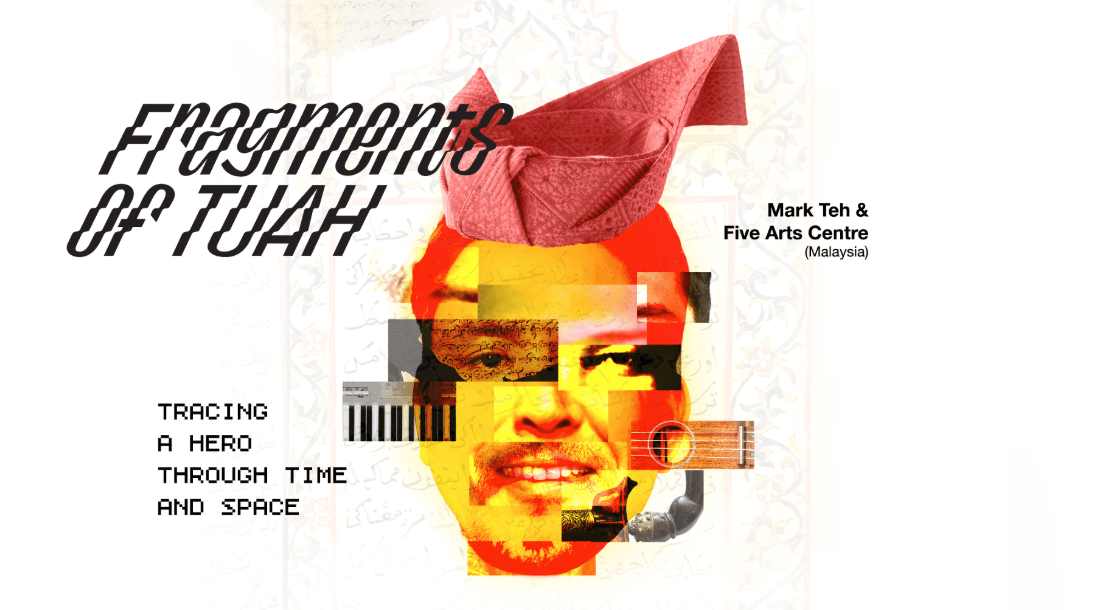
Hang Tuah has occupied a singular place in the Malaysian imagination for centuries. The legendary warrior appears in school textbooks, literature, films and political speeches, often held up as the embodiment of loyalty, courage and duty. It is precisely because he is so deeply embedded in the national consciousness that theatre-maker Mark Teh never imagined he would make a work about him.
“He’s a mythic national trope that many people have sort of covered already,” Teh says. “He’s probably the most performed character on stage in Malay and in English in Malaysia. My friends and I make documentary theatre, so he wasn’t the most natural subject matter for us.”
Yet the journey towards Fragments of Tuah emerged not from a desire to retell a familiar legend, but from a series of curious coincidences that gradually revealed how persistently Hang Tuah continues to resurface in contemporary life. One thread began in 2019, when Teh travelled to Okinawa while researching an entirely different project. Returning to Malaysia, he came across a pseudo-historical book claiming that Hang Tuah had travelled there centuries earlier. “This book tells the story that Hang Tuah truly existed,” he recalls. “It claims some artefacts were found in Okinawa, India and Istanbul that belonged to him.” Around the same time, another phenomenon was unfolding online. During the pandemic, social media became flooded with videos in which content creators claimed to have uncovered new evidence of Hang Tuah’s existence, filming themselves at supposed gravesites and birthplaces that attracted hundreds of thousands of views.
For Teh, these parallel discoveries had little to do with proving historical truth. Instead, they revealed something about the present moment. “I found it interesting because I saw a connection between these videos, these historical books and the conspiratorial claims that were very much present during COVID. Maybe all of us lost friends and family down different rabbit holes during that period. This kind of thinking was becoming incredibly popular.”
Together with collaborators Faiq Syazwan Kuhiri, Syamsul Azhar and Wong Tay Sy, he returned to one of the foundational texts of Malay literature, the Hikayat Hang Tuah, beginning a reading group around the sprawling five-hundred-page epic. But almost immediately, the focus of the project shifted away from historical verification. “The point isn’t whether he existed,” Teh says. “It’s about the phenomenon. Why does this story or avatar reappear every few decades? What is he saying to us when he reappears?”
That question ultimately became the foundation of Fragments of Tuah. Rather than presenting a definitive biography or attempting to separate fact from fiction, the production embraces uncertainty, weaving together archival texts, schoolbooks, films, songs, social media, personal testimony and historical erasures into a theatrical collage. The work deliberately resists offering a single interpretation of Hang Tuah, instead asking why every generation seems compelled to reinterpret him in its own image.
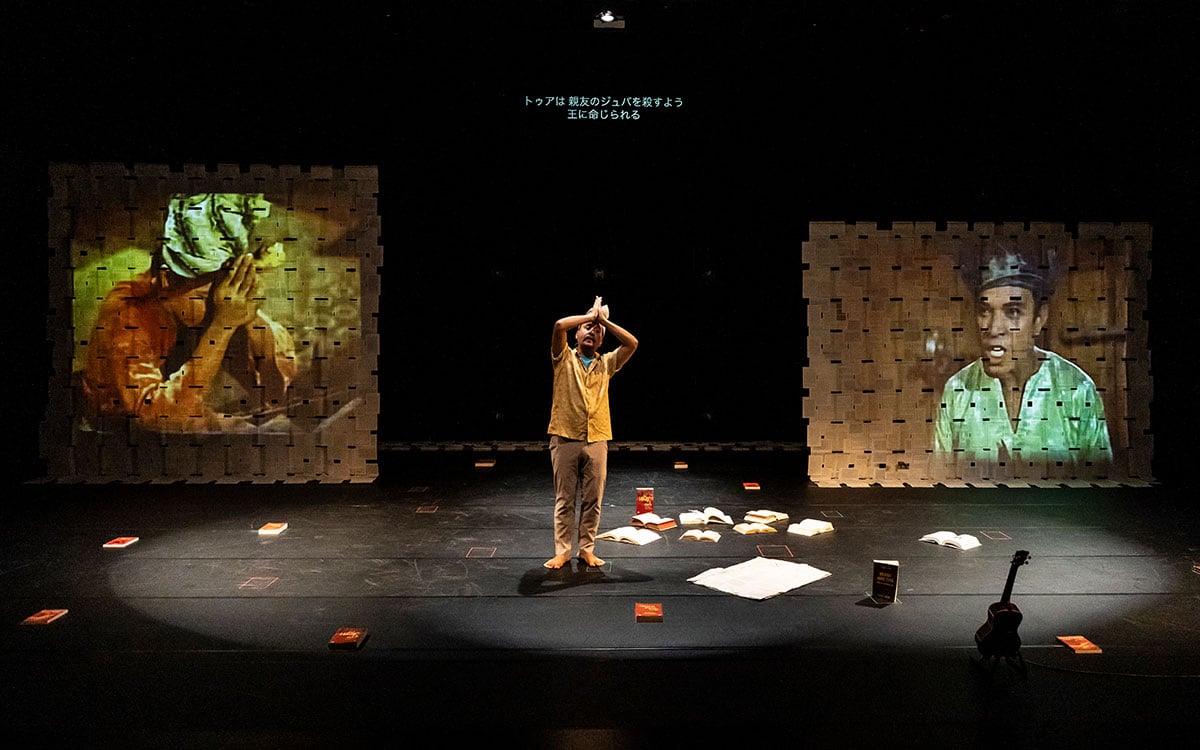
Finding a theatrical language for that exploration meant moving away from the legend itself and towards the people grappling with it. “The way we found for ourselves into the landscape of Hang Tuah was to centre it on the experience of the performer,” Teh explains. “He brings himself on stage to question these historical events and his relationship with history textbooks. He brings his own subjectivity as a young Malay man, and the privilege and baggage that comes with it.” Rather than positioning the performer as someone explaining history to an audience, the production places him alongside the legendary warrior. “He stands on equal level with Hang Tuah: the myth, the legend, the stories, and asks what the distance is between himself and Hang Tuah.”
Music unexpectedly became one of the keys to unlocking that relationship. While the company was researching, performer Faiq Syazwan Kuhiri began writing songs and sending voice notes to Teh over WhatsApp. They were deeply personal pieces that explored vulnerability and masculinity in ways that contrasted sharply with the familiar image of Hang Tuah as the stoic, loyal warrior. “They were songs of vulnerability,” Teh says. “Other ways of thinking about masculinity. We live in a toxic world right now, and Hang Tuah is a story of power, state and duty. Listening to those songs, they became very interesting material, a kind of compass to dialogue or create friction alongside the stories relating to Hang Tuah.” Those songs grounded the work in lived experience, preventing it from becoming an abstract historical exercise. “That process rooted us in our own subjectivities,” he says, “and helped shape different modes of storytelling.”

The company also found itself thinking about storytellers themselves. They drew inspiration from traditional travelling performers moving from village to village, from stand-up comedians, contemporary content creators and TikTok personalities, all figures who command an audience alone, relying on personality as much as authority. “We were thinking about solo storytellers,” Teh says, “and especially the idea of unreliable narrators.” That notion became one of the production’s guiding principles. Rather than claiming certainty, Fragments of Tuah constantly invites audiences to question who is speaking, why particular versions of history endure, and whose voices have disappeared from the record.
Inevitably, any conversation about Hang Tuah returns to loyalty, perhaps the quality most closely associated with his legend. Teh is quick to point out that this is not simply a theatrical concern but one that has occupied scholars for decades. “Serious academic and scholarly work has been done on loyalty: to king, to friend, what brotherhood means,” he says. Yet the idea remains politically charged today. “In Malaysian politics it’s a trope that appears over and over. Politicians switch parties throughout their careers, and immediately the question becomes: are they loyal or are they rebels?”
But for Teh, the issue extends far beyond Malaysia. “It’s really about proximity to power. How does one hold power to account? What happens when power corrupts and abuses? These are things we’re seeing in many parts of the world.” Seen from that perspective, even Hang Tuah himself becomes less a symbol of certainty than of contradiction. “One thing we’re trying to surface is how Hang Tuah himself is actually a precarious body, not simply an unquestioning warrior.”
That reinterpretation was encouraged by discoveries Teh made during his archival research. Revisiting P. Ramlee’s iconic 1956 film Hang Tuah, released just before Malaya gained independence, he found a moment absent from the original text that profoundly reshaped the story. “After killing Hang Jebat, P. Ramlee looks out of the window and asks, ‘Was I right or was Jebat right?’ That question doesn’t appear in the original text.” For Teh, the addition changes everything. “He questions his own complicity within the feudal structure. There’s a vulnerability there. P. Ramlee clearly sees him in more dimensions.”
Equally revealing were the handwritten manuscripts Teh encountered while working in archives across the Netherlands, Britain and Malaysia. Many ended not with declarations of authority but with extraordinary humility. “At the end of these manuscripts, convention was that the authors would leave an invitation to the next copier. They would write, ‘If there is any error in this copy of the story, please take the liberty to amend it and continue the story.'” Teh still speaks about those discoveries with obvious affection. “It’s very poetic and beautiful. These unknown authors seemed to open up many possible paths for the story.” Over time, however, those possibilities narrowed as national narratives settled on a more singular version of Hang Tuah. “The nationalistic version became almost one-dimensional. We’re simply taking up that invitation from the authors. We’re trying to remind people that stories continue.”
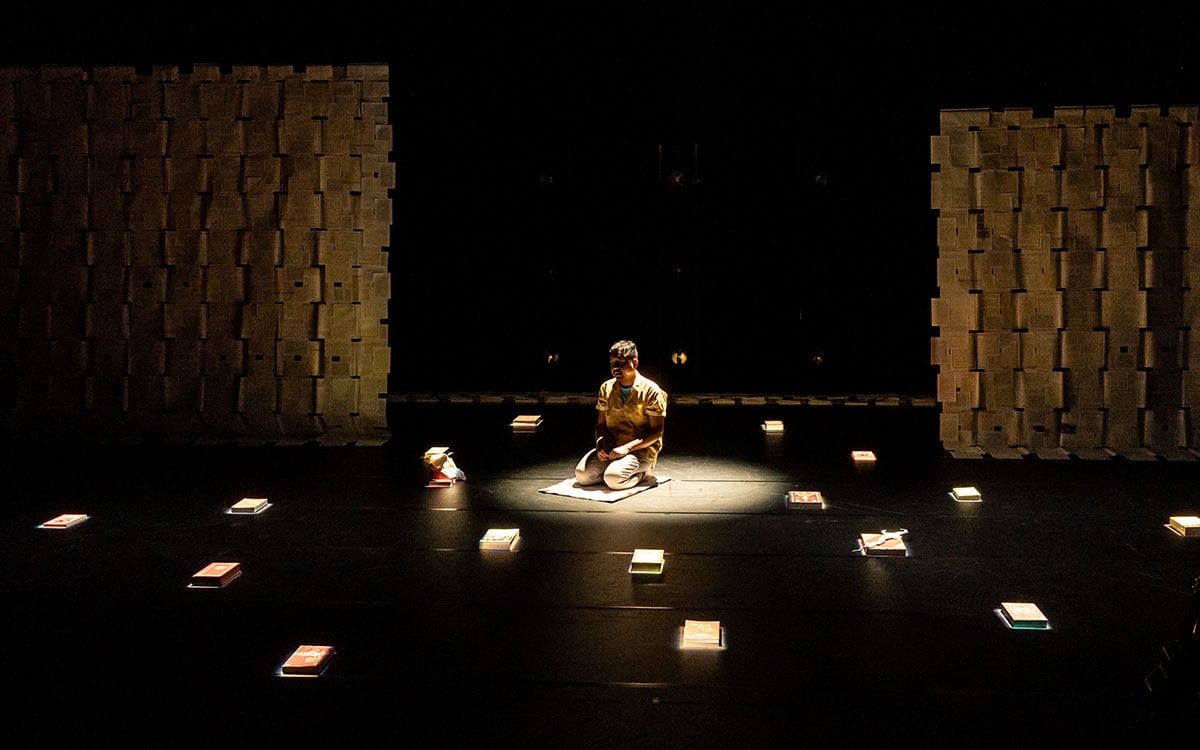
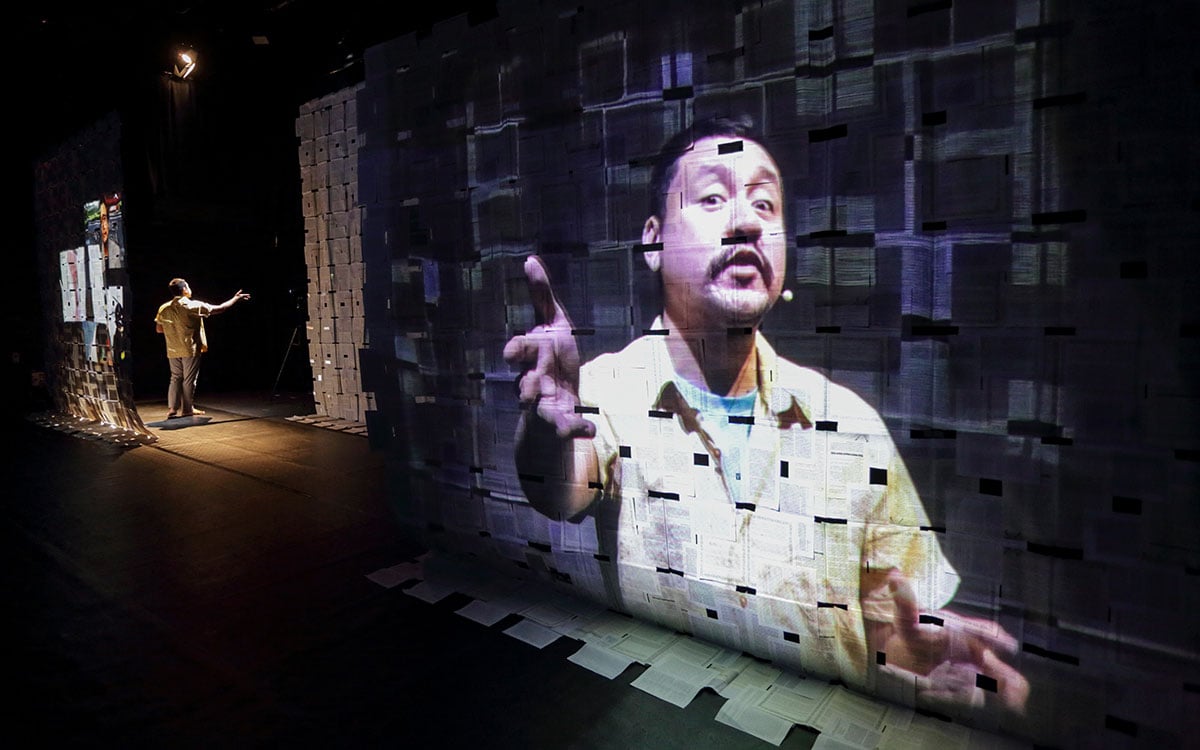
That philosophy extends to the production’s staging. Teh describes the stage as “a space for editing”, where everything audiences encounter is already present before the performance begins. Books, projections, archival materials and objects remain visible throughout, manipulated openly by the performer rather than concealed behind theatrical illusion. The structure itself mirrors the fragmented experience of navigating information today. “It’s almost like an algorithm that we’re leading the audience through,” Teh explains. One moment examines Hang Tuah’s place in the National Museum, another revisits the famous film, another explores the performer’s own relationship with him as a Malay man, before moving to the closing chapters of the Hikayat and videos filmed across Kuala Lumpur, Melaka and Bali. “That’s what I mean by algorithmic aggregation,” he says. “Even Faiq himself was a content creator, and he deconstructs that language within the performance.”
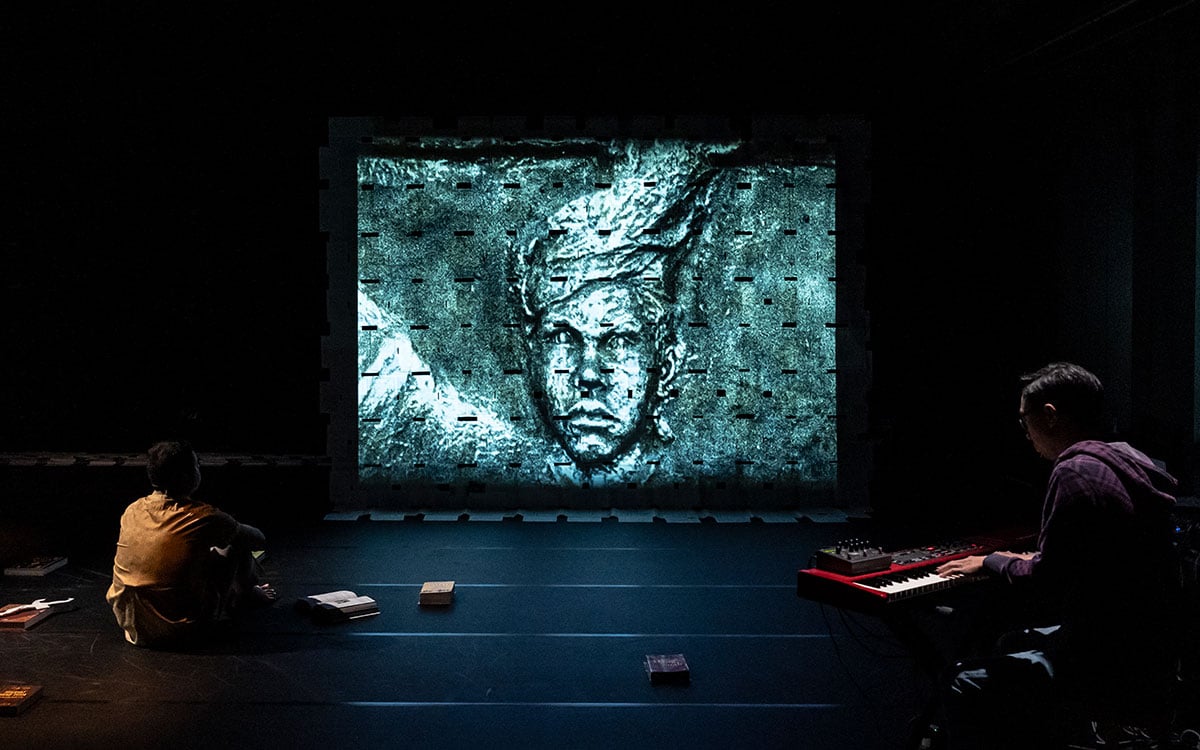
Although deeply rooted in Malaysian history, the work has resonated far beyond its borders. Presenting the production in Japan, Teh was struck by how readily audiences connected with its broader concerns. “One of the interesting responses was that people felt very close to this notion of old stories and legendary figures being repurposed by the powers that be,” he says. Across many societies, myths of a glorious past continue to resurface, finding new life through political rhetoric, viral videos and social media. “The mythic past, the golden age, the great successes, is reappearing in many cultures right now. Questions of authenticity, fake news and fake evidence are very much present.” While audiences may arrive knowing little about Hang Tuah himself, they quickly recognise the mechanisms through which stories are continually recycled, reframed and mobilised.
Ultimately, Fragments of Tuah is not an attempt to resolve centuries of debate but to reopen them. “The original story is a five-hundred-page epic,” Teh notes, “but today we reduce it to just one small chapter: the warrior who kills his best friend because his ruler orders him to. The story is so much more than that.”
His fascination lies in understanding why certain episodes are elevated while others disappear, and how those choices shape collective memory. “How are national heroes created, regardless of context? How are public heroes narrated? How do these symbols gain currency? What gives them power, and how do they morph across time?” Those questions, he believes, matter far more than whether Hang Tuah truly existed. “These things are liquid and malleable. We often think of foundational figures as fixed, but they’re not. Every society has its public enemies and its national heroes. Our work is simply asking why certain stories become dominant, why others fall away, and what that says about the societies continuing to tell them.”
Fragments of Tuah plays from 24th to 26th July 2026 at the Esplanade Theatre Studio. Tickets available here
The Studios 2026 – Precarious Bodies runs from July to September 2026 at the Esplanade. Full programme and tickets available here

