
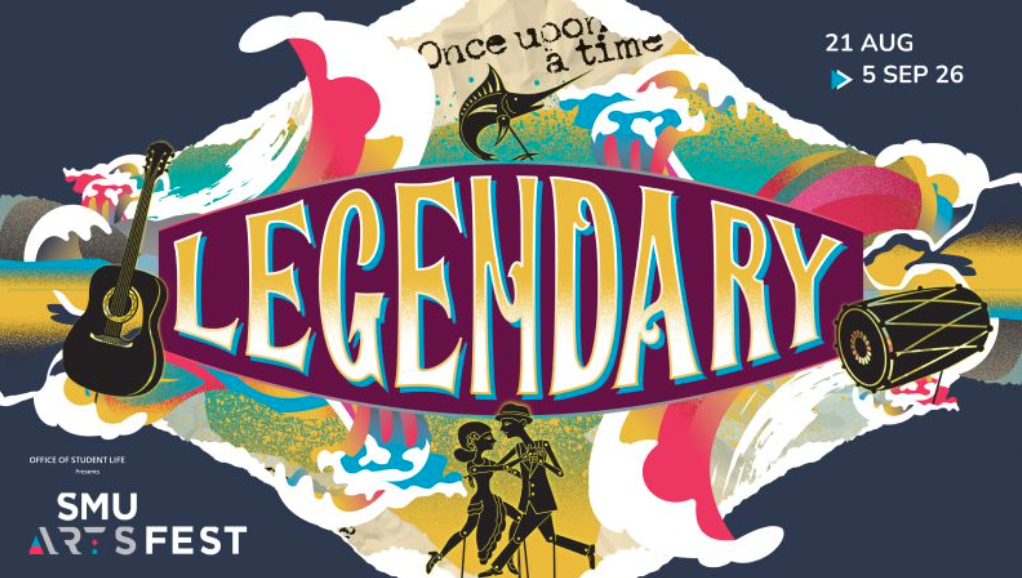
At SMU Arts Fest 2026, the legends may be old, but the ways of telling them are anything but. Running from 21 August to 5 September, Singapore Management University’s annual arts festival transforms its city campus into a hub of performances, exhibitions and music, bringing together some 400 performers, including 250 undergraduate and postgraduate students and 25 alumni, from 14 SMU arts clubs, alongside professional artists and community partners. This year, under the theme LEGENDARY, the festival takes Singaporean, Asian and global stories, figures and artistic traditions and places them in contemporary hands.
For Seah Wee Thye, Festival Director and Head of Arts & Creative Experience at SMU, the decision to call the festival LEGENDARY was partly about moving beyond the narrower idea of “myths and legends”. “Truth be told, it’s because we knew that we were already partnering with the Singapore Night Festival, and we were waiting for them to share with us what their theme was,” he explains. “When they shared that their theme was ‘Myths and Legends’, we thought that was a bit limiting, because myths and legends are really about legends, stories, folklore and old tales. So we decided on the word ‘LEGENDARY’ because actually, that word is wider.”
That wider definition allows the festival to go beyond traditional narratives, and also include legendary people and cultural icons, from Teresa Teng to Michael Jackson, as well as artistic practices that have survived across generations. “We decided to look at practices, people and their influence, as well as stories. That’s why we call it ‘LEGENDARY’,” he says.

That philosophy runs through the festival’s major programmes, each of which approaches the idea of inherited culture from a different direction. ONCE UPON AN ISLAND, presented as part of the Singapore Night Festival, brings together the founding of Singapura, the Redhill Swordfish story and the Kusu Island legend in a non-verbal multidisciplinary performance based on Oliver Chong’s What the Island Remembers. At SMU de Suantio Gallery, INTO THE LORE asks students to respond to six Asian folklores through visual art, photography and text. Meanwhile, BEATIFIC turns Campus Green into a percussion gathering featuring student and guest ensembles, while ICONS revisits musical legends across generations and genres.
The festival’s approach to audience engagement is equally unconventional. Rather than building a series of conventional seated performances, this year’s programming has been designed around the flow of people through SMU’s city campus. “All our programming is designed for a transient audience,” says Seah. “Nothing is a full sit-down experience, so we decided not to charge for it.” Everything on campus is free, and audiences are encouraged to drift between programmes rather than commit to an entire evening. “You want to sit on the floor, you want to sit on Campus Green, up to you,” he says. “The shows on Campus Green are half an hour each. So again, you can come in, watch 10 minutes and walk away. That’s fine.”
That format is particularly evident in ONCE UPON AN ISLAND, where each performance lasts just 15 minutes and is repeated throughout the evening. Seah compares the model, somewhat unexpectedly, to a theme park: “That model is very Universal Studios Singapore, where you watch short bite-sized shows.” The idea is to accommodate audiences who may be moving between SMU and the wider Singapore Night Festival precinct. “You may not watch all 15. You may come in, watch 12 minutes and then decide to walk. Fine, we are not going to stop you.”

For Wee E-Chiing, Producer of ONCE UPON AN ISLAND and the Festival Opening, the production’s most interesting quality is the way it brings together disciplines that students might otherwise encounter separately. The collaboration with The Finger Players and Oliver Chong began before the Singapore Night Festival announced its theme, initially as an exploratory attempt to find ways of connecting professional artists with SMU students. Once the “Myths and Legends” theme emerged, however, the connection became obvious. “There’s really no better year to do shadow puppetry,” recalls Seah.
The result is deliberately not a straightforward retelling of Singapore’s familiar founding stories. Seah says the initial brief was to create “a mash-up” rather than focus on a single narrative. Chong responded by finding a connection between the stories through the sea: Sang Nila Utama’s voyage, the turtle associated with Kusu Island and the swordfish of the Redhill story. “So he believed they’re all in the same ocean. Different timelines, but a multiverse,” says Seah.
Even the form of the performance challenged Seah’s original expectations. “The challenge in the beginning was that I said I needed dialogue. I needed announcements. I needed some student to do the ‘Once upon a time’,” he recalls. Chong instead insisted on making the work entirely movement-based, without dialogue or a conventional script. “I was very nervous about that. But I think now, watching it, it’s okay. I gave in to that.” For Wee, the process of getting the students to work within this unfamiliar language became an important part of the project itself. “Oliver was very candid in the meetings with the choreographers,” she says. “They had to understand how the shadow works, while the students were figuring out which parts were more difficult.”
The challenges multiplied when the work moved into the larger performance space, requiring the students to think not just about their own movements but also about shadows, light, screens and scale. “When we moved into the bigger space, with the screens, that created another challenge. It pushed them to try something new,” Wee says. “There were so many things for them to explore and learn, from the techniques, the movement, the way the torchlight moves, and how everything translates into a bigger space with two screens.” What might initially have seemed like a clash of artistic languages became, for the students, a lesson in collaboration. “I think that’s where they found the beauty of working together.”
ONCE UPON AN ISLAND runs on 28, 29 August and 4, 5 September at SMU Connexion, with 15-minute performances at 7.45pm, 8.45pm and 9.45pm.

If ONCE UPON AN ISLAND explores how old stories can be physically reimagined, INTO THE LORE turns the question inward, asking students what they themselves see when they encounter traditional narratives. The exhibition features works responding to six Asian folklores, but rather than prescribing a particular medium or interpretation, students were encouraged to approach the material through their own contemporary perspectives.
“We wanted them to have their own lens and perspective, because a lot of the stories are very traditional, love stories, cultural stories and so on,” says Aderyl Tan, Producer of INTO THE LORE and Festival Marketing & Comms. What emerged was an unexpected examination of issues such as gender and identity. “It’s interesting to see how they’re interpreted from a present-day perspective, especially around gender and identity in relation to culture.”
One student’s response became a particularly clear example of how dramatically that perspective can shift. After reading one of the traditional stories, she realised that there was no female representation in the narrative and responded with a painting of lilies. The exercise, says Aderyl, is less about correcting the original folklore than giving students the freedom to interrogate what they have inherited. “To do a project like that is also to raise awareness of their identity as Singaporeans. Singapore has its own myths, legends and stories to tell.”
The students were also deliberately pushed beyond the mediums they were most comfortable with. “We specifically wanted to challenge them to go beyond painting, which is what they normally do: painting on canvas,” says Aderyl. Workshops with artists opened up other possibilities, while students from literary arts and photography were also encouraged to consider how their practices could respond to the theme. “I always tell them to just trust the process,” she says. “The majority of the arts clubs have their own little productions, but they’re very limited in terms of funding, and it’s very rare that they have the bandwidth to do more. So we want to push them out of their comfort zone — whether it’s learning shadow puppetry or working with music that they’re not familiar with.”
That process also has a more fundamental purpose: introducing young people to stories they may not have encountered before. “A lot of the young students don’t even know most of the local myths and legends,” Aderyl says. “So even little things like this help raise awareness.”
INTO THE LORE runs from 21 August to 5 September at SMU de Suantio Gallery.

The festival’s musical programmes take the idea of “legendary” in yet another direction. BEATIFIC, produced by the trio of Christopher Goh, Augustine Sim and Anthony Kok, brings together nine percussion groups, including SMU Samba Masala, Wicked Aura, Damaru, Nadi Singapura, ZingO Festival Drum and a samba band from Republic Polytechnic. Rather than repeating the festival’s previous focus on samba, Anthony wanted to broaden the musical vocabulary and bring different strands of the percussion community together. “We wanted to do a percussion festival rather than what we used to do, which was a samba festival,” he says. “This can help bring the drumming community together as well.”
For Seah, placing student performers alongside more established groups is part of the festival’s educational philosophy. Students have to see where they stand, and sometimes that means being placed in an intimidating line-up. “The audience is going to compare you with the act before and the act after,” he tells the Samba Masala students. “If the act before is Wicked Aura, good luck. If the act after you is Damaru, also good luck. But I think that’s the way they grow.” The point, he says, is not simply to give students a platform but to give them something to aspire towards: “I have to programme them in between the industry groups in order for them to grow.”
BEATIFIC takes place on 28 and 29 August at Campus Green, with approximately 30-minute performances at 7pm, 8pm, 9pm and 10pm.

The following weekend, ICONS turns the focus to musical figures whose work has become part of collective memory. The programme was built around a deliberately broad definition of what makes somebody an icon. “We deliberately went through a very stringent deliberation process,” Seah says. “Who is an icon? Who isn’t an icon?” The result spans different generations, countries and genres, exposing students to artists and musical traditions they may not otherwise encounter.
Anthony has seen that process happening within the ensemble itself, particularly as younger performers encounter the music of artists they did not grow up with. “Even the young students, what does Anita Mui sing? The alumni share that with the whole band, and it’s quite heartwarming,” he says. “They get exposed to this kind of thing. And then someone knows the story behind it, the last song in the concert before she passed away.” For Anthony, there is something meaningful in those moments of musical knowledge being passed between generations.
ICONS runs on 4 and 5 September at Campus Green, with approximately 30-minute performances at 7pm, 8pm, 9pm and 10pm.
Although the festival is built around SMU’s student arts community, the organisers have also been conscious of its position within Singapore’s wider cultural district. This year’s collaboration with Temasek Shophouse brings LITTLE LEGENDS to a public-facing venue, with an artist talk featuring three young artists from INTO THE LORE, alongside LET’S JAM, a live music experience designed to bring people of different ages, backgrounds and abilities together.
For Wee, those external connections can fundamentally change how students perceive their own work. “The students do their own productions and it’s always within the SMU community,” she says. “But the opportunity to be part of something like the Singapore Night Festival, when I say, ‘The exhibition is part of the Night Festival, so people are going to see it’, they really appreciate that.” It gives students the sense that their work has a life beyond the university and encourages them to think more expansively about what they are making.
That same philosophy extends to the festival’s work with St Vincent Home. Seniors who had been participating in art workshops throughout the year were given the opportunity to see their work exhibited publicly for the first time. “They had been doing art classes and workshops throughout the year, but they had never exhibited their work or seen it presented publicly,” says Wee. “So when they came last week and saw their artwork, they were like, ‘Wow.’ It was a big deal for them.”

Underlying the festival is SMU’s broader argument that an arts education does not have to be confined to an arts school. The students participating in Arts Fest are studying across the university, and many will not go on to become professional artists. For Aderyl, that is precisely why the experience matters.
“Being creative and being an artist doesn’t necessarily mean that you must come from an art school or that you have to be an artist,” she says. “Creative thinking and conceptual thinking are very important.” Her hope is that audiences and students alike come away understanding that artistic practice is not a specialist activity reserved for a particular kind of person. “I do hope people walk away knowing that being involved in the arts is really for everybody.”
Seah describes the capabilities students develop through the festival as the “new five Cs”: “creativity, courage, confidence, collaboration and cultural understanding.” And there is a sixth quality he considers just as important: empathy. “By being involved in works like this or projects like this, they have to learn to work with each other,” he says. “Tear each other’s hair out or kill each other, I don’t care, but you learn lor.”
Perhaps more importantly, Seah believes the experience can turn participants into audiences for the arts even if they never pursue artistic careers themselves. One of his favourite sights, he says, is arriving at a professional production outside SMU and seeing former Arts Fest participants standing in the queue. “They’re now paying audiences for shows outside SMU. It’s because they understood what it takes to make a show, and therefore now they’re willing to pay $65 or $85 to go and watch one.” The university may not produce professional singers and performers out of every participant, he says, “but I think we’re producing some kind of an audience as well.”
That idea of audiences learning to look differently at art is ultimately connected to the festival’s larger interest in reinvention. For Seah, preservation and reinvention are not opposing forces. “To me, reinvention is a form of preservation,” he says, invoking Madonna, who continues to resonate with audiences around the world with each new album, as his unlikely example: “She reinvented herself in order to preserve her brand.”
The same principle applies to legends. A story does not necessarily survive because it remains unchanged; it survives because successive generations find new ways to understand and tell it. “You can always look at everything with fresh eyes or fresh ears,” Seah says. “You can look at the same story but tell it differently, or arrange it differently.
“There are maybe only so many stories in the world,” he adds. “How you tell them is what makes you different.”
For SMU President Professor Lily Kong, the theme also speaks to what a university can do with the cultural inheritance it receives, as she spoke at the festival’s opening night. “We acknowledge, celebrate the past but we also use it as an occasion to think about the future,” she said at the festival opening. With young artists taking familiar legends and myths into their own hands, she sees the festival as an opportunity to “turn that into something that makes meaning in the contemporary world”.
In that sense, she says, LEGENDARY reflects the broader mission of a university: “It’s acknowledging our past, our roots of our society, our culture and so forth but at the same time being willing to look at that with fresh eyes and to remake that in ways that might bring new meaning.” She adds that the theme appeals to her precisely because it “speaks to past and present and future” — and to the university’s role in “harnessing talent, drawing deep into our cultural resources and using that to look ahead.”
Kong also sees the festival as an expression of SMU’s relationship with the city around it, particularly as the university marks its fourth year of collaboration with the Singapore Night Festival. “I do not believe in a university that is inward-looking, that is only interested in our own metrics and our own interests and divorced from the rest of community and society,” she said. “I think a university is situated in community and society and the Arts Festival allows us to do that in still another way beyond what we usually do.”
From the Singapore Night Festival collaboration and the work with The Finger Players to the intergenerational projects with St Vincent Home and the partnership with Temasek Shophouse, she sees the festival as an opportunity to open the campus outward. And ultimately, she believes the students themselves are part of what makes the festival meaningful: “Legends, after all, are ultimately about people. Legends are ultimately about people and tonight we celebrate legendary stories and iconic figures, but perhaps the greatest legends are yet to be written by the students who are with us tonight.”
For SMU Arts Fest 2026, then, being legendary is less about putting old stories behind glass than about giving them another life, through students who question them, musicians who reinterpret them, artists who find themselves in them, and audiences who encounter them in unexpected places. As Seah puts it: “It doesn’t mean you stop telling stories. You can tell a story in a different way, use a different genre, use a different artistic practice, arrange it in a different format. If you keep telling stories, the legends will keep being remembered.”
SMU Arts Fest 2026: Legendary runs from 21st August to 5th September 2026. All programmes are free. More information and full lineup available here

