
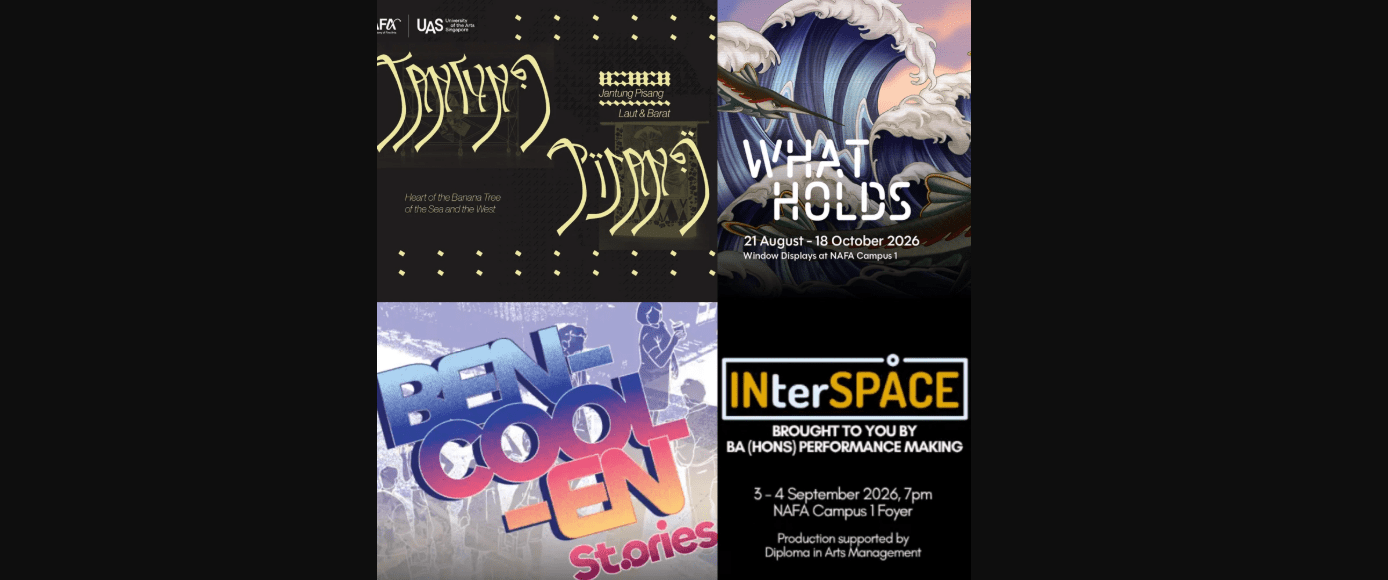
Across Singapore Night Festival 2026, NAFA students, graduates and faculty are bringing folklore, oral histories, illustration, sound, dance and theatre into public spaces, and finding new ways to work beyond the boundaries of the art school.
For many young artists, the transition out of art school can be an uncertain one. Graduation marks the end of a structured environment, but not the end of the need to make, experiment, collaborate and find an audience. The practical realities of sustaining an artistic practice, from finding work, paying the bills to carving out time to create, can make that transition particularly difficult.
At the Nanyang Academy of Fine Arts (NAFA), Singapore Night Festival 2026 offers one way of continuing that journey for their young, soon-to-be graduate artists. This year, students and alumni are participating across a range of projects that move between visual art, performance, sound, illustration, research and public engagement. Rather than presenting student work as something confined to the classroom or the annual graduation show, these projects place emerging artists within the city itself, asking them to respond to its histories, communities and public spaces.

The result is a collection of works that is as much about the process of becoming an artist as it is about the finished artworks. Take for example Jantung Pisang, an exhibition tracing folklore, identity and contemporary experience. All this surrounds a simple but evocative symbol: the banana blossom. Curated by NAFA alumna Alya Rahmat, the exhibition brings together artists at different stages of their practices, including fellow graduates and established artists. Its title draws from the anatomy of the banana plant as well as the Pontianak folklore that informed Alya’s earlier work.
For Alya, the project began with conversations among friends and former cohort mates about the difficulty of maintaining an artistic practice after graduation. “After graduation, it’s very hard to keep your momentum going for your art practice, especially when you’re solo,” she explains. Conversations that repeatedly returned to work, adulthood, the job market and the pressures of capitalism eventually became the basis for an exhibition built around collective making.
The exhibition is therefore also an act of mutual support. Its contributors include friends, cohort mates and former lecturers, with even the exhibition writer and designers drawn from Alya’s wider artistic community. Rather than waiting for opportunities to arrive, the group created one for themselves.

The choice of Jantung Pisang as the exhibition’s central metaphor also reflects Alya’s interest in things that are usually hidden. In her interpretation, the “jantung” (heart) is something that is ordinarily concealed inside the body, while the banana blossom visibly hangs from the plant. That image became a way of thinking about confronting what is usually unseen.
The same impulse runs through the artists’ individual works. One work by Alya, The Wealth of the Wealthy Springs from the Poverty of the Poor, brings together Pontianak folklore, colonial histories, national identity and contemporary political experience. The Pontianak becomes a figure capable of straddling pre-colonial, colonial and post-colonial identities, while the work also draws connections between historical systems of segregation and contemporary questions around power and inequality.

Elsewhere, fellow artist Koh Kai Ting uses the opportunity to push her practice beyond its familiar territory of buildings, architecture and maps. Having first exhibited in 2013, Kai describes her artistic practice as an ongoing struggle, but sees the exhibition as a chance to challenge herself, to explore questions of time, history and archival imagery through a subject that is not immediately connected to architecture.
That spirit of exchange is central to Jantung Pisang. “How can I learn from other people, work together with other people?” Kai asks. “Maybe how our work can talk to each other, have a dialogue with each other.”
For Madelyn Ziyi Zhang, the banana becomes another way of thinking about cultural connection. Drawing on the shared presence of banana plants across Southeast Asia, the exhibition considers both the similarities and differences between cultures. Rather than treating cultural difference as a barrier, the artists see the shared symbol as a starting point for dialogue — and potentially for taking the exhibition beyond Singapore to places such as Thailand or Indonesia.

That outward-looking approach is also visible in What Holds, a project tracing intersections between Singaporean folklore, history and contemporary experience. The installation brings together three legends: the Bukit Merah’s Swordfish legend, Sang Nila Utama, and Kusu Island, through an immersive combination of illustration, sound and spatial design, displayed on the NAFA Campus 1 window displays along the street.
For Bernadeth Bertha Sondjaja, an illustration student in NAFA’s Talent Development Programme, the project represented a significant expansion of her practice. Working under the direction of alumnus and theatre-maker Oliver Chong, she translated the three stories into large-scale visual environments designed for the installation’s window displays.
Although Chong provided the initial artistic direction, Bertha conducted her own research into the legends and took responsibility for determining how the illustrations would work within the physical space. What began as a rough verbal concept and layout became a substantial illustration project requiring her to consider scale, composition, placement and the relationship between image and environment.
“It’s essentially storytelling in such a very extravagant, huge, a lot of layers way,” she says. For an illustrator, the project offered an opportunity to use her medium not simply to create images, but to help communicate stories to a broader audience.

The soundscape adds another layer. Newly graduated musician Seem Jia Ang created original sound for What Holds, using instruments including gamelan and erhu to create a sonic environment in which different cultural references interact. Rather than functioning simply as background music, the sound is designed to bleed into the physical space and bring the installation to life.
For Jia Ang, the project also prompted a personal discovery. Despite growing up in Singapore, he was unfamiliar with some of the local mythologies represented in the work. That encounter reinforced the idea that folklore can reveal histories and cultural layers that are not always visible in everyday life.
His experience reflects one of the broader possibilities of interdisciplinary practice: artists can enter a project through their own specialism while discovering new material, methods and perspectives through collaboration. “I want to bring my sound and music to support other arts and bring them to life,” he says.

If What Holds uses folklore as a way of looking back, Bencoolen Stories 2026 turns its attention to the people living and working in the city today. Developed through NAFA’s Cultural Policy Lab, the project uses oral histories, archival research and artistic interpretation to spotlight the “living legends” of Bencoolen Street. Bertha returns here in a very different role, not only as an illustrator, but as a researcher responsible for meeting business owners and community stakeholders, conducting interviews and translating their experiences into portraits.
The project began with a simple question: if the Singapore Night Festival theme is about myths and legends, why not look for the legends that already exist around us? Bertha and the team approached businesses and institutions along Bencoolen Street, asking how long they had been there, how they experienced the street and what they had seen change. The resulting portraits deliberately bring together old and new, from a historic mosque to contemporary businesses , reflecting the layered character of the neighbourhood.
The process demanded a different kind of attention from Bertha. Rather than inventing characters, she had to listen to real people and find ways to represent their stories visually without losing the qualities that made those stories personal. The project also required her to negotiate the practical realities of public presentation, from printing and framing to adapting her digital illustrations for a larger-scale installation. Her experience on the project points towards an increasingly important role for artists: not simply interpreting culture, but helping communities tell their own stories.

There is a similar movement across NAFA’s participation in INterSPACE, which explores the spaces between dance and theatre through interdisciplinary performance-making. Here, the boundaries between disciplines become the subject of the work itself.
Max Yeo Zhen Yu, a 2026 graduate of NAFA’s Performance Making programme, returns for a second consecutive edition of INterSPACE. A heels dancer and former waacking dancer, Max developed his contemporary dance and choreographic practice through the programme. After choreographing and performing Self in 2025, he returns this year with May/Be, continuing a trajectory that moves between different dance forms while expanding his choreographic voice.
Other performers demonstrate a similar willingness to cross disciplinary boundaries. Third-year dance student Muhammad Syahir Bin Mohammad Hasni performs in What If and co-creates GRWM, allowing him to move beyond dance into theatre and collaborative performance-making. Meanwhile, second-year theatre student Muhammad Razin Nurulhaq Bin Sirhan works in both directions: as an actor in GRWM and as a dancer in May/Be.

Together, these artists represent a different model of arts education — one in which specialisation is a starting point rather than a boundary. Dance students can explore theatre; theatre students can enter dance; musicians can work within visual installations; illustrators can become researchers; and graduates can return to collaborate with former peers.
For NAFA Provost and Vice President (Academic) Dr Chong Keng Hua, creating these opportunities requires more than simply securing a festival slot. It means building relationships between the institution, artists, government agencies, businesses, residents and the wider precinct.
He sees public arts programming as part of a longer-term process of placemaking. A festival may last several weeks, but meaningful engagement with a neighbourhood cannot be reduced to a temporary programme. “It’s really about engaging the long-term stakeholders around here,” he says. The ambition, he explains, is to build sustained relationships between arts practitioners, students, residents and businesses, returning to those relationships through future festivals and projects.
That also means changing how students encounter the professional world. Chong argues that faculty themselves need to be engaged with industry and the surrounding community so that students can be brought along and exposed to those relationships. NAFA is already working with organisations including LTA, SLA, URA, NHB, NAC and HeritageSG, with the aim of creating a stronger ecosystem in which students can eventually make use of those platforms themselves.

The institution is also looking at how different groups of students, faculty and units can develop a more cohesive presence at festivals. Rather than simply assigning students individual projects, the longer-term ambition is to create a culture in which students can identify opportunities, organise themselves and step forward.
“We should create a culture where we provide a platform and then let it evolve,” Chong says. “Self-organise, step up, and then we just facilitate.”
That process, he acknowledges, will take time. It is perhaps fitting that the works themselves embody that same patience. In Jantung Pisang, artists slow audiences down through darkness, focused light and deliberately small fragments of text. In What Holds, folklore is encountered through layers of image and sound rather than a single explanation. Bencoolen Stories asks audiences to stop and listen to people whose stories might otherwise disappear into the everyday life of the city. And INterSPACE treats the boundaries between artistic disciplines not as fixed categories, but as spaces to move through.

Across these projects, the common thread is not a single artistic style or medium. It is a willingness to look beyond the conventional boundaries of the art school, between student and professional, artist and researcher, dance and theatre, image and sound, folklore and contemporary life.
For the artists involved, Singapore Night Festival becomes more than a platform for showing work. It becomes a place to test what happens when artistic practice enters the city, encounters unfamiliar audiences and works alongside people from different generations, disciplines and backgrounds.
And perhaps that is where the real value of these projects lies: not simply in giving young artists a place to exhibit, but in giving them the opportunity to discover what kind of artists they might become once they step outside the classroom.
Singapore Night Festival 2026 runs from 21st August to 5th September 2026. More information available here

