
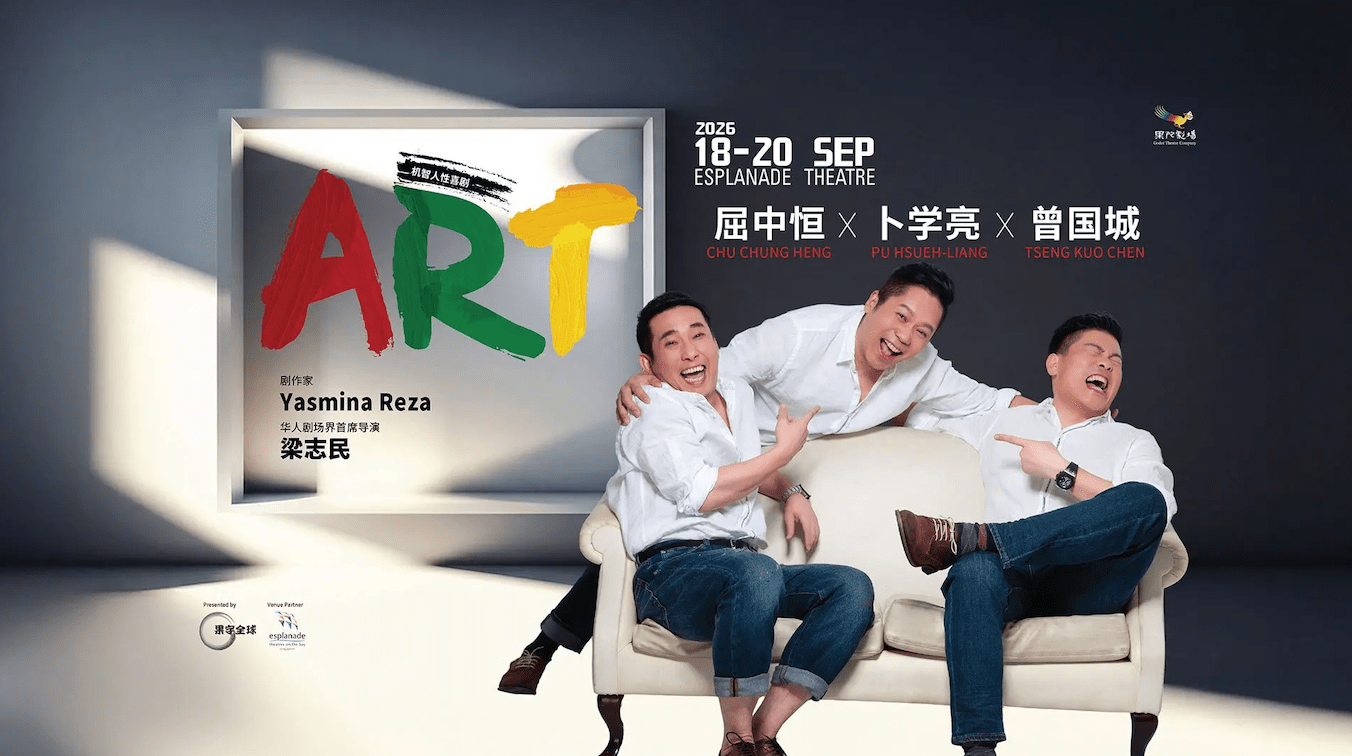
There is a moment before our interview properly begins that says almost everything one needs to know about ART. The first question has barely been asked when the three actors are already talking over one another. Within seconds, the room dissolves into laughter. They interrupt one another, finish each other’s sentences, argue over tiny details and gently tease each other without missing a beat. Before anyone has spoken about Yasmina Reza’s celebrated play, it becomes immediately apparent why audiences have never had much difficulty believing that these three men have known each other for decades; because they have.
This September, Taiwan’s Godot Theatre Company returns to Singapore with its acclaimed Mandarin production of ART, three years after the play first delighted audiences during the annual Huayi – Chinese Festival of Arts. Adapted from Yasmina Reza’s modern classic, the play follows three friends whose twenty-year relationship begins to unravel after one of them spends a small fortune on a seemingly blank white painting. What begins as a disagreement over taste gradually exposes long-buried resentments, insecurities and competing ideas of who each man has become.
Yet spending time with stars Pu Hsueh-Liang (卜学亮), Chu Chung Heng (屈中恒) and Tseng Kuo Chen (曾国城) quickly reveals that the production’s greatest strength has perhaps never been the painting at all. Instead, it is the easy affection between its three leading men, something that has only grown stronger over the ten years they have spent performing the play together. Although ART returns to Singapore in September, the actors admit they have only just begun preparing to step back into rehearsal.
“We actually haven’t started rehearsing properly yet,” says Pu. “It’s been almost three years since Singapore, so right now each of us has simply taken the script back out at home. We’ve been reading through it again, trying to recover that feeling we knew so well.”
There is no anxiety in his voice, only anticipation. “We’ve already performed this play more than sixty times,” he continues. “Once you find that feeling again, you know it’ll come back. I’m looking forward to officially going back into rehearsal and spending the next two and a half months polishing it again, so that when we arrive in Singapore we’re presenting it in the best possible condition.”
Before the thought can settle, Chu is already eager to add his own. “The nicest part was actually today,” he says. “Before the interview started, the three of us were already sitting together waiting. We suddenly realised how good it felt just being back in the same rehearsal space.”
He looks around at his friends. “The familiar feeling came back immediately.”
Then, after a theatrical pause, he grins. “The only surprise is that somehow, after all these years…none of us has gotten older.”
The declaration lasts all of two seconds before his co-stars begin protesting. “I got a little fatter,” Chu immediately corrects himself. “I actually became thinner,” Tseng counters, before the laughter begins again.

It is the sort of exchange that could easily have come straight from ART itself. For actors who have lived with these characters for nearly a decade, it would be easy to assume there is little left to discover. The script has been rehearsed countless times, every pause carefully considered, every exchange refined over more than sixty performances.
But life, they suggest, has quietly rewritten the play for them. “When we first rehearsed ART, we already spent a very long time building these characters,” says Pu. “The structure is solid. I don’t think I’ve suddenly developed a completely different interpretation of my role.”
Instead, what has changed is the person playing him. “We’ve all lived a few more years,” he reflects. “We’ve experienced more things. You begin to understand people differently. Why someone says something. Why they’re hurt. Why they react the way they do. Those emotional details become clearer.”
He believes audiences may not notice any dramatic reinterpretation, but they may feel something more subtle. “The characters might become a little more complete.”
One of the greatest challenges of ART, he explains, lies not in what appears onstage but in everything that doesn’t. “There are only three people in the play. The audience never sees the twenty years of friendship that came before the first scene. So we spent a lot of time creating that history ourselves. What did they experience together? How close were they? What kind of people were they before the audience ever meets them?”
None of those answers exist explicitly in the script.
“But we needed to know them.”
That invisible history, he believes, is what allows every argument to feel painfully real. And for Chu, returning to ART is also a chance to rediscover his fellow actors. “We first performed this play in 2016,” he says. “Now we’re in 2026, ten years on.” He laughs. “Every time we come back to it, I still hope we’ll find some new spark between us.”
Even after thirty years of friendship, he insists there is always room for surprise. “We’re actually thinking about making little adjustments this time. Maybe the rhythm changes slightly. Maybe the tone of a line changes. We’re looking for new chemistry again.”

Ironically, a play about friendship has deepened their own. “Because of ART, we’ve actually made new friends,” says Chu.
He recounts how an older audience member, having seen the production, became so fond of the trio that he invited them to dinner. One dinner gradually became another. “And now,” Chu laughs, “every month, the three of us each bring our wives, and we all have dinner together. We even have our own dinner group.”
“A drinking group,” the others quickly correct.
“A very good drinking group,” Chu agrees.
If ART examines how friendships fracture, it has also, unexpectedly, expanded theirs. Tseng believes the play has revealed sides of his colleagues he might otherwise never have noticed. “I realised something because of this production,” he says. “Both of them absolutely adore their wives and daughters.”
He smiles at the two men sitting beside him. “They’re both incredibly disciplined too.”
He points towards Pu. “After rehearsals finish late at night, I always offer to drive him home. His house is only ten minutes away by car. But Pu refuses every time, and he insists on walking.”
That’s not a short walk either. “It takes over half an hour.”
Tseng still seems slightly bewildered by the memory, and says: “I realised that’s simply who he is.”
Then he turns towards Chu. “And before performances, he becomes even more disciplined. He’ll go running. He’ll exercise. He changes his whole routine.”
“And drinks less,” Pu chimes in.
Everyone laughs heartily. “They’re little things,” Tseng says. “But they’re things that made me admire them even more.”
Listening to them, one begins to understand that ART is no longer simply a play they perform. It has become one of the ways they continue learning about one another. That familiarity extends onto the stage, where audiences often remark on the astonishing precision with which the three actors bounce dialogue off one another.
How much of that timing is rehearsed? And how much changes with each audience? “The rhythm comes from rehearsal,” Chu says. “Yasmina Reza’s writing is incredibly precise. Every sentence matters. We spend a great deal of time making sure every exchange lands exactly where it should.”

That precision, however, never becomes rigidity. “Every audience is a little different,” he adds with a smile. “And Singapore audiences spoil actors.”
He laughs as the others nod in agreement. “The reactions here are so direct, so enthusiastic. Sometimes audiences in Singapore laugh at places where audiences in other cities never laugh. You begin wondering, ‘Why is this line suddenly so funny here?'”
The audience’s laughter, he admits, can become infectious. “Sometimes we almost get carried away.”
Pu reveals another adjustment audiences may never notice. “Because Mandarin isn’t everyone’s strongest language in Singapore, we deliberately slow our speech down a little.”
Not enough to disrupt the rhythm. “Just enough so audiences have time to follow every thought.”
It is one of countless tiny calibrations made out of respect for the people sitting in the theatre. For all its reputation as a play about contemporary art, the actors insist audiences often misunderstand what ART is really about. “People think we’re discussing the painting,” Chu says. “But we’re not. The painting is only the excuse.”
What the play truly examines, he believes, is friendship. “How do you see your friends? How do your friends see you?”
He remains fascinated that Yasmina Reza, writing from a woman’s perspective, captured male friendship with such startling precision. “She understands those tiny things men become obsessed with,” he says. “The pride. The comparisons. The little calculations that men make without ever saying them aloud.”
The white painting merely gives those hidden tensions permission to surface. “The painting isn’t the point,” he says quietly. “The friendship is.”
At one point, the conversation unexpectedly drifts away from theatre altogether.
“I’ve actually been thinking about the title,” Tseng says. He begins counting on his fingers.
“‘A’ is Action. If you care about your friends, you have to do something. Friendship doesn’t maintain itself. ‘R’ is Relationship. That’s what you’re building,” he pauses. “And ‘T’…, well, that’s ‘Treasure.'”When you’ve looked after your friendships properly, they become one of the greatest treasures you’ll ever have.”
The others immediately burst into laughter. “You changed it!” Chu protests. “It used to be ‘Revolution’!”

They spend the next minute arguing playfully over which interpretation is better. Neither appears interested in winning. Later, when asked whether they would actually hang the play’s infamous white painting if someone gave it to them, the discussion unfolds in much the same way.
Three hands go up immediately. Then Pu hesitates. “First I’d ask how much it was worth.”
The play says eight million Taiwanese dollars. “Then I’d refuse!” he laughs. “It’s too expensive.”
But if someone insisted on giving it to you? “…I’d probably accept.”
So would you hang it? “I honestly don’t know where I’d put it.”
Tseng has another reason. “I’d invite all my friends over. Then I’d watch human nature unfold.”
Chu’s answer is wonderfully straightforward. “I’d hang it because it’s worth eight million.”
The room dissolves into laughter once again. Yet perhaps the most revealing answer of the interview comes near its end. In ART, the three friends eventually realise that even after decades together, there are still parts of one another they cannot fully understand. Is that true in real life?
“I think it is,” Tseng says after a pause. “I don’t think it’s possible to completely understand another person. Not your wife. Not your children. Everyone keeps a part of themselves that’s only theirs.”
“But that’s alright. What matters is sincerity. If I’m sincere towards my friends, then their little flaws don’t matter. I choose to believe they’re good people.”
Pu nods. “I don’t think I need to understand someone completely either. I believe friendships are built on chemistry. Sometimes you don’t even have to speak. You simply feel comfortable together. Those become the people closest to you.”
Tseng looks at the others before offering one final reflection. “The Earth keeps moving, and so do people.” Looking at us, he says: “You, you’re also already different from who you were three years ago. Your work has changed. Your life has changed.”
“Everything changes.”
A pause.
“But there’s one thing that shouldn’t, and that’s our enthusiasm for caring about our friends. If we never lose that, we’ll always keep trying to understand one another.”
For a brief moment, nobody interrupts. Nobody has another joke. Perhaps because, after nearly forty minutes of finishing one another’s sentences, they have already demonstrated exactly what they mean.
ART may begin with a painting. But after spending an afternoon with Pu Hsueh-Liang, Chu Chung Heng and Tseng Kuo Chen, it becomes difficult to believe the play was ever really about art at all. It has always been about the quiet, ongoing work of friendship, about returning to the same people, again and again, even after disagreement, even after change, and discovering that there is still something new left to understand.
Photo Credit: Godot Theatre Company
ART plays from 18th to 20th September 2026 at the Esplanade Theatre. Tickets available here
Read our 2023 review of ART here

