
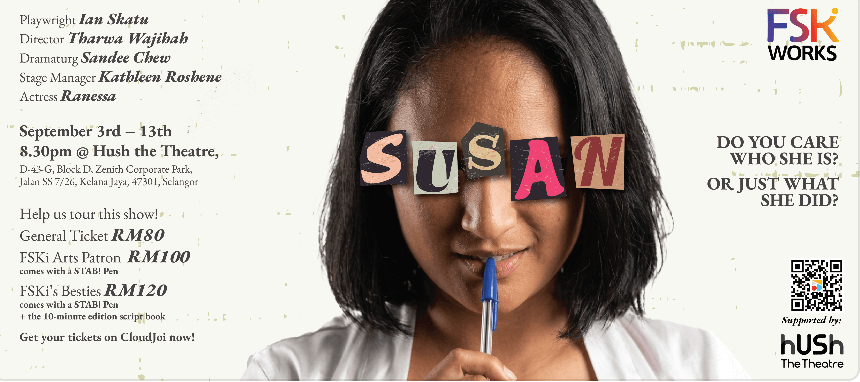

Do you care who she is? Or just what she did? A woman stands before us. She has two dead husbands behind her, a murder case in front of her, and one thing she refuses to give away: her name.
That is the provocation at the heart of SUSAN, FSKi Works’ full-length world premiere opening this week at Hush The Theatre in Petaling Jaya. Following its success at Short+Sweet Malaysia, where it won Best Script for playwright Ian Skatu and Best Actress for Ranessa, the one-woman play expands its original 10-minute form into a nine-night production running from 3 to 13 September.
And while the premise sounds like a murder mystery, SUSAN appears far more interested in the woman at its centre, and in what an audience does when it cannot easily decide who she is. Performed entirely by Ranessa, SUSAN unfolds across three acts, with one actress inhabiting three women.

In the first, a woman is accused of murdering her two husbands. In the second, a lawyer takes on a murder case, defending a client against the charge. In the third, an entrepreneur enters a boardroom to pitch a docuseries about the serial killer. The structure shifts accordingly: confession becomes defence, defence becomes sales pitch, and entertainment begins to expose something much darker.
It is an ambitious format for a one-woman show, but it also gives the production its central tension. These are not simply three characters for one actress to play. They are three ways of constructing a woman’s identity, through what she has done, what others say about her, and what she chooses to become. The question remains: whether those identities can ever be separated.
The play’s refusal to give its central character a conventional identity is deliberate. Its starting point is a stark reality: women are most often killed by people they know, particularly intimate partners or family members. SUSAN turns that reality inside out by giving us a woman who has allegedly killed not one but two husbands.

Yet instead of asking only whether she is guilty, the play asks something more uncomfortable: how much do we actually need to know about her before we decide what she deserves? That question becomes particularly pointed when the story reaches the world of true crime. A woman’s tragedy can become someone else’s courtroom argument, business opportunity, or entertainment product. In SUSAN, the audience is therefore being asked to examine our appetite for stories about murder.
The full-length production has an unusually collaborative origin. SUSAN began with a WhatsApp conversation between Ranessa and Skatu, after the actress expressed a desire to return to theatre. Skatu, meanwhile, was looking for another opportunity to write following POLY. Their first result was the 10-minute version of SUSAN.
Its reception suggested there was considerably more to explore. The expansion was subsequently workshopped in Malaysia and Singapore with women from different backgrounds, while dramaturg Sandee Chew worked with Skatu to develop the text and stage language, as it went deeper into exploring the gap between who we believe we are, who we want to be, and who we ultimately become.
Skatu is also conscious of the inherent complication of a man writing a play centred on women’s experiences. Rather than dismissing that tension, he acknowledges it directly, saying that nothing gives him the right to do so, and that he therefore had to “earn the room” through the work. Whether the production succeeds in doing that is ultimately for audiences to judge. But the attempt is part of what makes SUSAN an interesting theatrical proposition.

Despite its subject matter, SUSAN is not being positioned as an unrelentingly grim experience. Director Tharwa Wajihah describes it as “a splash of raging fun”, a ride designed to command the audience’s attention and ignite the senses. That tonal contrast may prove crucial. Ranessa herself describes humour as a survival mechanism when life hands you tragedy, or, in this case, two dead husbands.
The result promises to be a production that can move between the disturbing and the absurd without allowing the audience to settle comfortably in either. And with only one performer carrying three acts, the success of that balancing act will rest heavily on Ranessa. Having already won Best Actress for the original short version, she now has considerably more room to explore the character, or characters, that first emerged from those 10 minutes.

There is also a larger ambition behind this premiere. SUSAN is intended to be the beginning of an international journey, with the production’s team looking towards festivals abroad, including the Edinburgh Fringe Festival.
That makes these nine performances more than simply a local full-length premiere. They are a testing ground for a production that hopes to travel. For audiences, however, the immediate question is much simpler. A woman has two dead husbands. She may or may not have killed them. She may be a victim, a killer, a lawyer, an entrepreneur, or all of them in different ways. For a production built around identity, perception and the stories we tell about women, the audience may find that the most revealing character in the room is not Susan at all, but themselves.
Photo Credit: Engku Armand
SUSAN plays from 3rd to 13th September 2026 at HUSH The Theatre, Selangor, Kuala Lumpur. Tickets available here

