

For Chan Tze Law, the question of whether the Orchestra of the Music Makers (OMM) will complete Wagner’s Ring cycle is, for now, best left unanswered.
OMM has already travelled three quarters of the way. After Die Walküre in 2020 and Das Rheingold in 2023, the Singapore-based orchestra will take on Siegfried at the Esplanade Concert Hall on 5 September, bringing one of the most demanding works in the operatic repertoire to the Singapore stage. The fourth opera, Götterdämmerung, remains the obvious question.
But ask Chan, OMM’s music director, and the answer is characteristically practical. “Currently, all the brain space is being taken up by Siegfried,” he says. “After Siegfried, the brain space will be taken up by the cost of Siegfried. And then, after that, we can hopefully see that there are other possibilities.”

There is a laugh in the answer, but also a serious philosophy behind it. OMM’s Wagner project may look like an exercise in grand ambition, but Chan describes the orchestra’s approach in a word that is rather less glamorous: “prudency”. “Prudency means that you kind of make the right choices with the music being the most important thing.”
That principle is evident in one of the most fundamental decisions surrounding Siegfried: the opera will be staged in the Esplanade Concert Hall rather than the Theatre. For a semi-staged production, the choice might seem counterintuitive, particularly when the work’s mythological world invites theatrical spectacle. But for Chan, the answer is straightforward.
“Why isn’t it in the theatre? Why is it in the concert hall? Because we found out it’s all about the sound. So the music comes first. But because of that, we pay a price for it.”

It is a revealing comment about how OMM approaches projects of this scale. The orchestra is willing to spend more, take on logistical difficulties and accept practical compromises if they serve the music. It is also why the organisation has committed substantial resources to recording the performance. “Why do we spend huge amounts of money to record it? Because this is worthy of posterity.”
The historical dimension matters. Siegfried will be Singapore’s first performance of the opera, and if OMM eventually completes the cycle, it will be the first complete Ring in Singapore. “When we first talked about Das Rheingold, we were genuinely shocked that actually the Ring cycle had never been performed here,” Chan says. “But we are considered a first-world country.”
The scale of Wagner’s cycle helps explain why. There are only a tiny number of singers in the world capable of taking on these roles, while the orchestral requirements are enormous. Even for established opera companies, mounting the Ring is an undertaking that stretches over years. For a largely volunteer orchestra, it is a particularly audacious proposition.

Yet Chan is careful not to frame OMM’s Wagner project as an attempt to prove that Singapore can simply replicate Bayreuth. “There are only about 150 Wagner singers in the world, anyhow,” he says. “To expect Singapore to produce one, if there is one, is a miracle. But actually, the expectation is unreasonable.”
The solution is not to wait for Singapore to develop an entire Wagnerian ecosystem before attempting Wagner. Instead, OMM brings international expertise into Singapore while looking for every opportunity to involve local musicians and artists.
“The next best thing that we can do is, despite this, we can still put on the opera,” Chan says. “And within all the opportunities that come with putting up such a project, we give as much of it to Singaporeans as possible.”

There is another reason to do it. Singapore’s place on the international Wagner map is itself significant. “It brings tremendous prestige to Singapore. The Wagner world is very aware of what we are doing. How many Siegfrieds happen in a month, in a year? And we are one of them.”
For Chan, however, the greatest beneficiary remains the audience. Singaporeans can encounter a work that they might otherwise have to travel to Germany to hear. “They get to be able to see something like this without necessarily going to Bayreuth,” he says. “Although, it of course might inspire them to go to Bayreuth, and that’s good too.”
The decision to attempt Wagner was not made overnight. OMM’s first full opera project, Humperdinck’s Hansel and Gretel, came in 2017, while Bernstein’s Mass followed in 2018. In retrospect, both were part of a longer apprenticeship. “Both Hansel and Gretel and Bernstein’s Mass ended up becoming good learning opportunities for us to prepare for Walküre, which then prepared us for what you see now,” says Chan.

That gradual accumulation of experience is crucial to understanding OMM. The orchestra has developed a reputation for taking on projects that appear disproportionate to the resources of a volunteer ensemble; Mahler, Wagner, large-scale opera, international collaborations, but Chan does not see ambition for its own sake as the point. “It’s all about, in the end, how meaningful the project is to the musicians.”
Siegfried appears to pass that test. This is OMM’s third Ring opera, and there has been no shortage of musicians wanting to participate. “So it must have been meaningful the last two times,” Chan says.
There is pride involved too. Chan has never formally asked his musicians whether they feel proud to be part of OMM, but he has noticed the evidence. “Looking at the number of baggage tags and stickers that are on their instrument cases, on the bumpers of their cars, I’d be tempted to believe that the level of pride in OMM is quite high.”

For Chan, that pride cannot be manufactured. “If you don’t have that fire, don’t do it.”
The fire, ultimately, comes from the music itself. “The answer is in the question. Which is, it is because of the music. And the ability to be able to play that kind of music and get a reward. That’s where the pride comes from.”
This is particularly important because OMM’s musicians are not bound to the orchestra. They volunteer their time and, in many cases, have other musical commitments. “Remember, we don’t have a hold on these musicians. They can play everywhere. Many of them do, many of them play overseas. But they still come and play with us.”
That voluntary commitment is also what makes OMM fundamentally different from a conventional professional orchestra. Some of its musicians are professionals; others have careers outside music. The common denominator is not their employment status but their willingness to give their time.

“In the strictest sense, I suppose we are an amateur orchestra,” Chan says. “However, we have musicians who contribute their time with us who are not amateurs. They are professionals, but the rest of the orchestra isn’t. What is the common ground? The common ground is everyone’s volunteering their time.”
The term “volunteer musician”, in that sense, is not so much a statement about ability compared to one about commitment. That commitment is tested particularly severely by Siegfried. Wagner demands not just technical precision but stamina, concentration and the ability to sustain a dramatic arc across several hours. It is fundamentally different from performing a symphony in a conventional concert programme.
Chan sees those difficulties as one of the principal reasons for doing the opera in the first place. “The question leads to the core reason why we’re doing it,” he says. “Which is to be able to give our musicians the platform to further develop and further grow. It is quite different playing a symphony concert where the symphony could be half the concert, compared to playing something like this.”

The challenges of sustaining music live become particularly apparent when compared with film music, another area in which OMM frequently works. Chan points to The Lord of the Rings film scores, which may sound spectacular on record but were written for a very different performance environment. “Most people don’t realise a lot of it is unplayable. It was composed for a recording studio.”
“You can play it a hundred times until you get it right. But if you have to perform it, go and speak to the trumpeters, go and speak to the horn players. They’d probably much rather not play it if they had a choice.”
Live performance, then, is not simply a less polished version of recorded music. It is its own skill, and OMM’s musicians get to experience that first-hand. “What OMM allows the musicians to do for this type of music is, they can play it once to experience it.”
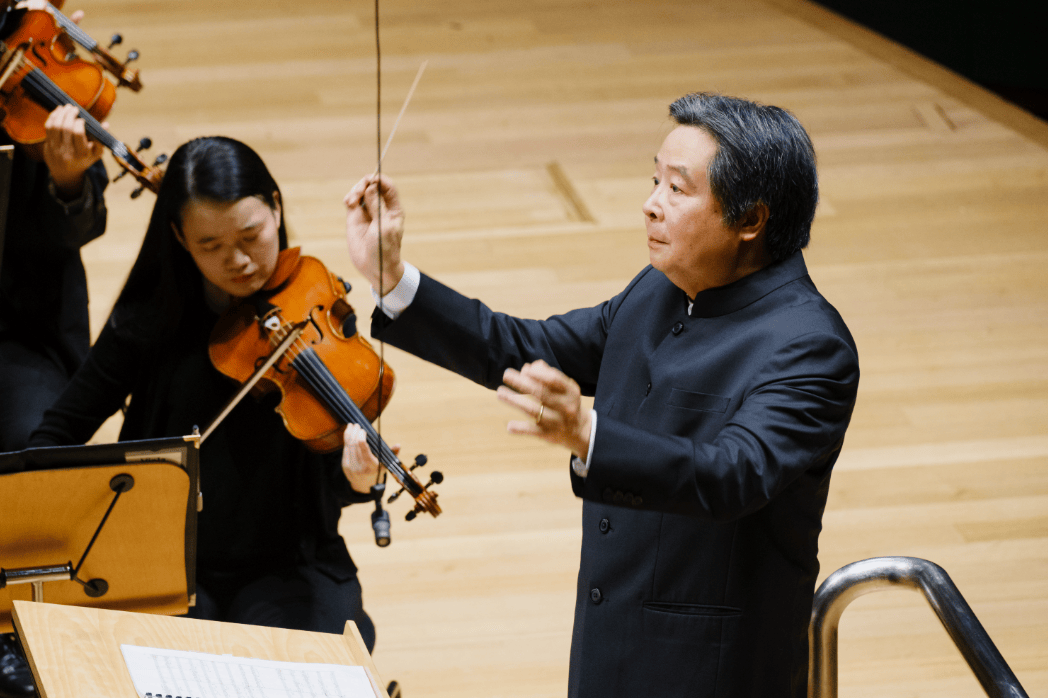
For Siegfried, that experience will be guided by Lü Shao-Chia, who returns to OMM for his third appearance after previously conducting Walton’s Belshazzar’s Feast and Mahler’s Sixth Symphony.

Chan, notably, is not conducting this instalment of the Ring. For a music director who has been closely associated with OMM’s development, handing the baton to another conductor for such a major project might appear unusual.
His answer is immediate: “With pride.”
There are three reasons, Chan explains, for bringing Lü back for Siegfried. The first is his standing as an Asian conductor who has made a significant mark in German opera. “Very few Asian conductors have made their mark in opera in Germany. He happens to be one of them.”
The second is more personal. “I have seen him do Siegfried before. And it was fantastic.”
But again, OMM did not simply bring Lü in and immediately entrust him with Wagner’s most demanding opera. “In typical OMM fashion, we didn’t bring him here straight away and do Siegfried. So this is his third appearance with us.”
His first appearance was with Bernstein’s Belshazzar’s Feast, drawing on his experience with choral repertoire. Mahler’s Sixth followed. The third reason, Chan says, is a broader statement about what OMM wants to represent. “There is a lot that Asia can be proud of. We wanted to bring all those elements together.”

That international outlook is reflected in the Siegfried cast, which includes singers such as Michael Volle as the Wanderer, alongside Dan Karlström, Joachim Goltz, Lukasz Konieczny, Anna Harvey, Stéphanie Müther and Vincent Wolfsteiner, with Singaporean singer Victoria Songwei Li among the cast.
The presence of internationally established Wagner singers also creates another kind of opportunity for OMM’s musicians. “It is not that unusual for OMM musicians to be challenged in this way,” Chan says. “In fact, they enjoy it.”
The orchestra’s musical development has never been about becoming specialists in a single repertoire. Chan has deliberately sought different sounds, colours and approaches from the orchestra. “As music director of OMM, I’ve always been interested in having OMM be able to play different sounds, different colours, different dynamics.”
Mahler and Wagner may share certain characteristics, but they demand different approaches. French repertoire provides another set of possibilities. So do the orchestra’s performances of film music. “We also bring in other conductors to look for a different sound.”
Chan compares the experience to a buffet. “If you go to a buffet, you really want to have a wide choice rather than just a few dishes.”

The metaphor is slightly complicated by the fact that audiences may still return to the same dishes, but the point remains: OMM’s versatility is part of its identity. That identity extends beyond the concert stage. OMM has long combined ambitious music-making with fundraising, youth development and community programmes. After almost two decades, Chan does not believe the fundamental mission has changed.
“We are still the music makers. We haven’t changed. However, we will contribute to society wherever there is a space for us to do so.”
The future, he believes, will reveal those spaces in ways that cannot necessarily be predicted now. “We are big believers that actually, it’s probably going to be something that either we have not done before or somebody else has not done before. Of course, if you look at it that way, the glass is half full. The possibilities are endless.”
That optimism is perhaps the most striking counterpoint to the constant financial caution that accompanies the Ring. OMM is prudent, Chan says, but prudence is not the same as timidity.
The orchestra does not attempt something simply because it would look impressive on paper. But once it has decided that a project is meaningful and achievable, it is not particularly interested in whether outsiders think the project is too ambitious.
“We don’t do anything that we don’t think we’re capable of. And when we decide to do something, we don’t care about whether other people think we’re capable of doing it or not,” he says. “Because we have internal guidelines whether we think it’s doable. So far, it’s always worked out.”

Siegfried also presents a different kind of dramatic energy from the two operas that preceded it. Its protagonist is younger, more impulsive and less burdened by the history that weighs so heavily on Die Walküre and Das Rheingold. But Chan resists making too much of a connection between Siegfried’s youth and the demographics of OMM. “The youth of a musician may not necessarily be an indicator of the ultimate artistic outcome.”
Instead, he sees the orchestra as a storyteller moving through the larger arc of Wagner’s cycle. “If you look at the Ring cycle as a complete journey, this is where the journey is right now. And so this part of the story requires OMM to be a particular way. And I think it is well within their palette of storytelling.”
For audiences, that means Siegfried need not arrive with a prescribed interpretation. One of the pleasures (and difficulties) of Wagner is that the same work can produce radically different responses from different listeners.
“One of the great things about classical music is that you can have four people sitting there listening to the same piece of music and the four people will have completely different takeaways from it.”

The same, he suggests, could happen with Siegfried, perhaps “at a slightly different level. Maybe potentially a more philosophical level.” “I think it would be dangerous for me or any one of us to prescribe,” he muses. “For the genuine audience experience, they need to go in there with their eyes open and not too much baggage.”
The production itself will help create that experience. Directed by Tan Shou Chen, the semi-staged presentation will attempt to transform the Concert Hall into Wagner’s mythological world while working within the limitations of a concert venue. “We’re trying to build a world as much as possible in the concert hall within the confines of the space to make it as immersive an experience as possible. And audience members should be looking forward to seeing the concert hall in a different way.”
The audience commitment is considerable. The performance begins at 4pm on a Saturday, with the opera stretching over several hours. There is no second performance that evening, partly because a Wagnerian cast cannot simply repeat the same roles a few hours later.
“If we did an 8PM show, it’s going to end a little bit early in the morning. Like maybe 2AM. Not sure if audience will like that. More importantly, “you can’t do any of the Ring operas with the same cast twice in the same day. Doesn’t really work.”

Some productions solve that problem with a double cast. OMM does not have one. “There are some good things about doing it this way too. We only have one shot.”
For the musicians, the commitment is similarly intense. For the audience, Chan acknowledges, spending a Saturday afternoon and evening with Wagner is an undertaking of its own. “For us, it’s probably both,” he says when asked whether the commitment is a sacrifice or a gift. “But encapsulated in passion, because if you’re not passionate in love, you wouldn’t make the sacrifice.”
Yet he also points out that, by Wagnerian standards, Singapore’s version is relatively forgiving. International Ring cycles can unfold across consecutive evenings, while OMM is giving audiences one opera at a time. “And so, taking that into consideration, ours is the light version.”
What might audiences take away from Siegfried after making that commitment? Chan is interested in the opera’s sense of renewal. “The emotional content of each of these Ring operas are actually different,” he says. “This particular one has quite a lot to do with renewal.”
It is a theme that he had not previously connected with the timing of the Singapore performance, but which now strikes him as an interesting coincidence. “Coming in just after the month of National Day, it’s quite interesting. I never thought of it that way. Swords that are broken can be put back together.”

That image perhaps offers a useful way into OMM’s own Ring journey. Each opera is a continuation of something that came before, but also an opportunity to rebuild, reassess and test what the orchestra can do next.
Which brings the conversation inevitably back to Götterdämmerung. Chan is not ready to commit. The orchestra is approaching its 20th anniversary in 2028, but even that milestone is currently secondary to the immediate task. “We can think about number four soon, but at least not for two weeks, is how I would put it.”
The joke aside, the caution is deliberate. “It is a monumental task to put something like this together. And I feel that that will forever be underestimated.”

For the musicians, the commitment required is unusually high even by OMM’s standards, given the length of the music, the technical demands and the sheer scale of the orchestra. And so the question of completing Wagner’s cycle remains subject to the same principle that has governed OMM from the beginning: whether the project is meaningful, and whether it is genuinely possible.
“That prudency that we discussed about earlier, which I think actually is the hallmark of OMM’s achievement,” he says. “We don’t do anything that we don’t think we’re capable of.”
For now, then, Siegfried is enough. After that comes the bill. Then, perhaps, another Wagner opera. Perhaps something else entirely. OMM does not yet know. But that uncertainty seems to be part of Chan’s point. An orchestra that has survived nearly two decades cannot simply live by repeating its past achievements. Its next chapter has to be discovered by doing the work.
If there is one thing Chan remains certain about, it is what OMM ultimately exists to do. “We are still the music makers.” And for audiences, his final message is even simpler: “Support opera in Singapore.”
Photo Credit: Orchestra of Music Makers
Wagner’s Siegfried plays on 5th September 2026, 4pm at the Esplanade Concert Hall. Tickets available from SISTIC
 Bakchormeeboy
My personal experience with rehearsal schedules shows that logistical constraints often delay ambitious projects like this. The complexity of coordinating such a large ensemble presents unique challenges for the group.
LikeLike