
Singapore’s Xander Pang leads an ambitious reimagining of the manga phenomenon that dazzles in moments but struggles to match the psychological intensity of its source material.
LONDON, UNITED KINGDOM – There is something inherently audacious about bringing Death Note, one of Japan’s most recognisable manga properties, to the London stage as an English-language musical. Even more so when the musical itself has travelled such an unusual international route: created by an American creative team, first developed for Japanese audiences, subsequently staged across Asia, and now returning to an English-speaking audience in a substantially reimagined production.
At the Barbican Theatre, Death Note: The Musical arrives with a distinct visual vocabulary, a committed international cast and the considerable weight of a beloved franchise behind it. It is recognisably Death Note, but this is not a museum-piece translation from page or screen to stage. The production takes considerable liberties, condenses its source material and reshapes the emphasis of the story for the stage. The resulting show is accessible to newcomers and likely to intrigue fans, although those most intimately familiar with the manga and anime may find some of those choices divisive.
There is also something to applaud in the production’s willingness to put fresh and emerging talent at the centre of such a high-profile international property. For performers still establishing themselves, Death Note is hardly a gentle introduction: its characters are heightened, its score demanding, and its source material comes with an enormous existing fanbase. Not every performer can be expected to master every demand of such material immediately, but giving newer voices the opportunity to tackle roles of this scale is part of what makes this London production exciting.
For Singaporean actor Xander Pang, meanwhile, the production represents a particularly significant opportunity. As Light Yagami, Pang occupies the centre of a show whose entire moral universe depends on the audience believing in the transformation of an exceptionally gifted young man into Kira, the self-appointed god of a new world. It is a demanding role, requiring Pang to carry not only the musical’s dramatic weight but one of the franchise’s most recognisable characters onto a London stage.
The story will be familiar to many. Light, a brilliant high-school student disillusioned by the crimes and injustices around him, discovers a supernatural notebook belonging to the Shinigami (death god) Ryuk. Anyone whose name is written in the Death Note will die, and Light begins using it to execute criminals, believing he can create a world free of wrongdoing. Soon adopting the name Kira (a romanization of ‘killer’), he attracts the attention of the eccentric master detective L, setting up a deadly psychological game between two young men whose obsession with one another becomes increasingly difficult to separate from their pursuit of justice.
The musical’s central conceit remains a fascinating one: what happens when an ordinary human being is handed the power to decide who lives and dies? Yet the production sometimes seems more interested in moving through the story than allowing the audience to fully sit with the philosophical question.
That becomes most apparent in the relationship between Light and L. Pang has the youthful physicality required of Light, and the visual transition from schoolboy to Kira is effectively supported by the costume design. There are glimpses of the character’s arrogance and growing certainty, particularly as the production moves toward its final stages. The role is also an unusually exacting one: Light has to register as both an ordinary young man and an extraordinary intellect, while making the moral slide into Kira feel increasingly inevitable.
Pang is strongest when that darker confidence begins to emerge, although the transformation could arrive with greater force earlier in the production. He can also find himself vocally overpowered in some of the larger musical passages, with the orchestra occasionally swallowing his delivery. This matters because Light needs to command the stage long before he commands the Death Note. The character’s intelligence, charisma and capacity for manipulation are the engine of the story, and when those qualities are underplayed, the battle with L inevitably loses some of its voltage.
Still, there is value in seeing a young Singaporean performer take on a role of this magnitude in London. Pang is not simply stepping into an existing template; he is helping shape an English-language interpretation of a character already deeply embedded in global pop culture. That is a sizeable challenge, and one that gives this production an added sense of possibility.
Colin Ryan, by contrast, makes a vivid impression as L. His interpretation captures the detective’s strange physicality and eccentricity without reducing him entirely to caricature. Crouched on chairs, perched in unusual positions and seemingly processing several layers of thought at once, Ryan gives L an unsettling comic energy. His introduction is particularly effective, combining his performance with glitch-like choreography and an ensemble that seems to move according to the rhythms of his mind.
But the crucial problem is that Light and L do not always feel like intellectual equals. Their cat-and-mouse relationship should be the beating heart of Death Note. Instead, their confrontations can feel strangely effortful, with the famous tennis sequence in particular landing awkwardly between psychological duel and comedy. The staging is busy, but the dramatic stakes never quite catch fire. There is little of the delicious mutual fascination, the sense that each has finally encountered the one person capable of truly challenging them, that makes their relationship so compelling in the original story.

Fortunately, whenever Telly Leung’s Ryuk appears, the stage heats up. Leung is a joy to watch, and his Ryuk is arguably the production’s most complete performance. He finds the Shinigami’s mischievous curiosity without simply reproducing the anime’s performance, instead creating a Ryuk who feels fully alive on stage: playful, unpredictable, slyly menacing and constantly aware of his audience.
His comic timing is impeccable. His singing is assured throughout. Even in quieter moments, Leung seems to be operating on a slightly different frequency from the humans around him, giving Ryuk an effortless sense of amusement at the chaos unfolding below. His first appearance in Light’s bedroom produces one of the evening’s clearest collective reactions, a genuine gasp from the audience, and Leung maintains that connection throughout.
Most importantly, this never feels like a cheap imitation of an animated icon. Leung gives Ryuk his own physical and vocal identity, retaining the character’s essential mischief while finding the theatrical possibilities of the role. His entrances and exits are beautifully timed, and the audience energy visibly shifts whenever he takes the stage.
The only thing missing is scale and god-like majesty. Ryuk is an enormous supernatural presence in the Death Note universe, and the production’s physical staging occasionally makes him feel too much like another human performer sharing the stage. The set’s impressive levels and mechanical architecture could have been exploited more aggressively to separate the Shinigami from the mortals below. When Leung is elevated, or physically removed from the same plane as the humans, the character suddenly becomes much more otherworldly.
Grace Mouat’s Shinigami Rem is another highlight. Her later solo is among the evening’s most emotionally convincing musical moments, giving the Shinigami dimension beyond simply being supernatural accessories to Light’s story. Mouat brings a tenderness and sincerity that helps broaden the show’s emotional palette, while the Shinigami sequences more generally demonstrate one of the musical’s cleverest ideas: these gods of death can be every bit as curious, petty, emotional and impulsive as the humans whose lives they observe.
This is also one of the places where the musical format feels particularly appropriate to its source. Manga and anime can spend considerable time inside a character’s thoughts; a stage musical has another tool available. Characters can stop the narrative and sing what cannot easily be spoken. Frank Wildhorn’s score, with lyrics by Jack Murphy and additional lyrics by Morgan Reilly, finds some of its strongest moments in these internal and supernatural passages. The Kira number has real energy, while the Shinigami material provides some of the production’s most memorable musical and emotional peaks.
Not every number lands with the same force. At times, the score becomes repetitive, and some songs feel more functional than transformative, tending to move the plot along rather than deepening character or atmosphere. There are also moments in which the balance between orchestra and vocals makes certain performances harder to hear than they should be. But when the writing, performance and staging align, the musical demonstrates why Death Note is such fertile material for the stage.
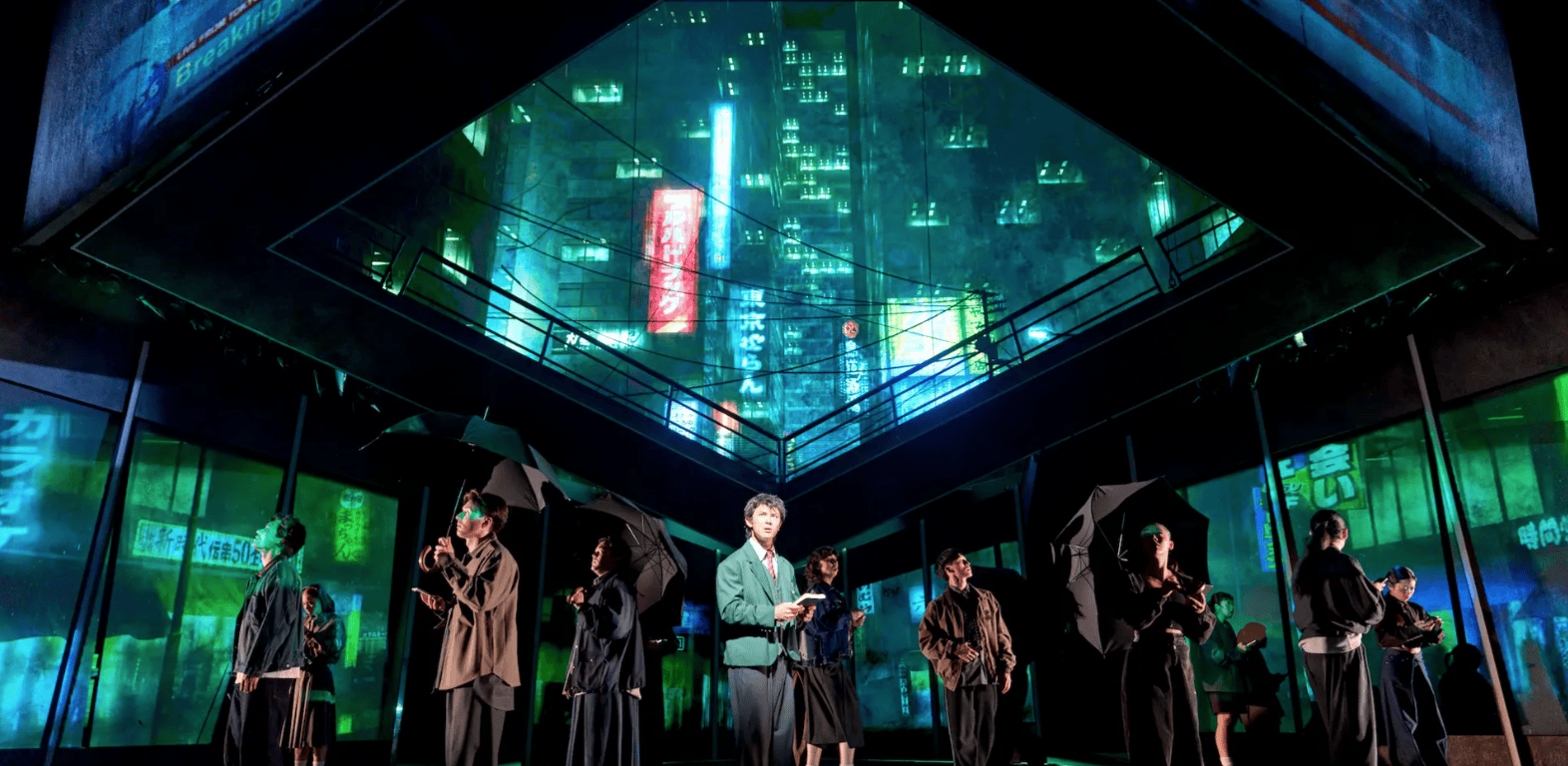
The production’s design is considerably more confident. Jon Bausor’s set immediately establishes a futuristic, angular world: concrete-like structures frame a large video wall, while a retractable catwalk creates the possibility of multiple levels and perspectives. The turntable and moving side units give the production considerable mechanical flexibility, and Akhila Krishnan’s video work complements rather than overwhelms the physical design, at times plunging us into a noir urban cityscape with towering buildings, or the ethereal Shinigami realm.
There is a tantalising sense of what the production can achieve when all these elements align. The final rooftop sequence, with the catwalk lowered, rain and moody Gotham City-esque lighting, is perhaps the clearest example. For a moment, the machinery disappears into the world of the story and the stage becomes somewhere genuinely cinematic. The illusion is less successful when characters step directly from that elevated world onto the bare stage, reminding us of the mechanics underneath.
The same unevenness affects the pacing. The first half holds attention more securely, with the introduction of the Death Note and Ryuk providing an immediate theatrical hook. But the second half becomes noticeably softer and slower. Misa’s storyline occasionally feels overextended, while the central Light-L conflict, which should be gathering momentum, can instead feel increasingly compressed.
That compression is one of the unavoidable challenges of adapting such a dense Japanese property for the musical stage. There is a certain boldness in taking a work that has already passed through manga, anime, live-action film, television, novels and games, and asking an English-language audience to experience it through song. It is equally bold to alter the emphasis of a story that fans have spent years dissecting. The production does not attempt to reproduce every element of the original, and that is arguably necessary. A musical cannot simply become a three-hour illustrated manga.
But adaptation also creates an obligation to understand what cannot be lost. For Death Note, that is the psychological duel. It is the intoxicating question of whether Light and L are hunting one another because justice demands it, or because, having finally found an equal, neither knows how to stop. The musical gets close to that idea without consistently making it pulse.

Still, there is much to admire. Stephen Whitson’s direction gives the production a clear contemporary identity; Fabian Aloise’s choreography finds inventive movement within the machinery; the costumes by Sachiko Nakahara distinguish the characters effectively, particularly the transformation of Light into Kira; and the lighting, video and sound teams have built an ambitious theatrical world. Even where the material itself places heavy demands on the performers, the cast approaches it with evident commitment.
That willingness to give a new generation of performers the chance to stand alongside seasoned international names is one of the production’s most appealing qualities. It is not every night that emerging actors get to wrestle with a property of Death Note‘s scale, nor that audiences get to see those performers develop their interpretations of characters already familiar to millions. The result may not be perfectly even, but there is something refreshing about a production willing to take that risk.
For Xander Pang, a Singaporean performer standing at the centre of one of Japan’s most internationally recognisable stories, on a London stage, this is a significant coming-of-age moment. Light is a role that demands more than simply looking the part. It asks for stillness and charisma, intelligence and vulnerability, and ultimately the ability to make an audience understand how easily righteousness can mutate into entitlement. Pang has the foundations of that journey, and there are moments when Kira emerges convincingly. With more time and material that allows the transformation to breathe, there is considerable room for him to grow into its full complexity.
By the time the final confrontation arrives, the show has spent so long building toward its inevitable conclusion that the deaths of L and Kira themselves land with less theatrical aftershock than one might expect. Yet even here, the production’s ambition remains apparent: it is attempting to give a vast, intricate Japanese story a new theatrical language for a contemporary London audience.
Death Note: The Musical may not capture every psychological nuance of its source, but it is an energetic and visually ambitious attempt to carry a beloved Japanese property into a new cultural and theatrical context. With Leung’s magnetic Ryuk, Mouat’s affecting Rem, Ryan’s eccentric L and Pang taking on the formidable role of Light, there is plenty to celebrate in a production that is unafraid to put new performers in the deep end.
When Leung’s Ryuk appears, when Mouat’s Rem sings, when the mechanical architecture finally transforms into a supernatural world, the show reminds us exactly how exciting this strange journey from Japanese manga to English-language musical can be. It is an imperfect adaptation, but an ambitious one, and sometimes ambition, discovery and the thrill of seeing a new generation take on formidable material are themselves worth applauding.
Photo Credit: Manuel Harlan
Death Note: The Musical runs at the Barbican Centre in London from 30th July to 12th September 2026 for a strictly limited season. More information and information available here

