
Pangdemonium’s 2026 finale season began with Force Majeure in March, followed by A Mirror in June. The company’s founders, Tracie and Adrian Pang, had previously announced in February that they would step away from Pangdemonium at the end of 2026, describing the decision as a deeply personal one and saying they wanted to bring the company’s story to an end on their own terms, on a graceful note, and while still in love.
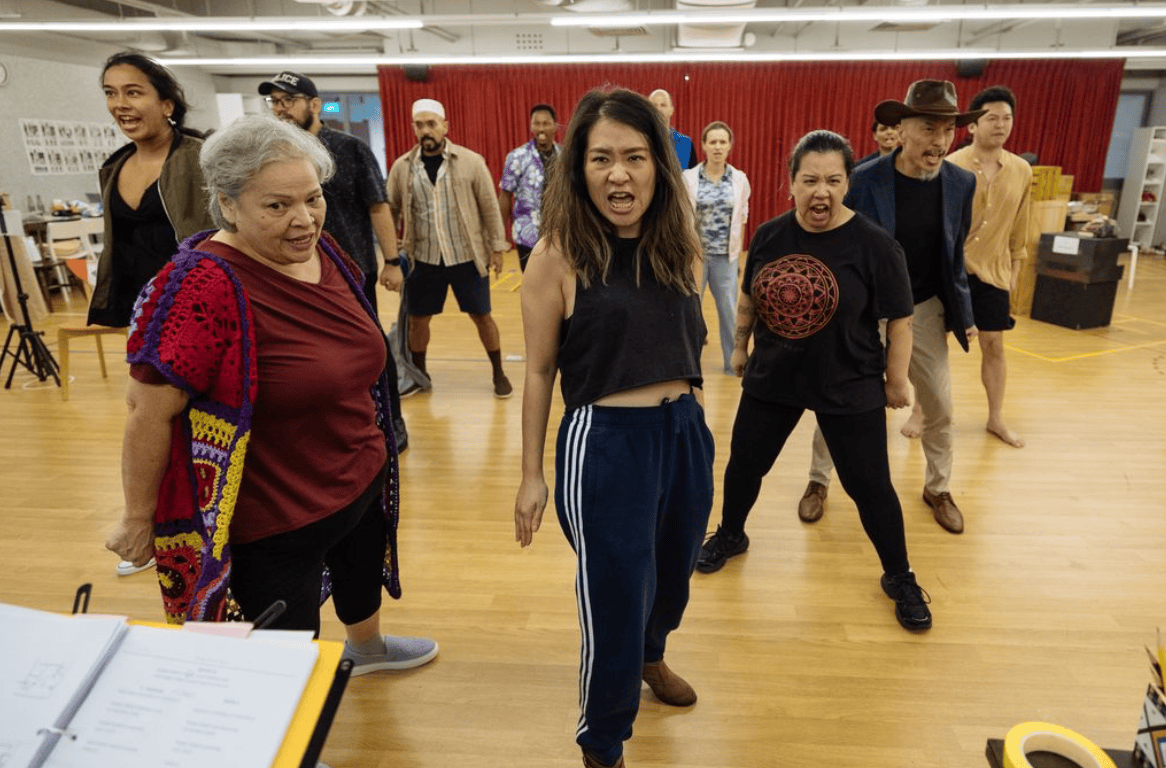
Now, as September dawns, it feels more real than ever that Pangdemonium is about to end their 16 years in the local theatre scene as they fast approach their final show – the musical Come From Away, which runs from 11 to 27 September at Victoria Theatre.
When Tracie Pang looks at Come From Away, she does not see a carefully engineered farewell. “We put our season together two years in advance,” she says. “So it wasn’t a piece that was chosen with the view that this was going to be the final show for the company. The decision that we made actually only happened in January.”
Instead, the decision to close forced the company to look at the productions it already had in its pipeline and decide which ones would become part of its final season. “It really became more about that rather than, if I was planning the final show, what would it be?” Pang says.

There were other possibilities. Perhaps, she says, Pangdemonium could have ended with a revival of one of their other beloved productions, a final return to something audiences already associated with the company. “There have been times when we’ve talked about, if we had a final year, would we look at it as like, do we bring back our most loved pieces? And that might have been the choice,” she says. “And there were a couple of pieces that we were like, ‘Yeah, I would love to revisit this again. I’d love to revisit that again.’ And then we would have ended like that.”
But that was not how the cards fell. Force Majeure had already consumed years of work, and Pang did not want to let it go. A Mirror was a piece she had felt deeply connected to from the moment she encountered the script. And for the final slot, they wanted something that could reach beyond the people who might normally seek out a Pangdemonium play. “The final show, the end of the show, we knew it needed to be a musical,” Pang says. “We needed it to be something that the community will love, something that has a more open appeal, I suppose.”
Come From Away was a poetic choice then. The musical tells the true story of what happened in the small Canadian town of Gander after the 9/11 attacks in 2001 closed US airspace and forced 38 international planes to land there. Nearly 7,000 passengers, along with 19 animals in cargo, suddenly found themselves stranded thousands of kilometres from home. The people of Gander opened their doors, fed them, clothed them, comforted them and, for a few extraordinary days, turned strangers into neighbours. Pangdemonium describes the show as a celebration of “love, life, and the very best of humanity”, and among its many accolades, counts the Olivier Award for Best Musical and received seven Tony Award nominations. “It really just fit the bill,” Tracie says.
The fit is almost uncanny. Come From Away is a show about people who discover that a community is not simply a place you live in. It is something you choose to participate in. Theatre, Pang argues, works in much the same way. “I think the piece is essentially about community coming together,” she says. “And I think we have worked very hand in hand with the community of people who love theatre.”
“And theatre itself is a community. Every time we put on a show, the cast, the crew, everybody who works on it becomes a family. It almost kind of represents what it’s like to be in a show,” she adds. “We come together, we support each other, we help each other to put on something to be the best that we can be for those performances that we have.”

That idea seems to have taken hold inside the rehearsal room. For Lim Yu-Beng, who plays Mayor Claude Elliott, returning to the stage after a long absence has been one of the great pleasures of making Come From Away. He has known Pang for decades and was “overjoyed” when she offered him roles in the final two productions. But the joy, he says, has less to do with the glamour of returning to the stage than with the tiny acts of collective care that happen in rehearsal. “I miss the stage. I miss the rigour. I miss the challenge. I miss the community,” he says.
He talks about making mistakes and having another actor quietly correct him. He talks about singing beside his castmates and looking at them in panic when he encounters a note he cannot quite find, only to have someone sing it into his ear. These are things that an audience will probably never see. For Yu-Beng, they are also the point. “We understand that community is real,” he says. “That lifeblood, that energy, that frisson is real.”
He is not worried that technology will make that kind of human interaction obsolete. “It’s not something you can AI the shit out of,” he says. “I’m not afraid of AI in the least. Because they will never touch this. They will never be able to replicate.”

And if Come From Away has given him a reason to return to theatre, the story itself has given him another reason to believe in it. “I love Come From Away because I think it speaks volumes,” he says. “I had never heard of it before Tracie told me about it. And now I’m like, ‘Oh my gosh!’”
What moved him was the musical’s insistence that people are capable of choosing something better, even when the world around them appears to be doing the opposite. “It is such a messed-up world,” he says. “And the very people that preach about certain things ignore the central teachings of it. Who’s your neighbour? Who’s your neighbour? Who are you going to help? You really think that anybody who’s not like you deserves to die? Is not human? Yeah, there’s something wrong there.”
His conclusion is simple. “ I think this speaks exactly to that. At exactly the moment where those forces were pitted against each other so violently as they are today. We can all be better. And I think this show shows that we can be better.”

That optimism is everywhere in the cast, even when they are talking about tragedy. Filipino actress Sheila Francisco, who plays Beulah, understands the generosity of the people of Gander less as an act of heroism than as a choice. “Kindness is a choice,” she says.
Francisco remembers a flood in Manila when people were unable to get home and began making their way towards the higher ground where she lived. She and her sister immediately started thinking about how they could help. “These people are in trouble. Let’s make something. Let’s feed them. They probably haven’t eaten.”
She later spoke with Diane Davis, one of the real women who inspired Beulah, and heard a similar account of what happened in Gander. The moment the townspeople understood that the stranded passengers were in trouble, Davis told her, nobody stopped to ask why they should help strangers. It was simply: what can we do? Francisco says that instinct is something she recognises in herself and in others. “The good comes out of us when someone or a group of people are in trouble,” she says. “And if that doesn’t move you to do something for them, you know, maybe you’re wired differently. But for most people, I think, it comes out. The good in you, the desire to help, no matter how small, how insignificant it may be.”
That is the quality she wants to bring to Beulah. Not saintliness, but truth. “You’ve got to dig deep down, whatever instance that is, to show the real thing,” she says. “You’ll spot it. So you’ve got to dig in what’s real and true to you.”
In the show, Beulah cannot fix Hannah’s biggest problem. Hannah’s son, a firefighter, is missing. Beulah cannot find him. “But you know what?” Francisco says. “She can put a smile on Hannah’s face. She can make her laugh.”
It is an almost absurdly small gesture in the context of a catastrophe. It is also precisely the kind of gesture that Come From Away keeps returning to. “I may not be able to solve your problem, but you know what? You and I can have coffee, and we can talk about it,” Francisco says. “Or maybe not talk about it. Just listen, and these small acts of kindness can change everything.”

For Rebekah Sangeetha Dorai, playing pioneering pilot Beverley Bass alongside Annette, the production has become unexpectedly personal too. “Me and the Sky”, Beverley’s main song and account of breaking through the barriers of a male-dominated aviation industry, is one of the show’s defining numbers, and Dorai admits she still cannot get through it without getting emotional. “I have listened to that song hundreds of times. I’ve never been able to get to the song without crying. I just can’t,” she says.
But her connection to Beverley has less to do with the character’s achievements than with what those achievements have made Dorai reconsider about her own life. When she turned 35, she remembers feeling that she had not accomplished enough. “35 is one of the defining ages of Singaporeans, right? You buy an HDB apartment, like BTO,” she says. “I remember I felt a little bit down, I think, because I felt like I was 35 but I had nothing to show for it. I didn’t have an HDB, I didn’t have a BTO.”
But building Beverley’s story made her reconsider the way she had been measuring herself. “I looked back and I realised actually life is more than, it’s about charting your own path.”
Over the past five years, Dorai has undergone two major surgeries and lost people close to her. But she has also built relationships and gained experiences that, she says, matter just as much. “It’s not just about collecting experiences or work or being able to say I have a house,” she says. “It’s about who are the people in my life who showed up? How have I grown as a person? And that informs who I am as an actor.”

Perhaps appropriately, Beverley also gives Dorai the opportunity to combine two of her greatest loves: aviation and singing. She is the sort of person who will stop to look at a plane, study its livery and follow its flight path. “When Beverly says, ‘On final approach, we’re coming in, final approach,’ there’s also so many terms within final approach, not just final approach,” she says. “There’s so many different terms before a plane even touches down.”
She is delighted by the technical detail, but the deeper connection is with Beverley as a woman who spent her life blazing a trail. “Who are the women, amazing women, in my life who have done that for me?” she asks. The answer, she says, is all around her.
There are women in the cast, in the rehearsal room and across Pangdemonium’s history. And there are even the performers in Singapore Repertory Theatre’s Legally Blonde, which ran alongside Come From Away‘s rehearsals. During that overlap, Dorai went to watch Legally Blonde. She waited at the stage door afterwards, expecting to see the cast emerge. Instead, performers came straight towards her. “You are here. Are you okay? Are you well? I can’t wait to see you perform,” they told her.
Hearing those words, Dorai began to cry. “I was so overwhelmed by the love of these people who just performed a three-hour difficult musical,” she says. “And they came off stage and I’m like, ‘We can’t wait to see you. I’m so happy you’re healthy and well. You’re back in action.’ I felt so touched.”
She laughs at the memory. “I’m here to show you love. And that’s community, right? That’s community.”

That feeling of being held by the people around you is particularly meaningful to Nadya Zaheer, new to Pangdemonium, who plays Janice, a young reporter thrown into an extraordinary situation. Janice starts the story unsure of herself. She is new to Gander and new to reporting, and suddenly finds herself trying to make sense of a situation far beyond anything she could have anticipated. Zaheer has chosen to play her as bright-eyed, passionate and eager, while allowing little cracks of insecurity to show through.
But Janice’s journey has made Zaheer think about her own evolution as an actor. When she first entered the industry five or six years ago, she says, she was constantly thinking about whether she was doing a good job. “I kept telling myself ‘I need to be so good’,” she remembers thinking. “I need to make sure I listen, I need to do this. Like, I need to prove myself on making good choices and this.”
Now, she says, something has shifted. “I feel now I am rooted in confidence in a rehearsal room,” she says. “And I feel like I am now more present and more alive.”

That feeling of knowing you have done the work and can finally stop worrying about whether you are good enough has become one of the things she sees in Janice. “You don’t have to be in your head and think, am I doing… All these things are actually not serving you in this moment,” she says. “And yeah, I was thinking about that and I was thinking that that’s a really nice feeling.”
It is also why the kindness within the Come From Away company has meant so much to her. During the weeks when she was performing in two shows, she says, she could not have managed without people repeatedly checking in, asking her “Hey, you okay? Have you had lunch?” And then there were the more practical offers: “Do you need silence? Do you need a massage? Do you need a hug? Do you need food? Do you need sugar? What do you need?”
“It was so giving,” she says. “It was also not the expectation that I’m going to give you what I think you need. But it was asking.” That ends up becoming one of the most revealing things about this production. The cast is not simply performing a story about community. They seem to have found themselves reproducing its values in the room.

And for Timothy Koh, who directs Come From Away, that communal spirit is also what makes the musical such a thrilling challenge. Koh has worked behind the scenes on numerous Pangdemonium productions, as both assistant director and director, but this is his first large-scale musical as director. Pangdemonium’s official production credits list him as director, leading a 12-member ensemble cast.
He describes the show as fundamentally different from the more conventional musical-theatre structures audiences may expect. “It is an ensemble show with lots of short, bitty scenes and short, bitty sequences,” he says.
His task is to create a stage picture that gives the actors something to play with, then allow them to reshape it. “The best ideas are the ideas that I maybe started,” he says. “I give it a certain shape. And then maybe someone’s like, ‘Oh, what if we added this to this? Or what if in this moment I turn this way or I look this way?’ Suddenly, we’re all playing and building on each other’s ideas. And I think that, to me, is the greatest joy of directing.”
That word, joy, keeps resurfacing when the company talks about this final production. Koh knows the ending carries weight. Both Francisco and Yu-Beng were in The Full Monty, Pangdemonium’s first production 16 years ago. There is history in the room. “There’s a strong emotional undercurrent, I think, to each day and to each rehearsal,” he says.

But he does not describe the experience as paralysing. Instead, he talks about being grateful. “The last five years have been a real, real true joy,” he says.
For someone less than a decade out of university, being entrusted with Pangdemonium’s final musical is a remarkable opportunity. He graduated only months before COVID-19 upended the performing arts industry. “I think that this is the best kind of first step forward in my career that I could have been afforded,” he says. “So for Pangdemonium, I think that I’m incredibly lucky, incredibly grateful.”
And he is already looking forward. Koh says he expects to direct several projects next year. And while he cannot reveal the titles or companies yet, what he can reveal promises to be exciting. For now, though, he is enjoying the particular pleasure of working with an ensemble that is building the show together. “We are all determined to tell this story of kindness and compassion and community,” he says. “And it is a very fun room to be a part of. Everyone is always laughing.”
That is perhaps the surprising emotional centre of Pangdemonium’s final production. There is sadness, certainly. There is history. There is the knowledge that the people in the room will eventually have to walk away from something they have built together. But the people making Come From Away do not sound as though they are spending their final weeks mourning Pangdemonium.
They sound like they are having a really good time.

Even Tracie Pang, who has spent much of the year learning how to contain the emotions surrounding the company’s closure, refuses to frame the ending primarily as a tragedy. “I don’t think the reality has changed,” she says. “Pangdemonium closing, it was such a big step that it has been a weight that we carry.”
But there was one unusual difference between closing a theatre company and leaving an ordinary job. “Unlike, for example, if you were to hand in notice at your job, you might give a month’s notice, or you might get at most two months’ notice, right?” she says. “We were given a year.”
That has meant pacing herself emotionally. “I cannot be emotional for a whole year. I would be a quivering wreck,” she says.

So she has built a protective barrier. Every now and then, something breaks through it: a rehearsal, a memory, a person, a tiny moment that suddenly reminds her what Pangdemonium has meant. And now, as the final production gets closer, those barriers are becoming harder to maintain. “It’s been a part of my life for such a long time,” she says. “Sixteen years, it’s watching a child grow up, you know? And at some point, that child flies away from the nest.”
That metaphor captures what seems to be happening around Come From Away. Pangdemonium is not being killed off by some external catastrophe. Its founders have decided that it is time to let it go while they are still proud of it, still passionate about it, and still able to leave on their own terms. Pang says the next few months will probably be difficult. “But I’m not sad,” she says. “If I was sad, then I’d have made a wrong decision.”
What she wants instead is for audiences to see the accumulation of 16 years. “Gosh, I hope they see a body of work, and not just one thing,” she says. “I hope they’ve been touched by the work, all the work we’ve done.”

She hopes Pangdemonium leaves Singapore’s theatre scene stronger than it found it. She hopes the company has introduced new artists into the world. And when she looks at Timothy Koh directing its final musical, she sees evidence that it has. “I hope that we have left behind an industry in a stronger place than when we entered it,” she says. “I hope we have introduced new, exciting artists into the world, one of which I’m extremely proud of. I’m so proud that Timothy’s doing our final show.”
That may be the most satisfying way for Pangdemonium to end, choosing not to look back on past glories with a retrospective of its greatest hits, but with a room full of people who are still making something new. Come From Away is a show about a community that responds to disaster by asking what it can do for the people who suddenly need it. Pangdemonium’s final production seems to have become an echo of that idea, a group of artists, many of whom have spent years working together, supporting one another through one last creative challenge.
And then there is the ending of the musical itself. Pang has spoken previously about what she loves most about Come From Away: its final moments turn into a celebration, with the band playing and the entire room becoming a party. That is an unexpectedly perfect image for Pangdemonium’s farewell. Not a funeral; a party. Not a company collapsing under the weight of its own ending, but a company finishing the work, looking around at the people beside it, and recognising what it has built.

Pang does not expect herself to be sad when the curtain finally falls. “I think we’re all going to be very proud,” she says. “I don’t think we are sad. I think we are just very proud.”
After 16 years, perhaps that is the emotion Pangdemonium wants to leave behind. No grief. No nostalgia. Just the enormous, slightly exhausted, deeply human satisfaction of having made something together, and having had the good sense to know when it was time to let it fly.
Photo Credit: CRISPI
Come From Away plays from 11th to 27th September 2026 at Victoria Theatre. Tickets and more information available here

