
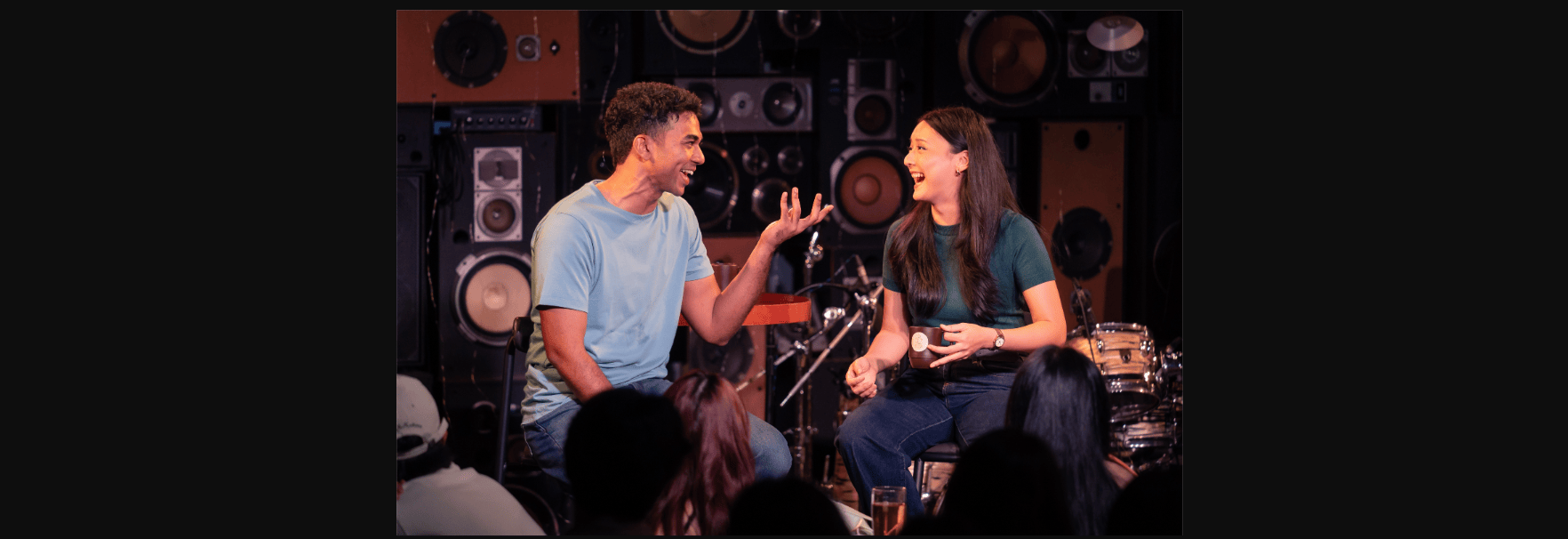

Rishi Vadrevu and Juliana Kassim Chan deliver warm, sincere performances in Gateway Arts’ tender, devastating site-specific production, drawing attention to masculinity and mental health.
Duration: 75 minutes
There is something fitting about setting a play called The Parting Glass in a pub. Originally written by Chris O’Connor, the play takes its title from a traditional Irish and Scottish farewell song about having one last drink among friends before someone leaves, with all the warmth, regret and affection that comes with saying goodbye. Naturally, the song plays at the end of Gateway Arts’ new local, site-specific production, and by the time it reaches its final moments, it carries considerably more weight: what began as an evening spent getting to know and celebrate a milestone birthday becomes an unexpectedly intimate farewell.
Directed by Samantha Scott-Blackhall and staged at The Blackbird pub at Gillman Barracks, The Parting Glass has been adapted for a Singaporean audience by Krish Natarajan. Over its 75-minute running time, we find ourselves among the invitees to Jim’s 30th birthday, where he is celebrating at his favourite bar with the people who know him best.
Jim (Rishi Vadrevu) is the life of the party: the joker, the storyteller, the person who always seems to know what to say. That is, except when he first meets Sarah (Juliana Kassim Chan). Suddenly, the words disappear. His attempt to make a good impression leaves him flustered and clumsy, but Sarah finds it endearing. What begins as an awkward first encounter soon develops into something that looks very much like love.

But beneath the birthday celebrations and easy laughter, something is not quite right. Jim has always felt as though there is a cloud hanging over him, something he cannot quite clear or explain. Tonight, surrounded by friends and at the place where he feels most at home, he decides to tell us his story.
Krish Natarajan’s sincere Singaporean adaptation is one of the production’s biggest strengths. Rather than simply transplanting a British play to Singapore and sprinkling it with local references, he has given Jim a distinctly local texture. He is a Tamil Indian Singaporean who grew up relatively ordinarily, supports, of all teams, Leeds United, and works at a friend’s Burmese stall at Ghim Moh Market. There are references to local places and familiar Singaporean habits, but more importantly, Jim feels like a person who could actually exist here.
He is also an everyman, and a very recognisable kind of guy’s guy: someone who likes football, drinks with his mates, tells terrible jokes and seems perpetually ready with a smile. That is helped enormously by Rishi, who is simply an incredibly charming actor. He makes even the dad jokes land, filling the room with an easy warmth while possessing the vocal control and physical presence to command the entire pub.

It is important that we like Jim. He is funny, dependable and seemingly content with his uncomplicated life. He talks about his father’s funeral with a mixture of affection and dark humour, jokes about his father’s alcoholism and Irish heritage, treats his high-risk bets like a matter of life and death while referencing old anti-gambling ads, and recalls how there was so much food at the funeral that you could tapau it for the next funeral. He is the kind of person who appears to have figured out what makes him happy without needing much more.
In a Singapore where we are perpetually worrying about career progression, productivity and getting ahead, there is something almost radical about Jim’s contentment with a modest existence. He rejects the 9-to-5 rat race; he likes cooking, his friends and his simple routines. For a while, it seems like he has everything he needs. The trouble is that the cracks have been there all along.
One of the most affecting aspects of The Parting Glass is how much of Jim’s distress is revealed retrospectively. Early details that seem like harmless characterisation begin to take on another meaning once we understand what is happening. His recollections of his mother are particularly telling: despite clearly recognising that his father’s death has affected her, she repeatedly avoids talking about herself, redirecting questions towards the housework she needs to do or expressing concern for Jim instead.

It is essentially a foreshadowing of Jim himself. As much as he says he is his father’s son, he has inherited not just some of his father’s traits but his mother’s instinct to deflect as well. When his own darker cloud arrives, he does much the same thing. He jokes, changes the subject, tells people he is fine and, eventually, downs several pints in a single night.
That is where Rishi’s charm becomes more than simply a performance asset. It becomes part of Jim’s camouflage. The same qualities that initially make him so likeable also make it easier for everyone around him to believe that he is okay. He is funny, dependable and always ready to show up for everyone else. Why would anyone think to ask whether he needs someone to show up for him?
The pub setting makes this gradual revelation especially effective. It is an obvious choice for a play whose world revolves around friendships, drinking and the routines built around a local watering hole. It is not necessarily the ideal theatrical venue, a black box would offer greater control, and the space still retains much of its identity as a bar and live music venue, but the production makes a convincing case for being there.

The audience effectively becomes a collection of invitees to Jim’s birthday. We are close enough to him to feel like part of the occasion, and yet, in an interesting bit of theatrical complicity, we initially behave much like the people in Jim’s life. We accept the jokes. We enjoy the stories. We assume he is fine. We are, in effect, another group of people who might have noticed the signs but did not necessarily know what to do with them.
Rishi moves through the space with the ease of someone who belongs there. The seating arrangement gives him clear paths through the room, allowing him to enter from different points, move between audiences and even head to the bar to pick up a pint of lager. Samantha Scott-Blackhall leans into the informality of the space, occasionally having Jim address audience members directly, while the existing stage infrastructure is augmented with theatre lighting, small set pieces and platforms.
The production also finds a simple but effective visual language for Jim’s state of mind. The recurring image of clouds becomes particularly striking: there is the clear sky Jim looks out at, set against the darker “cloud” he repeatedly describes in his own mind, while white clouds literally appear physically around one of the pillars in the space. It is a simple image, but one that gains significance as Jim’s mental state deteriorates. The world around him can look perfectly clear while, internally, he is struggling to see through his own cloud.
There is something genuinely homey about it. The production makes it easy to imagine the countless hours Jim might have spent here with his friends. Gateway Arts seems to have found a good partner in The Blackbird, even down to the co-branded “The Parting Glass” cocktail served during the run.

Later, Sarah enters Jim’s life as the girl of his dreams, and Juliana Kassim Chan brings a different but equally important energy to the production. Sarah is intelligent, sweet and observant, trying to do her best for her partner even as she struggles to understand what is happening. Juliana is particularly strong in her delivery and characterisation, and when addressing the audience directly, she handles Sarah’s uncertainty without allowing it to diminish her presence. Sarah is not as naturally effervescent as Jim, but that is precisely the point. She has her own anxieties and complications, and Juliana gives her enough layers to make her more than simply “the girlfriend who notices something is wrong”.
The structure of the play reinforces this. Rishi and Juliana largely take turns being onstage, with their interactions often existing as recollections rather than conventional scenes between two actors. We see the same relationship from different perspectives, and that becomes particularly charming during their meet-cute, when Jim remembers himself as suave and confident while Sarah remembers a nervous wreck desperately trying to juggle a chilli sauce bottle.
It is a well-paced sequence, funny precisely because both memories feel equally plausible. Their chemistry is not necessarily effortless, but that almost makes the relationship more convincing. It feels built over time, and the two actors have clearly developed a shared history through the course of the production. We watch their relationship progress from an awkward first meeting to intimacy, affection and eventually its dissolution, with the accumulated little moments doing much of the work.

The Parting Glass is very good at those little moments, whether it’s Jim and Sarah getting lost in a forest, or the two of them talking at the end of the day after crawling up a maintenance ladder to look at the stars across the neighbourhood. These are not grand theatrical events, but they are the things that make a relationship feel real. It is surprisingly difficult to make the ordinary feel theatrical, and here the production succeeds because both actors make these people feel like people we might actually know.
Which is why the darker details become increasingly difficult to ignore. Once Sarah enters the picture, despite their love for each other, Jim’s cloud seems to grow bigger and more frequent. He disappears into his phone, not necessarily doomscrolling but using it as an escape from the ennui of life. He begins to feel the burden of expectations within his relationship. He experiences an anxiety attack at work. His drinking increases. He tells Sarah that everything is fine, and lies about it because admitting that he is struggling feels like admitting that he is weak. Even his visit to the polyclinic becomes another opportunity to minimise what is happening to him, convincing himself that he isn’t actually sick.
One of the most telling moments comes when Sarah finally tells him to his face she’s worried. She’s looking at him, but he doesn’t meet her eyes. It is a small physical detail, but an important one: by this point, he is already emotionally detached, unable or unwilling to confront either Sarah or what she is trying to tell him.
The play deliberately avoids diagnosing Jim’s precise condition. His distress remains somewhat abstract, and that is arguably one of its strengths. We do not need a neat label or a single cause to understand that something is wrong. Instead, we watch a person slowly become less able to carry what he has been carrying, while everyone around him tries to figure out how to help. Eventually, the inevitable happens. There is no great twist here. If you are paying attention, you can see the ending coming a mile away.

But that is exactly why it hurts. By this point, we have spent enough time with Jim and Sarah that we are rooting for them almost as we would root for friends in real life. We see the signs. We know something is wrong. We want them to work it out anyway. And when the relationship finally breaks, the audience is left in the uncomfortable position of understanding why it has to happen while desperately wishing it didn’t.
There are occasional moments where the pacing feels a little loose, particularly as the play moves between its memories and present-tense reflections. Some scenes could probably arrive at their destination a little faster. Sitting on bar stools for 75 minutes is also not necessarily the most physically forgiving way to experience theatre.
But these are minor complaints, and there is an odd trade-off at work: the very unhurriedness that occasionally tests the pacing also gives us time to become comfortable with Jim and Sarah. We settle into their rhythms, their jokes and their memories. By the time things begin to fall apart, they no longer feel like characters we are watching. They feel like people we have been sitting with.

And perhaps that is where the simplicity of The Parting Glass becomes its greatest strength. There is no elaborate set. There are no spectacular technical effects. The Blackbird is still, fundamentally, a bar. The production has some theatre lighting, a handful of set pieces and a few platforms, but it does not need much more. What it needs is a good script, good actors, a director who knows how to bring those elements together, and an audience willing to sit with them and listen.
Gateway Arts has done all of that. The final production is one that is so affecting because of how long we’ve spent with it. Its site-specific setting gives the show novelty, but it is not novelty that makes it work. Nor is its message about men’s mental health delivered as a lecture. Instead, the production makes us laugh with Jim, enjoy his company and gradually realise that the very qualities that make him so easy to like are also helping him hide.
That matters particularly in Singapore, where the pressure to keep going, keep functioning and keep difficult things to ourselves can be difficult to escape. There is a familiar kind of masculinity in Jim’s instinct to minimise what he is feeling, to tell people he is fine and to avoid making his problems someone else’s problem. The Parting Glass is quietly insistent that being able to say you are not fine is not weakness, and that sometimes the most important thing you can do is find someone you trust enough to talk to.

There are, after all, plenty of Jims in our lives: men who are funny and reliable, who show up for everyone else, who insist they are fine because they do not quite know how to say that they aren’t. The difficulty is not always in recognising that someone is struggling, but in knowing how to respond, and in creating the kind of space where they might actually feel safe enough to tell you.
The production never offers a grand solution to that problem, nor should it. Its point is simpler and perhaps more useful: ask again. Listen a little longer. Notice when the person who is always making everyone else laugh has gone quiet. And if you are the person struggling, find someone who will listen. There is no shame in needing an outlet, in needing help, or in needing to be reminded that the world is better with you in it.
That is also why the play’s simplicity never feels like a limitation. Gateway Arts has increasingly carved out a space for accessible theatre that takes on important social issues without sacrificing entertainment or theatrical craft. There is something almost refreshing about seeing a production take what could easily become an earnest, issue-driven piece and simply trust its writing, performers and audience. The Parting Glass is earnest without being preachy, emotionally direct without being manipulative, and simple without being slight.

Towards its final moments, Sarah asks if Jim is alright, and his response tells us all we need to know, as he is unable to meet her eyes even when he claims he is ok. She is tentative, knows something is wrong, but knows there is nothing more she can do if he is unwilling to share.
When the play comes to a close, Sarah delivers a final speech, in which she begins to understand how to move forward, gives the play its emotional release. It is not just a case where she has lost a relationship, but also about recognising that loving someone does not always mean being able to save them. Sometimes it means recognising what you cannot do for another person, and learning to let go, and doing better next time, for all the Jims of the world. The tears flow as easily for us as it does for her.
By the time Ger O’Donnell and Trevor Sexton’s rendition of The Parting Glass plays over the ending, the farewell feels less like the conclusion of a play than the last drink shared with people we have somehow come to know. There is warmth in it, but also the ache of knowing that some departures are necessary. In the span of this production, we feel as if we have genuinely spent time with people who might exist beyond the walls of the theatre. We laugh with them, become invested in them, and eventually have to confront the possibility that the person we thought we knew was carrying something we could not see.
That makes The Parting Glass not just a play about mental health, masculinity or the end of a relationship, but about the limits of what we think we know about the people closest to us. Sometimes, the hardest thing is not noticing that something is wrong. It is making sure the person who is struggling knows they do not have to carry it alone.
Photo Credit: Gateway Arts
The Parting Glass plays from 2nd to 13th September 2026 at The Blackbird (Gillman Barracks). Tickets and more information available here


My experience watching the show involved a noticeable shift in how I perceived the characters’ emotional distress. This specific atmosphere seemed to amplify the themes presented in the script.
LikeLike