

A harrowing, brutally honest look at what happens when we judge what we see without looking closer, and the people who fall through the cracks as a result.
For a long time now, disability in Singapore has been framed through the language of charity and celebration: to champion the differently abled, applaud their resilience, celebrate the obstacles they have overcome, and hold them up as an “inspiration”. Yet beneath that well-meaning rhetoric lies a harsher reality. For many disabled people and their caregivers, being seen is not the same as being supported, with many in the community often overlooked, avoided, judged, pitied, but left to fall through the cracks of legislation, education, social services and the communities around them.
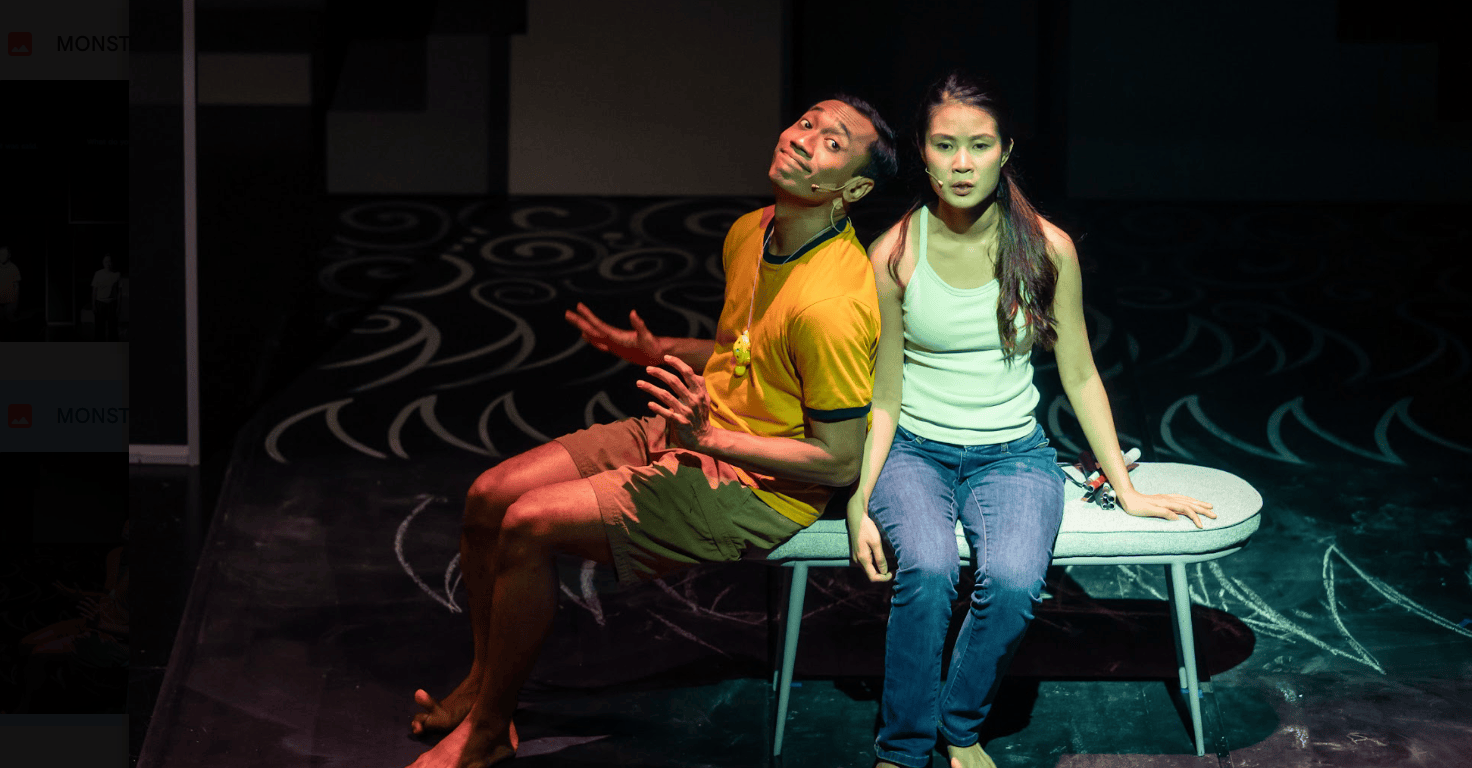
Presented by ART:DIS as the closing show for the Esplanade’s 2026 The Studios programme, MONSTRESS asks audiences to look again at the people and situations we think we already understand. Written by Claire Teo and directed by Yvan Karlsson, it opens in a courtroom, where Melissa (Oon Shu An) is sentenced for the neglect and death of her intellectually disabled son Sam (Syarifuddin Sahari ‘Dean’), before rewinding to trace the circumstances that led to this moment. Alongside her story is Mei (playwright Claire Teo), a blind secondary schoolgirl who moves into the neighbourhood and gradually becomes part of Melissa and Sam’s lives, while carrying her own issues of abuse, isolation and institutional disbelief.
At its strongest, MONSTRESS is devastating precisely because it refuses to make Melissa an easy villain. The title most immediately seems to point towards her: the mother who, from the outside, could easily be condemned as a “monster” for failing to adequately care for her disabled child, and ultimately for his death. But as the play peels back the layers surrounding her, it becomes clear just how impossible her circumstances have become.

Early on, Melissa is already established as exhausted, isolated and increasingly overwhelmed by a system that offers advice without necessarily offering meaningful relief. A social worker can recommend courses and workshops, but Melissa cannot simply take time off from being a full-time caregiver. Schools refuse to take Sam because they lack the facilities and training to support him, despite being on the waiting list for years. Her ex-husband provides money but little else. Neighbours silently judge her when Sam runs around in public or draws where he should not, even calling the police, while she struggles to keep up with a teenage boy who is becoming physically stronger and harder to restrain.
The cumulative effect is crushing. MONSTRESS is particularly good at showing how caregiving can become a silo, where responsibility is repeatedly pushed back onto the one person who has already been carrying too much. Every solution comes with another condition; every offer of help comes with another expectation. Melissa cannot take her eyes off Sam, cannot trust others to care for him, cannot afford to step away, and cannot make him fit neatly into systems that were never built around his needs. The production does not excuse everything that happens, but it makes the circumstances impossible to ignore.
Shu An anchors the play with one of its strongest performances, capturing both Melissa’s abrasiveness and the tenderness underneath it. From the beginning, she is constantly bubbling over, raising her voice simply to manage Sam and snapping because she has run out of patience. Yet as her defences gradually crack, Shu An reveals a woman who is still desperately trying to believe in the family she had imagined. A particularly powerful monologue sees Melissa reflecting on the prenatal tests that could have revealed her child’s disabilities, insisting that she would have gone through with the pregnancy regardless. She believed they could still be a strong family together, even after her husband left, even when she had to do everything herself. That conviction makes the tragedy that immediately follows all the more devastating, realising that she has exhausted herself to the utmost, and done everything within her power to give Sam a good life.

Syarifuddin Sahari is equally affecting as Sam. His physical and vocal characterisation, from the stiffened arms, slapping legs, repeated words to particular rhythms of speech, gives Sam a strong presence while preserving his essential innocence. Crucially, he never makes him feel malicious. Sam can be impulsive and difficult to manage, but the performance constantly reminds us that there is a good-natured boy underneath the behaviour, making it impossible to watch his fate as simply the consequence of a “problem child”.
The tragedy itself is handled with surprising subtlety. Rather than pushing for melodrama, the production lets the weight of what has happened settle over the audience. The central set piece, a sloping structure that doubles as a playground facility and meeting point, becomes especially evocative here: Sam’s fascination with the beach and turtles is echoed through the physical landscape, and when he dies, the slope rolls over him almost like a wave swallowing him whole, without melodrama and without terror. It is one of the production’s most effective visual images, coupled with the sound of waves that gives his death even more heartbreaking.

If anything, Melissa and Sam’s story is so powerful that it makes MONSTRESS’ other storyline feel comparatively less assured, even if no less serious. Mei’s story sees her, a blind teenager, living with her uncle after her single mother can no longer afford their own place. Often left in his care due to her mother working long hours, Mei gradually becomes the victim of sexual abuse, dismissed at first due to insufficient evidence, only to face the additional trauma of having to revisit her experience years later when her case comes back to court.
Her storyline brings in questions of testimony, disbelief, isolation and the ways disabled people can be doubted or dismissed when they try to make themselves heard. There is also a measure of hope here: the possibility of making legal proceedings less traumatic, of accommodating her needs when she testifies, and of Mei eventually finding the determination to pursue justice.
But dramaturgically, it feels as though Mei has wandered in from another play. Melissa’s story is fundamentally about the crushing demands of caregiving and the systemic failures surrounding a disabled child; Mei’s is about abuse, testimony and institutional disbelief. Both fit within MONSTRESS’ broader concern with who gets seen and supported, but they operate in very different emotional registers. The production does not always do enough to make their connection feel like a core part of the show, and several elements of Mei’s backstory are introduced more as passing remarks than fully developed threads.

Teo’s performance nevertheless makes Mei compelling. She has grown considerably as a playwright and performer, balancing Mei’s thorny, defensive personality with moments of startling vulnerability. Mei can be bratty, abrasive and deliberately provocative, but Teo never lets those qualities become the entirety of her character. A particularly striking sequence sees the stage in near darkness, as the cast lift her and their hands become the grasping, slithering presence of her uncle while she recalls the abuse. It is an unnerving physicalisation of trauma, suggesting how an experience can remain lodged in the body long after the event itself.
There is also something refreshing about seeing a blind teenage girl simply being a teenager. Mei goes to school, gets into trouble and even has to go through the pain of getting her report card signed by a parent or guardian; her blindness is part of her life, but does not entirely define it. Her eventual friendship with Sam is where the two narratives most naturally converge. After an initially rocky relationship, Mei starts visiting almost every day and becomes something of a third family member, finding an unusual ability to connect with him. Both understand what it means to be treated as a problem before being treated as a person. It still does feel as if their bond could have been developed further. We understand they are meant to be close, but it often feels more like an older sister caring for a younger brother than the genuinely mutual friendship the play ultimately seems to suggest and hinges on.
The fourth cast member, Sindhura Kalidas provides some welcome comic relief, taking on the various peripheral roles with an instinctive comic rhythm. Her repeated “hmm”s and “huh”s, as well as her portrayals of the eternally busy school principal and care officer, find the absurdity in a system populated by people who are constantly trying to help while somehow never quite helping enough. Her humour becomes an important pressure valve in a production where the emotional weight can otherwise become almost overwhelming.

The production itself then, feels overwhelming because it is packed with ideas. The studio is divided into three spaces: Melissa’s kitchen on one side, Mei’s bedroom on the other, and the central slope representing the playground and meeting point. Both storylines are stretched as much as they can to capture as much detail of the struggles both Mei and Melissa go through. Creative captioning projects dialogue onto screens above the performers, with font size shifting to convey volume. It is an intriguing extension of the production’s preoccupation with seeing and being seen, though it also raises an interesting question about accessibility: when every movement, word and detail is made explicit, does more information necessarily mean more understanding?
This question feels particularly relevant because MONSTRESS itself sometimes struggles with the same problem. It has so much it wants to say about disability, caregiving, education, public judgement, abuse, institutional failure and the responsibilities of community that its pacing occasionally becomes long-winded. The material is already harrowing, and its accumulation of suffering can become exhausting rather than illuminating. There are moments when the production feels as though it is carrying every possible example of society’s failure at once, when Melissa and Sam’s story alone already feels like it provides more than enough emotional and dramatic weight.
In that sense, while important, this is also what keeps MONSTRESS from becoming the fully cohesive work it might have been. Its ambitions are admirable, and there is real value in putting these stories alongside one another, but the two narratives sometimes compete rather than deepen each other. The result is a production that feels slightly overburdened by its own desire to make us understand everything.

That being said, its final reflective question remains potent: what happens when we judge what we see without looking any closer? MONSTRESS refuses to reduce its characters to convenient labels, whether victim or villain, mother or child, instead asking us to consider the circumstances that shape them. It speaks directly to The Studios’ theme of Precarious Bodies, presenting ordinary people living in silos, precarious not because they are inherently weak, but because the structures around them are insufficiently equipped, or insufficiently willing, to hold them.
The production can be an exhausting watch, and at times its weight becomes its own obstacle. But that discomfort also comes from its refusal to look away from the many factors that can lead to tragedy. At its best, MONSTRESS is not asking us to celebrate resilience, but to question why so many people are forced to be resilient in the first place, when they should have been supported. Above all, it is a plea to look closer, listen harder, and learn to see one another before we are left mourning what might have been prevented.
Photos by Poh Yu Khing
MONSTRESS played from 4th to 6th September 2026 at the Esplanade Theatre Studio. More information available here
The Studios 2026 – Precarious Bodies ran from July to September 2026 at the Esplanade. Full programme and more information available here
Production Credits
| Playwright Claire Teo Director Yvan Karlsson Dramaturg Charlene Rajendran Research & Development Oon Shu An Cast Claire Teo, Oon Shu An, Syarifuddin Sahari (Dean), Sindhura Kalidas Set Designer Grace Lin Lighting Designer Stella Cheung Sound Designer Serene Tan (Stan) Creative Caption Designer Joanna Ong Producer ART:DIS (Arts & Disability) Singapore Production Manager Karisa Poedjirahardjo Technical Manager A Kumarran Stage Manager Wisely Chow Assistant Stage Manager Mara Karma Props and Costume Coordinator Teo Li Lin Originally Co-Devised with Jean Tay & Zhuo Zihao |

