

Orchestra of the Music Makers returns to Wagner’s Ring cycle with a six-hour Siegfried that transforms the Esplanade Concert Hall into a world of gods, dragons, forests and awakening desire.
Duration: 360 minutes, including a 20 minute and 80 minute break
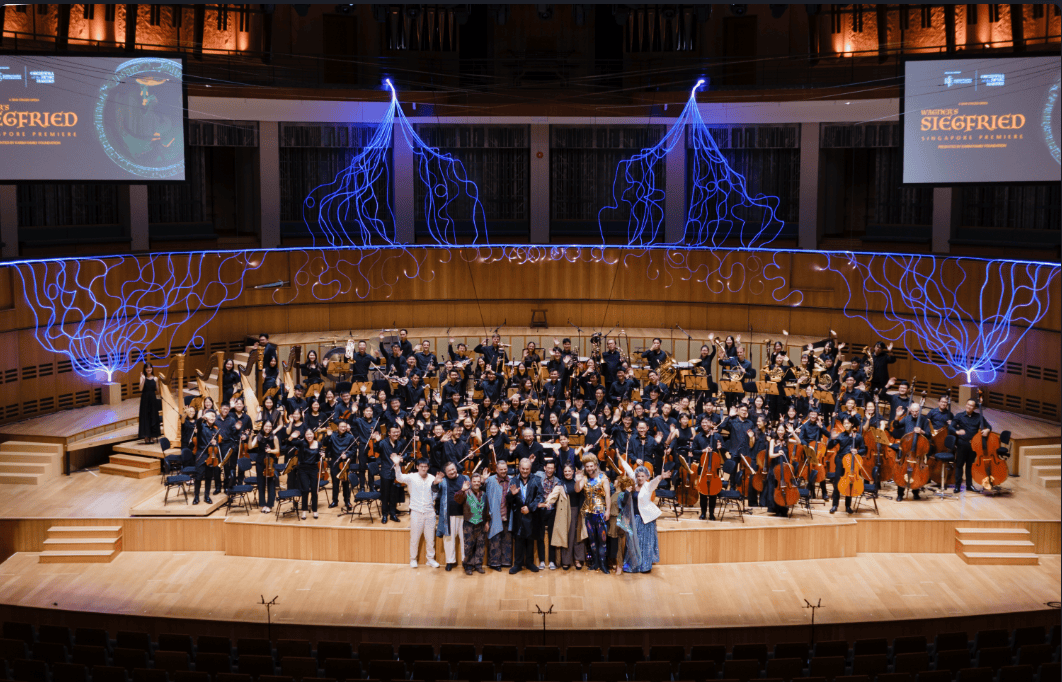
Six hours is a long time to spend with Siegfried. It is an even longer time to spend with Wagner’s Siegfried if the world of gods, dragons, dwarves, magic swords and primordial forests remains merely something on the page. Last Saturday, however, the Esplanade Concert Hall became something else: a cave, a forest, a dragon’s lair, a place of memory and, ultimately, a mountain surrounded by fire. In Orchestra of the Music Makers’ latest instalment of its Wagner Ring cycle, conductor Lü Shao-Chia and director Tan Shou Chen have taken a notoriously demanding concert work and made a persuasive case for why Siegfried does not need a conventional opera house to acquire theatrical life. The achievement is not that the concert hall has been made to look like an opera house, but that it has been made to feel like a world.

Tan’s staging begins from an ambitious idea, observing the epic as a form through which humanity passes stories from one generation to the next, allowing us to discover who we are, why we exist, and who we hope to be. For him, Siegfried is particularly compelling because it traces the becoming of a hero, and the production consequently treats the opera as more than the next instalment in Wagner’s enormous mythology, elevating it to a psychological journey. Siegfried begins as a man-child: extraordinarily strong, extraordinarily confident and extraordinarily ignorant. He knows almost nothing of the world into which he has been born, and even less about himself. What he does know is that he is not afraid, but the irony is that he does not yet understand what fear is. That contradiction gives the performance much of its dramatic centre, and it is one of the reasons the final encounter with Brünnhilde carries considerably more weight than its apparent simplicity might suggest.
From the opening moments, the semi-staging establishes a physical world around the singers. Dan Karlström’s Mime isn’t just a tenor singing at the front of an orchestra, but embodies a blacksmith, hammering away at his work, while the combination of movement, props, lighting and orchestral sound immediately establishes the cave-like environment in which the first act unfolds. Credit belongs to Tan and his creative team, set designer TK Hay, lighting designer Gabriel Chan, costume designer Max Tan and props designer and maker Beverly Liang, for understanding that a semi-staged production does not have to pretend it possesses the resources of a fully staged opera. Instead, the production repeatedly makes the concert hall’s limitations part of its visual language. Lighting changes the mood and apparent geography of the space, while the singers are physically directed through it so that journeys which could easily become static in concert are given shape. This creates a show that asks us to use our imagination while giving us enough visual information to know where that imagination should go.

Tan’s most distinctive idea is to treat the stage almost as an externalised mind. In wanting to showcase the birth of the psyche, he utilises the orchestra as “the central grey matter” from which everything else emerges. At various points in the performance, the lighting surrounds the set in ways that suggest a brain or an interior mental landscape, and this is particularly effective because Wagner’s orchestra is already doing something similar musically. The characters seem to inhabit an orchestral world whose recurring motifs, colours and textures continually remind us of histories they themselves may not understand. Tan draws on Carl Jung’s idea of Wagner speaking to a “collective unconscious”, although he is careful to acknowledge the limits of such a reading. His point is less that every character must correspond neatly to an archetype than that Wagner’s mythology gives us material with which to think about ourselves, and the staging is strongest when it allows that psychological reading to coexist with the sheer theatrical pleasure of the story.
That pleasure is especially evident in the first act, where the relationship between Mime and Siegfried is established with considerable clarity. Karlström’s Mime is scheming, nervous and physically expressive, while Vincent Wolfsteiner’s Siegfried is deliberately rough around the edges. There is an almost childlike physicality to him, but it is accompanied by the entitlement of someone who has grown up believing that strength gives him the right to demand whatever he wants. This makes him difficult to like at first, and the production is better for not trying to soften him prematurely. The semi-staging allows the performers to make the imbalance between the two characters visible: Mime is continually attempting to manipulate the young man, while Siegfried responds with impatience and aggression. Their chemistry is one of the performance’s strengths, and it demonstrates why the acting component of a concert production matters so much in Wagner. The singers are not simply delivering text and music; their physical relationships help the audience understand the emotional mechanics of the drama.

The comedy also deserves more credit than it might initially seem to require. Siegfried is an enormous work, and a production that played every scene with solemn mythological gravity would risk exhausting its audience long before the final awakening. Tan instead allows the humour of Mime, the exchanges with the Wanderer and later the encounter with the Woodbird to provide moments of relief without reducing the opera to a comedy. Michael Volle’s Wanderer brings a different kind of authority into the first act, particularly in his questioning of Mime, whose confidence gradually gives way to unease. The timing of these encounters matters, because in an opera this long comic relief is not decorative; it gives both audience and performers room to breathe before Wagner asks them to climb another orchestral mountain.
The first act’s central object, Nothung, carries the larger story with it. Siegfried is fascinated by the broken sword that once belonged to his father, although he does not yet understand the history it contains. His demand that Mime repair it eventually becomes the moment in which he discovers that the old order cannot simply be restored for him: he must forge something himself. As he puts the fragments into the fire and reforges Nothung, the production’s central idea of becoming begins to take shape. Siegfried is not simply being told who he is; he is making himself, and the orchestra is the machinery of that transformation. The physical act of forging therefore works on two levels, as both literal stage business and an image of a personality being constructed out of fragments inherited from a past Siegfried barely comprehends.

This is also where Lü Shao-Chia and OMM face one of the performance’s greatest challenges. Siegfried demands enormous stamina from everyone involved, but the orchestra’s challenge is not merely to survive the score. It must sustain Wagner’s huge architecture without allowing the music to become an undifferentiated wall of sound, particularly when the singers are working at the limits of their vocal and physical endurance. For much of the afternoon, OMM maintained an impressive balance between weight and transparency. The orchestral sound had enough substance to create the epic scale Wagner requires, while individual colours, particularly the brass and woodwind writing, retained their character rather than disappearing into a generalised Wagnerian mass. There were moments when the orchestra seemed almost to generate the scenery itself, which fitted neatly with Tan’s conception of the musicians as the production’s “grey matter”.
The second act is where the production’s theatrical imagination perhaps becomes most vivid. The opening orchestral passage immediately transports the audience back into Wagner’s world, while the Wanderer’s encounter with Fafner and Mime’s attempt to lead Siegfried towards his confrontation with the dragon give the production opportunities to move between menace, comedy and fairy-tale fantasy. The staging of the Woodbird is particularly effective because it understands Siegfried’s innocence as something that can be funny without being merely childish. He can kill a dragon and forge a sword, yet he has almost no understanding of how to communicate with another creature. His attempts to attract the Woodbird, his awkward playing and the bird’s cautious response turn the encounter into a charming piece of theatrical business, while the orchestra provides the sense that Siegfried is gradually discovering a world beyond the narrow one Mime has constructed for him.

The dragon itself is deliberately theatrical rather than naturalistic, and there is something almost camp about the presentation of Fafner. That choice works because Wagner’s dragon is not really a naturalistic creature in the first place. Fafner represents greed, possession and the hoarding of power, and a stylised theatrical monster can make that symbolism more legible than an attempt at cinematic realism. Lukasz Konieczny makes an impression despite the relative brevity of the character’s stage life, and the confrontation has the directness that the scene requires: Siegfried enters the dragon’s world, kills him and emerges changed. After tasting Fafner’s blood, he suddenly hears and understands the Woodbird, and the production makes the transformation feel like an expansion of consciousness. The world has not changed; Siegfried’s ability to perceive it has.
The death of Mime further accelerates that process. The man who has raised Siegfried, manipulated him and planned to poison him is finally destroyed by the very young man he hoped to control. Yet Siegfried’s reaction is not one of complicated grief so much as bewilderment. He is still learning what relationships mean, even as he tears through the structures that have governed his life. This is where Wolfsteiner’s performance becomes increasingly interesting. The Siegfried of the first act is almost aggressively uncomplicated; by the end of the second, his physical confidence remains, but the world has begun to supply him with questions that strength alone cannot answer.

The third act takes that process into more explicitly mythological territory. The Wanderer’s encounter with Erda places the audience in the presence of two figures representing an older order that is increasingly unable to control what comes next. Anna Harvey’s Erda brings an appropriately grave weight to the encounter, while Volle’s Wanderer carries the burden of a god who understands that his power is diminishing. The orchestral balance in this section was especially important. Wagner’s score is dense and physically demanding, and after several hours of music the challenge is to retain discipline, tonal clarity and dramatic momentum without allowing the sheer size of the orchestra to overwhelm the singers. OMM largely manages this, and the sound remains expansive without losing its sense of internal organisation.
When Siegfried finally confronts the Wanderer, the transformation is complete enough that the young man can now challenge the authority that once stood above him. He breaks Wotan’s spear and moves forward without the hesitation that characterised his earlier encounters. The gesture is both physical and symbolic: the old world has lost its ability to determine the young hero’s path. The production gives the confrontation enough space for that meaning to register, while the orchestral punctuation — including the striking use of the trumpet in synchronisation with Siegfried’s actions — adds to the sense of an old order being decisively broken.

And then the scale changes again. After hours of gods, giants, dragons and magical objects, Siegfried arrives at the sleeping Brünnhilde. Stéphanie Müther’s entrance brings a different emotional temperature to the performance, and the production makes effective use of the verticality of the stage, with Brünnhilde positioned high at the centre before Siegfried reaches her. The visual arrangement creates a convincing sense of destination: after wandering through forests, caves and confrontations, Siegfried has finally arrived somewhere. Yet what he finds there is something he has no experience of confronting. He has killed a dragon and broken a god’s spear, but he does not know what to do with love.
That is where the final encounter becomes more than a conventional operatic love scene. Siegfried’s discovery of Brünnhilde is also his discovery of vulnerability. Müther conveys Brünnhilde’s movement from fear and disorientation towards recognition, while Wolfsteiner allows the previously swaggering Siegfried to become almost boyishly delighted. There is something touching in the simplicity of the final exchanges, even if the romance has an element of puppy love about it. After such an immense journey, Wagner does not end by giving Siegfried another enemy to defeat. He gives him another person to encounter, and that person forces him into a kind of emotional territory for which all his physical courage has failed to prepare him.

This brings Tan’s conception of the opera full circle. If Siegfried traces “the becoming of a hero”, then heroism here is not simply a matter of fearlessness. Siegfried begins by claiming that he fears nothing because he has never properly encountered fear; by the end, he has encountered something he cannot conquer with a sword: another human being who can change him and make him vulnerable. The final awakening is therefore as much an awakening of consciousness and desire as it is a romantic one. Tan’s Jungian framework gives the production one way of understanding that transformation, but the performance wisely leaves room for other readings, of a child discovering himself, an old order losing its authority, and a young man encountering love for the first time.
For OMM, Siegfried represents another formidable stage in its Ring journey, made all the more remarkable by the fact that its more than 140 musicians are volunteers. They give their time because they want to make music at this level, taking on the long rehearsals, physical demands and enormous concentration that Wagner requires without it being their day job. There is something deeply passionate about that commitment: these musicians are not obligated or forced to play Siegfried. They choose to, and it is that choice gives the performance a particular sense of collective purpose, with the orchestra not merely accompanying the singers but actively building the world they inhabit. For a volunteer orchestra, this is an act of love: the musicians give their time because the music matters enough to them to make the sacrifice worthwhile.

That commitment also helps explain why the production holds together across its extraordinary six-hour span. The semi-staging is never merely decoration, with the singers moving through a changing landscape of light, space and physical relationships, while the orchestra sustains the psychological and mythological world beneath them. The result is not a substitute for a fully staged Siegfried, but something with its own theatrical language — one that relies on suggestion rather than illusion and allows the audience to complete the picture.
By the end, when Siegfried and Brünnhilde finally find each other, the enormous machinery of Wagner’s mythology has narrowed into something unexpectedly simple: two people discovering one another. After gods, dragons, broken swords and battles with the old order, Siegfried’s greatest discovery is not another enemy but his own capacity for love and vulnerability. Around them, OMM completes the journey it has carried for six hours, and the concert hall, which has been cave, forest, dragon’s lair and psychological landscape, becomes a place in which two human beings stand together. The hero has awakened, and so, in its own way, has the world around him.

Photo Credit: Yong Junyi
Wagner’s Siegfried plays on 5th September 2026, 4pm at the Esplanade Concert Hall. Tickets available from SISTIC

