
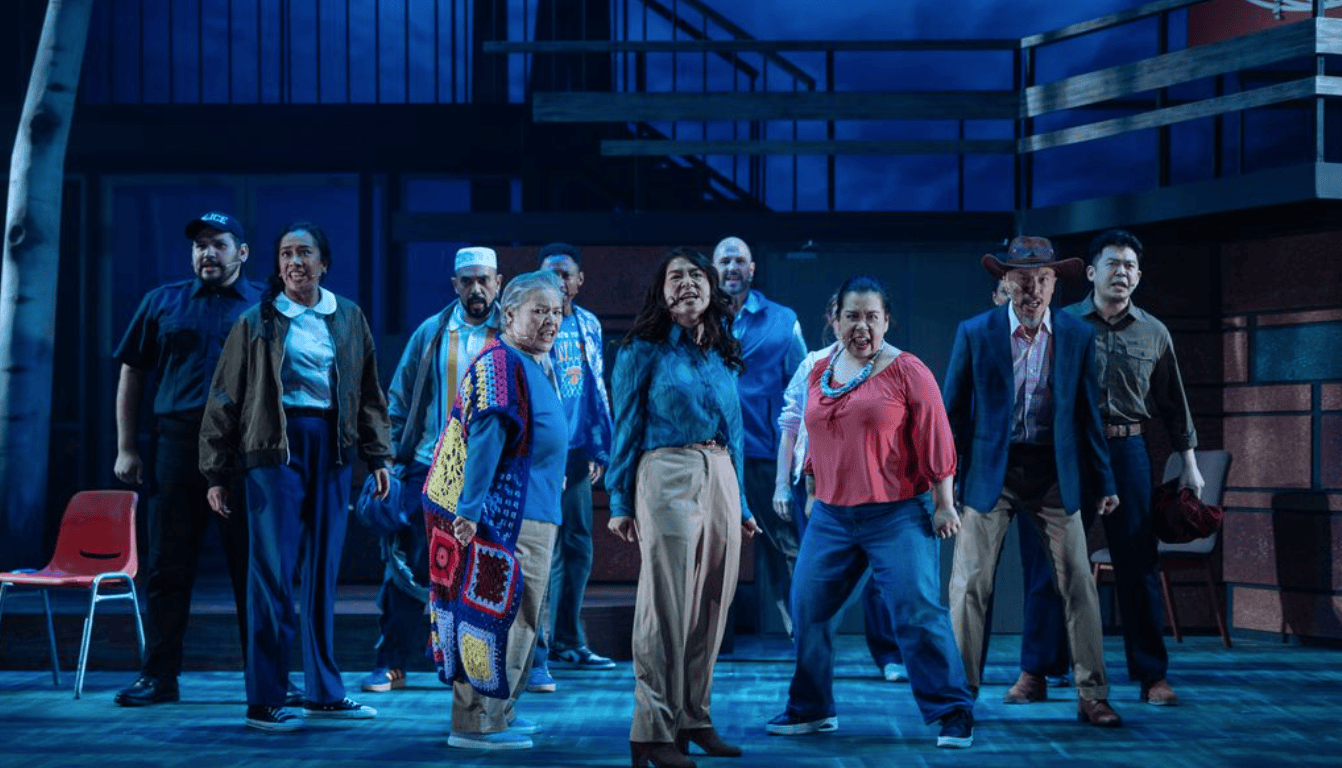
Pangdemonium’s final show finds hope and grace with how Come From Away finds the extraordinary power of care, community and an open door, even in the face of loss and tragedy.
Duration: 105 minutes
It seems poetic that Pangdemonium should end its 16-year journey as a company with Come From Away. On the 25th anniversary of 9/11, the musical arrives as a story about what happens after catastrophe: not the planes that fell or the towers that collapsed, but the people diverted and left behind, frightened and stranded, and the strangers who decided to take care of them. It is a story about hospitality in the face of fear, about choosing generosity when suspicion would be easier, and about the small acts of care that allow strangers to become something like a community. For a company that has spent 16 years making space for stories, performers and audiences in Singapore, there could hardly be a more resonant final production.
Written by Irene Sankoff and David Hein and directed by Timothy Koh, Come From Away tells the true story of the 38 international aircraft diverted to Gander, Newfoundland, after American airspace was closed following the September 11 attacks. Nearly 7,000 passengers and crew suddenly descended on a town whose population was only around 9,000, doubling the number of people who needed somewhere to sleep, something to eat and some reassurance that they would be all right. Over five days, Gander’s residents opened schools, kitchens, homes and community spaces to their unexpected guests, while the passengers grappled with the terrifying uncertainty of not knowing what had happened, whether their families were safe and when they might be allowed to go home. The musical is therefore technically a 9/11 musical, but its real subject is the aftermath of 9/12 and beyond: what people choose to do when confronted with someone else’s fear.
The musical is not so much interested in bringing the tragedy itself to the fore as in finding drama in the accumulation of human responses to it. Some people become frightened; some become suspicious; some fall in love; some fall apart. Others simply make coffee, find blankets, crack jokes or try to locate the animals left in cargo. The scale of the disaster is enormous, but the musical repeatedly brings it back to the ordinary things people can do for one another to get them through. In doing so, it finds something deeply universal in a very specific historical event: the recognition that care is not always about being able to solve someone’s problem. Sometimes it is simply about refusing to let another person face it alone.
Pangdemonium’s production is built around that same sense of collective effort. Come From Away is an ensemble-driven musical in which all 12 performers play multiple characters across both the residents of Gander and the stranded “plane people”, requiring constant changes in accent, physicality, costume and emotional register. There are dozens of locations and scenes to move through, yet there is no interval to provide a reset. The result is a production that must continually transform itself while retaining the emotional thread of the story, and Koh proves particularly adept at managing that rhythm. The show never needs to move at a breakneck pace, but it does need to keep moving, allowing the audience to remain caught in the uncertainty of those five days even though we already know that the people onstage will eventually get home.
There is something quietly extraordinary about who is telling this story, too. Sheila Francisco, Candice De Rozario and Lim Yu-Beng were all part of The Full Monty, Pangdemonium’s first production 16 years ago; now they are among the performers closing the company’s final chapter. Koh, meanwhile, began his relationship with Pangdemonium as an intern and now finds himself directing its last mainstage production. The production consequently carries a history that exists beyond the script. Watching performers repeatedly step into different lives, rely on one another and disappear into the larger ensemble, it becomes difficult not to see a reflection of Pangdemonium itself: a company sustained over the years by people coming together, making room for one another and trusting that the whole can become greater than any individual part.
Koh’s first mainstage musical as director is therefore no small undertaking, particularly with a show that demands such precise coordination. Yet his greatest strength is not imposing a grand directorial signature on the material, but understanding how to let its ensemble storytelling work. His direction is most impressive in its attention to detail: the placement of bodies across the stage, the distance between two characters, the direction of a gaze, or the simple fact that an actor who is not speaking is still reacting to what is happening around them. The stage is rarely static, and scenes gain additional tension from who is watching whom and how far apart they are with good tension distance. It gives the production the feeling of a community actually existing rather than a succession of actors waiting for their turn to speak. Koh’s direction is, in this sense, the work of someone who pays attention.

Andy Benjamin Cai’s choreography works beautifully in tandem with that approach, finding theatricality in surprisingly simple gestures rather than attempting to turn the ensemble into a conventional dance troupe. Performers arrange chairs into the shape of an aircraft, climb onto them and pose, or raise their hands together to create shifting formations. These gestures become a physical vocabulary for planes, crowds, movement and collective action, allowing the production to suggest far more than its relatively spare set can literally depict. The choreography is often at its strongest when it is barely recognisable as choreography at all: people moving together, making room for one another, or instinctively forming an image as a group.
Leonard Augustine Choo’s costumes provide another layer of this efficient storytelling. With performers constantly moving between characters, there is no time for elaborate changes, so recognisable details do much of the work: a traffic marshal’s vest, a captain’s hat, or another carefully chosen piece immediately tells us who someone has become. Clever layering allows the actors to transform quickly without interrupting the action, while small period details, including the limited presence of mobile phones, quietly establish the world of the story. It is a production full of decisions that could easily go unnoticed precisely because they work so seamlessly, and quietly contributes to the realism of the world built.
Eucien Chia’s set provides an equally effective framework for this constant movement. Victoria Theatre becomes a hybrid airport, lodge, school and pub, with tall glassy windows evoking an airport viewing gallery, clocks marking different time zones and a neon red “YOU ARE HERE” sign echoed directly in the musical. A cheerful welcome-to-Gander sign sits above towering tree trunks that stretch beyond the visible stage, while the wooden walls and panels below create an environment abstract enough to transform quickly without ever losing its sense of place. The backdrop is particularly beautiful, with an expansive sky filled with clouds and distant lights that seem to stretch for miles. It quietly reminds us that this is not a metropolis but a small community surrounded by nature, far from the centres of power and yet suddenly at the centre of a global crisis.
The ensemble numbers are at their best when all these elements converge. The synchronised stomping of “Welcome to the Rock” establishes the communal pulse of the production almost immediately, while circular LED lights become the lights of aircraft in a wonderfully uncomplicated theatrical gesture. “On the Edge” is even more exuberant, turning Victoria Theatre into a drunken pressure valve as the stranded passengers and Gander residents finally let some of their accumulated anxiety loose. The stage becomes a tangle of movement, music and drunken debauchery, with the band joining the action, and Koh manages to sustain the energy through an extended sequence in which there is always something else happening at the edge of the audience’s attention. These are the moments when the production most clearly understands that joy is not the opposite of fear; sometimes it is how people survive it.
The production is not without technical problems. It takes some time to settle, with early sound issues occasionally allowing the music to overpower the microphones and making certain lyrics difficult to catch. The musical direction by Joanne Ho is also less assured than the production’s ambitions warrant: the orchestral balance often does not sit comfortably with the voices, some exposed instrumental passages, including the flute, sound noticeably insecure in tuning, and the bass lacks the depth the score requires. In a musical whose storytelling depends so heavily on the immediacy of its score, these moments are distracting, particularly because the ensemble is doing so much work to carry the narrative. There are also times when the performances lean into the show’s broad emotional language so strongly that the feeling can seem presented rather than fully inhabited. The smiles, gestures and declarations of joy occasionally feel like the cast are demonstrating what the audience ought to be feeling rather than allowing the feeling to emerge naturally.

Yet the production’s genuine moments of connection are strong enough to break through that performativity, and when they do, they are extraordinarily effective. Rebekah Sangeetha Dorai is the clearest standout as airline captain Beverley Bass, bringing a compelling mixture of authority and vulnerability to a woman accustomed to being responsible for everyone else. Beverley begins the story as a natural leader, attempting to keep passengers calm and orderly while she herself has no idea what is happening beyond the aircraft. In “Me and the Sky”, however, that command begins to fracture. The song traces Beverley’s lifelong relationship with aviation, from childhood fascination to becoming the first female captain at American Airlines, before confronting the devastating possibility that the career around which she has built her identity may suddenly be taken away from her.
Rebekah understands that the song is not simply a celebration of a pioneering woman. It is also about what happens when a person who has always known where she is going suddenly has nowhere to go. The stage darkens around her and the backdrop becomes an all-consuming sky, leaving Rebekah’s voice to carry Beverley’s exhilaration, pride and eventual helplessness. It is one of the production’s rare moments in which the emotional machinery disappears completely, leaving a woman confronting the loss of the future she thought she had secured. Rebekah’s performance is genuinely affecting, and “Me and the Sky” remains one of the strongest musical numbers of the evening.
Her comic work as Annette is almost diametrically opposed to this. As the romantic fantasist who swoons over every attractive professional she encounters, Dorai embraces broad physical comedy and knowingly ridiculous exaggeration, collapsing into the arms of imagined sexy pilots and cardiologists with impeccable comic timing. The contrast demonstrates the versatility required of the ensemble, and also contributes to the musical’s strange emotional elasticity: within minutes, the same performer can take us from existential uncertainty to outright silliness.
Benjamin Chow and Dwayne Lau find a more uncomfortable truth in the relationship between Kevin T and Kevin J. Their chemistry initially feels slightly awkward, but that awkwardness becomes increasingly appropriate as the show progresses and it becomes clear that the two men are experiencing the crisis very differently. Kevin T throws himself into the strange exhilaration of being stranded in a new land, while Kevin J remains consumed by anxiety over his family back in Brooklyn. Their relationship gradually frays under the pressure, making their eventual breakup less a surprise than the culmination of tensions that have been accumulating throughout their stay. Lau nevertheless finds plenty of comedy in Kevin J’s anxiety, particularly when he snaps at those around him and later drunkenly admits to being Kevin T’s “sex-atary.”
Inch Chua and Gavin Leahy’s Diane and Nick offer a different kind of romantic awkwardness. They are strangers from completely different worlds who somehow find themselves falling for one another in the middle of an international crisis, and their relationship feels appropriately tentative and strange. “Stop the World” captures the peculiar tenderness of realising that a connection forged in extraordinary circumstances might actually mean something, even as the prospect of returning to their separate lives looms over them. Disaster has brought them together, but ordinary life is already preparing to pull them apart.
The show’s ability to hold these disparate experiences together is perhaps its greatest achievement. Sheila Francisco and Candice De Rozario’s Gander native Beulah and passenger Hannah, for instance, bond over the fact that both their sons are firefighters, while Hannah desperately waits for news of hers. Beulah cannot solve Hannah’s problem, but she can keep her company, listen to her and make her laugh. Francisco gives Beulah a warmth that avoids turning her into a saint; her kindness is active rather than sentimental, grounded in the simple understanding that when someone is in trouble, you do what you can, even when it is initially difficult to break through the shell one forms around oneself.
That idea becomes even more powerful in “Prayer”, where Dwayne Lau’s Egyptian Muslim chef Ali, an Orthodox Jewish rabbi played by Eric Larrea, and the Christian Beulah and Hannah pray separately but simultaneously for peace. Their faiths remain distinct, but their fear and longing for safety are recognisably shared. Ali’s story is particularly painful because the crisis follows him home: as a Muslim man of Egyptian heritage, he later returns to an America where suspicion towards him has intensified, eventually confronting the fear his daughter develops about going to school. The musical does not pretend that a few days of hospitality can erase the prejudices that existed before the passengers arrived or after they leave. Instead, it asks us to notice how quickly fear can make people divide the world into strangers and threats, and how difficult but necessary it is to resist that instinct.
Brandon Gill’s Bob undergoes a similarly revealing shift. As a Black man from the United States, he carries the everyday fear of being under suspicion and potentially shot by police while also harbouring his own assumptions about the supposedly backward people of Newfoundland. Lim Yu-Beng gets one of the production’s more amusing entrances as the mayor of Appleton, leaning into the character’s exaggerated local accent and geniality, but the comedy eventually gives way to Bob’s recognition that the people he expected to distrust are the very people who have taken care of him. When he returns home, it is not Gander that suddenly seems frighteningly strange, but the place he came from, newly conscious of the threats that surround him.
Victoria Mintey’s Bonnie extends the show’s idea of care even further, worrying about the animals left behind in the aircraft cargo holds while everyone else is occupied with the human passengers. Her determination to care for pets and exotic animals alike is another small but telling reminder that compassion is not necessarily measured by the scale of the problem. Sometimes it is simply a matter of noticing what has been overlooked. Nadya Zaheer’s Janice, meanwhile, brings a youthful perspective to the unfolding crisis. As the inexperienced reporter documenting events in Gander, she begins with the understandable desire to do a good job and prove herself, but gradually confronts the responsibility involved in recording an event that is affecting people in radically different ways. After appearing in three musicals this year alone, Nadya is establishing herself as a promising young performer of her generation, and her Janice is particularly effective when that confidence begins to emerge through the character’s initial uncertainty.

All of these stories could easily become sentimental in less careful hands, and Come From Away does occasionally flirt with that danger. Its emotional vocabulary is broad, its characters often deliberately heightened, and its message is ultimately an optimistic one. But what gives the musical its staying power is that it never entirely escapes the ugliness surrounding its central act of kindness. Racism is present. Fear is present. Grief is present. The possibility of violence is always hovering over the story. Even the passengers’ eventual gratitude cannot undo what happened before they arrived or what they will return to afterwards.
That makes its optimism feel more valuable, rather than less. The show is not arguing that kindness fixes tragedy. It is arguing that kindness is one of the things people can choose when tragedy has already happened. A person may not be able to find a missing son, but she can make his mother laugh. A reporter may not be able to understand the enormity of what she is witnessing, but she can try to tell the story responsibly. A stranger may not know how to reassure someone who is terrified, but he can sit beside them. These are modest acts, almost embarrassingly ordinary, but Come From Away understands that ordinary acts are precisely what make up a community.
This is also where the production’s occasional performativity becomes less damaging than it might otherwise be. There are moments when the cast’s joy feels too carefully projected, when the production seems to be insisting on its own warmth. But there are also moments when the 12 performers genuinely seem to enjoy being together, when laughter appears to come from somewhere beyond the choreography, and when their dependence on one another becomes visible. The most affecting parts of the production are often not the grand emotional climaxes but these glimpses of people simply responding to each other. That is when the musical’s central idea becomes real in front of us.
It is difficult, too, not to see Pangdemonium’s own history reflected in that ensemble. For 16 years, much like this production, the company has been a place where artists of different ages, backgrounds and levels of experience could come together to make something larger than themselves. It has built seasons, nurtured performers, brought international work to Singapore, introduced audiences to new stories and created its own particular theatrical community. The company’s ending is therefore not simply the disappearance of a name from the theatre calendar. It is the ending of a place that has meant something to the people who passed through it.
That knowledge inevitably colours the final production, but it does not diminish it. Instead, it gives Come From Away an additional resonance that could never have been manufactured deliberately. Gander becomes a place where people who have never met suddenly have to depend on one another; Pangdemonium has spent 16 years doing something smaller and gentler but recognisably similar, bringing people into the same room and asking them to trust one another enough to make theatre together. Timothy Koh’s journey from Pangdemonium intern to director of its final mainstage production, alongside performers who have been with the company since its earliest days, makes that sense of continuity especially poignant.
There is mourning in watching this, and there should be. It would be strange to watch Pangdemonium’s final production and feel nothing about the fact that there will not be another one. But the dominant emotion here is not sadness so much as gratitude. Come From Away itself understands that grief and joy do not cancel one another out. They can exist simultaneously: the relief of being safe alongside the knowledge of what has been lost; laughter alongside fear; the pleasure of being together alongside the certainty that eventually everyone has to go home. That makes it a remarkably fitting way for Pangdemonium to leave.
For all its technical imperfections and occasional emotional overstatement, this is a musical that leaves you wanting to be part of the community it describes. It reminds us that survival is not the end of a crisis; what matters just as much is what we do with one another afterwards. It asks us to resist the instinct to retreat into our own safety bubbles and instead consider whether we might be capable of the kind of hospitality that Gander offered to people it had no reason to know or trust. In a world that can feel increasingly defined by suspicion, division and the impulse to close ourselves off, that is an unusually generous thing for a musical to ask.
Perhaps that is why Beulah’s final knock-knock joke lands with more weight than it ought to. Why are people in Gander so bad at knock-knock jokes? Because they leave their doors wide open. It is a small joke about an open door, but after watching Come From Away, and after 16 years of Pangdemonium, it becomes something more. Pangdemonium has spent its own run leaving the door open: inviting audiences in, giving artists somewhere to grow and making room for stories that could make us laugh, cry, think or simply recognise something of ourselves in another person.
The door is closing now, and that is something to grieve for a while. But Come From Away is a fitting final reminder that what matters about a door is not that it stays open forever, but how many people you welcomed through it while you could. For a company that has spent 16 years building a home for theatre, there are few better final messages than this: that even in the aftermath of loss, we can choose to make room for one another, and that the communities we build together can outlast the places in which we built them.
Photo Credit: CRISPI
Come From Away plays from 11th to 27th September 2026 at Victoria Theatre. Tickets and more information available here
Production Credits
| Directed by Timothy Koh Book, Music & Lyrics by Irene Sankoff and David Hein Cast Benjamin Chow, Inch Chua, Candice De Rozario, Rebekah Sangeetha Dorai, Sheila Francisco, Brandon Gill, Eric Larrea, Dwayne Lau, Gavin Leahy, Lim-Yu Beng, Victoria Mintey, Nadya Zaheer Music Director Joanne Ho Choreographer Andy Benjamin Cai Vocal Coach Natalie Yeap Set Designer Eucien Chia Lighting Designer Genevieve Peck Sound Designer Jing Ng Costume Designer L.A.C Hair Designer Leong Lim Associate Set Designer Grace Lin Associate Sound Designer Ryan Ng Arrangements Ian Eisendrath Orchestrations August Eriksmoen Accent Consultant Gavin Leahy Produced by Tracie Pang & Adrian Pang |

