
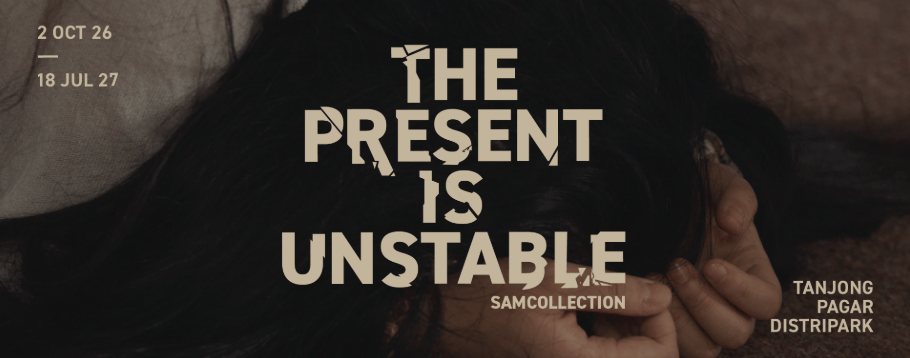
What happens when artworks are allowed to move in and out of a museum gallery, their meanings shifting with every new arrangement? At Singapore Art Museum’s latest collection exhibition, the act of looking becomes a journey through identity, memory, history and the unstable conditions of contemporary life.
A museum collection is usually understood as something to be preserved: a gathering of artworks, carefully acquired and held in trust, with each piece occupying its place within a larger cultural record. But what happens when that collection is treated less as a fixed archive and more as something alive, capable of changing its meaning depending on what surrounds it?
At Singapore Art Museum’s SAMCollection: The Present is Unstable, the answer unfolds through an exhibition that is as much about movement as it is about the artworks themselves. A pathway of oversized barriers invites visitors to reconsider how they navigate space. A woman cast in the form of a historical monument appears almost impatient with the role she has been made to perform. Elsewhere, a marble slab waits to be slowly worn away by water, while photographs of empty rooms and fading family images raise questions about what remains of the past when memory begins to recede.
Rather than presenting these works as illustrations of a single theme, the exhibition allows them to enter into a shifting conversation about how we see, move through and make sense of the world. Some connections are immediately apparent; others emerge only when one changes position, pauses before an artwork or encounters it alongside something else.

Opening on 2 October 2026 at SAM at Tanjong Pagar Distripark, The Present is Unstable marks a new phase in the museum’s presentation of its collection of more than 3,800 works from Singapore, Southeast Asia and beyond. The exhibition is the third in SAM’s collection display series, but introduces a more fluid approach: artworks will be brought in and out of the gallery over time, placed in new configurations, with traces of earlier arrangements remaining as the exhibition evolves.
It is a proposition that challenges the expectation of a museum display as something settled and complete. Here, an artwork’s meaning is not necessarily exhausted by its original context or the moment it was first exhibited. A work acquired years ago might speak to a concern that feels particularly urgent today, while a new pairing could reveal something that was previously overlooked.
As Shabbir Hussain Mustafa, Chief Curator of SAM, explains: “Since SAM opened in 1996, its Collection has grown alongside the changing conditions of contemporary art in Singapore, Southeast Asia and the wider world. But a museum collection cannot remain only as a record of what has been acquired or preserved. The Present is Unstable asks a simple question: how can works from the past help us understand the present? By allowing artworks to move in and out of the gallery on a constant basis, the exhibition invites our publics to see how older histories, recent acquisitions and current concerns can speak to one another.”

The first configuration is guided by the notion of the exhibition-as-musical-score, with movement serving as a fundamental condition of experience. Rather than following a prescribed narrative from beginning to end, visitors encounter works through changing vantage points, allowing relationships to form and dissolve as they move through the gallery. There is a certain choreography to this arrangement: moments of visual intensity give way to quieter encounters, while repetition, gesture and spatial interruption become ways of connecting artworks that might otherwise seem disparate.
The curatorial framework offers three points of departure — embodied scripts, accretion and afterness — but these are less rigid categories than overlapping ways of approaching the works. Together, they consider how identity and authority are performed, how meaning accumulates through repeated actions and traces, and how we inhabit the spaces left behind by events, transformations and histories.

One of the more theatrical encounters comes through Sin Wai Kin’s The Time of Our Lives (2024), a two-channel video installation that unfolds like a speculative sitcom. Blending science fiction, melodrama and performance, it follows a couple, both roles played by Sin, as they move through familiar milestones in life. Yet the apparent familiarity of the format is repeatedly unsettled by scenes that loop, stutter and fold back upon themselves, accompanied by a glitching doomsday clock that disrupts any straightforward sense of time.
At intervals, The Storyteller, also played by the artist, interrupts the narrative with contradictory monologues that question our assumptions about truth, meaning and who gets to control a story. Meanwhile, a studio audience watches, laughing, gasping, applauding and jeering at the unfolding scenes. Their reactions mirror our own, creating a curious feedback loop in which the viewer is no longer entirely separate from the spectacle.
Sin’s work is particularly compelling in how it treats identity not as a stable condition but as something continually constructed and performed. Drawing on drag, popular culture, science fiction and traditional performance forms, the artist plays with the conventions through which gender and social roles become recognisable. The result is at once entertaining and disorienting, inviting us to consider whether we are shaping what feels real or merely consuming familiar images, perhaps doing both at once.

This idea of the self as something that can be assumed, performed and dismantled continues in the accompanying trio of works, Taking off V Sin (The Time of Our Lives), Taking off The Storyteller (The Time of Our Lives) and Taking off Wai King (The Time of Our Lives) (2024). Made from makeup on face wipes, these framed objects function as remnants of a character’s unmaking. The residue of a performance becomes an artwork in its own right, drawing attention to the relationship between the face presented to the world and the self beneath it.
Where Sin’s work explores the instability of identity through performance, Nadiah Bamadhaj’s Casting Spells for the Movement (2021) turns to the historical roles assigned to women and the possibility of refusing them.

At the centre of the installation stands a resin sculpture modelled after the matriarch figure in Jakarta’s Patung Pahlawan (Heroes Monument), which commemorates peasants who participated in Indonesia’s struggle for independence. In the original monument, a woman offers food to an armed farmer, her position embodying a familiar representation of feminine support and sacrifice. Bamadhaj’s version, however, appears uncomfortable, even irritated, as though the figure has grown tired of holding the pose expected of her.
Nearby, a three-channel black-and-white video shows a group of young women gradually freeing themselves from that same restrained position. Their movements introduce a striking contrast to the sculpture’s permanence, turning the installation into a meditation on what happens when bodies begin to resist the historical narratives imposed upon them. The work does not simply revisit a monument; it asks us to reconsider how history is constructed through images, whose contributions are remembered, and what might become possible when those representations are disrupted.

From the performative body, the exhibition moves into the territory of action and repetition, where meaning is built not through a single defining moment but through the gradual accumulation of gestures, absences and collective acts.
Gary-Ross Pastrana’s Water Cuts (stone) (2017) is perhaps the most immediately participatory expression of this idea. A marble slab, accompanied by water and sea salt, invites visitors to ladle rivulets across its surface in an attempt to leave a mark on the stone. Inspired by Asian idioms describing water’s ability to wear away even the hardest material, the work turns a familiar metaphor into an almost comically ambitious task.

The gesture is simple, yet its implications are surprisingly expansive. Each ladleful of water seems inconsequential against the solidity of the marble, and the prospect of actually cutting through it within the exhibition’s limited duration appears almost absurd. But this Sisyphean quality is precisely where Pastrana’s humour and poetic sensibility come into play. What might initially seem like an exercise in futility becomes a meditation on faith, persistence and the possibility that seemingly insignificant actions might acquire force through accumulation.
There is also something quietly communal about the work. Each visitor contributes to an action that extends beyond any single person’s effort, prompting the question of whether faith can move something as seemingly immovable as stone, or whether change requires the combined agency of many.

A different kind of accumulation takes place in Hao Jingban’s I Witness (2025), a three-channel video installation that considers the difficulty of expressing grief and the ways mourning continues to inhabit everyday life long after a loss. Rather than presenting sorrow through overt displays of emotion, Hao attends to the quieter ways it persists: in habitual movements, ordinary routines and the physical presence of people who carry memories of those they have lost.
The central screen documents a workshop in authentic movement, in which participants move according to their inner impulses with their eyes closed, while witnesses observe and connect with the emotions expressed through their movements. On the other screens, silent everyday activities unfold alongside a performance shaped by choreography and theatre. The juxtaposition creates a space where private grief is made visible without being reduced to a single narrative of loss.

The relationship between mover and witness is particularly affecting. To witness another person’s grief is not necessarily to understand it fully, but to remain present with an experience that might otherwise be kept private. In this sense, the visitor becomes part of the work’s emotional landscape, sharing a space with forms of mourning that resist easy articulation.
Placed within the exhibition’s broader consideration of accumulated gestures, I Witness also suggests how collective memory is formed through the small, repeated acts of individuals. Grief may be intensely personal, but the act of witnessing allows it to enter a shared space, resisting the possibility that loss might simply disappear from public consciousness.

Movement takes on a more architectural dimension in Jason Wee’s Labyrinths (2017), where visitors are invited to enter a pathway composed of oversized fences, truncated barriers and sections of tactile paving. At first glance, the work resembles an incomplete public infrastructure project, but its unusual proportions and disrupted arrangement quickly unsettle the familiar logic of wayfinding.
Tactile paving, normally used to assist visually impaired persons in navigating public spaces, appears here in patterns resembling Morse code. These spell out fragments of “Archipelago”, a poem by Singaporean poet Boey Kim Cheng, transforming a navigational system into a coded literary text. As visitors negotiate the pathway, the act of walking becomes a conscious process of interpreting signs, deciding where to go and questioning the systems that direct movement through a city.
The work is particularly interesting for the way it makes an invisible structure tangible. Our daily movements are often shaped by barriers, instructions and navigational cues that we rarely stop to consider. By exaggerating and interrupting these elements, Wee makes us aware of how much our ability to move freely depends on systems of authority and access.

This concern with the structures that shape public life finds a different expression in Manny Montelibano’s Sorry for the Inconvenience (2011–ongoing), a multi-channel video installation assembled from televised speeches, declarations and apologies, largely sourced from YouTube. Through time delays and repeated layering, the footage begins to loop and glitch, with familiar words and images becoming increasingly difficult to decipher.
The effect is visually overwhelming, but it also reveals something about the nature of contemporary media. Repetition, which might ordinarily reinforce a message, instead produces a breakdown in communication. As context is flattened through endless circulation, the authority of the original statement becomes increasingly difficult to establish. The title itself evokes the familiar language of public apology, raising the question of whom such expressions are really for: the people affected, or the audience watching.
Seen alongside Labyrinths, Montelibano’s work extends the exhibition’s interest in the systems through which we navigate contemporary life, whether through physical spaces or the images and statements that shape public understanding. Both works invite us to question what we take for granted, and how easily the structures that guide us can become obstacles to seeing clearly.

As the exhibition moves into its quieter encounters, questions of movement and participation give way to the traces left behind by time, migration and loss. The works grouped under the idea of afterness inhabit spaces that exist after an event, belief or historical condition, occupying an uncertain territory between presence and absence, intimacy and distance, memory and forgetting.
Chua Chye Teck’s Eternity (2007) presents nine photographs of the former shophouses at 107 and 109 Rowell Road, taken before their conversion into Post-Museum, an independent cultural and social space. The images focus on cubicle partitions on the buildings’ second floor, stripped almost bare and retaining only a few traces of their former occupants.
There is little in the photographs that might traditionally be considered dramatic. Their power lies instead in the minute details that remain, prompting visitors to imagine the cramped conditions of the rooms and reconstruct the lives that once unfolded within them. Each photograph appears to offer a straightforward record of an empty space, yet the absence of its occupants makes the act of looking unexpectedly imaginative. We are required to negotiate the distance between what is visible, what can be remembered and what must be invented.
The title Eternity adds another layer of irony. Photography is often associated with preservation, but what does an image retain when the viewer has no knowledge of the place it depicts, or when that knowledge gradually fades? The work quietly challenges the idea that documentation can ever be entirely neutral, suggesting that photographs exist somewhere between evidence and interpretation.

A different relationship between movement and memory emerges in Farida Batool’s Kahani Eik Shehr Ki (Story of a City) (2012), a lenticular photographic work that takes viewers through the streets of Lahore, Pakistan. Using a technique in which multiple images are interlaced to create an illusion of depth and movement, Batool captures a city in constant flux: parked cars, precariously occupied rickshaws, street vendors, tattered advertisements, political posters and graffiti left behind by religious rallies.
As visitors shift their position, the image changes, creating the impression of moving through an urban landscape that is at once familiar and difficult to grasp in its entirety. Architectural styles reveal Lahore’s layered history as a centre of political and cultural power, as well as its transformation through British colonial rule and rapid urbanisation. The viewer assumes the position of the flâneur, observing the city while remaining both immersed in and detached from its everyday rhythms.
The work also offers a subtle reminder that movement determines what comes into view and what slips away. A city is never experienced from one fixed position, just as its history cannot be reduced to a single image.

This tension between what is preserved and what changes is especially palpable in Wei Leng Tay’s Untitled (sister) (2022). Drawing from family photographic slides dating from the 1960s and 1970s, the work reflects the artist’s family’s movement from Australia to Malaysia and Singapore, echoing wider patterns of migration between newly independent nations in search of better lives.
The installation presents two versions of the same photograph: an enlarged, colour-corrected image on wall vinyl and a framed print retaining the original slide’s colour shifts, dust and spotting. The contrast is immediately noticeable, but the relationship between the two images is more complicated than a simple before-and-after restoration. The corrected version appears clearer and more legible, while the original carries the physical evidence of time and climate across different geographies.
In presenting them together, Tay draws attention to how technical intervention can both reveal and obscure the histories embedded in a photograph. What appears to be an improvement in clarity may also erase the material traces that make an image a record of lived experience. The work is particularly resonant within an exhibition concerned with unstable histories, reminding us that even the photographs we rely on to remember the past are subject to change.

What makes The Present is Unstable particularly compelling is that its current configuration is only the beginning. From the end of 2026, the gallery will gradually transform, introducing works by artists including Lim Tzay Chuen, Singapore’s representative at the 2005 Venice Biennale; Singapore-born artist Erika Tan; Naeem Mohaiemen; Loeum Lorn; and Pio Abad. New works will create new relationships, while traces of previous arrangements remain to inform what comes next.
This results in an exhibition that invites repeat visits not simply to revisit familiar artworks, but to encounter them differently. A work that once seemed to speak primarily about identity might acquire another resonance beside a piece concerned with migration or collective memory. A historical question may become newly legible when placed within a contemporary context. Even the physical act of moving through the gallery can change the connections one makes.

Visitors can explore these relationships further through curator-led tours and public programmes, including an opening conversation with Hao Jingban, Han Nefkens and Shabbir Hussain Mustafa on the development of I Witness. The drop-in activity Stop to Ponder invites audiences to slow down, consider the connections and tensions between artworks, and contribute their own questions for others to reflect on. A Docent and Deaf Guide Tour, with Singapore Sign Language interpretation, will also take place in January 2027.
Ultimately, The Present is Unstable offers a different way of thinking about what a museum collection can be. Rather than a completed record of the past, it becomes a space in which histories, identities and experiences remain open to reconsideration. The artworks do not necessarily resolve into a single message, nor do they need to. Their significance lies partly in the new relationships they make possible, and in the questions they leave with those who encounter them.
By the time you return, the gallery may have changed. But perhaps that is the point: the present, like the collection itself, is never quite as settled as it first appears.
Photos Courtesy of Singapore Art Museum
SAMCollection: The Present is Unstable runs from 2nd October 2026 to 18th July 2027 at Level 3, Gallery 4, SAM at Tanjong Pagar Distripark. General admission fees apply, with free entry for Singaporeans and Permanent Residents. More information available here

