
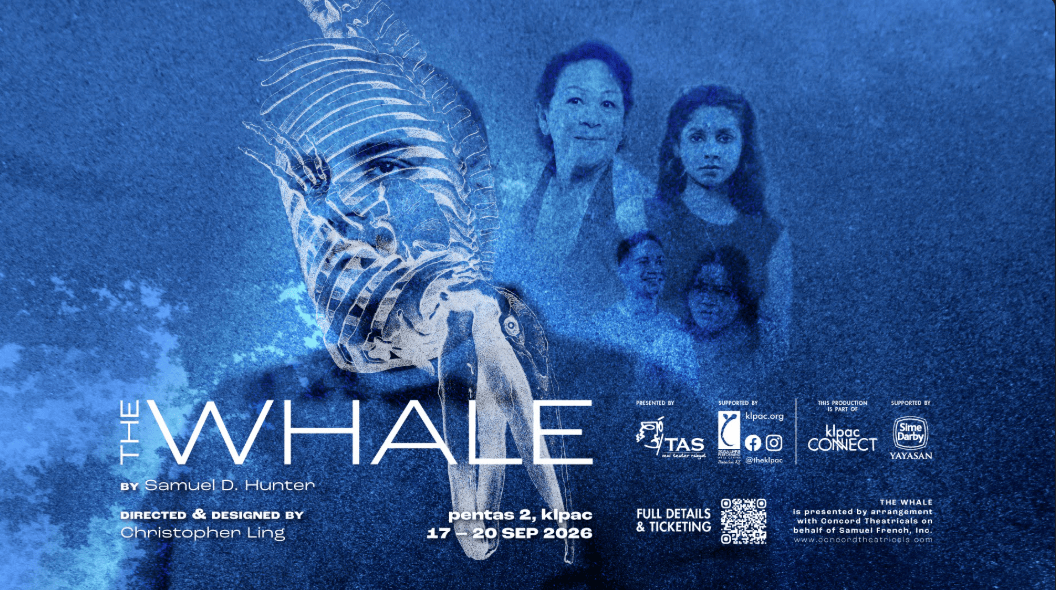

The Whale carries the weight of everything we cannot say in this emotional adaptation of Samuel D. Hunter’s play.
Duration: 120 minutes
There is a whale waiting for us when we enter the theatre. Not a living one, but its skeleton: a great, looming reminder of what once was, and of what remains after everything else has been stripped away. The cast is already onstage, inhabiting the space before the play properly begins. It is an unusually intimate way to receive an audience, as though we have walked into Charlie’s world rather than been invited to watch it from a safe distance. By the time his first online class begins, we already understand that we are going to spend the next few hours in a room where there is very little room left for anyone to hide.
Samuel D. Hunter’s The Whale, directed by Christopher Ling for The Actors Studio Seni Teater Rakyat, is an emotionally bruising play. On the surface, it is about Charlie, a reclusive English teacher who is eating himself towards death and attempting, in the little time he has left, to repair his relationship with his estranged daughter Ellie. But the play is really interested in the things people carry long after they should have put them down: guilt, grief, religious conviction, resentment, shame and the desperate need to believe that our lives have meant something to somebody.
Ling’s production understands that this is not a story that should be rushed. Much of The Whale unfolds with an almost uncomfortable slowness. We watch Charlie struggle for breath, struggle to stand, struggle to move across the room. We watch Liz monitor his health while simultaneously bringing him the food that is killing him. We watch the days change on the screen, only to discover that barely any time has passed. It can occasionally feel repetitive, even frustratingly so, but that repetition is also the point. Charlie’s life has narrowed to a series of small routines, and the audience is made to inhabit that narrowing with him.

It is a difficult thing to watch a man slowly die when there is no dramatic rescue coming. Sudhan Nair carries the production with a performance that demands as much physical control as emotional restraint. Beneath the prosthetics and the considerable physicality of Charlie’s condition, he finds a man who is painfully conscious of his own failures, yet still clings to the possibility that he might put something right before it is too late. What makes the performance affecting is the vulnerability that emerges in the quieter moments: Charlie’s attempts at humour, his awkward tenderness towards Ellie, and the shame that keeps him hidden from the world behind a webcam. Sudhan never allows the character to become merely a portrait of physical decline. Even as Charlie struggles to stand or catch his breath, there remains a mind searching for meaning and a father hoping that his daughter might still see something worth loving in him. It is this tension between the body failing him and the person still reaching out that gives the performance its emotional force.
Malin Faisal’s prosthetics and wardrobe deserve particular mention for the physical demands they place at the centre of the production. Charlie’s appearance is impossible to ignore, but the transformation serves a purpose beyond spectacle: it makes his struggle to stand, move and breathe painfully tangible. The challenge is to ensure that the character remains a person rather than becoming defined by his body, and Sudhan’s performance gives that physical transformation its emotional dimension. As Charlie’s condition worsens, the production’s visual language takes on an added poignancy, culminating in the recurring image of the whale and the suggestion of a weight finally being lifted. It is a striking example of how design can deepen a performance, giving physical form to feelings that the characters themselves often struggle to articulate.
Charlie’s refusal to go to hospital becomes less an act of stubbornness than an expression of someone who has already begun to accept that his life is ending. Even the $120,000 he has saved, money that could potentially help prolong his life, becomes part of that contradiction. Charlie has the means to fight for himself, but has somehow lost the desire to do so. What he wants instead is his daughter.
That makes his relationship with Ellie, played by Tania Ashwini is equally compelling as Ellie, bringing a combustible energy to a character whose anger is often easier to express than her hurt. She is spunky and sharp-tongued, with a willingness to be genuinely cruel to her father, but Ashwini never lets that aggression settle into a single note. There are flashes of vulnerability beneath Ellie’s hostility, moments when the anger seems less like a desire to wound Charlie than an attempt to make him understand the depth of the wound he has left in her. Ashwini also gives Ellie a youthful impatience that keeps the character from becoming simply a vehicle for the play’s heavier emotional themes. She can be difficult to like, but she is never difficult to believe. This makes the gradual shift in her relationship with Charlie all the more affecting: when she finally agrees to read his essay, the tenderness of the gesture lands precisely because Ashwini has not softened Ellie too soon or made forgiveness come easily.

The contradiction is what makes the relationship work; Charlie wants to give Ellie his money, his attention and whatever fragments of himself remain. But Ellie does not necessarily want any of those things. What she wants, perhaps more than anything, is an explanation. And when she finally begins to understand the circumstances surrounding her father’s relationship with Alan, the play’s anger begins to soften into something more complicated.
That emotional shift is beautifully handled; if Charlie and Ellie represent a relationship that has been damaged by abandonment, Junji Delfino’s Liz represents what happens when love turns into enabling. Liz is Charlie’s nurse and sister-in-law, and she is furious with him. She tells him to go to hospital. She monitors his blood pressure. She gives him equipment to track his health. She watches him deteriorate before her eyes. And then she brings him a sandwich.
It is one of the most uncomfortable contradictions in the play because Liz knows exactly what she is doing. She is keeping him alive and helping him die at the same time. Delfino gives Liz the anger the role demands, but there is always grief underneath it. When she finally discovers that Charlie has been sitting on enough money to potentially save himself, her rage is devastating precisely because it is rooted in love. She cannot bear the possibility that she might have been trying to save someone who had already decided he was beyond saving.

The production is equally strong when it embraces its Malaysian identity. There is no attempt to make this feel like an imported American drama performed by Malaysians pretending to be American. The occasional Malay dialogue, the Malaysian rhythms of speech and the revelation that Thomas is from Georgetown all help locate the production somewhere recognisable. Asraf Zulk’s Thomas is particularly effective in this regard. His awkwardness and earnestness feel less like an interpretation of a stereotypical missionary and more like an actual Malaysian young man who has become entangled in a situation he does not quite understand.
The production’s Malaysian sensibility also lends these religious and personal conflicts an unexpected warmth. Thomas first appears as a Mormon missionary who happens to arrive at Charlie’s door at a moment of crisis, but the easy assumptions surrounding his presence gradually unravel. As Charlie draws him into conversation, their exchanges become less about religious persuasion than two men trying to reconcile what they believe with what they have experienced. Ling largely avoids turning these discussions into blunt theological arguments, allowing the characters’ histories and contradictions to give them emotional weight. This restraint matters: Thomas is not simply a representative of the Church, nor is Charlie merely a man searching for answers. Both are confronting the possibility that the beliefs they once relied upon may no longer be enough.
The production’s visual and technical elements do much of the work of drawing us into Charlie’s increasingly constricted world. The skeletal whale that greets the audience establishes an unsettling mood from the outset, its stark physicality echoing the play’s preoccupation with bodies, mortality and what remains when everything else falls away. Christopher Ling’s set design gives the action an intimate, almost claustrophobic quality, keeping us close to Charlie’s daily struggles rather than allowing his suffering to become something we observe from a comfortable distance. The lighting, designed by Yusman Mokhtar, complements this sense of confinement, shaping the room’s atmosphere as the story moves between moments of uneasy stillness and mounting distress. Sound design by Xavier Chen further supports the production’s emotional rhythms, helping to sustain the tension without overwhelming the performances. Together, these elements create a world that feels lived-in yet increasingly oppressive, mirroring Charlie’s gradual physical and emotional unravelling.
The Whale‘s central concern is not so much whether God exists than what happens when people can no longer bear the possibility that He does not. Charlie clings to the hope that Alan might have found peace beyond death, while Thomas struggles to recover a faith shaken by his own experiences. For Liz, the Church is inseparable from the loss of her brother, leaving her to grapple with a grief that has hardened into anger. Their differing convictions offer little comfort against the same unbearable uncertainty: that suffering might have no greater purpose, and that some losses cannot be explained away. What emerges is not a neat argument for or against faith, but a portrait of people reaching for meaning wherever they can find it.

The play’s literary references to Moby-Dick become another way of approaching that question. Charlie’s fascination with the novel goes beyond a simple intellectual and wink-wink quirk. He finds something of himself in it, and in the story of Jonah and the whale. The whale becomes an image of enormous, almost incomprehensible things that humans are forced to confront. The irony, of course, is that Charlie has become his own whale.
The production does occasionally push its metaphors a little too firmly. The symbolism is rarely subtle, and some of the scenes underline an emotional point that the actors have already made convincingly. There are also stretches where the deliberately slow rhythm begins to feel more static than meditative. The Whale asks its audience to sit with discomfort, but there are moments when the production asks us to sit with it just a little longer than necessary.
Yet there is something valuable about the discomfort the production creates. Charlie’s body may dominate the room, but his physical deterioration is only the most visible expression of the suffering that binds these characters together. Liz is still grieving Alan, while Ellie’s anger towards her father conceals the hurt of having been abandoned. Thomas is struggling to reconcile his disillusionment with the faith that once gave his life direction, and Mary remains trapped in the wreckage of a family she can neither repair nor escape. Their burdens are different, but each is shaped by loss and the need to make sense of it. Charlie, meanwhile, seems to have absorbed the pain of everyone around him, as though carrying it might somehow make amends for his own failures.

One of the production’s most effective sequences comes through Charlie’s online teaching. He refuses to switch on his camera because he is afraid of what his students will see. We hear and see the students on the other side of the call, played with a welcome sense of local authenticity, but they know almost nothing about the man teaching them. When Charlie finally turns the camera on, the reaction is immediate: they stare.
And suddenly the audience is forced to confront an uncomfortable truth: we have been doing the same thing. Just as how the students look at him and are shocked, we have spent the play looking at Charlie’s body. We look at him and think we understand him. But neither group really knows what is happening inside him. It’s a small moment, but one that gives the production one of its sharpest observations about the way we encounter people through screens and appearances. We are remarkably willing to decide who someone is before we have heard their story.
When Friday arrives, Charlie’s remaining defences have all but collapsed. His health is failing, and his announcement that he will be replaced as a tutor feels less like a practical arrangement than an acknowledgement that his time is running out. Having spent much of the play hiding from the world behind his webcam, he finally switches on his camera and allows himself to be seen. But there is little triumph in this act of vulnerability. His breathing grows laboured, and the room that has held so much anger and resentment descends into panic as Liz calls for an ambulance. In the midst of it all, Charlie makes one final request of Ellie: he wants her to read his essay to him. It is a small, almost ordinary thing to ask at the edge of death, which is precisely what makes it so devastating.

It is a beautiful yet painful request. The essay, which Charlie has praised as the best thing he has read, becomes the last bridge between father and daughter. Ellie has spent the entire play refusing to give him what he wants. Now, as he struggles for every breath, she finally reads to him. Not everything has been forgiven, nor has their relationship been magically repaired, but at the end, what’s most important is that she stays.
The ending comes quickly, almost too quickly. After the measured pace of the preceding scenes, the final moments arrive with such force that there is barely time to process them. Charlie’s breathing slows. The lights take on an almost otherworldly quality. The physical weight that has defined him throughout the production seems, symbolically, to fall away. Suddenly, he is looking into the light.
The image is almost unbearably simple. For all the arguments about faith, for all the anger, for all the guilt, for all the food and money and resentment and failed relationships, Charlie’s final desire is extraordinarily small: he wants his daughter to read to him. Perhaps that is what makes The Whale so painful. It spends so much time talking about the enormous things, ranging from God, death, sin, redemption, bodies, grief, only to arrive at something very small and human – of wanting to be heard, to be forgiven, and to have someone just stay.

Ling’s production does not make The Whale comfortable, nor should it. It occasionally overplays its symbolism and its deliberate pacing will test some audiences. But its strongest moments linger precisely because they refuse to let Charlie become simply a body on a stage. Sudhan gives him a soul; Ashwini gives Ellie a furious vulnerability; Delfino gives Liz the unbearable contradiction of someone who loves another person enough to help them and hurt them simultaneously; and the ensemble gives the play a distinctly Malaysian pulse.
When the lights finally go down, what remains is not the image of a man who ate himself to death. It is the image of a father, breathing his last, listening to his daughter read. And for a brief moment, after all that anger and all that suffering, the room feels weightless.
Photo Credit: Tat Chin
The Whale played from 17th to 19th September 2026 at Pentas 2, The Kuala Lumpur Performing Arts Centre (klpac), Kuala Lumpur.
Production Credits
| Director/Designer Christopher Ling Cast Sudhan Nair, Tania Ashwini, Asraf Zulk, Junji Delfino, Jae Gomes Lighting Designer Yusman Mokhtar Prosthetics and Wardrobe Malin Faisal Sound Designer Xavier Chen |

