
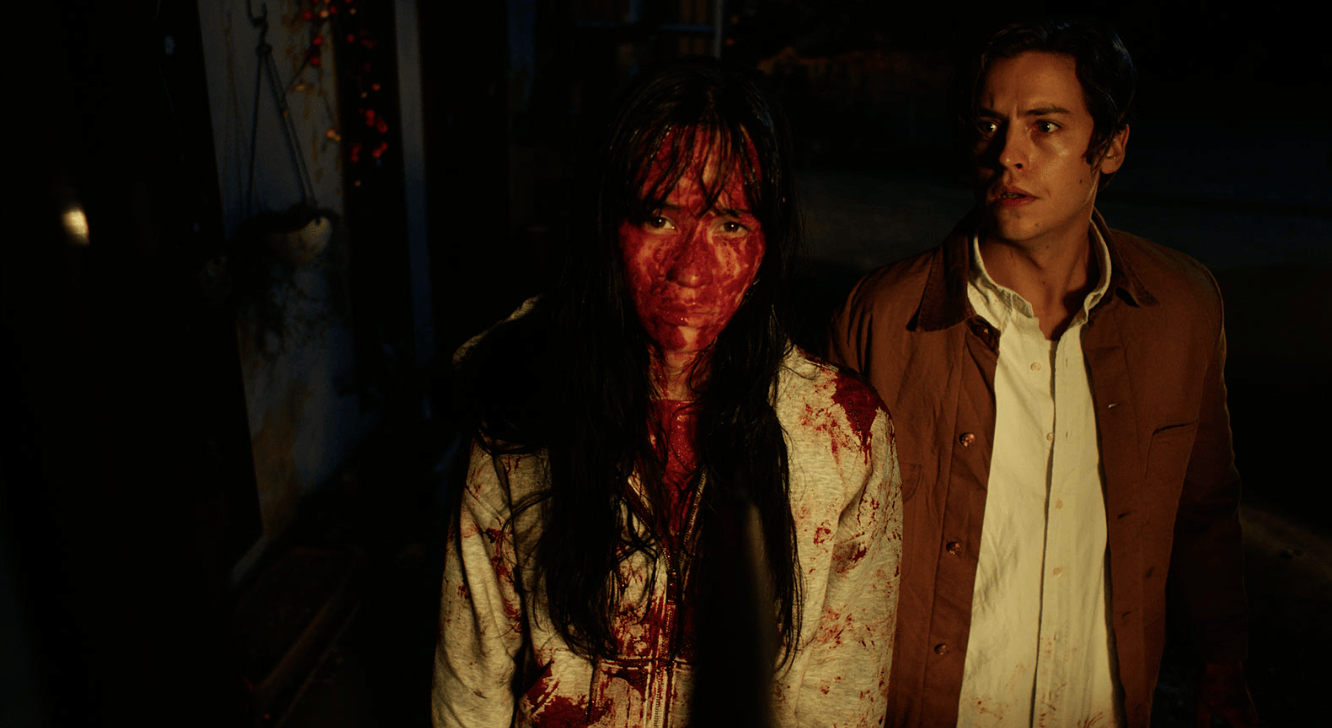
As the closing film of the 2026 Singapore International Film Festival, Eugene Kotlyarenko’s latest chaotic feature brings together Cole Sprouse and Kiko Mizuhara in a delirious exploration of online identity, internet fandom and the strange ways we turn our lives into content.
Vintage denim and livestreaming. Japanese genre cinema and American internet culture. Online fandom, urban exploration and organised crime. In the hands of most filmmakers, these ingredients might make for an impossible pitch. For Eugene Kotlyarenko, they make a movie.
His latest feature, Vintage Violence, brings together worlds that seem at first to have little in common, then throws them into a collision of comedy, action and digital-age absurdity. Starring Cole Sprouse and Kiko Mizuhara, the film moves between American and Japanese settings, using split screens, text messages, phone footage and livestream comments to tell a story shaped by the internet’s appetite for spectacle.
It is a fittingly unruly choice for the closing film of the 2026 Singapore International Film Festival (SGIFF). At a media roundtable at Marina Bay Sands, Kotlyarenko described his approach to tone and genre with a simple measure: “Am I enthralled? Am I captivated? Am I seeing something I haven’t seen before?”
“As a writer and director, and as a film viewer, I don’t really make distinctions between tones or genres,” he explained. “I think that’s the kind of film we’re trying to make.”
He likes films that are difficult to categorise, describing his preference for work that feels “schizoid”, because, as he sees it, “our culture is schizoid”. It is a sensibility that suits a film about a world in which the boundaries between entertainment, performance and real life are constantly shifting.

The premise of Vintage Violence grew out of several of Kotlyarenko’s interests, rather than a single grand concept. Friends who collect and sell vintage clothing introduced him to the world of Japanese denim collectors. His interest in urban exploration offered another piece of the puzzle: people discovering vintage denim in unexpected places while exploring abandoned buildings and other locations.
“I have some friends who are vintage clothing collectors and sellers,” he recalled. “One of them specialises in denim, and he told me all of his biggest clients are in Japan. So I was like, ‘Oh, that’s interesting.’”
From there, he began imagining a livestreamer and urban explorer who discovers vintage denim, and a fan who invites him to Japan. The story could bring together two characters from different cultures who first connect online before meeting in person. “For me, the motivation was to figure out a way to bring two characters from two different cultures together online first, and then to see what happens when they connect in real life,” he said.
The idea also grew from something he had observed: people forming deep virtual connections with others they may never have met. “Is it real?” he wondered. It was a question he felt cinema had not explored enough.
His love of Japanese films, particularly genre and yakuza cinema, helped complete the picture. The production brought him together with Japanese actors including Pierre Taki and Hitoshi Ozawa, whom he described as hilarious and unusually open to improvisation.
“Films should make you feel things inside of you and observe them in the world,” he said. “You synthesise this because it makes sense in your mind. So hopefully when you see it, it’ll make sense to you.”

The instinct to bring seemingly unrelated things together is also reflected in the film’s visual language. Its digital elements are not simply references to contemporary technology; they are part of the way its characters experience and interpret the world.
Kotlyarenko had already explored livestream culture in his 2020 feature Spree, starring Joe Keery as a fame-obsessed man who goes on a killing spree. But Vintage Violence shifts the focus towards the connections that form online, and what happens when those relationships cross into physical space.
For Mizuhara, who plays Izumi, the film’s many moving parts meant that understanding her character’s unseen history was particularly important. “There’s so much going on in the film,” she said. “Izumi’s background isn’t really in the film, but I wanted to connect all the dots so that I wouldn’t get lost in the chaos.”
Her solution was a mind map. She wanted to understand why Izumi and Carter might connect despite never having met, and how the relationships around them fitted together. “I just wanted to try to find where they connect,” she explained. “I think that really helped.”
Kotlyarenko was amused by the thoroughness of her preparation, joking that she had made a mind map when he had not needed anything of the sort.
Sprouse described a different but equally structured approach to working within the film’s unpredictable style. He tries to establish a neutral version of a scene before experimenting with different possibilities, taking into account how much time and how many takes are available. “As long as you can kind of attack from a place of control from the jump, you’re allowed a lot of freedom to play,” he said.
For him, preparation is not the opposite of spontaneity. It is what makes spontaneity possible. That sense of collaboration became one of the cast’s strongest memories of the production. Kotlyarenko, who often makes films with people he has known for years, was surprised by how quickly he bonded with his two leads.
“I was just surprised by how quickly I bonded with Kiko and Cole, and how comfortable I felt,” he said. He was also impressed by how prepared they were, joking that when he works with friends, he sometimes has to ask whether they have even looked at their lines.
Mizuhara appreciated the openness of the working environment. “As actors, we want compliments,” she said, laughing. “We want to hear that we did good.”
When feedback from the director was not immediately forthcoming because he was busy, the actors would encourage one another instead. “We were like, ‘You look good, that was a good take.’”
She found the experience unexpectedly reassuring. In the past, she explained, she might have gone home wondering whether she had done well, sometimes even crying because she did not know how her performance had been received. “I learned so much from him that you can actually, it’s okay to just constantly communicate if you have anything,” she said. “And complimenting each other.”
Sprouse agreed that open communication was essential. For actors, he observed, scene partners are often the first people to experience a performance directly. He credited Kotlyarenko with establishing an environment where the cast could offer honest feedback without taking offence. “That’s the lifeblood of making a movie,” he said. “You need to be able to communicate honestly.”

The roundtable at Marina Bay Sands was one part of a wider SGIFF visit. Earlier that day, at the National Museum of Singapore, Kotlyarenko delivered a mini-lecture on Vintage Violence and the internet culture that has long informed his work, before being joined Sprouse and Mizuhara for a festival forum and audience Q&A.
The lecture offered a useful lens through which to view the film. Kotlyarenko returned to ideas he had explored in Spree: livestreaming as a form of performance, the internet’s appetite for spectacle, and the uneasy overlap between a person’s private life and the version of themselves they present to an audience. In a livestream, he suggested, the act of being watched can become part of the event itself. The performer is not simply sharing an experience; they are shaping it around the possibility of an audience, and the audience’s attention can in turn influence what happens next.
This is central to the characters in Vintage Violence, whose characters move through a world where moments are continually captured, broadcast and interpreted. The film’s split screens, text messages and livestream comments are not just visual flourishes: they reflect how digital platforms mediate the characters’ relationships and how online attention can transform ordinary experience into content. Kotlyarenko’s delivery was also fascinating, as he projected his screen for all to see, including while scrolling through his lecture notes, and leaving his previous films used as examples on loop throughout, quite literally exemplifying our modern habits of mind.
The lecture also connected Kotlyarenko’s filmmaking to a broader question about media and perception: when technology changes how we communicate, does it also change how we understand one another? Vintage Violence begins with two people who connect online, but it is interested in what that connection means when they meet in person. The film’s central tension is not simply between the internet and “real life”, but between the intimacy people can feel online and the uncertainty of translating that intimacy into the physical world.
The forum brought those ideas back to the film itself, hosted by SGIFF Programme Director Thong Kay Wee and Festival Ambassador Rebecca Lim, with Sprouse and Mizuhara reflecting on its deliberately unruly style, its cultural crossings and the characters’ attempts to connect. The audience Q&A extended the conversation beyond the filmmakers’ own intentions, giving festivalgoers a chance to consider how the film’s questions about visibility, performance and online life might resonate in their own experiences.
Together, the events offered three ways into Vintage Violence: the lecture traced the ideas behind it, the forum explored how those ideas took shape through the film and its performers, and the Q&A opened them up to the audience.

The film’s interest in online behaviour is more than a matter of style. Its characters inhabit a world in which identity is constantly being presented, interpreted and circulated—and where the desire to connect can quickly become a source of exposure.
For Sprouse, who grew up in front of cameras, the experience of public attention offers a particular perspective on the film’s concerns. He observed that people who spend a lot of time online often become accustomed to being criticised, mocked or provoked. “The people that are really good at navigating the space, like, address it head-on,” he said. “They’re okay with it, and it washes over them.”
He sees this as an increasingly necessary skill for entertainers, who must learn to deal with both extremes of online attention: “undying love” and “severe criticism”.
Mizuhara’s relationship with social media is more intimate. “I treat my Instagram like a diary,” she said, “even though now it’s become a business tool.” She tries to be genuine, but has become more cautious about what she shares, particularly when it comes to revealing her location. The possibility of strangers turning up somewhere after seeing a post has made her more protective of her privacy.
For her, Instagram remains a way to stay connected with friends around the world. She uses the Close Friends feature to share more selectively, but is also conscious of how easily a post can be misinterpreted. “You’re trying to post something positive, but people can just take it as something negative,” she said. “I try to be careful.”
It is a revealing account of the contradictions the film explores. Social media offers connection, but also scrutiny; self-expression, but also the possibility of losing control over how others interpret you.
Sprouse took the discussion further when asked what piece of technology he would remove from modern life. His answer was immediate: the camera on the phone. “I think the camera on the phone needs to be demolished,” he said. His objection was not simply to the volume of images being produced, but to the constant possibility of being recorded.
“We are living with a pretty consistent paranoia of filming that can happen at any point in our day,” he said. “And it has severed us from one of, I think, if not the most important emotion for creation and artistry, which is embarrassment.”
He believes the fear of being caught doing something awkward, silly or embarrassing has made people more self-conscious. “We used to operate with a certain level of anonymity,” he reflected. “And in that anonymity, and that embarrassment or whatever it was, we used to grow a lot.”
It is a striking observation from someone who has spent much of his life in the public eye. In Vintage Violence, the act of recording becomes more than a technological habit: it is tied to performance, identity and the desire to be seen.

If Sprouse would do away with phone cameras, Mizuhara would bring back magazines. She remembers growing up with magazines as a source of information and inspiration, discovering websites, music, films, places and people through their pages. She still collects old issues and misses the distinctive styles and subcultures that flourished in Japan, particularly from the late 1980s through the early 2000s.
“I grew up reading magazines,” she said. “All the information that I was getting was from magazines.”
She would find a website mentioned in an article, visit it, make friends or even build her own website after learning how to do so. Magazines introduced her to “cool girls and cool places and music and movies”.
“I still collect all these old magazines,” she said. “I really miss that so much.”
She acknowledged that social media has made global connection easier, and that it is also how people have been able to discover her. But she feels something has been lost in the shift away from magazines.
Kotlyarenko agreed that magazines offered a form of curation that the internet does not necessarily provide. Their editorial teams helped readers find material that was substantial and meaningful. “The algorithm is not a team of cool editors,” he said. “They’re not the same.”
He also remembered the street culture of 1990s Harajuku, where people would deliberately dress up and gather in public spaces, sometimes hoping to be photographed. It was a different kind of visibility, rooted in physical presence and a shared cultural scene. “I want to get rid of the algorithm, the curatorial algorithm,” he said. “I think it sucks. It really limits what people can explore.”
Mizuhara was not entirely convinced. “I like the algorithm,” she countered, prompting a brief disagreement about whether people would simply have to search harder to find interesting things without it.
The exchange was light-hearted, but it touched on a serious question at the core of the film: who decides what we see, and how much of our experience is shaped by the platforms through which we encounter the world?

Kotlyarenko is particularly curious about how audiences in different countries will respond to the film. He recalled screening it with the Japanese crew, who had initially been unsure about its humour. “They were like, ‘This is an action film. Is it a comedy?’” he remembered. But when they finally watched it together, they laughed, much to his relief.
He found the response encouraging, though he is still interested in how audiences with different cultural sensibilities and online habits will interpret the film.
He mentioned the Philippines and Brazil as places with particularly visible fandom cultures. The film, he suggested, acknowledges that world through its characters: Izumi is almost an extension of fandom culture, while Carter represents another side of it. “I put all this stuff in a movie because I see it in real life all the time,” he said. “I don’t see it in a movie, but I see it in real life.”
He hopes audiences will recognise those behaviours wherever they are watching from. Singapore, with its own highly connected culture, will offer another perspective.
The film’s cultural contrasts also emerged in the cast’s memories of making it in Japan. Kotlyarenko recalled a purification ceremony at a temple in Kabukicho before production began. The monks prayed for the film and its actors, chanting their names and the film’s title as part of the ceremony. “It was a really great bonding experience,” he said. “I do feel like we were very lucky.”
The cast also shared memories of exploring Japan and trying local food. One recurring topic was hormone, a Japanese term for offal dishes that became something of a running joke among the group. Kotlyarenko was particularly enthusiastic about it.
The lighter memories offer a counterpoint to the film’s frenetic energy, and suggest that the collaboration was as much about building relationships off-screen as it was about finding a shared creative language on set.

For all its stylistic excess, Vintage Violence is not simply a warning about technology. Its participants have different relationships with the internet, and none offers an easy solution to its contradictions.
Mizuhara values social media as a way to connect, even as she becomes more protective of her privacy. Sprouse sees the phone camera as a threat to spontaneity and anonymity. Kotlyarenko is fascinated by the internet’s capacity to connect people and shape culture, but wary of the algorithms that increasingly determine what we encounter.
Their perspectives make for a lively conversation around a film that is itself built on collisions: between cultures, genres, identities and ways of seeing. As the closing film of SGIFF 2026, Vintage Violence promises a suitably unpredictable finale. Its combination of comedy, action and digital-age unease may not fit neatly into one category, but that is precisely what Kotlyarenko wants.
He is less interested in giving audiences a tidy answer than in making them feel, observe and question the world around them. And in a film about the spectacle of other people’s lives, perhaps the most unsettling question is not who is watching, but what we are willing to do once we know they are.
Vintage Violence closes the 37th SGIFF on 1st November 2026. More information and tickets available here
The 37th SGIFF runs from 21st October to 1st November 2026. More information and lineup available via their website here

