
A gloriously unhinged love letter to cinema, Japanese culture, connection and the internet and a guaranteed cult classic, best enjoyed as a midnight special with company.
Duration: 105 minutes
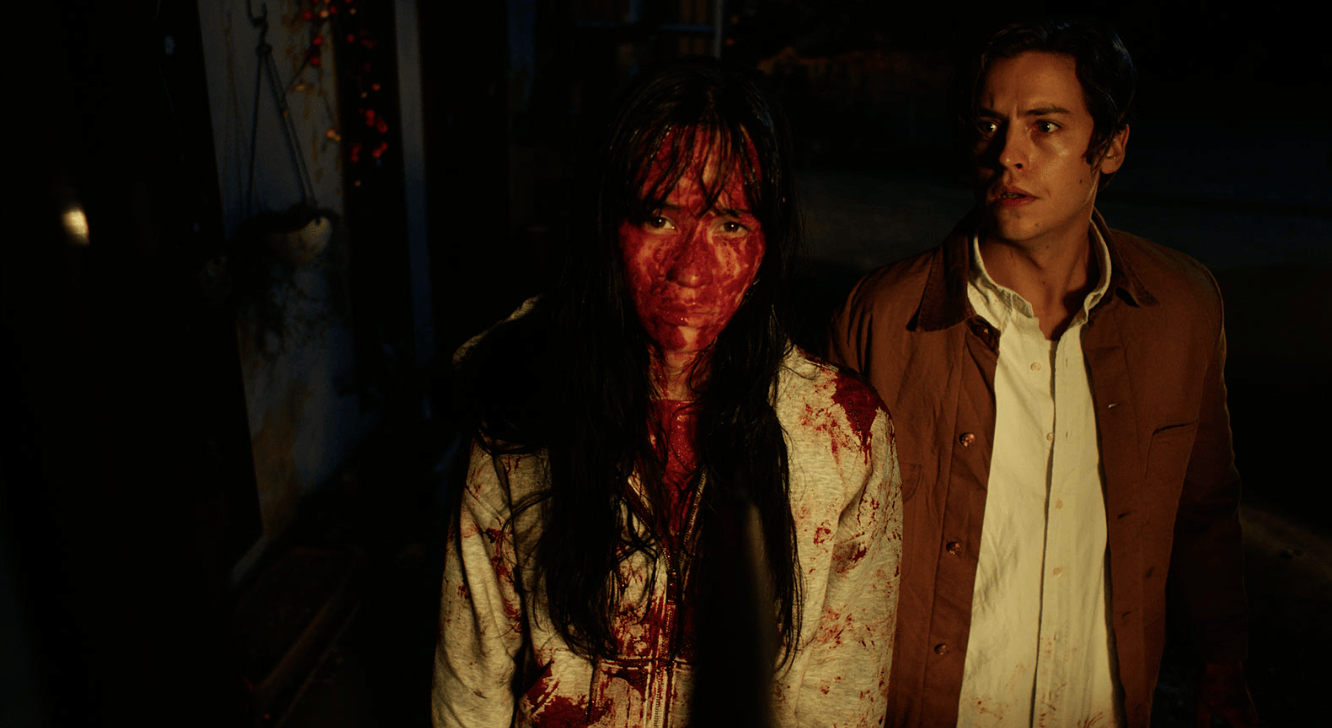
There are films that ask you to suspend your disbelief, and then there is Vintage Violence, which asks you to throw it out the window, hand it a livestreaming phone and chase it through Tokyo. Eugene Kotlyarenko’s latest is a deliriously entertaining collision of romantic comedy, crime thriller, yakuza homage and internet-age absurdity. At 105 minutes, it is wild, bloody, funny and unexpectedly heartfelt, and you leave the cinema convinced that this is destined to become a 2026 favourite for many.
The film opens with Carter (Cole Sprouse), an urban explorer livestreaming his adventures in Colorado, where he stumbles upon a stash of vintage Levi’s jeans. Thousands of miles away, Izumi (Kiko Mizuhara) is watching from Japan. She recognises the potential value of the denim and pays to get Carter’s attention, setting in motion a chain of increasingly ridiculous events that brings him to Japan. What follows is a madcap journey through the country’s denim trade, criminal underworld and digital subcultures, with a budding romance at its centre.
One of the film’s most immediately striking choices is how it incorporates the internet into its visual language. The livestream comments are not merely decorative overlays; they become part of the viewing experience, giving us a second screen to read and react to as the action unfolds. Some of the comments are genuinely hilarious, including some incredibly culturally-aware contributions from Singaporean Matt Chan. The opening is deliberately overwhelming, but that sense of information overload is precisely the point. We are not simply watching someone livestream, we are watching alongside an audience, with all the strange intimacy and chaotic commentary that comes with it.
Technology is everywhere in Vintage Violence, but rarely does it feel like a gimmick. Livestreams, direct messages, video calls, location sharing, facial recognition, AirTags and AirPods all become integral to the story. The film is particularly inventive in the way it uses sound and connectivity as a means of tracking characters. At one point, the familiar crackle of an AirPods connection becomes a clue, turning an everyday piece of technology into an unlikely instrument of suspense. It is a clever and often very funny reminder of how thoroughly our devices have become extensions of ourselves, and how easily those same extensions can make us visible, traceable and vulnerable.
Even in the seemingly out there ideas, there tends to be a real-world precedent as well, such as the film’s livestream hotel, inspired in part by Japan’s Asahi Ryokan which famously experimented with offering a room for ¥100 a night in exchange for guests allowing their stay to be broadcast live online. The film takes the basic premise of turning one’s privacy into a commodity and pushes it somewhere far more extreme. It is an especially fitting idea in a story so preoccupied with the strange economics of online attention: what we are willing to expose, what an audience wants to see, and what happens when being watched becomes a way to survive.
This technological inventiveness also feeds into the film’s more thoughtful ideas about connection. Academic Marshall McLuhan’s ideas about technology as an extension of the human body and the relationship between medium and message come to mind. Vintage Violence seems fascinated by the contradictions of living through our screens. We can be connected to someone on the other side of the world, share our location and soundtrack, and find one another through the smallest digital traces. Yet we are also constantly recording ourselves, being watched and leaving behind information that can be used to find us. The film turns that tension into both a source of comedy and a driving force of its plot.
For all its bloodshed and technological chaos, however, the film’s emotional centre is surprisingly old-fashioned. Beneath the crime caper is a rather sweet romantic comedy about two people who find themselves drawn to one another in the most unlikely circumstances. Carter and Izumi’s first day together has the gentle rhythm of a date: they eat, walk around, share music and slowly build a sense of trust. He introduces her to his rather unconventional musical tastes, including the wonderfully bizarre 10 hour loop of the “Loneliest Whale Song”, while she opens up the world of Japanese city pop to him. Their shared AirPods become a charming symbol of the connection forming between them.
One of the most touching moments comes when Carter agrees to split the proceeds from the jeans with Izumi equally, rather than insisting on the more favourable arrangement he had initially considered. It is a small gesture, but it means something to her. Their relationship develops through these little exchanges, and the film gives their growing affection enough room to breathe amid the increasingly chaotic action. Sprouse and Mizuhara have an appealing chemistry, and their relationship gives the film a warmth that makes the violence around them all the more entertaining.
The film is also remarkably affectionate in its engagement with Japanese culture and genre cinema. Its world is packed with wonderfully specific details: tattoo-only bathhouses (fictitious, but fun to imagine), love hotels, neoprint booths, pachinko parlours, darts, host culture and the ubiquitous maneki-neko. The journey eventually takes us to Kojima in Okayama Prefecture, a place closely associated with Japanese denim. Denim is more than a plot device here; it becomes a point of cultural exchange, a symbol of American identity and a rather absurd object over which an entire criminal enterprise is willing to wage war. The film plays with the relationship between American and Japanese culture without losing sight of its own heightened, stylised sensibility.
There is also an unmistakable love for Japanese genre cinema, particularly the traditions of yakuza films. The criminal hierarchy, elaborate betrayals, ritualised violence and larger-than-life characters all feel like part of a gleeful homage. Pierre Taki is a particular highlight as a returning exiled criminal whose mechanical finger is among the film’s most gloriously grotesque inventions. His character brings a wonderfully eccentric energy to the proceedings, while Hio Miyazawa’s denim-obsessed yakuza boss is every bit as absurd as the premise demands.
The violence is frequently gratuitous, occasionally stomach-churning and often so over-the-top that it becomes funny. A scene involving a blender is a particularly memorable example, made even better by an ingenious transition that turns the blender into the wheels of a motorcycle. Elsewhere, the film’s visual playfulness is just as inventive: darts are accompanied by video-game-like scoring graphics, and its transitions, framing and split-screen compositions keep finding new ways to surprise. The film wears its influences proudly. There are shades of Kill Bill in its stylised bloodshed, Scott Pilgrim in its playful graphics and heightened reality, and plenty of affection for the exuberant excesses of Japanese action cinema.
And yet, for all the mayhem, Kotlyarenko never lets the film lose its momentum. The script is remarkably tight, the pacing impeccable, and the humour arrives at just the right moments to break the tension. Carter’s anxiety over whether the precious jeans will be handled carefully during his flight to Japan, for instance, is made all the funnier by the casual way the people handling his luggage toss it around after assuring him they will take care. There are so many wonderfully ridiculous moments that it is almost impossible to pick a favourite. Just when you think the film has reached peak absurdity, it finds another way to surprise you. It is unhinged in the best possible way: gleefully chaotic, gloriously excessive and completely in on the joke. You will want popcorn for this one.
What makes Vintage Violence such a satisfying watch is that it never feels embarrassed by its own excesses. It is a film that embraces the possibilities of cinema as pure entertainment: the kinetic editing, the inventive transitions, the outrageous set pieces, the music and the sheer pleasure of watching a story spiral further and further out of control. But beneath all that spectacle is a sincere interest in the ways people connect, whether through a screen, a shared song or the simple decision to trust someone.
In the end, the jeans themselves become almost beside the point. What matters is what Carter and Izumi find in one another, and the connection they manage to preserve even when they are no longer physically together. The final moments, with Izumi dancing on a ferry as the credits roll, leave the film on a note that is unexpectedly tender after everything that has come before.
As the closing film of the Singapore International Film Festival, Vintage Violence feels like a particularly fitting choice. It is exuberant, unpredictable and immensely fun to experience with an audience. It is the kind of film that makes you want to turn to the person beside you, exchange a look and laugh at the sheer audacity of what you have just witnessed. More than anything, it is simply a joy to watch, the sort of gloriously unhinged cinematic ride that reminds you how much fun going to the movies can be. A little bit unhinged, a lot of fun, and full of ideas about the strange ways we live and connect today, Vintage Violence is exactly the sort of film that deserves to find its audience, and become the instant cult classic it feels destined to be.

Vintage Violence played on 1st November 2026 to close the Singapore International Film Festival. More information available here
The 37th SGIFF runs from 21st October to 1st November 2026. More information and lineup available via their website here
Read our coverage of the forum and roundtable held with Eugene Kotlyarenko, Cole Sprouse and Kiko Mizuhara here

