
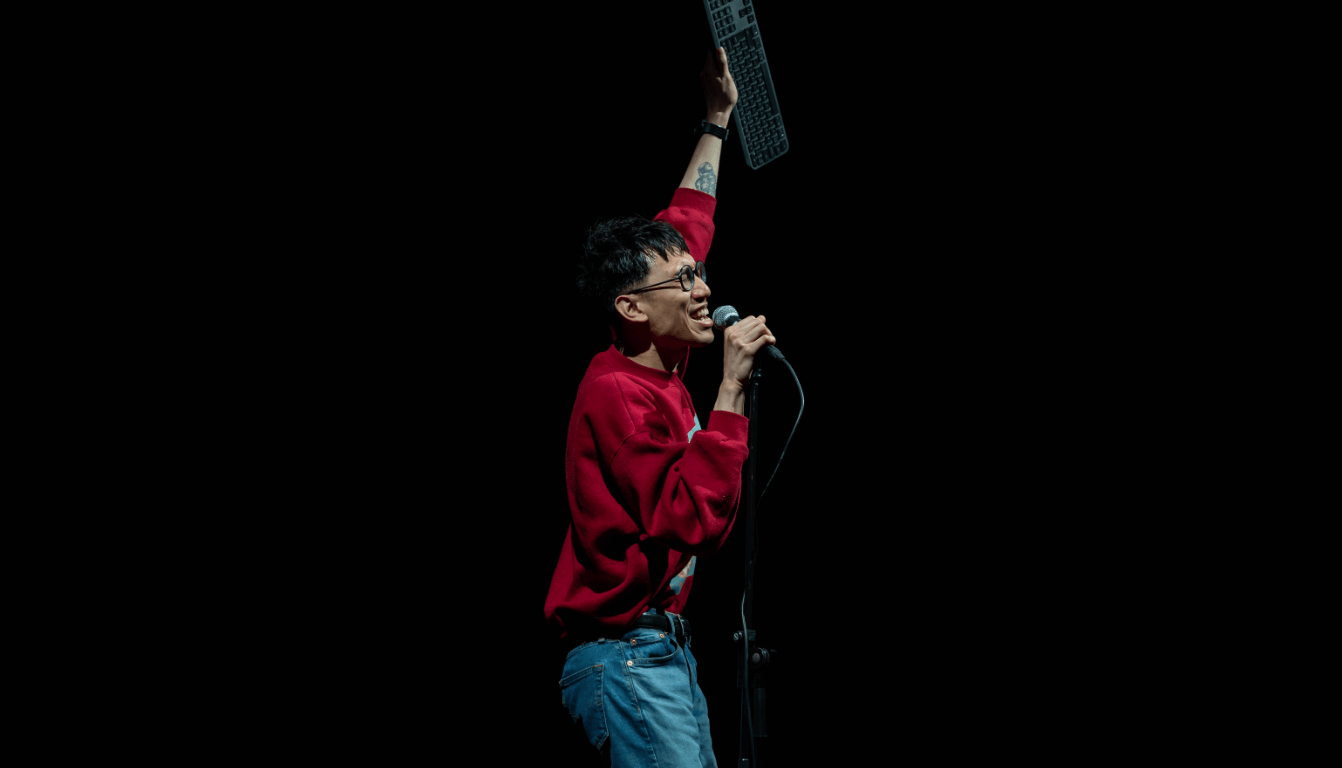

Taiwanese artist Wang Ping-Hsiang explores the uneasy tension between nationalism and violence in a winding piece of anecdotal theatre.
It is difficult to pin down exactly what kind of show Retina Manoeuvre wants to be. Playing at Theatre Practice’s Practice Space as part of the Singapore Fringe Festival, Berlin-based Taiwanese theatremaker Wang presents a relatively stripped-down setup: a desk, a laptop, a microphone, and a camera. There are no elaborate set pieces, and as with most one-man shows, the focus rests squarely on the performer and his words.
Oddly enough, the first words we hear are not Wang’s. Instead, he launches, off-key and with unrestrained gusto, into Alicia Keys’ “Girl on Fire,” as if expelling a day’s worth of pent-up emotion at a karaoke bar. Dressed in a red sweater, jeans, and black-rimmed glasses, Wang cuts a gentle figure: soft-spoken, earnest, almost disarmingly sweet.

“Girl on Fire” becomes the entry point into the work. Wang reflects on the song’s passion, its lyrics, and perhaps most importantly, its release date: 4 September 2012. From here, the show pivots toward memory and Wang’s deep-seated fear of forgetting. He reveals his obsessive documentation of life through his calendar app, projecting it onscreen and scrolling back through months and years in an attempt to anchor himself within time.
The date carries further personal significance: it is also his long-time partner’s birthday. Wang traces the evolution of their relationship, from a disappointing first trip to Mykonos to a trip to Hong Kong that changed everything (also on 4 September). Moving fluidly between postcards, house flyers, email archives, and online purchase histories, he recounts falling in love with the city, forming friendships within its art scene, and even buying an apartment there.

The narrative, however, shifts rapidly, sometimes to the point of near non sequitur. Wang’s jumps from focusing on the relationship to ignoring actually characterising his boyfriend turned partner, from house hunting to last-minute marriage jitters prompted by a newly ordained acquaintance. These abrupt transitions are disorienting, seemingly mirroring the fragmented nature of memory itself, but they also begin to test the audience’s patience. The sense that everything is building toward something remains, though its shape is still unclear.
That carefully constructed sense of stability eventually collapses. COVID-19 arrives in a Hong Kong still reeling from the Umbrella Movement. Friends begin migrating, connections dissolve, and Wang’s partner ends up stranded in Shanghai, leaving the couple indefinitely separated by lockdowns and borders. The life Wang has painstakingly archived suddenly feels fragile, even illusory.

A new symbol emerges: Disney’s 2020 live-action Mulan. Wang plays an extended battle scene before pivoting sharply into the show’s true crux: his own experience of compulsory military service in Taiwan. Footage of Taiwanese trainees performing bayonet drills fills the screen as they thrust forward, shouting “杀!” (“kill”). Wang recalls his training and confronts the growing unease that, amid escalating tensions between China and Taiwan, these drills may one day be enacted on real bodies. Friends are already being recalled for additional training; the hypothetical inches closer to reality.

At this point, Hong Kong, his partner, and his friendships disappear almost entirely from the narrative, as though they belong to a different show altogether. While the tonal whiplash is undeniably effective, it also raises the question of payoff. The earlier intimacy and detail begin to feel less like foundations and more like detours, sometimes endearingly rendered, but ultimately under-integrated. Much like the show’s title suggests, our “retinas” are manoeuvred, particularly when Wang speaks of eye drops meant to relax his vision but instead leave it irritated and blurred. Reality, too, becomes distorted under shifting political forces: friends into strangers, safety into threat, dreams into something far more precarious.
The ideas at play are compelling, even urgent, yet the experience is ultimately a frustrating one. The personal anecdotes, while evocative, often feel tangential rather than meaningfully woven together. Wang’s tendency to over-explain his intentions and every section leaves little room for ambiguity or audience interpretation, flattening moments that might otherwise resonate more deeply if we came to certain conclusions ourselves. The show arrives at a conclusion that feels overly neat and simplified: the world is uncertain, and everything can change in an instant.

As such, for all its revelations, Retina Manoeuvre paradoxically feels shallow by its end. We know many facts about Wang’s life, yet remain unsure of what has truly shaped him. His anxieties, while understandable, are never fully interrogated. There is no immediate danger, no lived experience of war, only its looming possibility. These fears, framed against an otherwise stable life, risk feeling abstract or even indulgent.
This disconnect may be especially pronounced for Singaporean audiences. The parallels between Taiwan’s and Singapore’s systems of military conscription are hard to ignore. For many male local viewers, the transformation of mild-mannered boys into disciplined soldiers is neither shocking nor revelatory, but deeply familiar. National service here is so entrenched that it is rarely questioned. What may read as alarming in a European context lands with far less impact in Singapore.

In the final scene, Wang strips off his red sweater to reveal a plain white T-shirt and lifts a yellow umbrella, an unmistakable symbol of Hong Kong’s resistance. As the audio of bayonet drills blares, he executes the same movements with chilling precision. Behind him, images of cities ablaze and buildings under bombardment flicker across the screen. “Girl on Fire” returns, now layered with the shouted “杀!” What was once an anthem of empowerment is transformed into something darker: a cry caught between pride, fear, and resignation.
Retina Manoeuvre asks how easily our memories, identities, and moral bearings can be reshaped by forces beyond our control. Yet in manoeuvring our vision so insistently, it leaves us with little space to see for ourselves.
Featured Photo Credit: Juha Hanse
Retina Manoeuvre played from 16th to 17th January 2026 at Practice Space. More information available here
Singapore Fringe Festival 2026 runs from 15th to 25th January 2026. Tickets and more information available here
Support the Fringe by donating to The Necessary Stage here
Production Credits:
| Artistic Creation and Performance k*hole karaoke – Wang Ping-Hsiang Dramaturgy Wan Shi Lighting Design Raquel Rosildete Lighting Assistant Sára Enyingi Artistic Producer Aurora Kellermann Graphic Design Hsieh Meng-Jiin Stage Support and Consultation Oh Soojin Lighting Support and Consultation Chou Yi-Ju Development Stage Assistant Director Chang Kang-Hua Subtitles and Touring Management Tien Yi-Wei |
 Bakchormeeboy