
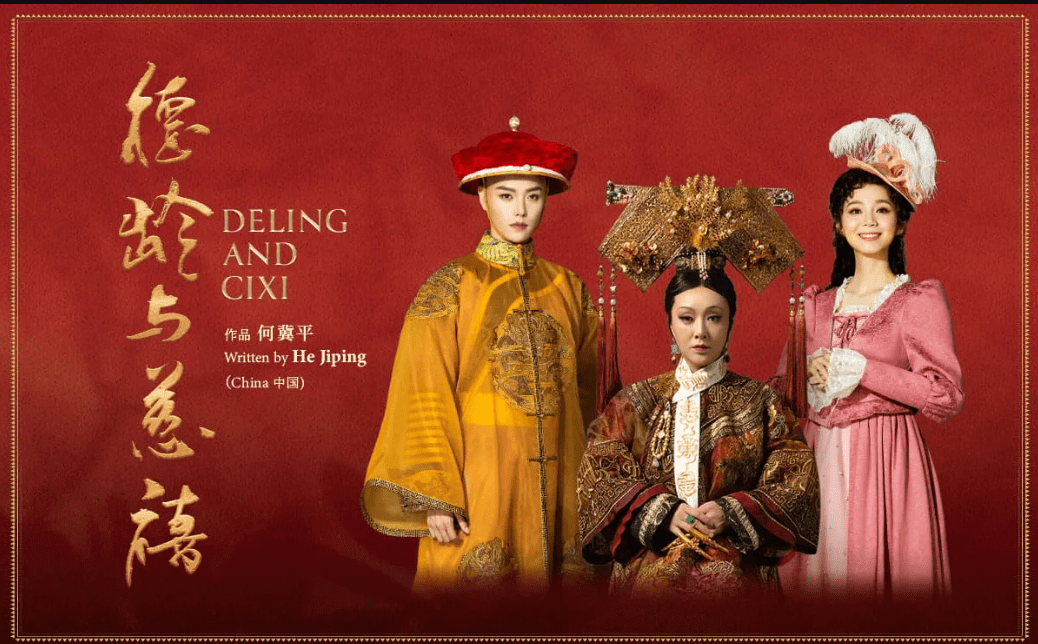
Set against the twilight of the Qing dynasty, Deling and Cixi brings together two formidable women at a moment when an empire and a worldview stands on the brink of collapse. Written by celebrated playwright He Jiping and directed by Roy Szeto, the play looks beyond familiar historical narratives to uncover an intimate, humane encounter between Empress Dowager Cixi and the Western-educated aristocrat Deling. Through their unlikely bond, the work reframes power, tradition and reform not as abstract forces, but as lived, deeply personal experiences.
As Deling and Cixi returns to the international stage at Huayi – Chinese Festival of Arts 2026, He and Szeto reflect on the enduring resonance of this story across cultures and generations. In this interview, they discuss history as lived humanity rather than legend, the delicate balance between spectacle and emotional truth, and how the collision of East and West continues to mirror the questions we face in a rapidly changing world today. Read the interview in full below:

Bakchormeeboy: Deling and Cixi places two formidable women at the heart of a collapsing empire. What first drew you, each in your own way, to this intimate encounter within such a monumental historical moment?
Roy Szeto: What initially captivated me was the humanity — the deeply private warmth between Cixi and Deling amid the clamor of an empire in decline. Empress Dowager Cixi is often portrayed as an iron-fisted ruler, but I was more interested in her loneliness, the tenderness and fear hidden beneath her authority. Deling enters this sealed world like a breath of fresh air, awakening a long-buried sense of humanity within this powerful woman.
For me, Deling and Empress Dowager Cixi is not simply a court drama, but a story about understanding and being understood — two women, two eras, two cultures illuminating one another at the edge of collapse. I chose this period because it resonates with my own life: we have all sought moments of gentleness under immense pressure. This play is not about “great women”, but about the truth that everyone carries a soul yearning to be seen. I hope that when audiences leave the theatre, they will show a little more kindness to those around them.
He Jiping: Among all historical periods, the Qing dynasty has always drawn great interest because it is closest to modern times. Deling’s memoirs about court life, such as The Fragrant Records of the Imperial Palace, have had considerable influence in mainland China. I read the book many years ago. Her account of returning from the West, entering the palace and serving Empress Dowager Cixi offers a rare and valuable perspective.
The book largely praises Cixi, but one sentence stayed with me: standing beside Cixi’s dragon bed, Deling wrote, “If only I could use this opportunity to do more.” What she could not do, I chose to do. I had long wanted to write this story, but struggled to find the right entry point. After living in Hong Kong for eight years, I finally found it. Hong Kong allowed me to experience the true fusion of East and West, and during the 1997 handover, I felt a strong connection between the city and Deling — a woman of mixed Chinese and French heritage, like a fresh breeze blowing into the Forbidden City.
Cixi is often judged in one-dimensional terms — corrupt, feudal, decadent — but historical figures should be portrayed as complex and human. She was both a ruler and a woman. While her actions cannot be absolved, she was also capable of reflection and reform. When Deling appeared at a time when the dynasty was nearing its end, she brought Cixi a glimpse of a world she wished to understand but never had. The dramatic tension lies in the encounter between an ageing empress and a young woman shaped by another culture. What I aim to write is not palace intrigue, but the vitality and hope born from the collision of cultures.

Bakchormeeboy: The play has resonated across time and cultures since it was written. In your view, what is it about the relationship between Deling and Empress Dowager Cixi that continues to speak to contemporary audiences today?
Roy Szeto: The conflict faced by Deling and Cixi is one we continue to experience today. One represents tradition, the other new ideas — and the tension between them reflects the inner struggle of wanting to move forward while fearing what may be lost. In our fast-paced society, we are still searching for belonging and self-worth.
After one performance, a young audience member told me that Deling reminded them of arguments with their parents not opposition, but two expressions of love. That is the play’s power: it becomes a mirror. Cixi’s persistence is not stubbornness, but a protection of roots; Deling’s rebellion is not rejection, but an embrace of possibility. Aren’t we all caught between family, culture and work? Without this human resonance, the play would not have survived. I hope audiences leave wanting to embrace their loved ones and say, “I understand you.”
He Jiping: There have been many versions of Deling and Cixi. Before the Mandarin version, the Cantonese and Mandarin productions were staged 65 times in Hong Kong — a rare achievement. What has been especially moving is its popularity among young people; at least eight arts institutions have staged it as a graduation production.
Director Tsui Hark once told me he cried while watching the play, not out of sadness, but because of acceptance. Drama speaks to universal human emotion, just as Shakespeare continues to do. The ending of Deling and Cixi is one of hope. Not everyone can realise their ideals in life, but when audiences see a more desirable version of themselves reflected on stage, that is the true power of art.

Bakchormeeboy: This production balances historical grandeur with deeply personal emotion. How did you work together to ensure that the human stakes were never overshadowed by spectacle?
Roy Szeto: I often reminded the team not to let the grandeur of history drown out the characters’ breath. No matter how magnificent the design, everything must serve the inner lives of the characters. We constantly asked: why is she silent? What is she afraid of? This ensures each scene becomes a shared emotional experience, not mere reproduction.
For me, the balance lies in restraint. History is the backdrop; humanity is the protagonist. Audiences come not for fireworks, but for the echo of their own heartbeats. Deling embodies the tension between tradition and change, a reminder that cultural integration is not about discarding the old, but reconciling difference to find a more complete self.
He Jiping: Every character in this play comes from my own heart. There are no truly evil figures. Even Li Lianying’s farewell to Deling carries dignity and meaning. Emperor Guangxu, too, is not portrayed as weak, but as intelligent and hopeful; his encounter with Deling offering a final glimmer of light after the failure of reform.

Bakchormeeboy: Deling represents a meeting point between East and West, tradition and change. How does this tension mirror questions we are still grappling with in today’s rapidly shifting world?
He Jiping: De Ling is one of my favorite female characters. Born and raised in China, yet receiving a systematic Western education, she naturally possesses characteristics of both Chinese and Western cultures. The protagonist of each play is the playwright himself, conveying my intentions and thoughts. As I mentioned earlier, De Ling and Cixi was written after I had lived in Hong Kong for eight years. Hong Kong allowed me to experience the joy and significance of the fusion of Chinese and Western cultures. This exchange continues with the development of the world; we continue to protect and promote Chinese national culture, without losing our traditions in accepting and learning Western culture. The fusion of Chinese and Western cultures is inevitably a global trend.
Bakchormeeboy: Jiping, you have written extensively about individuals caught within the tides of history. How does Deling and Cixi reflect your evolving perspective on women’s agency and power across different eras?
He Jiping: A vague history, a clear humanity. A script must first be engaging. Without engaging content, even the most profound truths and meanings cannot be conveyed. But this engaging quality isn’t about deliberately seeking sensationalism; it should arise naturally from the characters and the story, containing the author’s intention. De Ling and Cixi is precisely a story that fills history with human characters. Within the framework of historical themes, playwrights grasp the spirit of history without being bound by historical facts. Playwrights have creative freedom to offer new interpretations and developments of established facts, concretely translating the true spirit of antiquity into the modern era. When a writer’s hopes and ideas become a leap forward, that is my greatest satisfaction in writing historical dramas. De Ling and Cixi‘s leap forward in reflecting real history—for example, the scene of De Ling submitting a memorial on Empress Dowager Cixi’s birthday is entirely fictional. Consort Jin is only mentioned in historical records as “plump, smoking cheap tobacco every day,” but the script condenses this into her repeating the same phrase every day: “The mistress is right.” Historical figures should not be stereotyped, but rather portrayed as more multifaceted and relatable.

Bakchormeeboy: Jiping, having seen your work travel internationally and be staged in diverse contexts, what new meanings or nuances do you hope audiences in Singapore might discover in this production?
He Jiping: Singapore, like Hong Kong, is a treasure trove where Eastern and Western cultures converge. This inclusiveness and diversity resonates particularly well with the story that De Ling and Empress Dowager Cixi aims to tell. I love Singapore; it’s a beautiful and prosperous place. Singaporean audiences also have a high level of artistic appreciation. This is the third time my play has come to Singapore; the previous two were for the play The Best Restaurant Under Heaven, both of which were warmly received by Singaporean audiences. I hope that this time, when audiences enter the theater, they will feel a refreshing breeze blowing into the Forbidden City and find their ideal selves within the play.
Bakchormeeboy: Roy, you have directed Deling and Cixi alongside a wide range of contemporary and classical works. What unique directorial challenges and freedoms does this play offer you at this point in your career?
Roy Szeto: Directing De Ling and Cixi was both a challenge and a reward for me. Working with local actors in Beijing for the first time, rehearsing in Mandarin, allowed me to see a familiar cultural background from an “outsider’s” perspective. That process was like stepping into a mirror, rediscovering the complex temperament of Chinese women. In the creative process, I particularly enjoyed the thrill of “rediscovery”—the actors’ understanding, their life experiences, would in turn influence the director’s thinking. It was a feeling of constantly igniting each other, and it’s also why I love theatre so much.

Bakchormeeboy: As Deling and Cixi arrives in Singapore during the Lunar New Year celebrations, what wishes would you like to share with audiences for the Year of the Horse, or what you hope the audience would take away from the show?
Roy Szeto: The Year of the Horse symbolises movement and vitality. Though Deling and Cixi unfolds amid turmoil, it is ultimately about perseverance and imagination for the future. I hope audiences find strength in this story, the courage to love, and the courage to move forward. No matter how times change, the warmth of the human heart never goes out of date.
Deling and Cixi plays from 27th February to1st March 2026 at the Esplanade Theatre. Tickets available here
Huayi – Chinese Festival of Arts 2026 runs from 27th February to 8th March 2026 at the Esplanade. Full programme and tickets available here
 Bakchormeeboy