
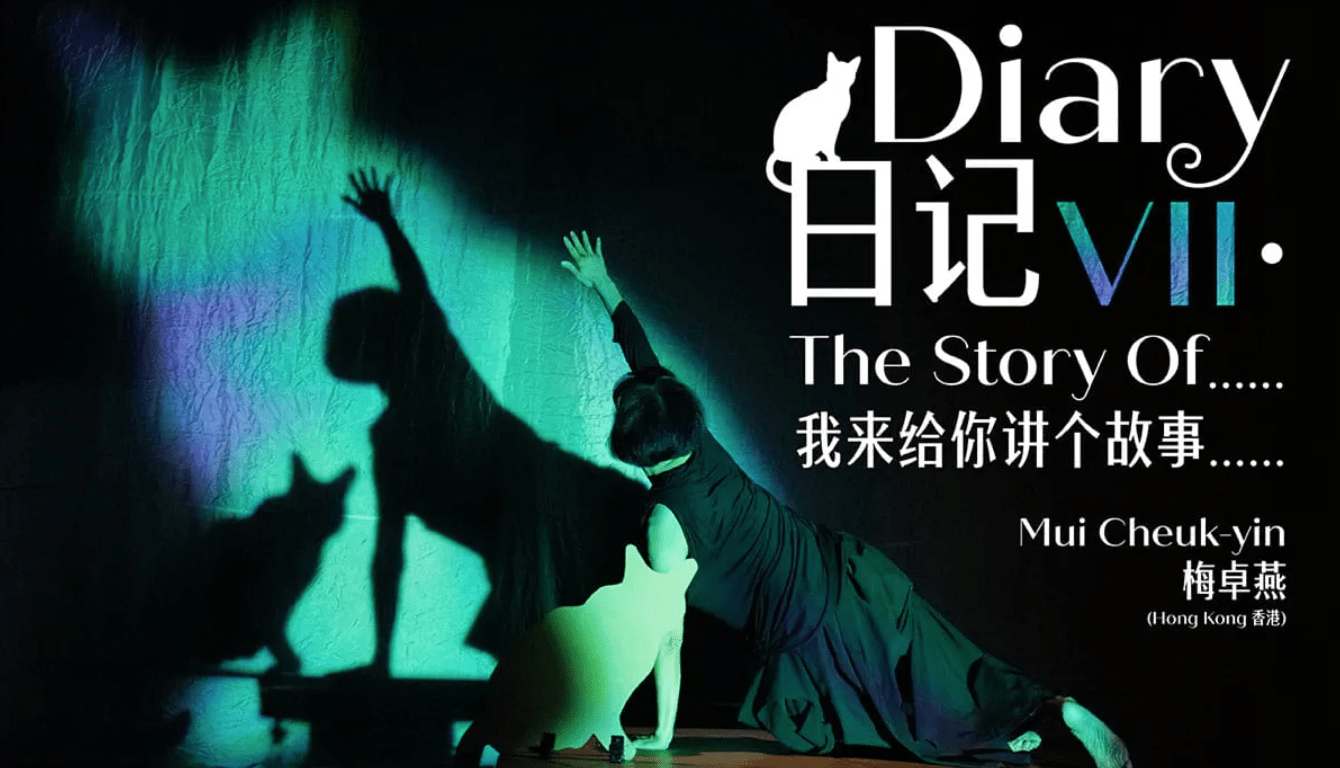
For more than four decades, Mui Cheuk-yin has shaped the language of contemporary dance in Hong Kong through works that are deeply personal yet quietly expansive. Her long-running Diary series, begun in 1986, traces a life in motion: recording memories, migrations, encounters, and the passing of time through the body. With Diary VII・The Story Of……, which makes its Singapore premiere this February as part of the Esplanade’s Huayi – Chinese Festival of Arts 2026, Mui returns to this autobiographical form with rare intimacy, drawing on everyday acts of care and companionship to reflect on larger questions of home, belonging, and displacement.
A solo work, the subject matter is unlikely but profoundly resonant: stray cats. Through her relationship with them, Mui finds parallels between feline instincts and human survival: drifting, adapting, enduring. Light, shadow, sound, and text become extensions of movement, shaping a poetic world where small, tender moments open onto universal experiences. Ahead of her long-awaited return to the Esplanade, Mui reflects on the evolution of her Diary series, the physical translation of memory and emotion, and what it means to revisit old audiences with a work so closely intertwined with her own life. Read the interview in full below:

Bakchormeeboy: Diary VII・The Story Of…… emerges from your long relationship with stray cats. How did this deeply personal connection evolve into a choreographic language that speaks to universal ideas of home and belonging
Mui Cheuk-Yin: From the age of 30, when I picked up my first cat on the street, I was thrust into a space completely different from living in Hong Kong. In this city, there were all sorts of stray animals, including cats. They might have been working cats, or left behind when someone left their old home, or they might have been lost, or they might have been born on the street after several generations, and so on. This sudden encounter with them in a city felt like a chance meeting, both familiar and strange. This kind of encounter, or the state of being adrift, wandering, and then surviving in this displaced environment, reminded me of my own childhood home and family experiences.
In my family, whether it’s my mother’s or father’s family, it was from our third generation—our grandparents—that we left mainland China and went to live in different places. From childhood, I’ve witnessed my elders moving or relocating to different places. I was born in mainland China and came to Hong Kong at the age of 14; arriving in Hong Kong suddenly felt like an encounter in a vast sea of people. Hong Kong has always been known as a transitional city, where people from different places meet briefly, reside, and then disperse to all corners of the world. In my dance work, Diary VII, I extend this experience to the state of human existence.
While caring for stray cats, I discovered that some cats have disabilities, such as blindness due to illness. These cats rarely find homes, so they usually live with me. It was this long-term, close companionship, especially with this blind cat, that opened my eyes—how it used its body and instincts to overcome its disability and live a lively and happy life. This directly influenced me, someone who expresses myself through dance. I gained so much inspiration from it.
Bakchormeeboy: The Diary series has accompanied you for nearly four decades. Looking back, how has your understanding of autobiography in dance changed since you began this journey in 1986?
Mui Cheuk-Yin: In 1986, I was in my early twenties and wanted to keep a diary, but I had no concept of autobiographical dance. As a dancer, I wanted to use theatre and dance to write my diary. This was just a simple starting point; I began to record events, experiences, and feelings that had a significant impact on my life. A dance genre that originates from oneself, such as dance theatre, actually records, while recording, also records events of that era that I cared about, and indirectly reveals a social state of that time. My understanding of autobiographical dance gradually evolved into a very interesting form of seeing an era or a society from the perspective of the individual.

Bakchormeeboy: This work engages themes of displacement and migration with remarkable restraint and sensitivity. How do you navigate translating such complex emotions into movement without over-defining them?
Mui Cheuk-Yin: The creation of this dance wasn’t a theme-driven process. The primary element was a cat, and then my feelings and interactions with it. This included its actual presence before me, its silhouette at dusk, and our interactions at home. This work can be seen as two parallel lines running simultaneously, primarily expressing my memories of my time with the cat—whether in form, movement, or circumstances—and how this relationship is conveyed. In this respect, I didn’t need to seriously consider the discrete meaning expressed in each state.
My memories of being with them are quite unpredictable; for example, sometimes the cat would suddenly disappear. When I expressed this perspective on those times, I indirectly fell into that sense of separation, or the drifting nature of our lives, a certain characteristic of life’s wandering. This construction is very interesting; it uses very small things to indirectly address a complex theme. Because the subject of cats is very physical, it allowed me to approach a complex emotion from a relatively relaxed or warm perspective.
Bakchormeeboy: Light, shadow, words and sound play a crucial role in shaping the emotional landscape of Diary VII. How did you conceive this interplay, and what does it allow you to express beyond movement alone?
Mui Cheuk-Yin: Light, shadow, text, and movement didn’t occur in a pre-designed state; they were essentially based on my life and state with my cats, exploring possibilities in form.
Initially, when considering how to involve the cat in the work, I wondered whether to bring a real cat onto the stage or use a toy puppet cat. After much deliberation on how to handle these two different themes, Lee Chi Wai (Lighting Designer) quickly used his lighting ideas to carve out cardboard and wooden cats. This cat was originally one of my cats, a replica of its form from a photograph. A light and shadow cast on the cat’s form closely resembled our initial ideas about shadow puppetry, puppetry, and other forms of puppetry. This effect was very convenient because with light, it could appear and disappear at any time; furthermore, we used a rotating platform as a base, making the cat very lifelike in the theatre. The effect arises from our creation of something from nothing. Starting with a cardboard cat and a turntable, we gradually explored the possibilities of expressing this form, progressively constructing the state of a city, a home, or even an airplane or airport. We also presented this situation through music, and finally, the introduction of language played a magical role. When concrete language conveys a message within a relatively abstract image, a truly authentic dialogue is created.

Bakchormeeboy: You are often described as embodying an “east meets west” aesthetic. How does this duality manifest in Diary VII, both consciously and intuitively?
Mui Cheuk-Yin: When creating this diary series, I didn’t consciously incorporate Chinese dance elements as I had in my previous works. For example, I used to interact contact improvisation techniques with props commonly used in Chinese dance—a more conscious fusion of technique, body, or concept. But in this diary series, I didn’t think that way, since the themes all stem from my life experiences. Especially since this is about cats, I didn’t consciously try to address or explore anything special. But on another level, I allow for this kind of “East-meets-West” fusion. For example, in our musical approach, we don’t mind the source of the music, whether it’s Western or Eastern, any form of music is fine. As long as it helps express a certain situation, I’ll accept it.
Bakchormeeboy: Returning to the Esplanade after more than ten years, what does this moment mean to you personally and artistically?
Mui Cheuk-Yin: Of course, it’s very happy. Every time I performed here before, whether in collaboration with others or with my own work, I established a relationship with the Singaporean audience or with the Esplanade’s theatre. I feel that returning now, finally through my own dance, with dance carrying more direct personal experiences, allows me to have a deeper conversation with the audience I’ve built up before, like seeing old friends again. This is something I’m very, very happy about, and a rare opportunity.

Bakchormeeboy: As an artist who has shaped and witnessed generations of dance in Hong Kong, what continues to drive your curiosity and commitment to solo performance today? How much has the Hong Kong dance scene changed today?
Mui Cheuk-Yin: Initially, I wanted to create a solo dance because of limited resources. When starting a creative project without resources, the easiest thing to do is probably to start on your own. Once a form started, I felt it was a great creative method because it doesn’t require any burdens and can be engaged in anytime, anywhere. Gradually, I also felt that this form was quite unique among various choreographical forms. For example, when creating group dances, I need to deal more with space, time, combination, and how to use flowing energy to express a group. But creating solo dance can be very personal. Whether it’s my own solo or a solo I do for others, it’s very much based on my personal characteristics. For me, it’s a unique opportunity to see some precious and authentic aspects.
Bakchormeeboy: As you reconnect with audiences in Singapore during the Lunar New Year, what wishes would you like to share with audiences for the Year of the Horse, or what you hope the audience would take away from the show?
Mui Cheuk-Yin: This work deals with themes of life, encounters, and family, ultimately aiming at genuine and sincere communication. The most genuine connection between people, or between people and other animals, is selfless giving and heartfelt care. That kind of love doesn’t need words; you can feel it in every action, situation, and attitude. I hope this most authentic exchange, this sincerity, can be experienced in our lives. I wish everyone a new year where they can better appreciate and cherish these fleeting moments of interaction, encounters, communication, and love. These things aren’t inevitable, they don’t last forever, so cherishing the present is incredibly important.
Diary VII ・ The Story Of…… plays from 27th to 28th February 2026 at the Esplanade Theatre Studio. Tickets available here
Huayi – Chinese Festival of Arts 2026 runs from 27th February to 8th March 2026 at the Esplanade. Full programme and tickets available here
 Bakchormeeboy