
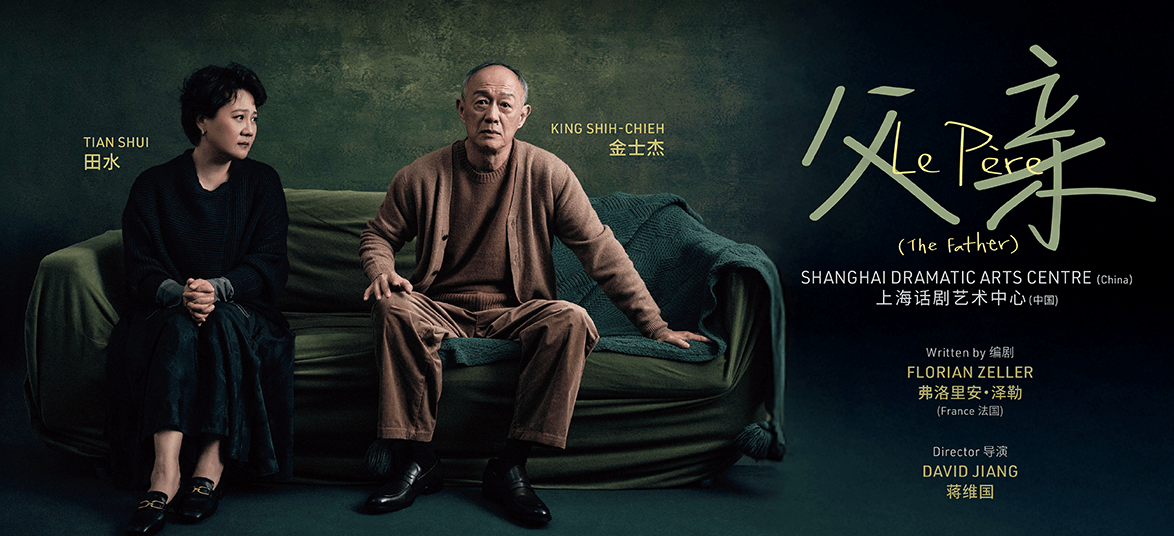
Quick-witted and sharp-tongued, André is used to commanding every room he enters. But as small ruptures begin to surfac;a missing watch, rearranged furniture, unfamiliar faces at the dinner table, the boundary between memory and reality starts to dissolve. Le Père (The Father) draws audiences into the disintegrating inner life of an ageing man confronting Alzheimer’s, unfolding with unsettling intimacy and emotional precision.
Presented as part of Huayi – Chinese Festival of Arts 2026, the award-winning Mandarin adaptation of Florian Zeller’s celebrated play is staged by the Shanghai Dramatic Arts Centre and stars Taiwanese theatre master King Shih-chieh, alongside China national first-class actress Tian Shui. Since premiering in 2024, the production has toured across China to critical acclaim. In this interview, King reflects on inhabiting André’s fractured consciousness and the profound questions of love, loss, and forgiveness at the heart of the play. Read the interview in full below:

Bakchormeeboy: Le Père (The Father) invites audiences into the fragile interior world of memory loss. What drew you to this work, and what felt most urgent about staging it now?
David Jiang: I was completely captivated by this script. It was the first time I’d seen a script express the inner spiritual world of a person in such a unique way. The script offers no superfluous explanations or elaborations; it simply depicts the father’s experiences and his interactions with those around him in seemingly ordinary ways. However, as the performance progresses, numerous incomprehensible events gradually emerge. The plot, characters, and scenes appear disjointed yet are always interconnected, prompting continuous reflection. The question-filled plot twists and the intense emotional fluctuations keep the audience gripped until the very end. Performing such a script on stage achieves a truly remarkable effect: it makes the audience unconsciously enter the disrupted inner world of this father suffering from Alzheimer’s disease, viewing everything around him from his distorted inner perspective, thus leading the audience to a deeper experience of the character’s genuine feelings.
In my initial conversations with the producer, I expressed my genuine admiration and love for the script. We also recognized that the illness depicted in the play has become a source of worry and suffering for countless families, making the play relatable and understandable to the audience. Indeed, from before rehearsals until dozens of performances, I heard countless people, including members of our cast and crew, speak of their family members or elderly acquaintances suffering from this illness, and the unspeakable pain and torment it brings. This is precisely why the play evokes empathy in the audience; I sincerely hope that as people gain a deeper understanding of the feelings of these patients, they will reflect more deeply on how to care for them.
King Shih-chieh: What attracts me most to this play is its central image: time. Time is like flowing water, ceaseless, eternal, and ever-flowing, without color, emotion, expression, right or wrong, or discussion. It washes away the appearance of everything in life until it’s all gone. Amnesia is a universal worry; as time passes, everyone and everything becomes a thing of the past. Alzheimer’s disease can be seen as a metaphor; everyone is like that patient, constantly battling their distorted memories. Those fears, anxieties, even rage and breakdowns—these are the stories that inevitably unfold when people confront the concept of time. André’s story is our shared story.

Bakchormeeboy: The play constantly destabilises the audience’s sense of reality. How did you collaborate to shape an experience that mirrors the emotional disorientation of Alzheimer’s without losing clarity or compassion?
King Shih-chieh: Trust the script. The playwright is incredibly talented, writing a brilliant and moving piece, and creating a novel narrative style. He is also responsible; it’s a story with a distorted timeline and characters, but with a clear and precise structural design. During rehearsals, the actors and director often had debates about different interpretations. These “blind men and the elephant” situations were anticipated by the playwright, and even anticipated by the audience. For example: Does the youngest daughter really exist? Whose house does she live in? Is the daughter’s fiancé really violent?… During rehearsals, the director and actors constantly explored, taking it one step at a time. It wasn’t easy to achieve order amidst the chaos, to glimpse the true nature of the events through the fog, or rather, the true nature the playwright wanted us to read. More precisely, we found the path and embarked on it with peace of mind, while the true nature of the events was left behind.
David Jiang: Such an unconventional script structure makes the stage presentation both very challenging and very interesting, and the interesting aspect stems precisely from the challenge. Because the play interweaves the realistic elements with the protagonist’s delusions during his illness, the presentation of time and space on stage contradicts our familiar habits, easily confusing the audience. However, this is probably precisely the author’s ingenious intention: to draw everyone into the patient’s chaotic inner world. This irregular concept of time travel, for our actors, contradicts their usual creative methods, requiring rapid and leaping changes and adjustments in the logic of emotions and actions during performance. Therefore, we spent a considerable amount of time reading the play, discussing, discerning, and selecting appropriate ways of expression. The entire rehearsal process was both challenging and joyful. The outstanding acting and deep understanding of the character by Jin Shijie, who played the father, the delicate and moving portrayal of the character by Tian Shui, who played the daughter, the earnest and precise performances of every other actor, and the consistent communication and exchange throughout the rehearsals—all these provided a powerful driving force for the final stage presentation. Because the script was highly polished, we all reached a tacit understanding: to maintain the greatest possible realism and lifelike quality in the performance. This style would convey the script’s multifaceted themes in the simplest and most unadorned way: love, confusion, seeking, and struggle. We would portray genuine human nature in an unadorned and straightforward manner.

Bakchormeeboy: This Mandarin adaptation has toured widely across China. How do cultural context and language influence the way audiences respond to André’s story? How relevant and hard-hitting are these issues in China these days?
King Shih-chieh: Like in Tuesdays with Morrie, the reactions of different audiences to “André, Anna, and Laura” in The Father are remarkably consistent—a universal appeal. One play deals with ALS, the other with Alzheimer’s disease; while not the majority in the population, the so-called minority is far greater than we imagine. Aside from names, cities, and certain lifestyle habits, the scripts still use Western terminology. The story of The Father is simply about an elderly family member growing old and sick, the daughter diligently caring for them, and not daring to reveal that she’s sent them to a nursing home. This situation is probably similar in every family, or perhaps people are simply preparing for it. Through skillful translation and the performers’ pursuit of a lifelike portrayal, the messages and meanings conveyed by this story resonate not only across China but also globally. The drama directly addresses each and every “you.”
Bakchormeeboy: At its core, the play is about love, dignity and letting go. How did you ensure these emotional truths remained central amid the work’s complex structure?
King Shih-chieh: This is a charming question, like a theatre enthusiast worrying about the many detours and pitfalls the play might take, lest the performers lose their way. To answer this, we must return to the playwright, his starting point in writing the play, his layered analysis of the characters, how he guided this falling family page by page… and the performers must read and understand these: the author’s sincere intentions, his deep compassion for the father and daughter, and his unvarnished exposure of the darker aspects of life. Only then will our direction in staging and performing the play be clear. Although the plot unfolds with a complex and multi-layered narrative, this does not prevent us from clearly and accurately conveying the original intention of the script. Behind every page burns the playwright’s intense passion.

Bakchormeeboy: With a career spanning continents and theatrical traditions, how did your experience as a scholar and educator inform your directorial approach to Le Père? How did the team make it feel distinctly different from other productions of The Father, besides the translation?
David Jiang: We placed great emphasis on using the visual imagery of the stage space to depict the tragic process of the ailing father’s life gradually becoming empty. We put a lot of research and effort into the stage design, aiming to help the audience gradually adapt from the initial confusion and understand that they were witnessing the protagonist’s inner world. Our stage design utilized a rotating stage to facilitate rapid and smooth scene transitions. Combined with changes in lighting, it gradually transformed a warm and comfortable apartment into a cold and desolate space. The furniture in the room gradually decreased, concretely showing the father’s loneliness and desolation. The green plants that had been there from the beginning were replaced by the few remaining leaves on the vines above the stage, symbolizing his unwillingness to accept defeat and his still-struggling spirit. We imbued the stage with dynamism to externalize the father’s fluctuating emotions: when his mind begins to wander, the revolving stage subtly shifts the space, as if the world beneath his feet has lost its balance, becoming unstable and unsteady. We also designed a moment of dramatic stage rotation between two scenes depicting the father’s impending admission to a nursing home. The stage rotates at an increasing speed, revealing a long corridor to the audience. The father wanders through the corridor, unable to find his way out. As the stage rapidly rotates, he enters a room, only to find himself lost again, returning to the corridor to open another door. Finally, as the revolving stage comes to a stop, he finds himself in a nursing home room with nurses. This transition, characterized by the actor’s emotionally charged, silent performance accompanied by powerful music, vividly portrays the father’s disorientation and his struggle to find reason and a way out.
Bakchormeeboy: What new insights did this production offer you about directing intimate psychological realism at this stage of your career?
David Jiang: Looking back on my directing career, I’ve encountered many different types of scripts, both ancient and modern, traditional and contemporary. What I value most is: does this play move me first, and what is it that moves me? In good scripts, some evoke a sense of dread with their sharp and profound ideas, others draw me in irresistibly with their intense emotions, and still others ignite a strong desire to try them out with their unique and unexpected dramatic structures. In fact, I feel that every play is an exception, so I always approach directing a new play with a cautious spirit of exploration and discovery. Father is no exception. This seemingly realistic script completely subverts the norms of realism, creating a unique structure and narrative perspective with its own entirely new logic, while conveying a high degree of emotional intensity and profound meaning. Encountering such a compelling play is not easy; I was completely moved. As a director, seeing how the stage ultimately radiates the power that moved me, and which I hope to move the audience, is the greatest reward for me.

Bakchormeeboy: André is both sharp-witted and deeply vulnerable. How did you approach inhabiting a character whose authority and identity are gradually slipping away?
King Shih-chieh: I had a loving father, and I am a father myself, and I am getting older. I know the bitterness that comes with age; every father inevitably goes from shouldering the burden of the family to becoming a peripheral figure. Authority is gone, but authority hasn’t been forgotten. André is even worse off; his only base is his home, and it seems his home is about to disappear as well. Amnesia further humiliates him, and his most prominent characteristic is “insecurity.” This feeling burns within him every second, from the first word of the script to the last. Every subsequent action stems from it: suspicion, doubt, misunderstanding, lying, irrationality, rage, aggression, persecution complex, begging, insomnia… and of course, things worse. Will he be able to avoid these predicaments and get a good night’s sleep because of amnesia? Sometimes, maybe. But wouldn’t a suspicious person even distrust their own bed? Like all those suffering in the world, his only support is perhaps his remaining “survival instinct.”
Bakchormeeboy: As you share this deeply human story with Singapore audiences during the Lunar New Year, what wishes would you like to share with audiences for the Year of the Horse, or what you hope the audience would take away from the show?
King Shih-chieh: This story depicts a certain predicament of life; it doesn’t explicitly offer any life lessons. But what is certain is that through this play, you will be more willing to be closer to your family when you go home, and you will be more willing to care about your health. This is the gift this play can offer during this festive season.
David Jiang: I am very pleased that The Father is being performed in Singapore during the Lunar New Year, and I sincerely hope that the experienced Singaporean audience will appreciate this play. Although this is not a celebratory Lunar New Year drama, and it has its moments of severity and tears, it can still encourage people to reflect on family ties, understand life, and look at their own lives and everything around them with more understanding during the New Year.
Le Père (The Father) plays from 6th to 8th March 2026 at the Esplanade Theatre. Tickets available here
Huayi – Chinese Festival of Arts 2026 runs from 27th February to 8th March 2026 at the Esplanade. Full programme and tickets available here
 Bakchormeeboy