
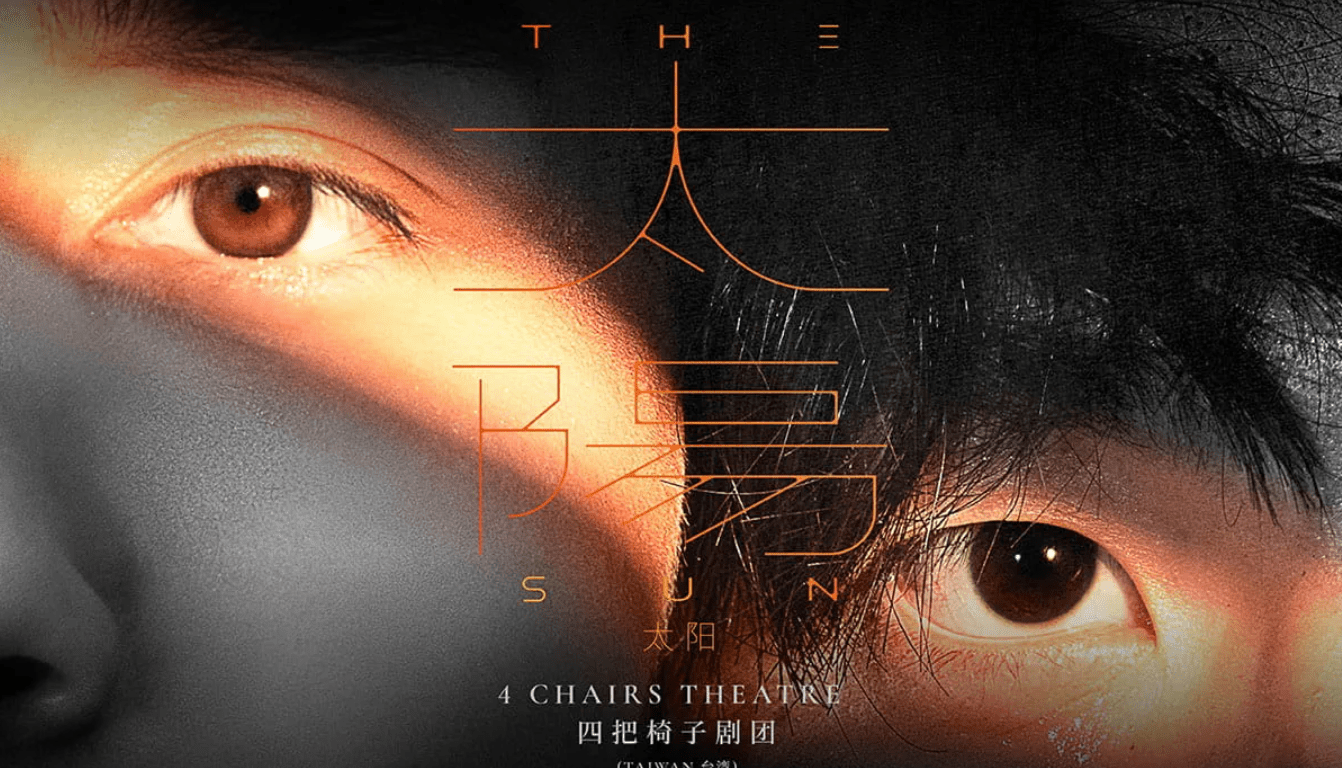

Set in a post-apocalyptic future marked by division and survival, The Sun is a contemporary reimagining of Japanese playwright Tomohiro Maekawa’s celebrated science fiction fable. Directed by award-winning Taiwanese theatre-maker Tora Hsu, with script adaptation by Chen Yi-en, this new staging reframes the work through a distinctly Taiwanese lens, responding to the fractures, anxieties and ideological tensions of the present moment. Premiering internationally at Huayi – Chinese Festival of Arts 2026, The Sun confronts what it means to coexist in a world increasingly shaped by fear, difference and competing truths.
In our interview, Hsu and Chen reflect on revisiting The Sun in a post-pandemic world, the challenges of localisation and adaptation, and how theatre can hold contradiction without collapsing into easy moral judgments. They also discuss the role of video and “new realism” in shaping the production’s dystopian landscape, and share their hopes for dialogue and encounter as the work meets audiences in Singapore this February. Read the interview in full below:

Bakchormeeboy: The Sun imagines a fractured future shaped by fear, survival and division. What compelled you to revisit this story now, in a post-pandemic world?
Tora Hsu: After the pandemic, global tensions and interpersonal conflicts have become sharper and more visible. Whether in politics, values or how we imagine the “other”, division increasingly feels like the norm. Returning to The Sun at this moment is, for me, a response to this global condition, and to how fear and anxiety shape the way we treat one another. The science fiction setting creates a necessary distance, it allows us to step away from immediate reality and examine the present from a more reflective, detached perspective.
Bakchormeeboy: This production reinterprets a Japanese science fiction classic through a Taiwanese lens. How did localisation shape your artistic decisions while remaining faithful to the spirit of the original? What was preserved or what was changed?
Tora Hsu: For me, localisation is about making the theatrical experience more grounded in the “here and now”. I retained the core spirit of science fiction and allegory in the original work, but rethought it through a Taiwanese context. By adjusting language, rhythm and cultural sensibility, the audience can connect the metaphor of the play to their own identity, history and contemporary experience. What changes is not the framework of the story, but how it speaks to the audience.
Chen Yi-En: Many elements of The Sun cannot be directly transplanted to Taiwan. Japan is largely ethnically homogenous, and its geographic scale is far larger than Taiwan’s. In the original work, the two races metaphorically reflect inequalities between central and local power structures. In Taiwan, these dynamics are harder to communicate through the same narrative relationships. The adaptation therefore seeks new ways to connect with Taiwan’s specific political tensions and conflicts.

Bakchormeeboy: The play confronts extreme positions and ideological divides. How did your collaboration navigate the balance between empathy and confrontation on stage?
Tora Hsu: My focus is not on right or wrong, or good versus evil, but on the irreducible contradictions that exist between them. The dramatic tension of The Sun comes precisely from this imbalance. I deliberately avoid turning characters into fixed representatives of ideas, and instead allow conflict to remain unresolved. This invites audiences to resist premature judgment, and also reminds me not to fall into overly simplistic moral evaluations myself.
Chen Yi-En: As mentioned earlier, ideological clashes of this kind are actually very familiar within Taiwan’s vibrant democratic culture. As a result, moments that may have felt highly tense in the original version become humorous or even absurd highlights in this adaptation.

Bakchormeeboy: With video design playing a significant role in this staging, how did visual elements contribute to the emotional and philosophical weight of the work?
Tora Hsu: In this production, video not only amplifies the characters’ inner states, but also functions as a metaphor for gaze and power. Who is being watched, and who is watching, is itself a power relationship. At the same time, video helps us construct a theatrical sense of science fiction on stage, allowing the future to be felt and perceived rather than simply described.
Bakchormeeboy: For Tora, your directing practice often centres on collectivity and “new realism”. How did these principles inform your approach to a dystopian narrative like The Sun?
Tora Hsu: Collectivity is essential for me, especially as a way to resist labelling people or characters as simply right or wrong. I am more interested in how groups operate under pressure than in individual heroes or villains. “New realism”, meanwhile, is how I understand theatre itself: theatre cannot replicate reality as it exists outside the stage, but can only respond to it through transformation. This idea has a subtle but natural affinity with dystopian narratives.
Bakchormeeboy: For Tora, as Artistic Director of 4 Chairs Theatre, how does this production reflect the company’s evolving relationship with audiences and contemporary social realities?
Tora Hsu: Compared to many of 4 CHAIRS THEATRE’s earlier works, which focused more on personal and emotional themes, The Sun carries much stronger political and social implications. For me, it reflects not only a shift in my own aesthetics and life experience, but also an invitation to audiences to offer new stimulation and encourage reflection on their own position in the world.

Bakchormeeboy: For Yi-en, adapting a well-known text comes with both responsibility and freedom. What were the most challenging choices you faced in reshaping the script for this new context?
Chen Yi-En: For me, the greatest challenge in any theatrical adaptation is always language. Theatre is not a two-dimensional reading experience, but a three-dimensional, empathetic one. How a character speaks reveals their temporal and spatial context, and their upbringing, even more than their stated personality. Translating the Japanese context into a near-future Taiwan, while preserving the weight and core of the original work, required very careful judgment, selection and expansion.
Bakchormeeboy: As The Sun makes its international premiere in Singapore during the Lunar New Year, what wishes would you like to share with audiences for the Year of the Horse, or what you hope the audience would take away from the show?
Tora Hsu: Although The Sun is not an especially cheerful work, being able to come to Singapore at this time and meet audiences from different cultural backgrounds is meaningful in itself. “Encounter” is a key concept at the heart of this piece. I hope The Sun can serve as a starting point for exchange, and that we can have a warm and sincere dialogue with Singaporean audiences.
Chen Yi-En: I hope that this work, though set in the future, can offer reminders and encouragement in the present — and leave future generations with a sense of blessing and comfort from the past.
Photo Credit: Yellow 黃煌智
The Sun plays on 28th February and 1st March 2026 at the Singtel Waterfront Theatre. Tickets available here
Huayi – Chinese Festival of Arts 2026 runs from 27th February to 8th March 2026 at the Esplanade. Full programme and tickets available here
 Bakchormeeboy