
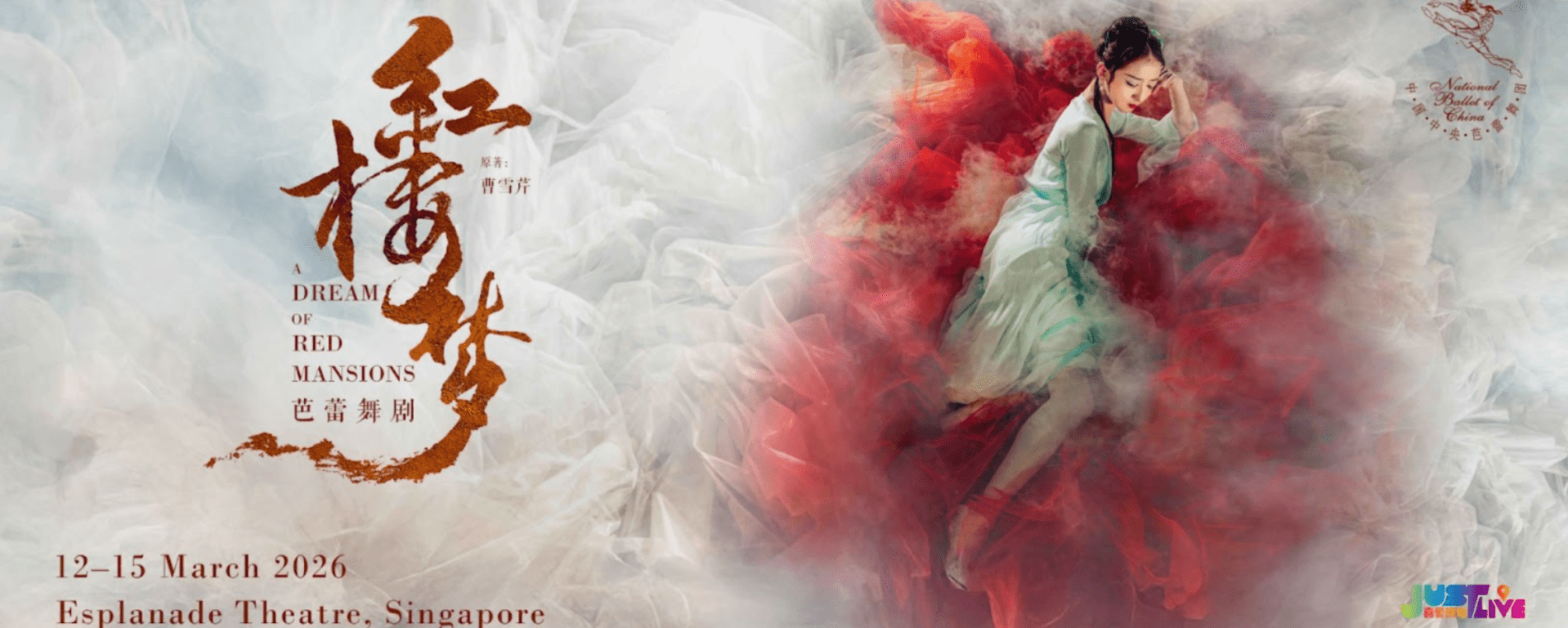
When audiences step into A Dream of Red Mansions this March, they will be entering a world suspended somewhere between memory and dream.
The ballet, performed by the National Ballet of China, transforms one of China’s most beloved literary works into a lyrical stage experience. Inspired by Cao Xueqin’s 18th-century novel, the production blends classical ballet vocabulary with Chinese movement aesthetics to evoke a fragile emotional landscape, one shaped by love, youth, and the quiet awareness that everything beautiful is fleeting.
Choreographing the work is Tong Ruirui, whose work often bridges traditional Chinese culture with contemporary stage language. For Tong, translating the monumental novel into dance was never about recreating every detail of its sprawling narrative. Instead, the challenge lay in distilling its emotional core. “I have an impulse to express our classical culture in a universal language and spread Chinese culture around the world,” she says. “I think that excites me.”

Through ballet, an art form that transcends language, Tong and the dancers of the National Ballet of China seek to transform one of China’s most enduring literary masterpieces into something both intimate and universal: a story of love, memory, and longing that can be felt as much as it is seen.
At first glance, the production retains the structure of classical ballet, with pointe shoes, classical technique, and the sweeping movement vocabulary familiar to audiences around the world. But within that framework, Tong has carefully woven in elements of Chinese aesthetics. “How to express the philosophy of Eastern people within a ballet body is a very difficult task,” she explains. “So I hope that our body language is breathing and has the beauty of process.”
Rather than the vertical, outward energy typical of Western ballet, Tong emphasizes something subtler. “Chinese emotions are subtle, restrained, and introverted,” she says. “You may need to express the inner turmoil, struggle, and inner conflict in this process. It emphasizes the curves within emotion, the process of struggling with oneself.”
The result, she says, is a movement language that sits somewhere between traditions. “You will feel that it is ballet but not ballet. It is definitely not completely Chinese dance. It is a combination of the two.”

For the dancers bringing the work to life, that hybrid language requires both technical precision and a different emotional sensitivity. For Qiu Yunting, performing the role of Lin Daiyu meant adapting to a different physical vocabulary from the classical ballets she trained in. “The classical ballet we learned in school was more like Giselle and Swan Lake,” she explains. “It was more upright, with a very vertical posture.”
In A Dream of Red Mansions, the movement shifts. “This ballet has more Chinese dance elements, so it feels more grounded rather than always reaching upward,” she says. “It also incorporates Chinese dance rhythms and sounds, which creates a different feeling.”
Yet the production never abandons ballet technique entirely. Instead, the dancers inhabit a space where traditions intersect. “We combine Eastern and Western elements,” Qiu says. “We still wear pointe shoes and use ballet technique, but we express Chinese stories and emotions. We also incorporate some very specific movements from Chinese dance and blend them together.”
The result is a performance language that reflects both the universality and the cultural specificity of dance. “I think dance culture is actually universal,” she adds. “Different places have different ballet companies, but we all use our bodies to tell stories. Emotions are interconnected.”

In the novel, Lin Daiyu is often remembered as fragile and melancholic, a character defined by sorrow. But the ballet seeks to reveal another side of her. “Many people think of Lin Daiyu as someone very introspective and sad,” Qiu says. “But in this production we wanted to show a different side of her.”
Choreographer Tong encouraged the dancers to explore the character’s emotional complexity.“She wanted to create a Lin Daiyu who also has moments of happiness and appreciates beauty,” Qiu explains. “Of course she experiences heartbreak, but she doesn’t completely suppress her emotions. We wanted the audience to see what is inside her.”
For Qiu, understanding those feelings does not require living the same life as the character. “Human emotions are universal,” she says. “If something like this happened to me, I think I would feel the same way. That kind of heartbreak is something anyone can resonate with.”

Opposite Lin Daiyu stands Jia Baoyu, the story’s dreamer, a character shaped by sincerity and emotional openness. For Li Wentao, who performs the role, the character’s innocence lies at the heart of the story. “The most precious thing about Baoyu is his pure innocence,” he says. “He is loved by everyone in the family because he has a very sincere heart.”
That emotional purity makes the role particularly complex for a dancer to portray. “As an actor, you have to get close to the character,” Li explains. “You can’t just be yourself, you have to become that person.”
While many classical male ballet roles emphasize calm authority or heroic presence, Baoyu is more introspective and emotionally open. “In that sense, it is challenging,” Li says. “But it also allows you to express yourself freely through the character.”

Both dancers describe ballet as an art form capable of communicating what language cannot. “Sometimes words cannot fully express emotion,” Qiu says. “There is a Chinese saying that words cannot completely convey meaning. But actions, even something as simple as a hug, can communicate feelings very deeply.”
Li agrees that dance often speaks more directly than dialogue. “Our profession relies on body language,” he says. “Dance is about using your body to express your inner feelings.”
For him, that is where the emotional power of ballet lies. “If our body language truly comes from the heart, the audience will feel it,” he says.

Ultimately, the artists behind the production hope audiences will experience the ballet not as an academic interpretation of a literary classic, but as something more immediate and sensory. For many viewers, the performance may even be their first encounter with ballet in a theatre.“There will definitely be audience members seeing ballet for the first time,” Qiu says. “They may not know what the movements should look like.”
But technical understanding is not essential.“If by the end they feel as if they have experienced a beautiful dream, then I am already very happy.”
Li believes the emotional sincerity of the performance will bridge any gap in familiarity. “Some people may not understand certain ballet movements,” he says. “But through our sincere performance, I believe they will feel it.”
And perhaps that is the enduring magic of A Dream of Red Mansions, a story written centuries ago, now retold through bodies in motion, inviting each audience member to step briefly into its dreamlike world.
Photos Courtesy of JUST LIVE
A Dream of Red Mansions plays from 12th to 15th March 2026 at the Esplanade Theatre. Tickets and more information available here
 Bakchormeeboy