
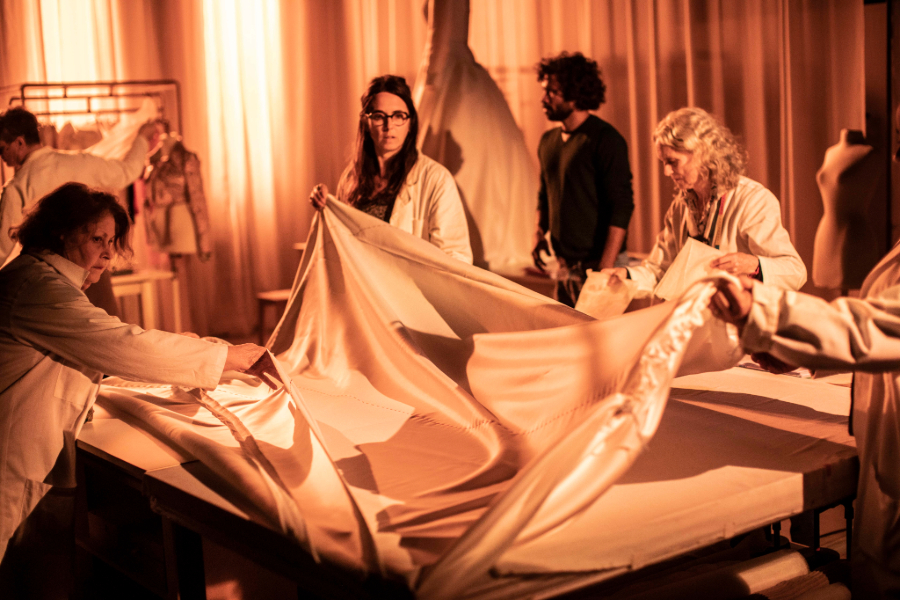
A searing commentary on the countless hours of tears and unseen labour it takes to weave a work of art.
In the realm of fashion, haute couture (literally “high dressmaking”) exists as the pinnacle of craftsmanship: exclusive, custom-fitted garments made almost entirely by hand using some of the world’s most luxurious fabrics. It is legally protected in France, strictly regulated by the Fédération de la Haute Couture et de la Mode, and reserved only for a select handful of prestigious fashion houses. Of course it is prestigious. But behind the glitz, spectacle, and impossible beauty lies an invisible mountain of backbreaking, eyesight-destroying labour required just to make these garments, with all their fine detail and embroidery and materials, exist. At what point do you stop and ask yourself – is it worth it?
As one of the opening productions of the 2026 Singapore International Festival of Arts (SIFA), LACRIMA by Caroline Guiela Nguyen strikes an unexpectedly familiar chord despite its seemingly rarefied and luxurious subject matter. At the sold-out opening night performance at the Esplanade’s Singtel Waterfront Theatre, audiences arrived prepared not only for a festival darling promising a searing insider look into the machinery behind haute couture, but also for what felt almost like a physical endurance challenge: a three-hour production with only a brief pause, during which audiences were explicitly warned not to leave the theatre lest re-entry be denied. It’s a duration that not only captures the intensity of the dressmaking process, but also reflects the gruelling work audiences have to sit through to fully comprehend and absorb the work in its entirety.

But there was ultimately little reason to worry. LACRIMA more than earns its reputation, unfolding as an innovative, intricately woven work of theatre that fuses multimedia, live cinema, hyperreal staging, and deeply human performances into something almost overwhelmingly immersive. Derived from the Latin word for “tears,” the title becomes both emotional thesis and structural warning. As the kids would say, this is a ‘high-cortisol show’, one that spikes your anxiety almost immediately as we watch lead seamstress Marion Nicolas collapse in the workshop from an overdose of pills, paramedics rushing in while her daughter Camille screams in horror. The title flashes overhead, and the play rewinds to eight months earlier, tracing the chain of events that led to this inevitable fall.
Written and directed by Nguyen, LACRIMA follows Parisian haute couture house Maison Beliana after it receives the commission of a lifetime: to create the wedding dress of the Princess of England. But with only eight months to complete the gown, Marion (Maud Le Grevellec), head seamstress of Maison Beliana, finds herself spiralling under impossible expectations as she coordinates demanding designers, lacemakers in Alençon, embroiderers in Mumbai, translators, couriers, museum archivists, and even the unseen Princess herself, all while juggling deteriorating health, mounting psychological strain, and a family life slowly collapsing around her.
Knowing from the outset where Marion’s story ends, the audience immediately shares in her dread. The production captures with terrifying accuracy the feeling of being trapped inside a high-stakes project that could either immortalise a company or destroy it entirely. As much as some might dismiss it as “just a dress,” for Maison Beliana this garment becomes everything: reputation, survival, history, identity. Marion throws herself into the project with such total devotion that work ceases to be something she does and instead becomes the logic through which she exists. Anyone familiar with workaholism: staying long past necessary hours, panicking over deadlines during supposed breaks, sacrificing health to appease endless stakeholders, will recognise something painfully familiar in her unraveling.

Nguyen approaches LACRIMA with an intensely cinematic sensibility. Throughout the production, live cameras project close-ups of the actors and craftsmanship onto a massive overhead screen, transforming the stage into a constantly shifting interplay between theatre and film. The effect is extraordinary. During a tense Zoom call with the Princess, we see the composed version of Marion presented onscreen while, simultaneously onstage, chaos unfolds around her, her brows furrowing as she mutes herself to deal with another escalating crisis. Elsewhere, the projections juxtapose simultaneous labour across countries and time zones: close-ups of intricate Alençon lacework and pearl embroidery unfold while, centre-stage in Paris, Marion and her husband Julien descend into argument. The contrast becomes devastating, one form of labour painstakingly physical, another emotionally corrosive.
The live video also becomes a tool of intimacy. We watch close-ups of lace patterns while hearing discussions of contracts and sworn secrecy; we watch a lacemaker silently process a painful phone call from her estranged granddaughter; we watch Abdul Gani, the Mumbai embroiderer, slowly realise he may be replaced despite all his expertise. The camera forces us into uncomfortable proximity with faces under strain, revealing tiny physical tremors and emotional ruptures impossible to ignore.
The physical staging itself is equally remarkable as what happens onscreen. Alice Duchange’s set resembles an immaculate couture workshop rendered in almost clinical white: dress forms, cutting tables, mannequins, fabric stations, all arranged with geometric precision beneath three massive oval portraits resembling giant lace cameos hanging overhead like silent witnesses. Fringed curtains conceal side rooms and hidden spaces where conversations occur half-heard and partially obscured, reinforcing the sense that secrecy itself is built into the architecture of haute couture. Lighting by Mathilde Chamoux and Jérémie Papin subtly transforms the environment from cold and sterile during moments of production pressure into spaces of surprising warmth during radio interviews or scenes set in Mumbai. Benjamin Moreau’s costumes and couture pieces are predictably stunning, but importantly, never fetishised beyond the labour required to construct them.

The play spirals outward from haute couture into an enormous network of interconnected ideas: admiration for craft and the invisible skill behind beauty; the way laceworkers and embroiderers often go blind young from years of microscopic concentration; stories of deaf laceworkers prized historically because silence increased efficiency; Abdul Gani’s glaucoma diagnosis and the creeping fear that these artisanal traditions are dying under the very systems that claim to preserve them, with a fast declining number of youths willing to take on the backbreaking work.
The production repeatedly returns to the question of invisibility. The Princess is never physically seen, only heard through voiceover as she excitedly discusses the dress she cannot wait to wear, entirely detached from the labour chain sustaining her fantasies. Her demands trickle downward through the hierarchy: to the abusive designer Alexander Schaaf (played with oily arrogance by Vasanth Selvam), to Marion, and finally to the lacemakers and embroiderers absorbing the physical consequences of impossible standards.
The Mumbai sequences are especially devastating, and Manoj Schandrasekar’s (also Vasanth Selvam) workshop exist as essential yet largely invisible labour within the global luxury economy, subcontracted by major fashion houses, sworn to secrecy, subject to ethical background checks, underpaid and unable to publicly claim their contributions despite their expertise underpinning the entire process. One particularly painful moment occurs when Manoj warns that using only fine pearls on the veil will warp its structure due to uneven weight distribution, suggesting plastic substitutes to balance it. His advice is dismissed immediately because aesthetic authority still belongs to Paris, not Mumbai. The system demands his labour while simultaneously refusing his knowledge, inevitably leading to its own doom.
And LACRIMA never limits itself to exploitation alone. It expands into questions of translation and power, how multilingual communication can both connect and exclude, how interpretation reshapes authority, how emotional truths disappear between languages. It explores the dangers of collapsing family and work into one another, the violence of secrecy, the taboo surrounding illness and mental health, and the terror of becoming professionally disposable. Marion becomes a compulsive liar to her own doctor out of fear she will be removed from the project; Thérèse’s family history of mental disorder hangs over her granddaughter like inherited trauma; relationships fracture because nobody can afford to stop working long enough to repair them.

What is most impressive is how Nguyen sustains this intensity without allowing the production to collapse under its own weight. The pacing is astonishingly controlled. Despite its intimidating runtime and often feeling its weight, LACRIMA never loses its grip on the audience. Nguyen understands exactly when to escalate tension and when to let the work breathe. Even at one of the play’s emotional peaks, when Marion’s body finally gives way, the performance literally pauses and instructs the audience to breathe for twenty seconds. A brief three-minute break allows people to stand and stretch and verbally react before plunging back in. Later, when a doctor teaches Marion simple stretching techniques to prevent fainting, audience members instinctively begin following along too. By then, the play has drawn us so deeply into its rhythms of labour and exhaustion that our bodies begin synchronising with it.
The performances across the board are extraordinary, rooted in a level of realism that becomes almost invasive under the scrutiny of the live cameras. Maud Le Grevellec carries an immense burden as Marion, embodying a woman whose devotion to her craft gradually transforms into self-destruction. You can see the exhaustion settling physically into her body scene by scene, the tension in her shoulders, the increasingly frantic breathing, the collapse she seems unable to prevent despite recognising it herself. Dan Artus gives Marion’s husband Julien a heartbreaking gentleness, portraying a mild-mannered spouse slowly driven toward violent frustration as work consumes his marriage. Liliane Lipau is exceptional as Thérèse Milano, balancing immense pride in her lacework with carefully concealed grief and familial pain.
Vasanth Selvam demonstrates remarkable versatility, shifting effortlessly between the anxious Mumbai workshop director Manoj Schandrasekar and the pompous, performative Alexander Schaaf, a whimsical man full of artistic ego yet detached from the physical consequences of his demands. Charles Vinoth Irudhayaraj’s Abdul Gani is perhaps the production’s quiet emotional core: restrained, dignified, and devastating precisely because he communicates so much through stillness and silence, never once responding to his daughter’s voicemails, remaining cheery despite never seeing her father for weeks, months on end. Across the ensemble, nobody feels like they are merely “acting”; they inhabit these people so completely that the production often feels less staged than observed.
Jean-Baptiste Cognet’s music, alongside sound design by Antoine Richard, is equally crucial to the atmosphere. The score frequently leans into tense classical instrumentation that swells beneath conversations until anxiety itself feels orchestral, but it is equally intelligent in knowing when silence is more devastating. There are moments where the absence of sound forces us to sit only with breathing, stitching, and the tiny physical noises of labour.
Really, the entire production feels like an act of relentless realism. You spend much of the play wanting to scream at Marion to stop and rest, to listen, to leave before it destroys her, and yet you completely understand why she cannot. From the beginning, we know she is fated to take the pills. We know this story ends badly. But Nguyen understands something terrifyingly modern: that people will often sacrifice everything for the chance to make something meaningful, beautiful, lasting. Logic falls away once identity becomes fused with labour. And perhaps that is why LACRIMA lands so powerfully. The production begins with a disclaimer insisting that it is a work of fiction not intended to resemble any real persons living or dead, yet Nguyen’s true intention is unmistakable: to expose the horrifying normality of these systems. This is not simply a story about couture. It is a story about every structure that demands total devotion while disguising its violence as passion.
By the end, the completed dress finally appears in all its splendour. From afar, it looks breathtaking. For one fleeting second, you almost believe it was all worth it. But in its epilogue, we learn that the painstakingly assembled veil was worn and on display for all of 27-minutes before being archived, its secrets stowed away for 99 more years before a generation after is allowed to begin unravelling its provenance. The title returns to haunt you. LACRIMA: tears, rendered in Latin, transformed into something elegant, classical, almost beautiful. The word itself feels cyclical, archival, as though sorrow has existed in this form for centuries and will continue long after these characters disappear.
The tragedy of LACRIMA is not that these characters are foolish enough to destroy themselves for work. It is that, deep down, most of us understand exactly why they do what they do. Because there will always be another impossible commission. Another invisible workshop. Another artisan sacrificing their body for beauty. Another Marion convincing herself she can endure just a little longer. And when the cycle is complete, it will repeat once more, again and again.
Photos Courtesy of The Arts House Group
LACRIMA plays from 15th to 17th May 2026 at the Singtel Waterfront Theatre. Tickets available here
SIFA 2026 runs from 15th to 30th May 2026. More information and tickets available here
Production Credits
| Playwright and Director Caroline Guiela Nguyen Cast Dan Artus, Dinah Bellity, Maud Le Grevellec, Nanii, Vasanth Selvam, Charles Vinoth Irudhayaraj, Liliane Lipau, Anaele Jan Kerguistel, Natasha Cashman, Rajarajeswari Parisot French Sign Language, English & Tamil translation Nadia Bourgeois, Carl Holland & Rajarajeswari Parisot On video Nadia Bourgeois, Charles Schera & Fleur Sulmont Additional Voices Louise Marcia Blévins, Béatrice Dedieu, David Geselson, Jessica Savage-Hanford, Maya S Krishnan Artistic collaboration Paola Secret Set Alice Duchange Costumes and High Fashion’s pieces Benjamin Moreau Lights Mathilde Chamoux & Jérémie Papin Music composer Jean-Baptiste Cognet Sound Antoine Richard Collaborator Thibaut Farineau Music Jean-Baptiste Cognet, Teddy Gauliat-Pitois, Antoine Richard Video Jérémie Scheidler Motion design Marina Masquelier Hairstyles, hairpieces and makeup Émilie Vuez Casting Lola Diane Stage Management Stéphane Descombes, Xavier Lazarini Dramaturgy trainees Louison Ryser, Tristan Schinz (TnS drama school students, dramaturgy section, Groupe 48) Directing trainee Iris Baldoureaux-Fredon Sound trainee Ella Bellone Dramaturgy assistant Hugo Soubise Artistic consultants Juliette Alexandre, Noémie de Lapparent Recorded music Quadar Adastra-quatuor à cordes Surtitling Panthéa Production Théâtre national de Strasbourg Set, costumes and embroideries have been made in-house by the TnS workshops. Co-produced by – Festival TransAmériques de Montréal (Canada); La Comédie – Centre dramatique national de Reims; Points communs — Nouvelle scène nationale de Cergy-Pontoise; Théâtres de la Ville du Luxembourg; Centro Dramático Nacional de Madrid (Espagne); Piccolo Teatro di Milano – Teatro d’Europa (Italie) ; Wiener Festwochen | Freie Republik Wien (Autriche); Théâtre national de Bretagne – Centre dramatique national, Festival d’Avignon, Les Hommes Approximatifs With the support of – the Odéon – Théâtre de l’Europe, du Centre national des dramaturgies contemporaines (CNDC) – Théâtre Ouvert, la Maison Jacques Copeau, le Musée des Beaux-arts et de la dentelle d’Alençon, l’Institut Français de New Dehli et l’Alliance française de Mumbaï Premiere, May 30 2024, Wiener Festwochen Freie Republik Wien |

