
Five masters of performance confront mortality and artistic legacy in Liu Xiaoyi’s ambitious, cathartic cross-border work.
What has always made theatre so beautiful is its temporality. Every performance exists only once; even repeated over multiple nights, no show will ever look or feel exactly the same again. It is fragile, fleeting, and alive precisely because it disappears the moment it is completed. By extension, the life of a performer carries that same poignancy. It takes decades to become a master of an art form, to arrive at that level of ease where movement, voice, rhythm and instinct become inseparable from the body itself, yet by the time such mastery is attained, there are often only a limited number of performances left before age, illness, or death inevitably intervene. Theatre has always been haunted by this contradiction: that its greatest beauty lies in the fact that it cannot last.
That idea forms the emotional and philosophical backbone of Last Rites, a monumental new work written, directed, and designed by Liu Xiaoyi, presented as part of the 2026 Singapore International Festival of Arts. Bringing together five veteran performers from across Asia: Yong Ser Pin, Didik Nini Thowok, Jung Dong-hwan, Nam Geung-ho, and Kanji Shimizu, Last Rites asks a deceptively simple question: “If you could envision your last performance, what would it look like?” For these artists, whose average age is 74, the question does not feel abstract or hypothetical so much as quietly looming, sitting somewhere just beyond the edge of the stage lights.

Yet despite its confrontation with mortality, Last Rites never feels morbid. Instead, it becomes deeply life-affirming, less concerned with death itself than with the traces left behind through art, mentorship, memory, influence, discipline, and performance. Documentary theatre often risks becoming static or overly informational, but Liu transforms testimony into something intimate and profoundly human. What emerges transforms a collection of interviews into a cohesive meditation on artistic devotion, ageing, and the fragile miracle of live performance itself.

The ambition of the project alone is staggering. Last Rites gathers together artists working across entirely different performance traditions and cultural contexts: Japanese Noh theatre, Korean classical and physical theatre, Indonesian dance, Singaporean Chinese-language theatre. The production must navigate four spoken languages: Japanese, Korean, Mandarin, and Bahasa Indonesia, requiring an immense network of translators, interpreters, and collaborators simply to facilitate conversation and rehearsal. Crucially, the work would also be impossible without its interpreters Mio Nakano, Tan Wan Sze, and Jeon Hakyung, whose translations become logistical necessities and essential bridges allowing genuine dialogue and intimacy to emerge across languages and cultures. This complexity also never becomes cumbersome onstage. Instead, Liu discovers points of emotional and philosophical resonance between these artists, allowing the work to evolve beyond a sequence of individual portraits into something collective and interconnected.

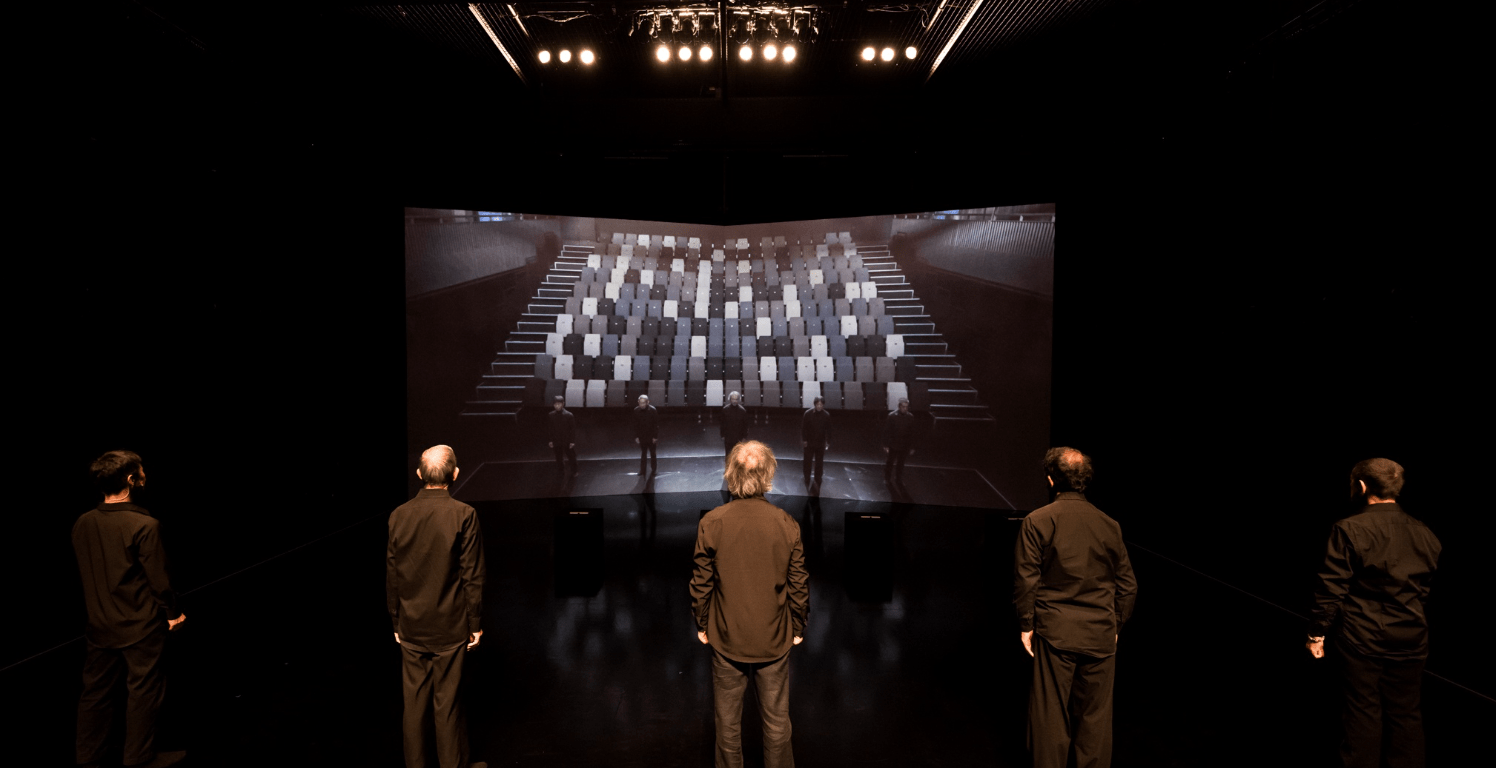
That interconnectedness becomes one of the production’s greatest strengths. Structurally, Last Rites appears straightforward. The performers sit in a line before a projection screen, dressed entirely in black, each receiving the spotlight as they take turns to reflect on childhood, training, artistic breakthroughs, mentors, brushes with death, and changing philosophies towards performance. But the stories never remain isolated. Similar memories and anxieties ripple across the stage in unexpected ways: revered teachers who shaped entire artistic lives, near-death experiences that altered perspectives forever, the burden and privilege of carrying tradition, the fear of the body failing before the spirit does. Rather than becoming repetitive, these recurring motifs accumulate into something expansive and emotionally overwhelming, like a tapestry woven from parallel lives. The performers are not merely recounting their own histories; they are gradually recognising themselves in one another.

And what extraordinary performers they are. One of the most affecting aspects of Last Rites is the sheer magnetism of these five men. They possess the kind of stage presence that can only come from decades upon decades of lived performance experience. Every gesture feels distilled and precise, carrying the weight of years behind it. Japanese Noh master Kanji Shimizu, designated by the Japanese government as a holder of Important Intangible Cultural Property, speaks with immense serenity and restraint, yet can transform his face with startling subtlety into the suggestion of a Noh mask through the smallest adjustment of muscle and posture. Korean theatre veteran Jung Dong-hwan, with over fifty years across stage and screen, commands attention through stillness and gravity alone, a master of classical and strenuous theatre lasting up to 12 hours long, reflects on brushes with death and moments where he quite literally collapsed unconscious, confronting mortality head-on long before this production.

In contrast, mime artist and director Nam Geung-ho radiates infectious energy throughout the evening. Constantly smiling, springing unexpectedly into spritely movement, and demonstrating physical techniques with almost boyish delight, Nam speaks movingly about discovering mime as a language through which he could finally express himself, eventually travelling to Paris to train extensively in corporeal mime traditions, and how he uses it as his form of protest, eventually showcasing a lengthy, silent mime piece that has you in awe at his precision. Indonesian dance icon Didik Nini Thowok, a frequent collaborator with Liu, emerges as one of the evening’s most charismatic figures, reflecting candidly on growing up bullied for his femininity before transforming that perceived difference into artistic power through cross-gender dance performance. His stories about constant learning, cultural hybridity, and surviving loss become some of the production’s most emotionally generous passages.

And then there is Yong Ser Pin, our local, Singaporean veteran actor whose presence grounds much of the production emotionally. Recounting his relationship with theatre doyen Kuo Pao Kun, Yong speaks not merely as a collaborator or student, but as family, tracing Kuo’s artistic philosophies, activism, mentorship, and eventual death with such tenderness that the atmosphere in the theatre visibly shifts. By this point, Last Rites has quietly guided the audience into deep emotional intimacy with its performers; hearing Yong speak about grief feels less like listening to an actor recount history and more like listening to someone mourn a loved one in real time.

What makes these stories so compelling, however, is not simply their content, but the way the performers inhabit them. These are artists completely at ease within their own bodies and traditions. At various moments, they slip effortlessly into performance fragments: a stylised gesture, a traditional dance phrase, a vocalisation, a physical demonstration. Nothing feels forced or performative in the conventional sense. Instead, the boundaries between conversation and performance dissolve naturally, revealing how inseparable art has become from these men’s identities after a lifetime of practice. Even when seated still, they remain utterly captivating, speaking with humour, warmth, humility, and emotional openness that transcends language barriers entirely. Whether heard directly or through surtitles, every story feels immediate and personal.

Liu’s direction is particularly remarkable in the way he allows coexistence itself to become theatrical language. The performers are not simply waiting for their turn to speak; they are actively listening to one another throughout. Small reactions ripple constantly across the stage: nods of recognition, expressions of concern, fleeting smiles. Connections emerge organically between traditions and experiences. Shimizu’s Noh practices unexpectedly mirror Didik’s masked dance traditions, eventually leading to moments where the two perform together in miniature exchanges of gesture and movement. Jung and Yong discover common ground through Samuel Beckett’s Waiting for Godot, eventually performing a cross-language exchange between Vladimir and Estragon beneath a vast projected moon. Nam and Jung, the two Korean performers, share quieter moments of mutual understanding and acknowledgement that never need explicit articulation.

One particularly astonishing sequence sees all five performers rise from their chairs and slowly traverse the stage while vocalising together. None claim to be good singers, and yet the imperfections in their voices only make the moment more powerful. The sounds layer and resonate across the theatre space until the scene becomes almost ritualistic, less like watching a staged performance than witnessing some form of spiritual communion. It is in moments like these that Last Rites transcends documentary theatre entirely and becomes something closer to collective ceremony.

What is perhaps most striking, however, is the way the performers ultimately answer the production’s central question. For all the weight surrounding the idea of a “final performance,” few of them imagine anything especially grand or definitive. There are no fantasies of spectacular exits or carefully orchestrated last bows. Instead, many speak with surprising calmness and acceptance, content with the lives and careers they have already lived, unwilling to force meaning onto an ending that may arrive unpredictably. Some simply express a desire to continue performing for as long as they are able, until the moment naturally comes.

Kanji Shimizu in particular, recalls how, upon the death of his own mentor, the body was brought back to the theatre to hold a wake before the troupe eventually proceeded with an outdoor performance afterwards. It is an astonishing anecdote because of how matter-of-factly it treats the continuation of art alongside it. Performance does not halt mortality, nor does mortality halt performance. The stage remains, the body disappears, and the work continues through those left behind. In that sense, Last Rites ultimately becomes less about staging one final act than about learning how to coexist with impermanence itself.

The production’s technical elements quietly but crucially sustain this atmosphere throughout. Darren Ng’s sound design is exceptional, creating an aural landscape shaped constantly by water: crashing waves, rainfall, rolling thunder, shifting currents. The motif becomes deeply evocative over time, suggesting lives continually reshaped by memory, ageing, and circumstance while also evoking something eternal and cyclical. Elsewhere, Ng’s environmental textures of street sounds, ambient noise, and subtle sonic transitions, lend extraordinary depth and atmosphere to even the simplest moments.

Similarly, multimedia designer Chiu Chih Hua’s projections resist spectacle in favour of emotional precision. Images frequently emerge from blur into clarity before fading away once more, like fragmented memories surfacing temporarily into consciousness. The effect is understated but deeply resonant, particularly in a production so preoccupied with memory, disappearance, and impermanence. Liu Yong Huay Faith’s lighting design is equally attentive, isolating performers with surgical precision while still allowing glimpses of the others listening in darkness, subtly reinforcing the production’s emphasis on collective witnessing rather than isolated monologue.

Near the end of the performance, a live camera turns towards the audience, projecting our own image in our seats onto the screen as the five performers silently watch us. Slowly, almost imperceptibly, the projected audience fades from view until only the empty seats remain. It is an extraordinary image, because the production suddenly extends its meditation on mortality beyond the performers themselves. Throughout Last Rites, we have watched these artists reflect on ageing, disappearance, legacy, and death, but in this final moment, the work reminds us that audiences, too, are temporary. We will disappear just as they will. The theatre will empty. The voices will fade. The moment will end.
And yet something remains. That is ultimately what makes Last Rites so profound. It understands that the immortality of theatre lies precisely in its impermanence. Performance cannot be fully preserved or replicated; its beauty comes from existing only in the fragile present tense. These artists know that their bodies will one day fail them, that eventually there will be a final bow, whether anticipated or not. But in sharing themselves with such honesty, humour, generosity, and vulnerability here, they achieve something extraordinary. You leave the theatre not merely admiring their artistry, but feeling deeply grateful to have existed in the same room as them, at this particular moment in time, before it too disappears forever.
Photos Courtesy of The Arts House Group
Last Rites played from 22nd to 23rd May 2026 at the SOTA Studio Theatre. More information available here
SIFA 2026 runs from 15th to 30th May 2026. More information and tickets available here
Production Credits
| Director/Playwright/Set Designer Liu Xiaoyi Performers Yong Ser Pin (Singapore), Didik Nini Thowok (Indonesia), Jung Dong-hwan (Korea), Nam Geung-ho (Korea), Kanji Shimizu (Japan) Sound Designer Darren Ng Lighting Designer Liu Yong Huay Faith Multimedia Designer Chiu Chih Hua (Taiwan) Co-Creator (Phase 1) Chong Tze Chien Producer/Graphic Designer Huang Suhuai Production Manager Victoria Wong Stage Manager Keira Lee Assistant Stage Manager Lilith Tan Multimedia Systems Designer Brian Gothong Tan Lighting Programmer Feezah Interpreters Mio Nakano (Eng-Jap), Tan Wan Sze (Eng-Kor), Jeon Hakyung (Eng-Kor) Creation and Research Assistant Dia Hakim Khaeri Hospitality and Admin Assistant Jasmine Lee |


One thought on “★★★★★ Theatre Review: Last Rites by Liu Xiaoyi / Emergency Stairs (SIFA 2026)”