
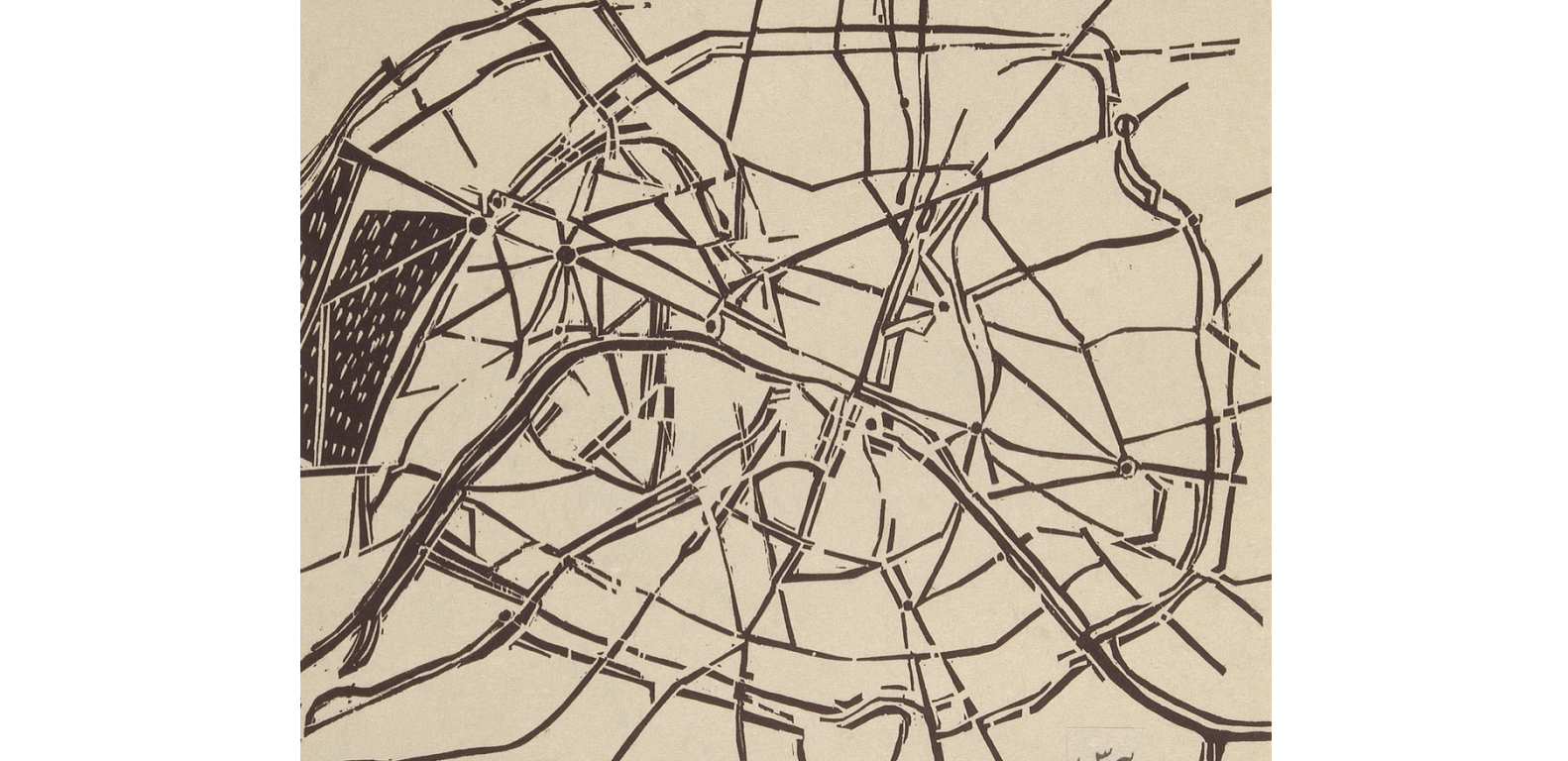

At STPI in Singapore’s Robertson Quay, Zarina’s world unfolds not as biography in the conventional sense, but as a sustained act of translation: of life into line, memory into geometry, and displacement into print. Zarina: Directions to My House (6 June – 1 August 2026), the institution’s Annual Special Exhibition, is the most comprehensive presentation of her work in Southeast Asia to date, bringing together over fifty works that trace a seven-decade practice shaped by movement across Bangkok, New Delhi, Paris, Bonn, Tokyo, Santa Cruz, and New York.
Curated by Sarah Burney, who once worked in Zarina’s studio and later co-authored one of her final publications, the exhibition is less a retrospective than a reconstruction of a sensibility, one that treats home not as location, but as something perpetually revised.

Burney frames Zarina’s practice from the outset as autobiographical in the most distilled sense: not confessional, but structural. “Zarina made her life the subject of her work,” she notes during the curator-led walkthrough, pointing to the way the artist oscillates between expansive cartographic imaginaries and almost childlike architectural forms. A single house shape, a floor plan, or a set of coordinates becomes a complete emotional register. Across the galleries, this duality holds: the vastness of Atlas of My World (2001), with its aerial logic of borders and distance, sits in quiet dialogue with the simplicity of a drawn dwelling, each insisting that home is simultaneously geopolitical and intimate, abstract and lived.
That tension is rooted in a life defined by movement. Born in 1937 in Aligarh during the final decades of British colonial rule in India, Zarina grew up in a relatively stable academic household before Partition disrupted the world around her at the age of ten, leaving a lifelong imprint of fracture and migration. Her adult life unfolded through diplomatic postings and personal transitions that carried her across continents, and each relocation became material for her practice. Works such as Cities I Called Home (2010) and Atlas of My World (2001) emerge from this accumulated geography, yet they resist the documentary impulse; instead of illustrating cities, they compress them into sparse visual grammars of line and text. Burney describes this approach as diaristic but non-linear—less a chronology than a recurrence, where places reappear as emotional states rather than destinations.

This sense of recurrence is most fully articulated in Home is a Foreign Place (1999), one of Zarina’s defining bodies of work, in which thirty-six Urdu words associated with home are transformed into stark woodcut abstractions. What might be language becomes structure; what might be definition becomes residue. The curator’s insight foregrounds how deliberate this reduction was. Zarina, she explains, worked from a list of words before stripping them of semantic comfort, allowing only form to remain. Yet the loss of legibility is not erasure. Rather, it becomes a way of preserving language at the moment it risks disappearance. This is echoed in Letters from Home (2004), where handwritten correspondence from her sister Rani is partially obscured beneath layers of print. The intimacy of handwriting persists, but it is no longer directly accessible; it becomes memory filtered through material.

Language, particularly Urdu, carries a deeper political and emotional charge throughout the exhibition. Burney recalls Zarina’s belief that Urdu was being slowly displaced from everyday life through disuse, migration, and generational shift. It was not, in her view, “lost” in a simple sense, but increasingly unwritten, unspoken in letters, uncarried into the future. In response, Zarina embedded it into print as a form of preservation, insisting on its presence even when it could no longer be fully read. This gesture sits alongside her sustained engagement with partition, which surfaces explicitly in works such as Dividing Line (2001) and Abyss (2013), where borders are rendered as stark, unresolved cuts across space. These works do not narrate history so much as insist on its continuity; partition is not treated as an event completed in the past, but as an emotional and spatial condition that persists across a lifetime.
That persistence extends into Zarina’s engagement with more recent global crises. In Rohingyas: Floating on the Dark Sea (2015), the visual language of cartography is turned toward contemporary displacement, maintaining the same restrained formal vocabulary even as the subject matter becomes more explicitly urgent. The effect is not illustrative but accumulative: over time, her practice builds a lexicon in which migration, exile, and statelessness are not themes added to the work, but its underlying grammar.

Materially, this grammar is inseparable from process. STPI’s presentation of printing plates, woodblocks, and tools alongside finished works reveals the extent to which Zarina’s abstraction is grounded in physical labour. The making of each work—cutting, incising, layering, pressing—becomes an extension of drawing as thinking. Her commitment to handmade paper, often sourced from Japan, Nepal, or India and mounted onto Western papers such as Arches or Somerset, is not merely aesthetic but conceptual. As Burney notes, this was a deliberate positioning of material hierarchies: local craft traditions are not background to printmaking but its foundation, placed in deliberate dialogue with European print conventions. For Zarina, paper was never neutral; it carried geography within its fibres.
This attention to material extends into sculptural works such as Flight Log, a cast paper work structured like a book in which each page bears a line of poetry. The work condenses her biography into four sentences—“I tried to fly, got lost in the thermal, could never go back, having lost the place to land”—which Burney identifies as Zarina’s own articulation of her life. Movement becomes disorientation; travel becomes a condition without return. Even her early fascination with flight, from childhood plane rides to later flying lessons, is folded into this logic of aerial perspective, where looking down at the world becomes a way of understanding its fragmentation.

The exhibition ultimately resists closure, instead moving toward reduction. Later works strip away colour, iconography, and density until only elemental structures remain: thread, album, house. Yet this reduction does not simplify meaning. It intensifies it. What emerges is a practice committed to holding complexity within restraint, to allowing absence to carry as much weight as presence. In the final galleries, Zarina’s work arrives at a kind of distilled clarity, not resolution, but a sustained question about how one inhabits a world defined by movement.
Seen together at STPI, these works do not assemble a life as narrative progression. They assemble it as repeated attempt: to draw home, to name it, to lose it, and to draw it again. In that repetition lies the quiet force of Zarina’s practice, where each line is both boundary and memory, and every map is also a wound that refuses to close.

Installation images courtesy of STPI. Featured image: Zarina, Paris, from the portfolio Cities I Called Home, 2010. © Zarina; Courtesy of the artist and Luhring Augustine, New York. Photo: Lamay Photo.
Zarina: Directions to My House runs from 6th June to 1st August 2026 at STPI, 41 Robertson Quay, Singapore 238236. More information available at their website

