

A nostalgic musical throwback to a simpler time, when dreams were big and morality came a little too neatly packaged with a happy ending.
Duration: 135min (including a 15min intermission)
There is an admirable sincerity running through Musical Theatre Limited’s Be A Star, one that feels increasingly uncommon in contemporary musical theatre. Originally conceived as Lost in Transit in 2005 by lyricist Stella Kon and composer Desmond Moey, this expanded revival reunites the original creators with writer-director Gavin Low and music director Elaine Chan. It revisits a homegrown story about ambition, integrity and the price of success for a very different audience twenty years later.
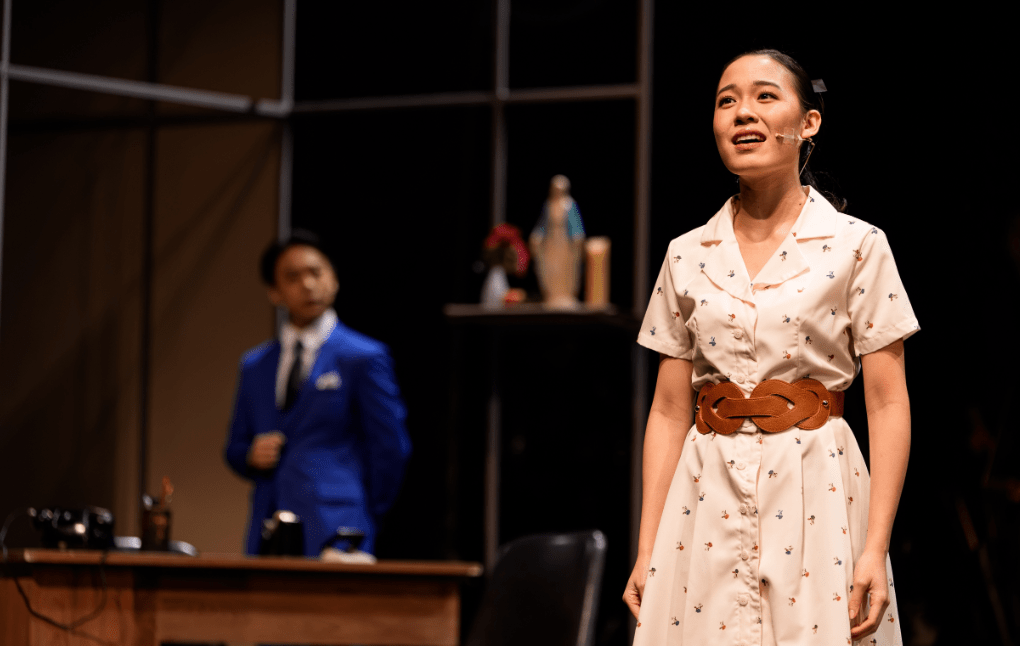
The story follows Mia (Johanna Van), a gifted village girl whose powerful singing voice earns her an opportunity to perform at the glamorous Kissy Club in the city. Leaving behind her devoted fiancé Sam (Jaxon Vaughn) and grandmother (Kimberly Sim), Mia is drawn into a world of sequins, cabaret and commercial entertainment under the guidance of songwriter Robert (Aaron Titus Ee). As her career gathers momentum, she also comes to the attention of wealthy impresario Mr Goh (Richard Chia), whose promise of making her a star conceals a far darker expectation. Also at the club are the Kissy Girls: Jessy (Fiona Chan), Lucy (Marissa Vojodi) and Mandy (Eugenia Lee), whose initial resentment towards Mia stems from the knowledge that every rising star eventually replaces another.

It is a perfectly serviceable story, and an earnest, sometimes charming production whose biggest obstacle is uncertainty over how its central message should be expressed. Be A Star belongs to a lineage of fairy tales and musicals about the innocent country girl seduced by the promise of fame, where temptation is clear, virtue is rewarded and moral order is ultimately restored. There is nothing inherently wrong with that framework. In fact, the musical’s intended message is a generous one. Robert is drawn to Mia because her simple village songs possess a sincerity missing from the Kissy Club’s increasingly commercial performances. His own frustration lies in writing heartfelt music that never reaches the stage, while Mr Goh represents success achieved through exploitation rather than artistry. By the finale, Mia succeeds not because she compromises herself, but because she remains true to her own voice, performing Robert’s songs instead of becoming another manufactured star. The idea that artistic authenticity, rather than cynicism or corruption, ultimately leads to success is an appealing one.

The problem is that Be A Star never quite dramatises this journey. It gestures towards exploitation, artistic integrity, celebrity and personal conscience, but these remain ideas rather than lived experiences. It never fully decides whether it is critiquing the entertainment industry, the commodification of art, or predatory men who abuse their power. Even its treatment of cabaret feels conflicted. The increasingly sultry performances appear to signal moral compromise, but the musical never clarifies whether sensuality itself is suspect or merely the environment in which exploitation occurs. As a result, its thematic centre remains frustratingly blurred.

Such uncertainty is embodied by Mia herself. Johanna Van sings well and brings genuine sincerity to the role, but the script gives her surprisingly little interior life. Beyond her remarkable voice, her kindness and her dream of becoming a performer, we learn very little about what truly motivates her. For much of the musical she embraces success without much hesitation, only questioning her choices after Sam unexpectedly reappears and reminds both her and the audience that she has a fiancé waiting back in the village. Her eventual rejection of Mr Goh therefore feels prompted more by circumstance than by an internal moral awakening. By the finale, Mia has found success without sacrificing her integrity, making for a satisfying conclusion in principle, but because we have never fully understood who she is or what she truly values, the ending feels intellectually convincing rather than emotionally earned.

That same uncertainty extends into the score. Musical theatre is often at its most powerful when songs reveal character, allowing us to understand people more deeply than dialogue alone can. Be A Star certainly attempts this: Robert’s guilt, Sam’s declaration of love and Lucy’s later solo are all clearly intended to illuminate their inner lives. Yet despite these intentions, few of the numbers leave a lasting impression.

That is not a criticism of the musicians themselves, who are arguably the production’s strongest asset. Under Elaine Chan’s musical direction, the live band is consistently superb, opening the evening with stylish jazz improvisations that immediately immerse the audience in the atmosphere of the Kissy Club before a single line has been spoken. Their playing remained polished, expressive and wonderfully responsive throughout, and one remembers the atmosphere they created far more vividly than the score itself.

The cast likewise elevates the material to the best of their ability. Johanna Van makes Mia as believable as the script allows, while Aaron Titus Ee lends Robert a bombastic showmanship and sincere warmth beneath, despite occasionally feeling constrained by the writing. Nicholas Bloodworth finds unexpected emotional depth as Pedro, making what could have been a minor supporting role surprisingly affecting. The real revelation, however, is the trio of Kissy Girls. Fiona Chan, Marissa Vojodi and Eugenia Lee are constantly alive onstage, reacting, observing and inhabiting the nightclub environment even when attention is elsewhere. Their chemistry creates the believable impression of performers who have spent years sharing dressing rooms and competing for the same spotlight, while Lucy’s later solo hints at a richer secondary story about ageing performers confronting their own replaceability.

What ultimately holds the production back is the direction. Working with a sparse set, the production makes intelligent use of movable scenic units to transform the stage into dressing rooms, offices and hotel suites, while a fringe curtain conceals the live band and reinforces the cabaret aesthetic. Budget limitations are evident but understandable. The larger issue is that the staging rarely feels physically alive. Performers often remain rooted where they stand, creating scenes that feel presented rather than inhabited, while Richard Chia’s choreography is clean and functional without ever becoming theatrically exhilarating. Even the nightclub sequences, complete with descending chains and dominatrix-inspired imagery, convey an idea of transgression rather than genuine danger or sensuality. Rather than embracing the moral ambiguity of cabaret, the production seems hesitant to fully inhabit its own world.

The pacing similarly lacks dramatic urgency. At over two hours including interval, scenes frequently linger beyond their emotional peak, while transitions sap momentum rather than build anticipation. Dialogue often feels flatly delivered rather than sincerely lived, and relationships that should crackle with tension remain politely understated. Even some of the visual choices work against the drama, such as the moving floral projections during Mia and Sam’s duets, which distract from rather than heighten their intimacy.

Yet it is impossible not to admire the commitment of everyone involved. This is clearly the work of artists who believe deeply in the value of musical theatre and in the importance of telling original Singapore stories. Every performer, every musician and every member of the creative team approaches the material with conviction, generosity and heart. Even when the book and score struggle to realise their ambitions, the production itself never feels cynical.

Beneath its familiar morality tale lies the possibility of a genuinely compelling exploration of ambition, exploitation and artistic integrity. Instead, it settles for broad archetypes where richer characters could have lived. Be A Star ultimately argues that success need not come at the expense of one’s conscience, and that remaining true to one’s own artistic voice is the surest path to fulfilment. It is an admirable sentiment, but one the musical never fully earns through its central character, nor its own form.
Photo Credit: Musical Theatre Limited
Be A Star: A Musical Fable ran from 17th to 18th July 2026 at the SOTA Drama Theatre.

