
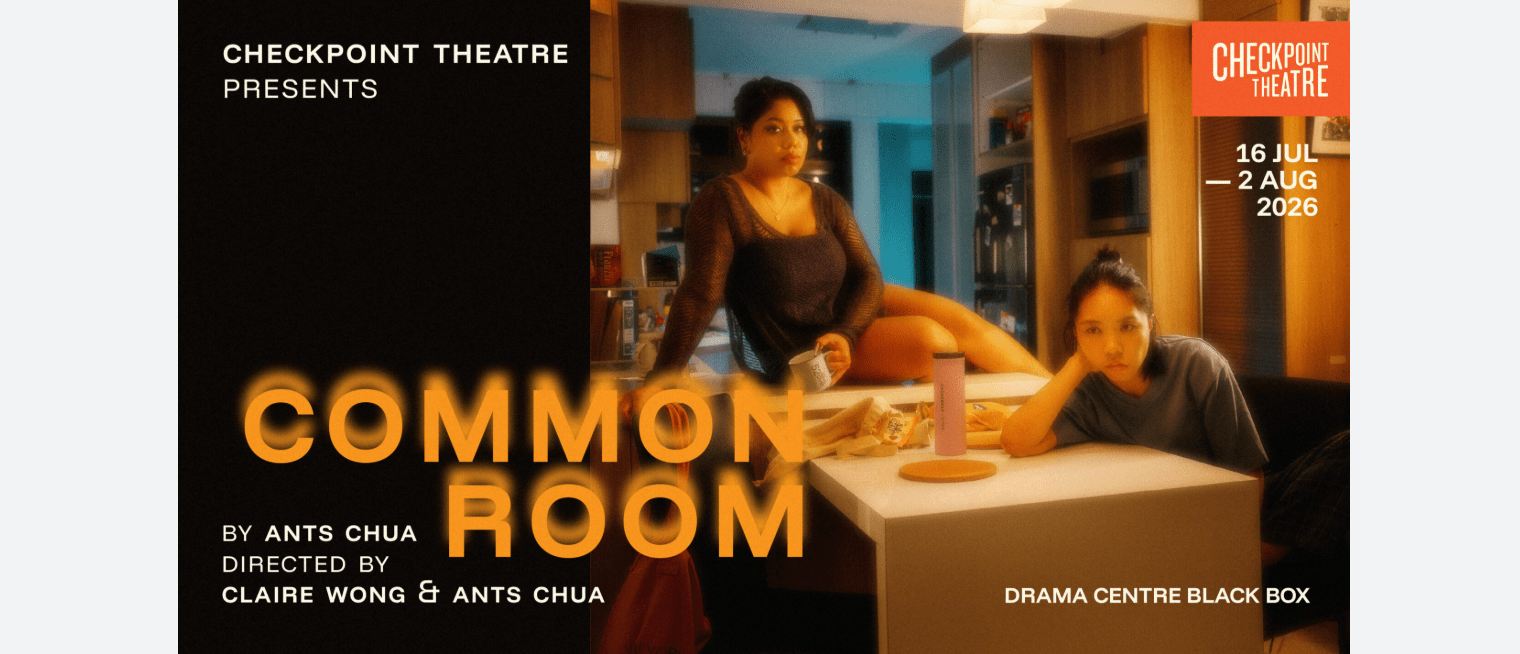
Checkpoint Theatre tackles queer themes by presenting an honest depiction of queer co-living that succeeds more as an act of representation than a piece of theatre.
Duration: 90min
Although Singapore has made significant strides towards LGBTQ+ acceptance, many queer Singaporeans continue to negotiate conservative workplaces, families and social expectations. For those unable to live fully out in public, chosen family and queer kinship become not merely comforting ideals but essential means of survival. It is precisely these quiet, private spaces that Checkpoint Theatre’s Common Room seeks to illuminate, offering visibility to lives still too rarely centred on Singaporean stages.
Written by ants chua and co-directed by chua and Claire Wong, Common Room follows two queer housemates, Third (Siti Sara Hamid), a bisexual sex worker, and You (Genevieve Tan), a teacher, as they navigate the rhythms of shared domestic life. Between forgotten chores, late-night conversations, memories of former lovers and family, and increasingly surreal flights of imagination, the pair grapple with identity, belonging and what it means to build a home in Singapore.
Common Room’s title is an interesting one, and more layered than it first appears. On its most literal level, it refers to the HDB flat the pair inhabit together, specifically the common room they rent rather than own. Throughout the play, Third and You allude to the familiar frustrations of Singapore’s rental market, where queer tenants often find landlords and agents inventing convenient excuses not to lease to them. The common room therefore becomes a negotiated refuge, a space secured despite exclusion elsewhere. Beyond the physical space, it gestures towards the commonality of queer experience and shared echoes of rejection, survival and chosen family.
Petrina Dawn Tan’s naturalistic apartment reinforces this reading. Functional and recognisable, the space convincingly captures the routines of shared domestic life, yet its almost clinical neatness lends it an oddly enclosed quality. Whether intentional or not, the apartment begins to resemble a carefully maintained sanctuary, one of the few places where its occupants can exist honestly, safely removed from the expectations of family, employers and strangers. Faith Liu Yong Huay’s lighting remains largely unobtrusive throughout, effectively supporting both the realism of the domestic scenes and the production’s more abstract departures.
By extension, the production also attempts to transform the theatre itself into a metaphorical ‘common room’, inviting audiences into this intimate domestic space and asking them, if only briefly, to inhabit it alongside its characters. That invitation succeeds largely because of Genevieve Tan and Siti Sara Hamid. The two actors possess an effortless chemistry that makes years of cohabitation believable. They tease one another over forgotten chores, parody bodybuilders during stretches before collapsing into laughter, invent increasingly absurd dream houses (evoking Carmen Maria Machado) that slowly morph into nightmares, and communicate through unfinished thoughts and shared references that only long familiarity produces.

Neither performance ever feels like a symbolic representation of queerness; both actors inhabit fully realised people whose histories seem to extend well beyond the confines of the script. Much of that authenticity comes from ants chua’s remarkable ear for authentic dialogue. Casual conversations effortlessly move between jokes about BDSM, pronouns, sex work and gender presentation before pivoting towards estranged parents, former lovers and loneliness. Queerness itself is never treated as the problem to be solved. Instead, it forms the backdrop against which the characters wrestle with far more ordinary questions: finding somewhere to live, sustaining friendships, surviving precarious work, caring for family and imagining a future.
Rather than constructing a conventional plot, the production attempts to recreate the rhythms of cohabitation itself, hoping for meaning to emerge through repetition, conversation and shared routine. Yet relatability alone does not a play make. Initially exhilarating in its specificity, the dialogue gradually becomes a victim of its own authenticity. Conversations continue well beyond the point of revealing new facets of character or advancing the emotional trajectory of the evening, leaving scenes that begin to resemble transcripts of lived experience more than drama. The production seems reluctant to compress or shape these exchanges, and what begins as intimacy slowly gives way to repetition. For long stretches, very little actually changes. Emotional states are revisited rather than transformed, and conversations succeed one another without generating anticipation about what might happen next.
This is where Common Room ultimately loses its grip. The play is less interested in asking “what happens next?” than in observing how queer people make lives together in the quiet spaces between life’s larger milestones. That is a perfectly valid artistic ambition, but observation cannot substitute for dramatic progression. Too often, Common Room mistakes accumulation for development, trusting that enough honest conversations will eventually generate emotional momentum. Instead, many scenes remain observational rather than revelatory, depicting queer life with generosity and specificity without transforming those experiences into compelling theatre.
This encapsulates a key problem: the emotional stakes are almost entirely internal. Third and You are never engaged in meaningful conflict with one another; theirs is an affectionate, deeply supportive relationship. Instead, each (primarily You) grapples privately with identity, family and selfhood. These struggles register in the actors’ performances, flickering across their faces in moments of hesitation and grief. Too often, Common Room mistakes accumulation for development. The emotional states established early on are revisited rather than transformed, abd by the final third, the production has largely exhausted its emotional vocabulary, where even the ninety-minute runtime beginning to feel markedly overextended.
This then raises questions about the production’s chosen medium. Much of ants chua’s writing is driven by interiority: observation, memory, language and emotional reflection. These qualities are compelling on page, but theatre demands that internal states become embodied action. Common Room never quite discovers a theatrical language capable of making that transformation. Instead, intimacy is mistaken for momentum, and what feels revelatory in conversation gradually becomes dramatically inert across a conventional production.

This is particularly striking given Claire Wong’s interest in developing a physical vocabulary that expresses emotions beneath the spoken text. One can certainly see those ambitions in the production’s intermittent departures into choreography, surreal imagery and spoken-word poetry. Yet these theatrical gestures never fully cohere into a distinct performance language. The spoken-word ‘poetry’ passages, while thematically resonant, often arrive abruptly and interrupt rather than deepen the dramatic flow. Towards the conclusion, when both characters begin sharing lines in a meditation on the fear of coming out, they finally achieve genuine poignancy. Elsewhere, however, they feel insufficiently integrated, as though another play is briefly trying to emerge before retreating into naturalism.
A similar issue affects the narrative climax. The production positions You’s decision to come out to their parents as its emotional destination, yet never fully establishes why this particular decision, rather than the many other tensions explored throughout the evening, should become its defining dramatic event. The vulnerability surrounding coming out is undeniable, but the emotional architecture underpinning it remains underdeveloped. Consequently, the ending feels moving because of the actors’ sincerity rather than because the dramaturgy has fully earned it.
Common Room is a queer play in every sense of the word, not only because of the queer lives it depicts but because it resists conventional dramatic structures altogether, privileging association over causality and interiority over action. That formal ambition is intellectually interesting, but rejecting convention is not, in itself, a guarantee of compelling theatre. Rather than feeling carefully shaped, the production often gives the impression of preserving every compelling idea instead of discerning which ideas best serve the whole. The result is a work rich in authenticity but lacking the editorial precision needed to transform lived experience into consistently engaging drama.
In watching Common Room, one realises that home is not necessarily where one is accepted by birth, but where one is permitted to exist honestly. In Singapore today, where even finding a room to rent can become another negotiation of one’s identity, that remains a quietly powerful truth. Common Room succeeds in getting that point across with authentic queer voices, but considerably less successful in transforming those voices into compelling theatre.
Photo Credit: Checkpoint Theatre
Common Room runs from 16th July to 2nd August 2026 at the Drama Centre Black Box. Tickets available from BookMyShow
Production Credits
| Playwright ants chua Directors Claire Wong, ants chua Dramaturgs Huzir Sulaiman, Claire Wong Cast Genevieve Tan, Siti Sara Hamid, Elle Cheng (Understudy) Set Designer Petrina Dawn Tan Lighting Designer Faith Liu Yong Huay Sound Designer Shah Tahir Assistant Director Clara Janssen Captioning Consultant and Operator Joanna Ong |
 Bakchormeeboy