
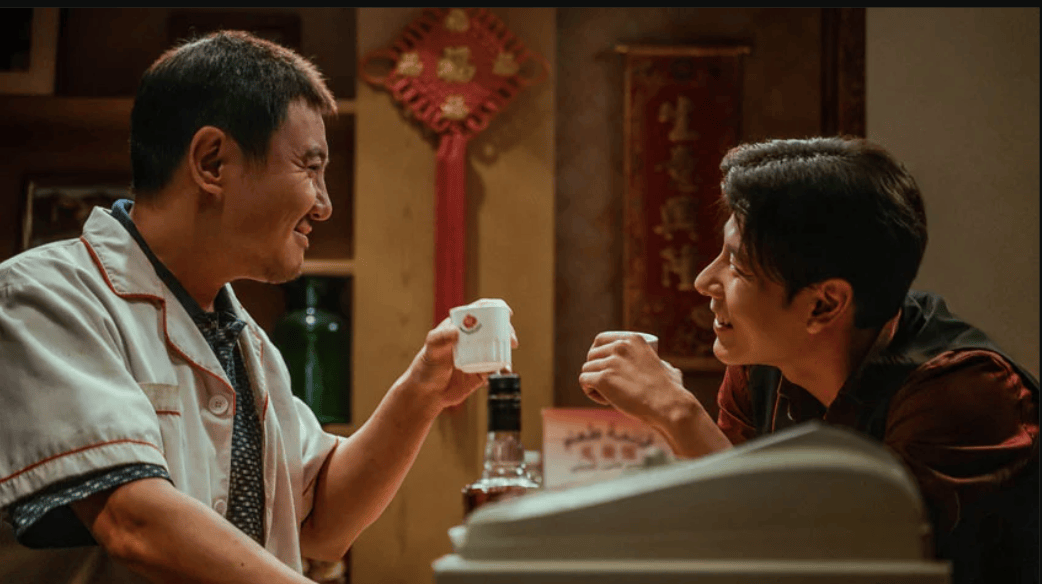

From China comes one of the best anti-war blockbuster films in recent history that captures the human cost of senseless conflict, in both body count and morality.
Duration: 140 minutes
War films are so often constructed around the perspectives of the countries that wage them, making it unusual to see a film so openly interested in the consequences of American intervention in the Middle East from a Chinese perspective. Yet Once Upon a Time in the Middle East is ultimately less interested in assigning simple blame than in asking what happens to ordinary people when geopolitical conflict tears through their lives. When the war is finally “won” and everyone goes home, what exactly counts as winning?
Directed by Wen Muye, the film follows Chinese chef Xu Fu (Shen Teng), who travels to the fictional Middle Eastern city of Bahata to make money, pay off his debts and eventually return home. He takes over the kitchen at the Loong Restaurant alongside manager Ma Junsheng (Jiang Qiming), and the two gradually turn it into a thriving little haven, with Xu’s cooking attracting everyone from local residents to foreign soldiers. Xu is practical, opportunistic and largely uninterested in the politics surrounding him. When war suddenly breaks out, he initially sees it as something to survive rather than something to oppose: keep the restaurant open, protect his employees, and make enough money to get home. Even as the city descends into violence and shortages, Xu finds ways to accommodate whoever walks through the door, including American soldiers, and for a while the war is almost something he can work around.
But the restaurant’s position as an island of normality becomes increasingly precarious. As the conflict expands, Xu’s relationship with the people around him changes with it. The children from a nearby orphanage begin seeking refuge at the restaurant, with the older Seif (Omar Sharif) becomes his reluctant apprentice, and the restaurant itself becomes entangled with soldiers, prisoners and the various factions fighting for control. What begins as a man’s attempt to make money abroad gradually becomes a story about responsibility: how far can someone remain an outsider when the people around him are suffering?

Shen Teng is fantastic as Xu, maintaining an almost comically stoic front for much of the film. There is already a masterful “shifu” quality to him: someone who always seems to know what needs to be done, who keeps his emotions buried and projects confidence even when everything around him is falling apart. That facade makes his relationships with Ma and Seif increasingly moving. The rare moments when Xu does allow himself to break through that exterior, particularly when he finally has the opportunity to speak to his mother and daughter again under duress, land with enormous force precisely because the film has spent so long showing how hard he works to keep those emotions hidden.
Ma Junsheng is another of the film’s great sources of warmth. Always smiling, always carrying some trace of optimism, Jiang plays him perfectly as a man with a dream of owning a restaurant who remains remarkably committed to doing what is right even as the world around him becomes increasingly unjust. His friendship with Xu becomes one of the film’s beating hearts, while Seif gradually becomes something more complicated than an apprentice. Xu initially sees the boy as additional work, but eventually, protecting him and his humanity becomes inseparable from protecting himself.
And that progression is central to what makes the film work. Xu begins by looking after his own interests. Food is the film’s great counterpoint to war. The restaurant becomes a tiny island of normality in a city that is steadily losing its own. It provides food, water, electricity, work and somewhere for people to gather, at least, those that can afford it. Food becomes business, celebration, friendship, cultural exchange, comfort and eventually survival. A meal can mark a wedding; cooking can become a way for Xu to bond with Seif; the restaurant can give exhausted soldiers somewhere to sit without fighting; and later on, even without the space of a restaurant, a Christmas feast can offer a moment of peace inside a prison. Even the simplest dishes take on a strange significance because they represent something the war is constantly trying to destroy: the possibility of ordinary human life, and these scenes of meal prep are showcased in glorious, mouthwatering glory.
There is something particularly beautiful about the contrast. Outside the restaurant, everything is being reduced to factions, shortages, violence and ideology. Inside, people are still arguing over food, learning recipes, laughing, eating and trying to make something worthwhile out of what remains. And that is also why the film’s violence is so effective. The gunfights, explosions and grenades aren’t presented as exhilarating spectacle for very long. They are brutal, sudden and frightening, and eventually the film trains its audience to dread the moments of apparent calm because something terrible could arrive at any second. The repeated returns to moments immediately preceding tragedy can occasionally feel heavy-handed, almost as though the film wants to make absolutely certain that nobody has missed what has just been lost, but they also reinforce the sense that every death leaves an absence behind.

The film is equally interested in the less visible costs of war. Lives are destroyed, but so are relationships, morality, childhood and the ability to imagine another future. Loong Restaurant owner Zaid’s (Sherif Sobhy) transformation is heartbreaking because the film gives enough context to understand how grief, helplessness and political violence can push someone toward radicalisation without treating his eventual actions as excusable. The same is true of Seif’s story, which becomes one of the film’s most horrifying ideas: children are not born to become violent. They are taught by adults. Watching Seif move from mischievous child to someone exposed to extremist ideology is devastating because the film makes it possible to see the person he might have been. The child soldiers are perhaps the clearest expression of the film’s anti-war argument. The horror lies in how they are being systematically stripped of the innocence that might have prevented them from becoming killers in the first place, before they are blown apart in the name of a senseless war.
And the film doesn’t restrict its criticism to one side. American soldiers are sometimes shown as cruel, exploitative or frightening, including scenes of torture and manipulation, but others are simply exhausted young men who don’t seem particularly interested in being there at all. Tony Wang (Aarif Rahman), the Chinese-American soldier, is especially useful in this regard. He complicates the divisions the film could easily have established between Chinese and American characters, simultaneously displaying violent bursts of rage while eventually falling outside of the battlefront. Everyone exists somewhere inside the machinery of a war that is much larger than any individual.
That makes Once Upon a Time in the Middle East much more compelling than a straightforward anti-American polemic one might expect. It is an anti-war film because it shows how war corrupts virtually everyone it touches. The opportunist becomes a protector, the grieving man becomes radicalised, and the child becomes a weapon. In that sense, the film’s politics are inseparable from its humanity. There is no romantic glory in the conflict here. Unlike many Western depictions of glory in victory, the concept of Dulce et decorum est is thoroughly dismantled: there is nothing noble about bodies being destroyed, children being indoctrinated, families being torn apart or ordinary people being forced into choices they never wanted to make.

The English title is particularly fitting. It evokes the language of Westerns, those old stories of gunslingers, glory and mythic violence, while placing that mythology against a fictional Middle Eastern country being torn apart by modern warfare. The Chinese title, literally ‘Welcome to Loong Restaurant’, emphasises something much more intimate. One title evokes the grand mythology of conflict; the other points toward the tiny human space where people actually live.
This is a film that is devastatingly clear about how thoroughly war can destroy lives and deform the people caught inside it. Yet it remains deeply optimistic about the fragments of humanity that survive; the food, the friendship, the lessons learnt and so does memory. Xu’s journey from a man who simply wants to make money to someone willing to risk everything for people who were never supposed to be his responsibility is therefore not just a conventional redemption arc. It is the film’s answer to its own question. Even when the war is over, it does not restore the lives that were destroyed, nor does it undo trauma or bring the dead back. But perhaps survival can still mean something when people carry one another through the wreckage, and focus on what still lives.
In its final moments, Xu discovers that the Loong Restaurant has survived all these years later, no longer in the same location, but still serving up Chinese food, in a traditional menu, with dishes that he once whipped up. And more than that, a singular dish that was created when all seemed lost, a staunch symbol of survival, still remembered and passed on. Resistance comes in many forms, whether counterforce, negotiations, or acts of care. After all the guns, grenades and destruction, the image that lingers is not one of violence at all, but a kitchen, someone cooking, and a meal carrying the memory of the people who once needed it. And what a strong case it makes.
Once Upon A Time In The Middle East is open in Singapore cinemas such as Golden Village from 17th September 2026.

