

Documentary, biographical theatre tracing Chinese Theatre Circle’s roots, its impact, and the love that’s carried it for 45 years and beyond.
For 45 years, Chinese Theatre Circle has been doing something no other company has done for as long and as fiercely as they have: keeping Chinese opera alive in Singapore. And to commemorate that, One Love, A Legacy: Celebrating Joanna & Leslie Wong and Chinese Theatre Circle makes clear just how important that is. Behind CTC’s four and a half decades are thousands of hours of rehearsal, teaching, translation, writing, organising and performing; international tours across more than 25 countries; festivals that brought unfamiliar forms of Chinese opera to Singapore; original works written and staged locally; and, perhaps most importantly, generations of performers who learnt the art and went on to pass it on themselves.
The anniversary production, created in collaboration with Esplanade, consequently has an unusual task. Going beyond mere celebration of the company’s origin and history, it is attempting to put an entire cultural ecosystem onstage, capturing the story of the founders who built it, the art form they fought to preserve, the country whose cultural landscape was changing around them, and the people who inherited and continue what they created. The result is a more unconventional theatre production, and that is precisely what makes One Love, A Legacy interesting.

Part theatrical biography, part opera performance, part documentary and part living archive, this is an attempt to turn 45 years of institutional history into something that can be experienced rather than merely remembered. It begins with co-founder and executive artistic director Joanna Wong herself, seated alone in a chair and dressed in white, addressing the audience directly. At 87, after more than six decades devoted to Cantonese opera, she has an authority that is immediately apparent. There is nothing tentative about her presence. Her voice is remarkably strong and assured, whether she is speaking in English or Cantonese, and the ease with which she moves between the two languages is itself a reminder of the role she has played in making this art form accessible to different generations of Singaporeans.
Joanna is not an elderly cultural figure being honoured for past achievements. Her presence proves that she remains an active performer, teacher and advocate, and there is a distinct sense that she is still the person in the room who knows exactly what needs to be done. Even simply watching her, there is something of the performer in her physicality: the clarity of her gestures, the precision of her movements and the confidence with which she occupies the stage. It is a fitting introduction to a production about influence and impact, because Joanna’s greatest influence is not something that can be listed in a biography. It can be seen in the people around her, and what she’s left with them.

From there, One Love, A Legacy unfolds a little like a museum exhibition brought to life. Archival photographs, programmes, flyers, text, video footage and other visual records fill the screen, accompanied by voices representing Joanna and Leslie, capturing their journey from two young university students with a shared love of Cantonese opera to the founders of one of Singapore’s most significant Chinese opera institutions. Thanks to multimedia director Ming Wong, the archive is impressively detailed, and there is value in simply being able to see this history assembled in one place. Old promotional materials and photographs that might otherwise remain scattered across private collections and institutional records become part of a larger visual history of Singapore’s Chinese opera community.
The effect can sometimes feel like walking through an exhibition rather than sitting through a play, except that the objects on the walls have been activated by performers, music, voices and movement. This is effective because CTC’s story is itself a story of accumulation. One festival leads to another; one production leads to an international tour; one student becomes a performer; one performer becomes a teacher. The sheer quantity of material becomes evidence of endurance. The production doesn’t have to insist that CTC was important when the archive keeps showing us how much was actually done.

That archival approach also means that One Love, A Legacy wisely resists becoming a conventional biopic. The younger Joanna and Leslie are played by actors, but their scenes are generally brief and stylised rather than psychologically elaborate. We see snapshots of their relationship and working lives rather than an attempt to dramatise every stage of their marriage. Their movements often carry something of the formal quality of Chinese opera itself, so even the theatrical reconstructions retain a connection to the tradition being documented. After all, this is not a domestic melodrama about a couple who happened to work in the arts, but an intertwining both both the love story and passion for the artistry. Joanna and Leslie met through their shared interest for opera, and that became the basis for a partnership that would eventually encompass writing, performing, teaching, producing, touring and institution-building. Their relationship is therefore presented as both personal and creative: the love between two people, and their shared love for an art form that they refused to regard as something destined simply to disappear, even when under threat.
The production’s historical sweep is particularly revealing when viewed against Singapore’s own transformation. The Wongs’ story begins at a time when Cantonese opera was already being described as a “dying art”, as traditional venues disappeared amid rapid modernisation. The arrival of television, changing entertainment habits, the increasing use of English and Mandarin, and the gradual decline of dialect among younger Chinese Singaporeans all created new challenges for an art form deeply rooted in Cantonese language and traditional performance conventions. CTC’s response was to resist that, and to innovate, repeatedly looking for ways to meet them the audiences and changing times where they were.

The introduction of English and Chinese surtitles in the 1970s is one particularly telling example. The production even finds humour in the early practical difficulties of making surtitles work, turning what could be a dry technological footnote into a small illustration of the ingenuity required to make opera accessible. Elsewhere, the visual language of the Speak Mandarin campaign becomes almost overwhelming as its symbols fill the screen, reminding us that the decline of dialect opera was not happening in isolation but within a rapidly changing linguistic and cultural environment. CTC’s history is therefore also a history of Singapore learning how to negotiate the tension between modernisation and cultural memory.
And this is where the production’s unusual form becomes more than an aesthetic experiment. CTC’s own history has been defined by adaptation: bringing opera into community centres, introducing it to schools, staging festivals, inviting practitioners from elsewhere to Singapore, taking Singaporean productions abroad, commissioning new works and experimenting with English-language Cantonese opera. One Love, A Legacy does much the same thing onstage. Traditional opera is placed beside contemporary multimedia; archival documents sit alongside live performers; recreated scenes coexist with documentary material; and a live orchestra gives the production an immediacy that photographs and recordings cannot. The production is therefore doing, formally, what it is saying CTC has done institutionally: taking a traditional art form and finding new contexts in which it can continue to exist. Preservation here does not mean freezing something in place. It means finding reasons for it to keep moving.

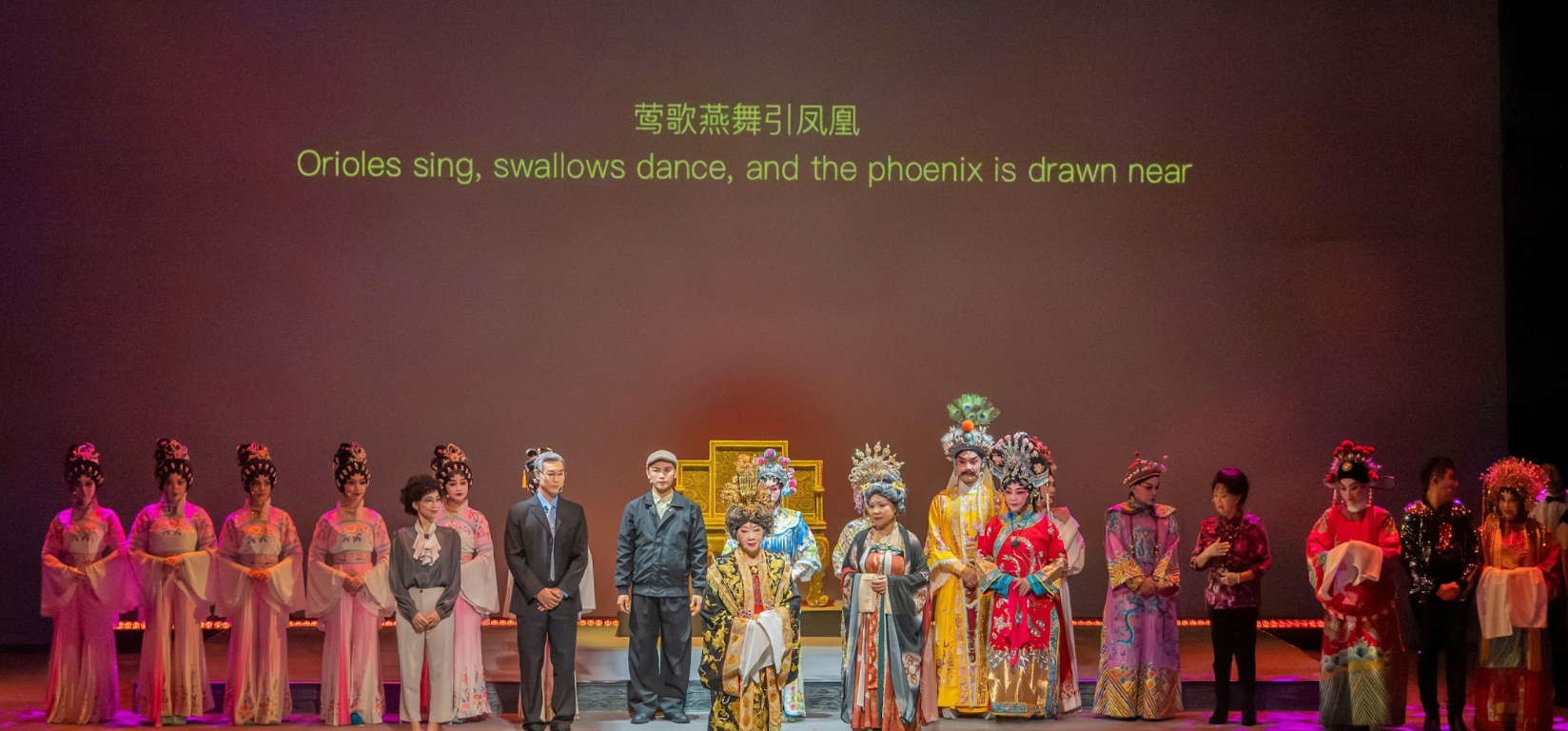
The moments when the actual Chinese opera elements take over are consequently some of the most valuable in the production. Between the archival material and dramatic snapshots are excerpts from Cantonese opera, performed by CTC’s artists, alumni and guest performers, accompanied by live musicians. After watching photographs of old productions and reading about the company’s achievements, there is something quite different about suddenly seeing the costumes in motion, hearing the vocal technique live and watching the stylised gestures performed by artists who have spent years mastering them. The costumes deserve attention in themselves: the intricate details, colours, headdresses and accessories become especially striking when set against the comparatively documentary aesthetic of the archival sequences. More importantly, the voices make a compelling case for the art form without requiring the production to explain why it matters. When a performer steps forward and sings with that level of control, the argument is being made in real time.
That becomes even more apparent in the production’s treatment of legacy. There are many familiar names associated with CTC’s history, but the most convincing evidence of Joanna and Leslie’s influence is not an award or an international performance. It is the succession of people they taught. Performers including Jeslin Cheong, Candice Chia, Chan Mei Yin, Ian Kwok, Chan Mei Leng, Frances Wong, Seetoo Hoi Siang, Cynthia Chow and Gary Ong are part of a wider network of artists who have learnt from, performed with or been shaped by the Wongs and the institution they built. Their presence changes the meaning of the anniversary. These are not hired performers, they are the continuation of the work of Joanna and Leslie, their love living on in these performers and their delivery. Some of them have become accomplished artists in their own right; some have gone on to teach others; and collectively they demonstrate that an art form survives not because one great practitioner keeps performing it forever, but because knowledge moves from one person to another.

One particularly affecting moment comes when Gary Ong appears without the elaborate costume that otherwise marks the opera sequences. With the visual spectacle stripped away, attention falls almost entirely on the voice. It is a small but powerful reminder that what Joanna and Leslie leave behind is not just historical archive. The technique, discipline, musicality and knowledge they have promoted and taught remain embodied in other people. The same idea is present throughout the ensemble. There is something almost genealogical about seeing so many of Joanna’s former students and collaborators on the same stage: the production becomes a family tree in which each performer represents another branch of an artistic lineage. CTC’s greatest achievement may therefore be that it has made itself unnecessary in one very particular sense. Its founders do not have to be the only people capable of carrying the tradition because they spent decades teaching other people how to do it.
The family dimension of the production makes this idea even more explicit. Joanna and Leslie’s daughter Audrey Wong is part of the production team as producer and researcher, while their nephew Ming Wong serves as Executive Producer and Multimedia Director, bringing his contemporary visual practice into an art form that has been part of his family’s life for generations. Christopher Choo, the production’s Artistic Director, Scriptwriter and Director, was himself a student of Joanna and has spent decades working in Chinese opera and theatre. Co-scriptwriter Jaron Leong, another former student, has likewise remained deeply involved in the art form across both performance and backstage work. The people telling this story are therefore not detached observers. They are people whose own lives have been altered by the institution being remembered. In that sense, the production is most convincing when it stops trying to explain the Wongs’ legacy and lets us see it standing around them.

A surprisingly moving detail is watching Joanna and Leslie age across the production’s archive. Photographs of the young couple gradually give way to images of older artists, and the accumulation makes visible what the programme’s statistics cannot quite convey: the extraordinary length of a shared artistic life. Leslie’s story is particularly remarkable, from his career in the police force to his work as a lyricist and composer, his deep engagement with Chinese literature and his continued writing of opera works. Joanna’s path is equally expansive, from her childhood fascination with Cantonese opera to becoming a performer, teacher, cultural innovator and the first Chinese opera artist to receive the Cultural Medallion. What’s more, the production isn’t just juxtaposing their achievements, but amplifying them by showing how their strengths complemented each other, and how their partnership allowed an institution to develop around them.
For much of the evening, however, the production remains fundamentally celebratory. Its purpose is commemoration, and it makes little attempt to dismantle or interrogate the people it is honouring. The struggles and disagreements that appear along the way are eventually folded into a larger story of perseverance. At times, the archival density can make the dramatic material feel secondary, and some of the biographical scenes are over almost as quickly as they begin. But it would be somewhat beside the point to demand that One Love, A Legacy become a conventional piece of critical documentary theatre. Its isn’t to manufacture conflict where the people making the work have chosen remembrance, and its primary purpose is for us to understand the scale of what they built, and to appreciate the human effort behind something that can otherwise be reduced to an institutional name.

The production becomes much more emotionally direct when it finally returns to Joanna alone. Again she is dressed in white, again she sits in the chair, but this time the context has changed. We have spent the preceding hours watching her life with Leslie, watching their achievements accumulate and watching generations of performers gather around the institution they created. Now Leslie is absent. Joanna speaks about the loneliness she sometimes feels after his death, and there is an audible shift in the room. You can hear the emotion in her voice, and the equally emotional response from the audience is immediate and deeply human. It is difficult not to feel the enormity of what his absence means when we have just spent an entire production being reminded of how intertwined their lives were.
Yet even here, Joanna is not portrayed as someone whose story has ended. She is comforted by Ann Chung in costume as Wu Ze Tian, and Joanna gradually dries her tears. The resolve returns and the strength comes back to her body. She may be mourning one of the most important people in her life, but she is also the person who has spent decades insisting that the art they loved deserves to survive. The scene earns its applause because we are watching a woman who has actually lived through the history being commemorated, and who is still standing at its centre.

The final image is therefore almost inevitable: Joanna appears once more, now wearing opera costume alongside the rest of the performers this evening. After all the photographs, archival footage, recreated scenes, historical documents and accounts of past performances, the production ends with the living artists themselves. It is a beautiful reversal. For a production that sometimes feels like a museum exhibit, the final exhibit is not an artefact at all. It is Joanna and the rest of CTC, still performing, still championing Cantonese opera.
There is a particular poignancy to the audience that gathers around her at this moment, especially on an anniversary occasion filled with people from Singapore’s Chinese theatre, opera and arts communities who understand the significance of the work that has gone into CTC over the decades. The applause carries the feeling of recognition for both the production and for a body of work and community that has survived because people kept showing up to teach, rehearse, perform, write, organise and learn.

Perhaps that is why One Love, A Legacy is ultimately less concerned with answering whether Chinese opera has been successfully preserved than with showing what preservation actually looks like. It looks like an archive, certainly. It looks like costumes, festivals, international tours, original compositions and old photographs. But it also looks like the many performers who have inherited what came before them, a production that has made Cantonese opera feel modern and relevant while true to its roots. And finally, it looks like an 87-year-old Joanna Wong standing in costume, still determined to keep going.
CTC’s legacy is not a static, finished monument to Joanna and Leslie Wong. It is a chain of people who have been born from their shared love of each other and the art form, one that has kept evolving because of their continual adaptation to make it accessible and relatable to new people. They taught because they understood that no tradition survives by being held by one generation alone. And now, decades later, the people they taught are the ones standing beside them.
A conventional play would have been the wrong form for this story. A life this long, an institution this deeply rooted and a legacy this widely distributed cannot easily be contained within a single dramatic narrative. Instead, the production gathers the fragments, the photographs, the costumes, the music, the voices, the memories and the people, and lets them accumulate until the scale of the achievement becomes clear: a legacy has been built but it is not finished. It is still singing.
Photo Credit: Ken Cheong
One Love, A Legacy: Celebrating Joanna & Leslie Wong and Chinese Theatre Circle played from 19th to 20th September 2026 at the Singtel Waterfront Theatre. More information available here
Production Credits:
| Cast Joanna Wong, Ann Chung, Han Fang Fang, Mo Wen Hai, Lo Siu Ling Huang Ziyin, Lan Haiyun, Liang Chunfeng, Huang Zitong, Ouyang Yingqi, Wang Geng, Titus Leong, Yuan Chonghuai, Fung Chi Shing, Jeslin Cheong, Candice Chia, Chan Mei Yin, Ian Kwok, Chan Mei Leng, Frances Wong, Seetoo Hoi Siang, Cynthia Chow, Gary Ong Orchestra Tung On Opera Pte Ltd: Chen Xiaorui (Orchestra Leader), Cheong Tim Choy (Gongs), Lai Chong Yeen (Cymbals), Chen Haizhou (Yangqin), Yong Phew Kheng (Flute), Xu Hongwei (Saxophone and Suona), Lee Khiok Hua (Cello), Nicholas Ng (Pipa), Claudia Tan Shi Lin (Guzheng), Zhou Kairui (Drums), Ouyang Jing (Lead Percussionist) Executive Artistic Director Joanna Wong Executive Producer and Multimedia Director Ming Wong Artistic Director, Scriptwriter, Director Christopher Choo Scriptwriter, Wardrobe Manager Jaron Leong Producer and Researcher Audrey Wong Production and Stage Manager Yow Wei Chui Assistant Production Manager Ian Kwok Music Director/ Composer/ Arranger Ouyang Jing Lyricist Sally Low Translator/Publicity (Chinese) Yow Wei Meng Lighting Designer Clement Cheong Sound Engineer Steve Zhang Visual Media Programmer/Multimedia Operator Maximilian Liang Assistant Stage Manager Foo Kok Wah Sound/Mic Operator Ng Wee Kiat Surtitles translator/operator Joyce Chua Hair Designer (modern styling) Zennie Makeup Designer (modern styling) Joyce Yeo Makeup Artist (modern styling) Carol Yoong Makeup Artists/Dressers (Opera – Singapore) Ng Kar Ying, Yue Meng Fong, Richard Lee Makeup Artists/Dressers (China) Yang Fen, Yuan Cun Stage sets/props Focus Stage Productions Costumes and Props (Singapore) Wong Kwok Onn Props (China) Deng Jianwen Stage Crew Chan Fook Hong, Jane Ong, Focus Stage Productions Stage Manager (China) Su Wenquan Backstage Manager (China) Chen Weijun Backstage Assistant (China) Han Ji Backstage Assistants (Singapore) Ho Yin May, Khoo Lay Wah, Woo Soon Ho Front of House Woo Yim Yong, Chan Kwai Lin Hong Dou Cantonese Opera Troupe Leader Su Hua |

