
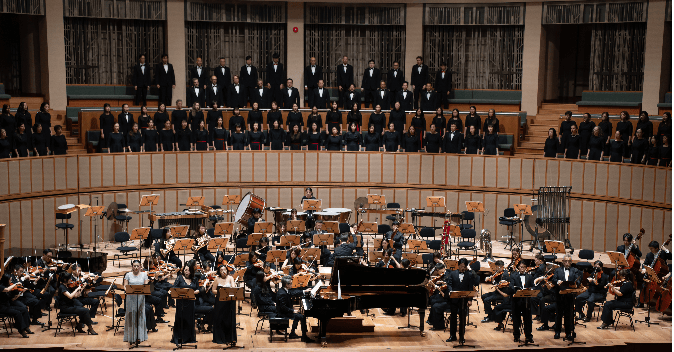

An evening of cultural exchange through music that celebrates what happens when different voices come together as one.
Some concerts impress with virtuosity; others leave you with a feeling that lingers long after the final applause. Listening to Taiwan, presented by the National Taiwan Symphony Orchestra (NTSO) at the Esplanade Concert Hall, manages both. Led by conductor Tung-Chieh Chuang, the evening brings together Taiwanese musical traditions, Singaporean folk melodies and some of the great works of the Western classical repertoire. With pianist Albert Tiu, the Singapore Symphony Chorus, the Singapore Symphony Youth Choir and a team of vocal soloists joining the NTSO, it becomes a celebration not only of music, but of what can happen when musicians from different backgrounds come together with a shared purpose.
Ching-Shan Chang’s Echoes of Eight Decades, commissioned to mark the NTSO’s 80th anniversary, opens the programme with a rousing sense of occasion. It feels almost like a warm-up, an opportunity for the orchestra and Chuang to settle into the evening together. Chuang is expressive from the outset, his gestures shaping the music with energy and clarity, while the orchestra sounds increasingly cohesive as the piece unfolds. Drawing on musical traditions from Taiwan, the work moves through contrasting textures and colours, building towards an invigorating finish that sets the tone for the concert ahead.

A change of mood follows with Zechariah Goh’s Singaporean Folk Medley. Hearing familiar songs such as “Ondeh Ondeh”, “Suriram”, “Kopi Susu” and “Jinkly Nona” reimagined in a choral and orchestral setting is a real pleasure. There is something particularly endearing about these well-loved melodies taking on the richness and blend of a classical choral performance while retaining their warmth and familiarity. The Singapore Symphony Chorus and Singapore Symphony Youth Choir bring an inviting character to the piece, making it both relaxing and fun.
It is also a wonderful choice for a concert built around cultural exchange. Here is Taiwan’s national orchestra embracing the musical heritage of Singapore, with Singaporean singers giving these local songs their own distinctive voice. Rather than feeling like a token gesture, the medley feels affectionate and sincere: a musical nod to the different communities and traditions that make up Singapore, and a reminder that our cultural identities can be celebrated just as meaningfully on the concert stage as in everyday life.

The evening’s centrepiece, Beethoven’s Choral Fantasy, brings the collaborative spirit of the programme into full focus. With Albert Tiu at the piano, the orchestra, chorus, youth choir and vocal soloists, the work draws together an impressive range of performers. Tiu is a highlight in his own right. During the piano passages, his fingers move fluidly across the keys, his concentration unwavering as he navigates Beethoven’s writing with assurance and finesse. Around him, the orchestra seems completely at home in the work, responding with confidence as the music shifts between intimacy, exuberance and grandeur.
What makes the performance especially satisfying, however, is the way everything comes together. The piano, orchestra and voices each have their own character, yet none feels disconnected from the whole. The music grows organically, beginning with a more intimate exchange before opening out into something increasingly expansive. When the chorus enters, the effect is stirring: individual voices and instrumental lines become part of a much larger musical statement, building towards a finale that feels genuinely celebratory. The enthusiastic bravo at the end is thoroughly deserved.

Much of the credit belongs to Chuang, whose conducting is both precise and expressive. He stretches himself physically across the podium, communicating the music through gestures that are energetic without feeling excessive. Yet it is his attentiveness to the people around him that leaves the strongest impression. He seems to see every section, giving the musicians room to shine and allowing individual contributions to register within the larger performance. Just as importantly, he acknowledges the guest performers and gives them their time in the spotlight when the applause comes. There is a generosity to his leadership, and a sense of mutual respect between conductor and musicians that makes the entire performance feel especially warm. He is not simply keeping everyone together; he is helping everyone belong.
After the interval, Tyzen Hsiao’s The Angel from Formosa offers a gentler interlude. Short and sweet, it has a soothing, almost dreamlike quality, with a delicate melody that unfolds gracefully through the orchestra. The woodwinds introduce a sense of lightness, while the harp adds a shimmering texture beneath the other instruments. As the strings join and the orchestral sound gradually expands, the music takes on a quiet emotional richness without losing its serenity. It is a lovely moment of repose, and an evocative tribute to the Taiwanese musical identity at the heart of the evening.

Then comes Rachmaninoff’s Symphonic Dances, and the concert shifts into an altogether bigger and more dramatic world. Composed in 1940, this was Rachmaninoff’s final completed orchestral work, and it feels in many ways like a summation of his musical life. Written after years of upheaval and exile from Russia, it brings together the sweeping lyricism and rich harmonies for which he was known with darker, more restless musical ideas. Across its three movements, there are haunting melodies, an unsettling central waltz and flashes of tremendous orchestral power.
This is the evening’s great orchestral showpiece, and the NTSO rises magnificently to the challenge. The sound is expansive and richly layered, with each instrumental section contributing to a performance that feels both meticulously controlled and exhilaratingly alive. The first movement draws the listener into its shifting colours and brooding intensity; the second unsettles with its shadowy dance rhythms; and the finale gathers momentum in a thrilling interplay of tension, movement and release.

It is in this final movement that the sheer excitement of live orchestral music becomes most apparent. The brass and percussion bring tremendous force, while the strings and woodwinds add layers of detail and momentum. Rachmaninoff’s music seems to hold contrasting worlds in tension before surging towards a triumphant conclusion. The result is epic, contemporary in its impact despite its Romantic roots, and utterly enthralling. It is the sort of performance that reminds you why hearing an orchestra live is such a visceral experience: the scale of the sound, the precision of the playing and the collective energy of so many musicians working towards the same climax simply cannot be replicated in quite the same way elsewhere.
And then, as a final surprise, the evening returns to Taiwan with a traditional folk song. – Yu-Sian Deng and Che-Yi Lee’s “Longing for Spring Breeze”《望見春風》. After the intensity and grandeur of Rachmaninoff, this beautiful, soothing close feels like a warm farewell. It brings the programme back to its cultural roots, leaving the audience with a melody that feels intimate and heartfelt after such an expansive orchestral journey. It is a lovely final touch, and a reminder that music’s emotional power lies just as much in the simplicity of a familiar tune as in the grandeur of a symphony orchestra.

What stays with you about Listening to Taiwan is the generosity of the whole undertaking. The programme moves between Taiwanese folk traditions, Singaporean melodies and classical masterpieces, but never feels like a collection of disconnected musical statements. Instead, each work contributes to a larger conversation about identity, heritage and the connections that music can create across cultures.
The Singaporean choirs, vocal soloists and pianist each bring something distinct to the stage, while the NTSO provides a powerful musical foundation. Through it all, Chuang leads with precision, expressiveness and a genuine attentiveness to his fellow musicians. He gives each contribution its due without losing sight of the bigger picture.

That is the real triumph of the evening. Collaboration does not mean that everyone must sound the same or surrender their individuality. At its best, it means giving every voice room to be heard while bringing those voices together into something greater than any one performer could achieve alone. Listening to Taiwan is a wonderful demonstration of that idea: a concert full of virtuosity and spectacle, certainly, but also warmth, sincerity and shared joy. By the time the final applause arrives, it feels as though the audience has been invited to take part in that exchange, too.
Photo Credit: National Taiwan Symphony Orchestra
Listening to Taiwan – NTSO 2026 Asia Tour Concert played on 14th October 2026 at the Esplanade Concert Hall.

