
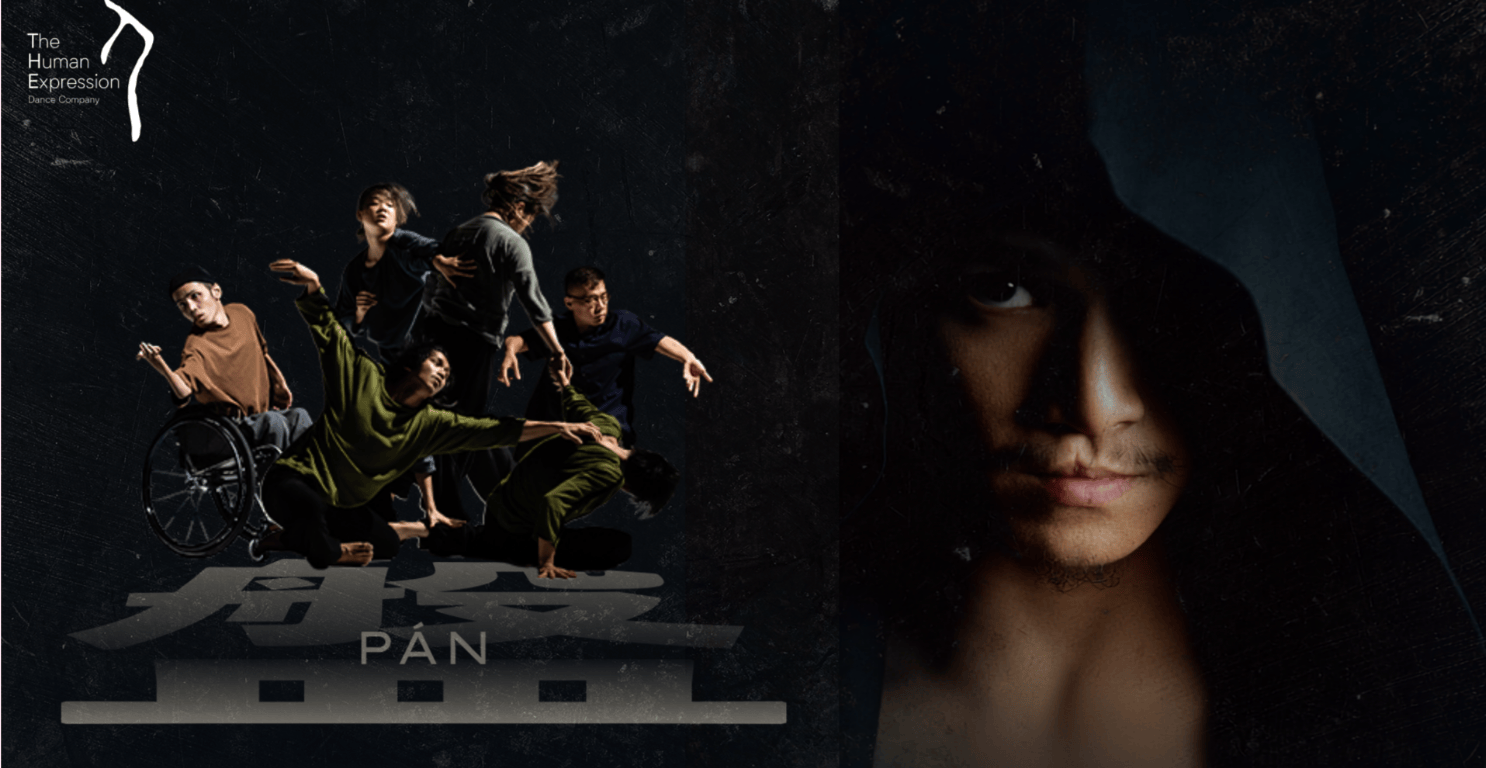
Five years after its digital premiere, the award-winning two-part dance work returns to Singapore for its long-awaited local live staging. Its choreographers reflect on cultural identity, artistic collaboration and why dance can express what words cannot.
When Kuik Swee Boon watched rehearsals for Pán《盤》 ahead of its Singapore staging, there was a particular feeling of anticipation. For the founding artistic director of T.H.E Dance Company, bringing the work back was not simply an opportunity to revisit an earlier creation. It was a chance to share a piece that had travelled across borders and formats with audiences at home.
“After we create a work, we always want to bring it back, but I never had a suitable opportunity,” he says. “The company has been busy with many new creations, but this work has always been on my mind because I think it is important and represents a very meaningful collaboration with Jae Duk.”
Created by Kuik and T.H.E’s resident choreographer Kim Jae Duk, Pán《盤》 was commissioned by the Singapore Chinese Cultural Centre for its Cultural Extravaganza 2021. Its premiere, originally intended to take place during the COVID-19 pandemic, was presented as a livestream in May that year. The work subsequently travelled internationally, receiving the Best Performance award at the Asian Arts Awards at the Edinburgh Festival Fringe, before its physical world premiere at Oriente Occidente in Rovereto, Italy, in September 2022.

Now, five years after its digital debut, Pán《盤》 will finally be presented live to Singapore audiences at the Singapore Chinese Cultural Centre Auditorium on 6 and 7 November, concluding T.H.E’s 2026 season. For Kuik, the return carries a personal significance. “The feeling is almost like it is finally coming home,” he says. “When we create work, we naturally want to tour, especially as a small company from a small country like Singapore. We really enjoy touring and receiving international recognition. That is important to us.”
“But eventually, we also have to ask ourselves who we are creating work for. I create work for the people around me, too. There is something special about being able to bring this work home and let more people here experience it.”
Pán《盤》 was a work that has always been concerned about transculturation: the continuous exchange, convergence and evolution of cultures. Drawing inspiration from the Chinese creation myth of Pangu, whose body fragments into the elements of nature, the work considers how identities are formed and transformed through encounters with others.

The production unfolds in two parts. Kuik’s Pán: The Notion of Transculturation explores these ideas through his choreography, set to music by Taiwanese musician Wang Yu-Jun. Kim’s Pán: SeungMu draws on his own cultural heritage and is accompanied by his original composition. The two choreographic worlds eventually converge in a collaborative epilogue.
For Kuik, the inspiration behind the work came partly from questioning how cultures are defined and who gets to claim ownership of them. “In the past, Chinese culture was very influential, particularly in Asia and East Asia. I love culture, but I sometimes dislike the ego that comes with it — when people claim that something belongs exclusively to their culture, or define their culture in relation to how it has influenced others,” he says. “For me, culture is constantly evolving and changing. If it does not evolve, it loses its vitality.”
The title itself reflects this fluidity. Kuik was drawn to the word pán, which appears in different cultural and linguistic contexts across Asia. In Korean, the word can refer to a performance space, as in pansori, a traditional performing art form.
“The word became a way for me to think about how culture moves across different contexts,” he explains. “Culture needs the freedom and flexibility to continue evolving, and I find that idea fascinating. I think it is important not to define cultures so rigidly that we create borders between them. A good culture should be shared with different kinds of people, with humanity as a whole.”

This is not an abstract question for the two choreographers. Having worked together for approximately 17 years, Kuik and Kim have developed an artistic relationship that accommodates their distinct cultural backgrounds while allowing common ground to emerge. “Somehow, from the first day we met, there was a chemistry between us,” says Kuik. “We appreciate many of the same things, even though we come from different backgrounds.”
He believes their relationship is rooted in “freedom, openness and inclusiveness”, values that have allowed them to collaborate without needing to articulate every thought. “Sometimes, we understand each other without having to communicate everything in words. There is a certain trust that has been built over the years, which makes working together very easy.”
Kim shares this sense of ease. “We communicate very easily. Even when we are not discussing work, we talk about our lives and what we are doing. Our relationship is not limited to business or artistic collaboration. It feels very flexible and natural.”
That familiarity does not erase their differences. Instead, it gives them room to explore how those differences might influence one another an idea that runs through the work itself. For Kim, the starting point for Pán: SeungMu was not an attempt to recreate a traditional Korean dance in a contemporary setting. Rather, it was a particular image that stayed with him.

“I did not formally learn SeungMu. I have encountered it through books, YouTube and occasionally watching it in the theatre,” he says. “What inspired me was the image of the performer beginning in a corner, with the face hidden. I also liked the hat. That image and the imagination it created really touched me, and I wanted to start from there. It was a small detail, but it gave me the inspiration to begin the choreography. That is why the opening starts in the corner.”
From this image, Kim developed his own movement language, drawing on the sensations and qualities he associated with the traditional form, including its use of breath and the feeling it evokes. His approach is less about illustrating a cultural reference than allowing it to become a starting point for something personal. “I was also inspired by the breathing, the feeling and the quality of SeungMu. These elements influenced my own interpretation of the form,” he says.
Kim’s dual role as choreographer and composer further informs the work. Rather than treating music as accompaniment to an already established sequence of movements, he approaches rhythm, tempo and physical expression as closely related elements. “I was thinking about the aesthetics of the body and movement. That was really what was on my mind when I created the work,” he says.

Kuik suggests that audiences might find it useful to approach Kim’s choreography through this musical sensibility. “Sometimes, we listen to music without asking what it means. We respond to its rhythm, tempo, energy, melody and feeling. These things can be abstract,” he says.
“Jae Duk naturally incorporates that musical sensibility into his choreography because he composes music as well as creates movement. To understand his work, it can be helpful to approach it through the experience of music, rather than only through dance or theatre.”
This openness to interpretation is important to both artists. Kim says he generally creates for himself rather than beginning with what audiences might want to see. “I want to remain focused on what I want to do and enjoy the process of creating,” he says. Yet he has found that work made from a deeply personal starting point can still resonate beyond himself. “Sometimes, after a performance, I receive responses from audiences that make me realise that something I wanted to explore for myself can also be universal.”

While Pán《盤》 examines cultural difference, it also challenges assumptions about how different bodies can share a performance space. The restaging features guest artists Tung Ka Wai and Wheelsmith (Danial Bawthan), a wheelchair dancer, alongside standing dancers. Their presence is not framed as a departure from the work’s artistic concerns, but as part of its exploration of different bodies, experiences and movement vocabularies.
For Kuik, working with the two artists has been an opportunity to reconsider his own creative habits. “I learned a great deal from Ka Wai and Danial,” he says. “When we become very good at something, we can sometimes become limited by what we already know. We may not recognise those limitations until we work with people who have different strengths and preferences.”
Working with artists whose physical approaches differ from those of the company’s dancers opened up new possibilities for him. “They made me reconsider what is possible and opened up new possibilities for me.”

He also points to qualities that cannot be measured purely in terms of physical ability. “We often talk about physical strength, but there is also mental strength, which can be incredibly powerful. I learned a great deal from both of them in that respect.”
This willingness to remain open to new possibilities extends to how Kuik develops choreography. The dancers are not merely executing steps devised in advance; their contributions can influence what emerges in the studio. “The dancers are also my collaborators,” he says. “Of course, finding a meeting point between everyone’s ideas can be challenging.”
Much of this process involves experimentation that may never appear in the finished work. “You might see only a small solo or a short section in the finished work, but a great deal of material has been developed in the studio. We spend a lot of time researching and working through ideas, and in the end, we have to be selective about what we use.” Even when movement material is discarded, the process remains valuable. “It helps us understand the work better and builds our knowledge of it.”

For Kim, working with dancers over a limited rehearsal period also requires responsiveness. His approach is to demonstrate the movement, communicate its quality and adapt when necessary. “If a movement does not look right, I will say so and change it. Sometimes, a movement simply does not suit a particular dancer, so I change my approach rather than insisting that they do something that does not work for them,” he says.
Kuik recognises that this flexibility is something choreographers develop with experience. “Over time, you learn that there is no point forcing a dancer to do something they cannot achieve or are uncomfortable doing. Jae Duk and I have both become more flexible in this respect.”
For a work that asks how different bodies and identities can come together, this adaptability is not incidental. It is part of the creative process itself. The return of Pán《盤》 also offers an opportunity to experience the work in a different medium. Its original Singapore premiere was shaped by the restrictions of the pandemic, when Kim was in Korea and the artists had to complete portions of the work through video.
“The communication was difficult because I could not see the dancers performing live or feel the work directly,” Kim recalls. “I could not give Swee Boon feedback and corrections in the same way I would have if I had been there in person.”

For Kuik, the difference between a recording and a live performance goes beyond the technical limitations of filming. A camera inevitably determines what audiences see, selecting certain movements and perspectives while leaving others outside the frame.
“For those who watched the work during COVID-19, I think experiencing it live will be different,” he says. “A camera has its own perspective. It chooses what the audience sees and what remains outside the frame. I think it is better to treat the livestream and the live performance as two different experiences, shaped by two different media.”
In a theatre, audiences can experience the dancers’ physical presence more directly: the exertion of their movements, their breathing and the space they occupy together. For Kuik, these are not merely incidental details surrounding the choreography. They are part of what dance can communicate. “The intention behind a work is important, but sometimes meaning can come afterwards. The experience itself can be meaningful,” he says. “When audiences experience the liveness of a performance, the dancers sweating, breathing and moving in front of them, that experience can communicate more than words can explain.”
He continues: “I believe that is one of the strengths of dance. We are trying to achieve something that sometimes goes beyond what words or other forms of media can express. If everything we wanted to communicate could be expressed through words, we could simply write about it. But that is not necessarily the strength of dance.”

It is a reminder that Pán《盤》 does not necessarily seek to provide definitive answers about culture or identity. Instead, it creates a space in which audiences can encounter difference without needing to resolve it into a single meaning.
Five years after its digital premiere, the central concerns of Pán《盤》 remain relevant to Kuik. The world around the work has changed, but he does not believe its underlying questions have become less urgent. “The work’s main intention and message remain relevant today,” he says.
For Kim, the collaboration continues to offer a way to consider what happens when artists from different backgrounds bring their perspectives together. He hopes audiences will be curious about the reasons behind the production and the possibilities that emerge from those encounters. “I am curious about how our different perspectives can come together, what we already have in common and how we can develop something further through that combination,” he says.
Ultimately, Kuik wants shift the focus away from prescribing what audiences should take away, and instead allowing them to experience the work on their own terms. “I hope audiences will simply enjoy the work,” he says. “We are trying to develop a new form of expression through T.H.E, something that goes beyond what words or other media can achieve. I think that is one of our strengths. We want to help people see the world differently. If audiences enjoy what we do, that is already enough. If they also leave with a meaningful reflection, a new understanding or an experience that stays with them, that is even better. But enjoyment comes first.”
He offers a simple invitation to those coming to the theatre: “I would encourage audiences to experience the work rather than overthink it. There is no completely right or wrong interpretation.”
For a work that questions the boundaries between cultures, bodies and identities, perhaps that openness is its most fitting conclusion. As Pán《盤》 finally arrives in Singapore, its choreographers are not asking audiences to agree on what it means to belong. They are inviting them to experience what becomes possible when people meet, move and create together. “If people walk away with something that inspires them and stays in their hearts for a long time,” Kuik says, “that means a great deal to me.”
Photo Credit: CRISPI
Pán《盤》plays from 6th to 7th November 2026 at the Singapore Chinese Cultural Centre Auditorium. Tickets available from BookMyShow.
Read our 2021 review of Pán《盤》here

