
BANGKOK, THAILAND – An angel lies face-down on the floor of the National Museum Bangkok. Its wings are spread awkwardly behind it; its robe has ridden up, exposing a pair of thin, weathered legs. There is nothing particularly celestial about this figure. It looks old, exhausted and possibly rather worse for wear.
A short journey away, at One Bangkok, a digital rainforest teems with human-animal hybrids. At Museum Siam, an artist revisits the uneasy relationship between power and the promise of peace, while another invites us to consider the many contradictory selves that inhabit a single mind. At Wat Pho, a bronze figure reclines in quiet contemplation of mortality.
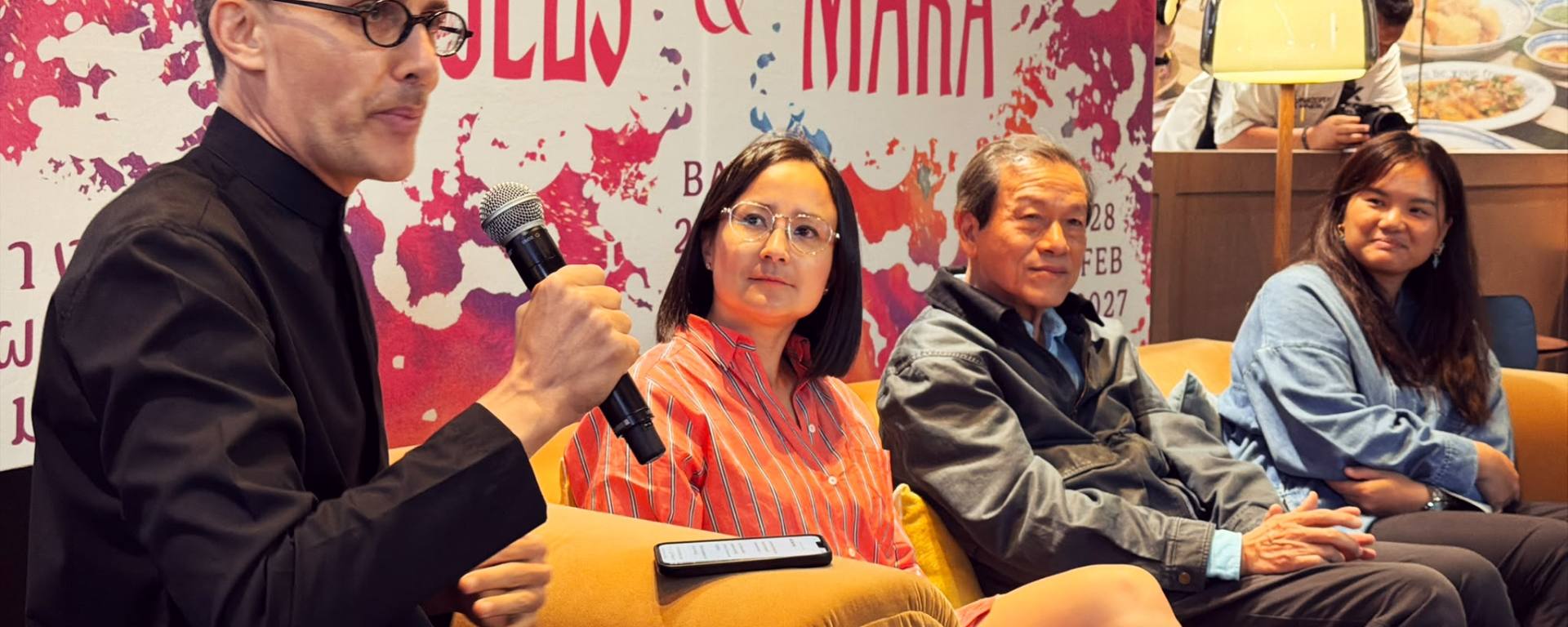
These are among the encounters awaiting visitors to the Bangkok Art Biennale 2026, which opened on 29 October and runs until 28 February 2027. Bringing together 72 artists and collectives, this fifth edition unfolds across temples, museums, galleries, cultural institutions and commercial spaces throughout the city.

Its title and theme, ANGELS & MARA, sets the tone for a Biennale concerned with a world in which the boundaries between good and evil, sacred and profane, beauty and decay, are increasingly difficult to distinguish. Rather than offering a reassuring division between opposing forces, the exhibition asks us to consider how both may coexist within the same person, society or moment in history.
In Bangkok, a city whose very name, Krung Thep, means the City of Angels, the theme carries a particular resonance. The city becomes not simply a backdrop but an active participant in the Biennale: a place where spiritual traditions, political tensions, commercial ambition, popular culture and everyday life continually intersect. The result is an exhibition that feels like a sprawling film in which Bangkok itself is the set. Angels and Mara have descended upon the city, and the visitor is invited to decide what, or whom, to believe.

The curatorial premise begins with a sense of unease about the contemporary world. War, terrorism, environmental destruction and trade conflicts sit alongside political propaganda, social division and the erosion of trust. Questions of race, faith and class, as well as corruption and political polarisation, have made it increasingly difficult to establish where right and wrong begin and end. The curatorial text describes a warped world of dialectical opposites, where apparently conflicting ideas may both be true and valid. Its central question is direct: “whose side are we on?”
The title brings together two figures from different spiritual traditions. An angel is, at its root, a messenger: the Greek angelos refers to one who carries a message. Across religious and cultural traditions, celestial or divine beings appear in many forms, from angels and cherubim to devas, thep, dharmapalas, apsaras, dakinis and nang fah.
Mara, in Buddhist cosmology, occupies a darker position. Associated with death and the forces that obstruct enlightenment, Mara can also be understood as a manifestation of the less generous tendencies within human beings: anger, jealousy, hatred, lust, delusion and the ego. Yet the Biennale is not interested in assigning these forces to separate camps. Angels can fall; demons may seek redemption; the apparently virtuous may harbour destructive impulses. The distinction between the two is not always stable.

This ambiguity is embodied in the work of the Biennale’s curatorial team, led by Professor Dr Apinan Poshyananda, alongside Adulaya “Kim” Hoontrakul, Rémy Jarry, Melanie Pocock and architect Kulapat Yantrasast. Their different backgrounds bring together perspectives from contemporary art, art history, institutional practice, education and architecture.
For Apinan, who has been involved in all three previous editions of the Biennale, the project also continues a longer conversation about how art can occupy and activate Bangkok. Since its founding in 2017, the Biennale has grown into a major platform for contemporary art, with previous editions exploring themes including Beyond Bliss, Escape Routes, CHAOS : CALM and Nurture Gaia.
ANGELS & MARA extends that conversation into a more unsettled present. It asks what happens when faith is weakened, when power becomes difficult to trust, and when the forces we might regard as angelic or demonic are no longer easily separated.
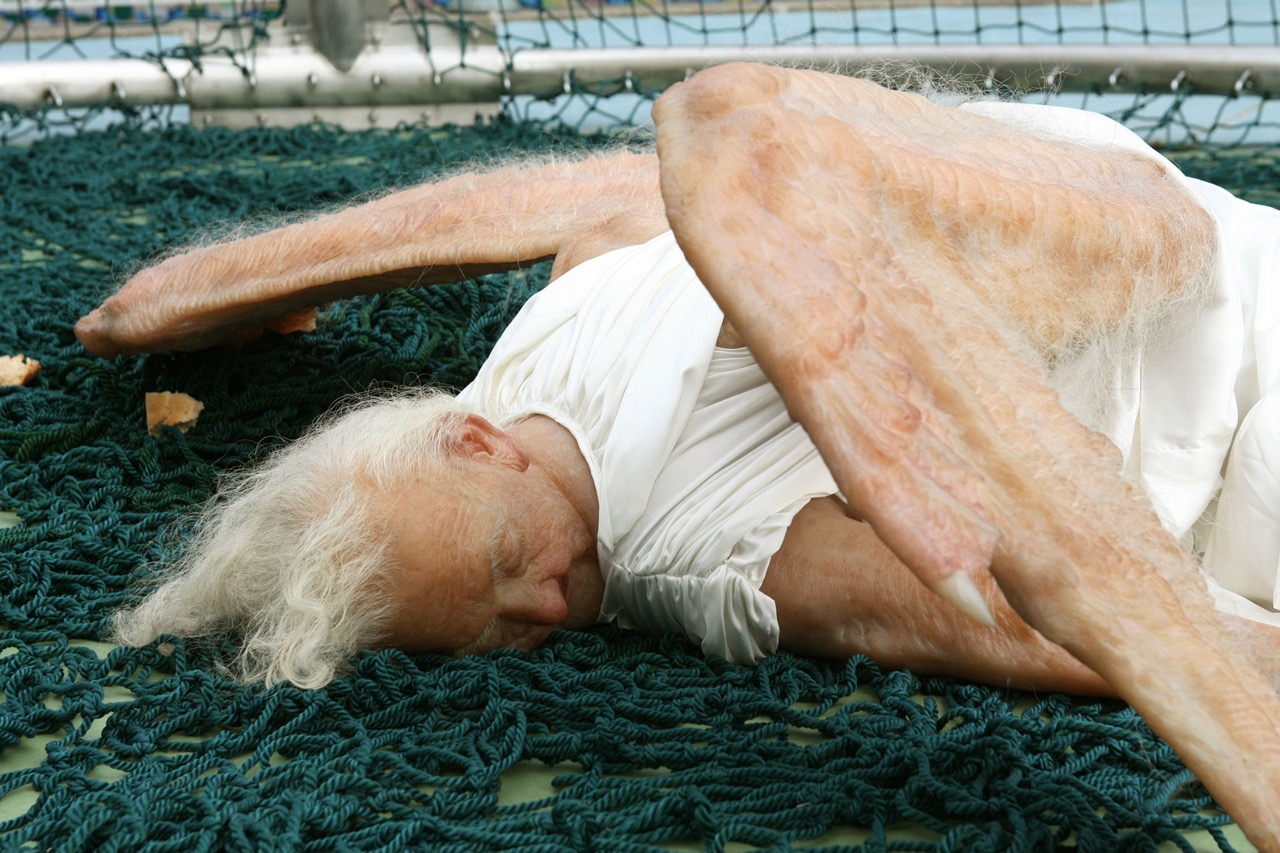
Angel (2008), by Chinese artist duo Sun Yuan and Peng Yu, is an arresting place to begin. Displayed at the National Museum Bangkok, the life-sized sculpture is made from silicone gel and other materials, rendered with such realism that it initially appears almost disturbingly human. An elderly angel lies face-down on the ground, as if it has fallen from the sky. Its wings and clothing suggest a celestial identity, but its body tells another story: age, fatigue, vulnerability and helplessness.
The work overturns the familiar image of angels as beautiful, youthful and divinely powerful. Here, the sacred has been dragged into the mundane. The figure could be exhausted, defeated or simply unable to get up.
Sun Yuan and Peng Yu are known for provocative works that explore mortality, moral codes and the limits of human experience. In Angel, dark humour makes the image both absurd and unsettling. The figure seems to embody a crisis of belief: what happens when the guardians we imagine watching over us appear as powerless as everyone else?
The sculpture acquired an unexpected second life in 2015, when photographs circulated online with false claims that a real angel had fallen in London. The images went viral before fact-checkers debunked the story. It was an early example of an artwork being transformed by misinformation, as the boundary between an artistic fiction and a supposed real-world event dissolved.
That episode gives the work an additional contemporary dimension. In an age when images travel faster than their context, even an artificial angel can become the subject of a collective act of belief. At the National Museum, the sculpture sits within a setting steeped in the histories and symbols of Thai culture. Nearby, another work makes a different kind of connection between cultural inheritance and contemporary interpretation.
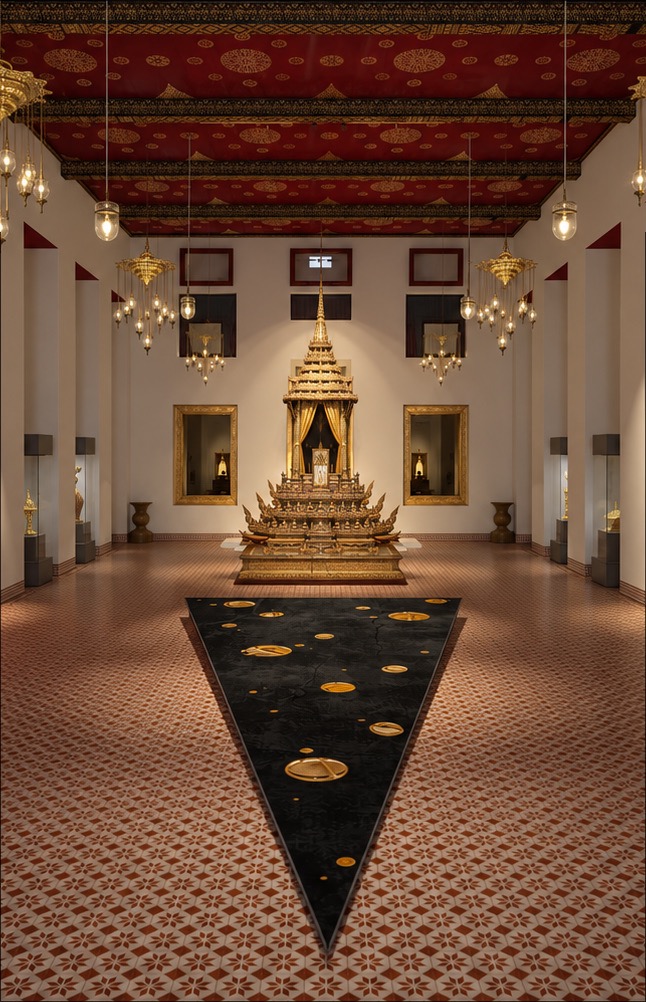
Liu Jianhua’s Square (Siamese Triangle) (2014–2026) is a site-specific adaptation of an earlier installation. Steel plates are arranged in a triangular formation that echoes the shadow of a throne, while fragments of glazed porcelain resemble molten gold. Produced in Jingdezhen, China, the ceramics evoke the long history of Sino-Thai exchange, including the tradition of benjarong and lai nam thong wares made for Siam since the Ayutthaya period.
Mirrored surfaces catch the vermilion ceiling and golden stars of the Throne Hall, creating a conversation between the installation and its surroundings. The work does not simply place contemporary art inside a historical institution; it reflects the histories already embedded in the space.
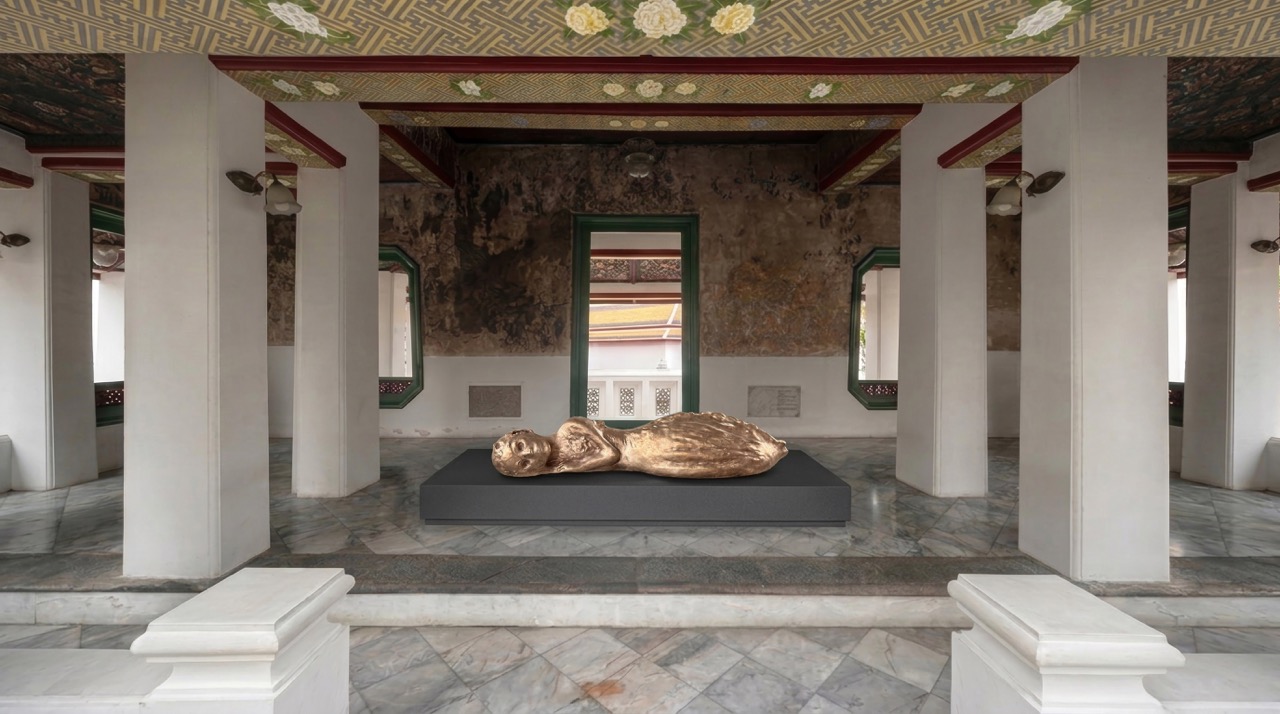
At Wat Pho, Leiko Ikemura’s Memento Mori (2013/26) offers a quieter meditation. The Latin phrase means “remember that you are mortal”. Ikemura’s bronze reclining figure draws on a long history of representations of the body, from Renaissance still-life motifs of withered flowers and skulls to medieval reclining sculptures. Its placement at Wat Pho also invites an association with the temple’s famous Reclining Buddha. The work brings together different cultural and spiritual approaches to impermanence. Its stillness is not simply an image of death, but a reminder that life and rebirth are inseparable from the passage of time.
Ikemura’s Wu-san (2004/05) and Ma-san (2004/05), known as “Angel from Cologne” and “Devil from Cologne”, extend the Biennale’s interest in opposing forces. Their titles suggest two distinct identities, but the works can also be understood as complementary presences. One does not necessarily cancel out the other. In the temple setting, these works invite visitors to slow down. The encounter between contemporary sculpture and sacred architecture becomes an opportunity to consider the cycles of life, death and renewal that connect the Biennale’s many interpretations of angels and Mara.
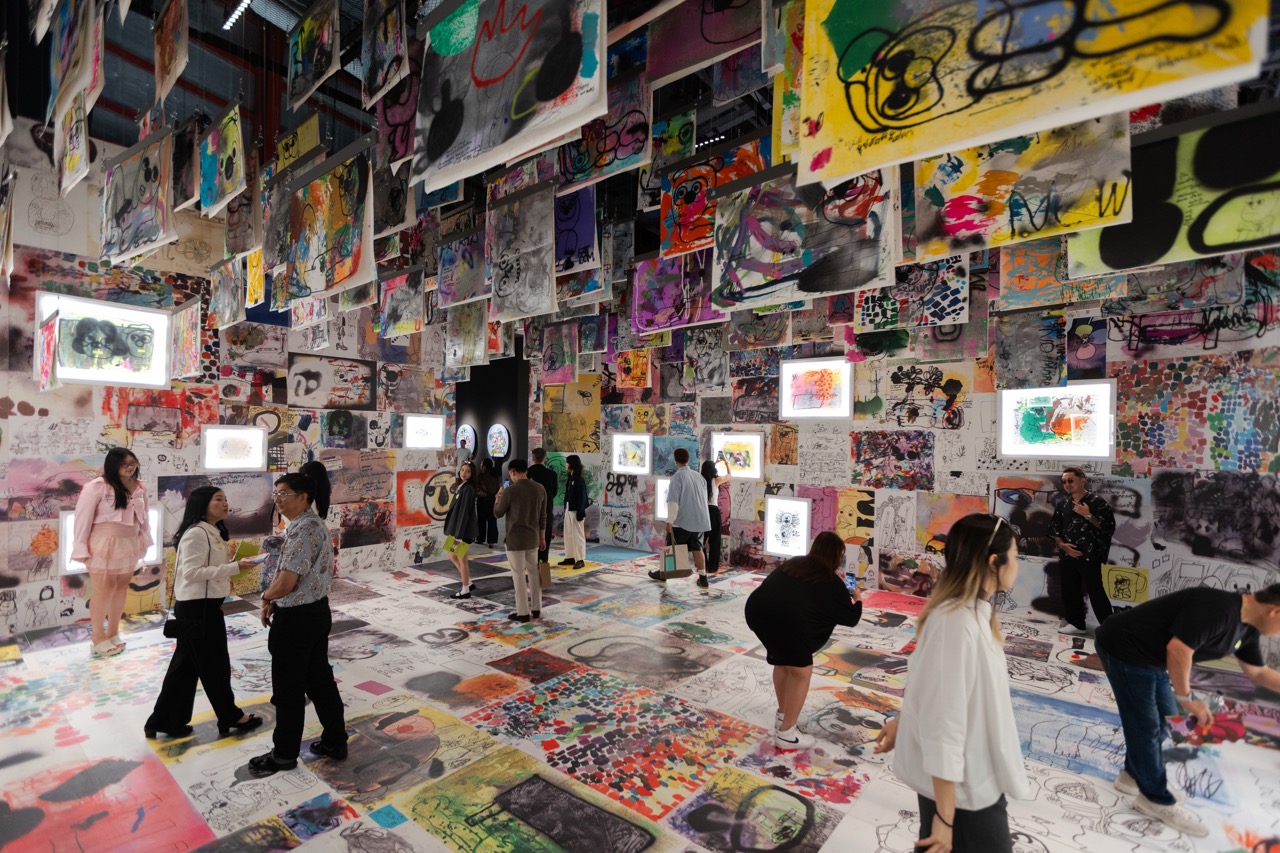
At Museum Siam’s Discovery Museum, the theme turns inward. Udom Taephanich’s THE TENANTS OF MY MIND (2026) considers the contradictory characters that can inhabit one person. We may be childlike and old, brave and cowardly, saintly and sinful, hunter and prey. We can be authentic and pretentious, gentle and aggressive, brilliant one moment and foolish the next. We may forgive while still carrying resentment.
The title suggests that the mind is not a single, settled home but a place occupied by multiple tenants. The self reflected in a mirror may be only a temporary state, shifting like a cloud rather than remaining fixed like stone.
It is an apt interpretation of the Biennale’s central premise. The angel and Mara need not be external beings; they may be competing tendencies within us. The same person can embody generosity and selfishness, compassion and cruelty, depending on circumstance.
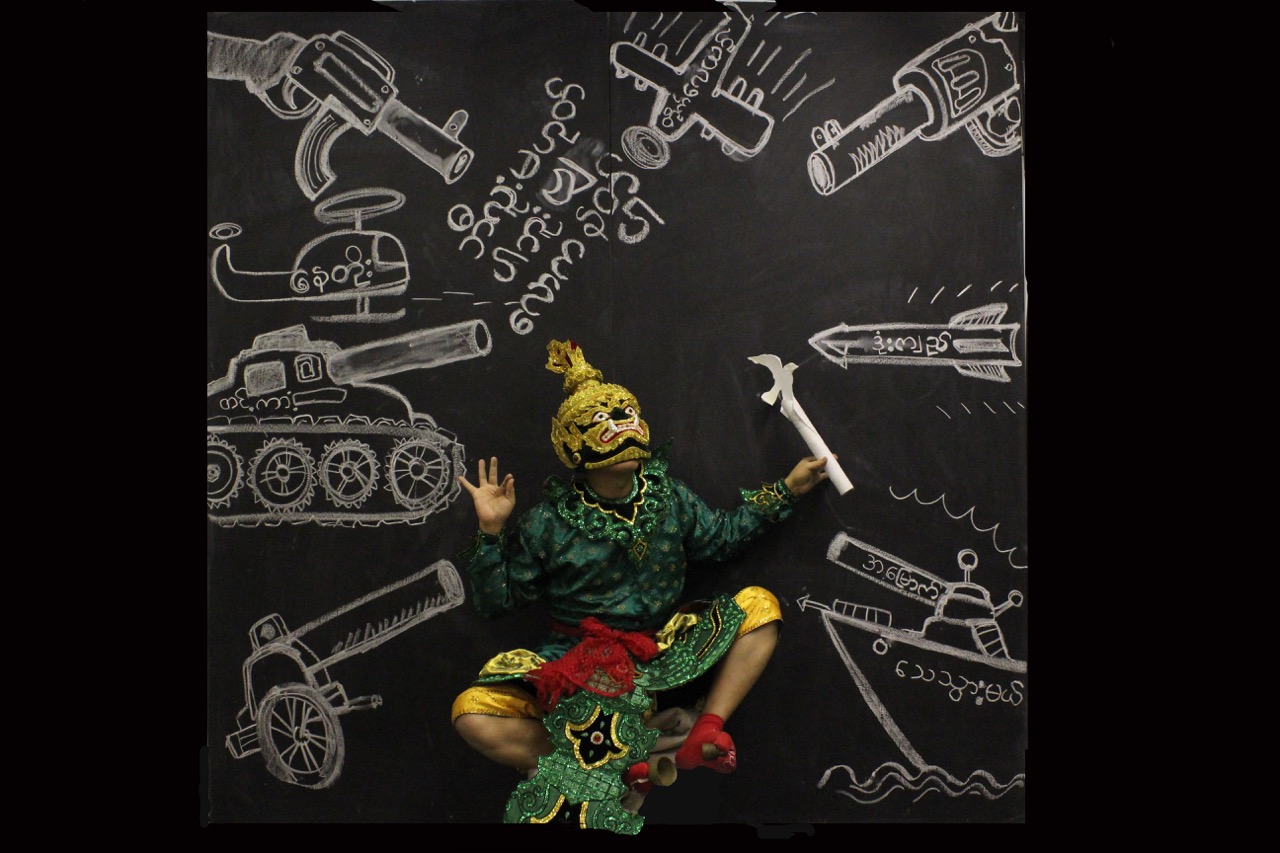
The work also sits in productive conversation with the presentation of Htein Lin, whose works at Museum Siam connect personal experience with the political realities of Myanmar. In I’m no demon! I am Lokanat, angel of peace! (2010), nine digital photographs document a mixed-media performance. A troublesome ogre, confronted by external forces, attempts to present himself as Lokanat, a spirit of peace. The work is a symbolic commentary on Myanmar’s 2010 election and the constitution that gave the Tatmadaw a significant role in the country’s political system.
The uneasy relationship between the ogre and the figure of peace raises questions about the language of authority and the images through which power presents itself. What does it mean to claim the identity of a protector? And how do we distinguish a promise of peace from a performance of it? Htein Lin’s 000235 (1998–2004) brings the discussion closer to the body. These monoprints reflect the artist’s experience of prison life, including isolation, longing, darkness and hope. They were made using improvised materials such as syringes, toothpaste-tube tops, bowls, prison uniforms and found textiles.
In When I was a Lousy Millionaire (2022), a video revisits his time with the All Burma Students’ Democratic Front. A communal activity involving the removal of head lice in a village recalls his first experience of lice while chained in freezing conditions. An ordinary act of care becomes entangled with memories of deprivation and confinement.
Together, the works reveal how the personal and political continually overlap. The language of angels and demons is not confined to mythology: it can also describe the roles people are forced to inhabit, the identities they claim and the ways they survive.
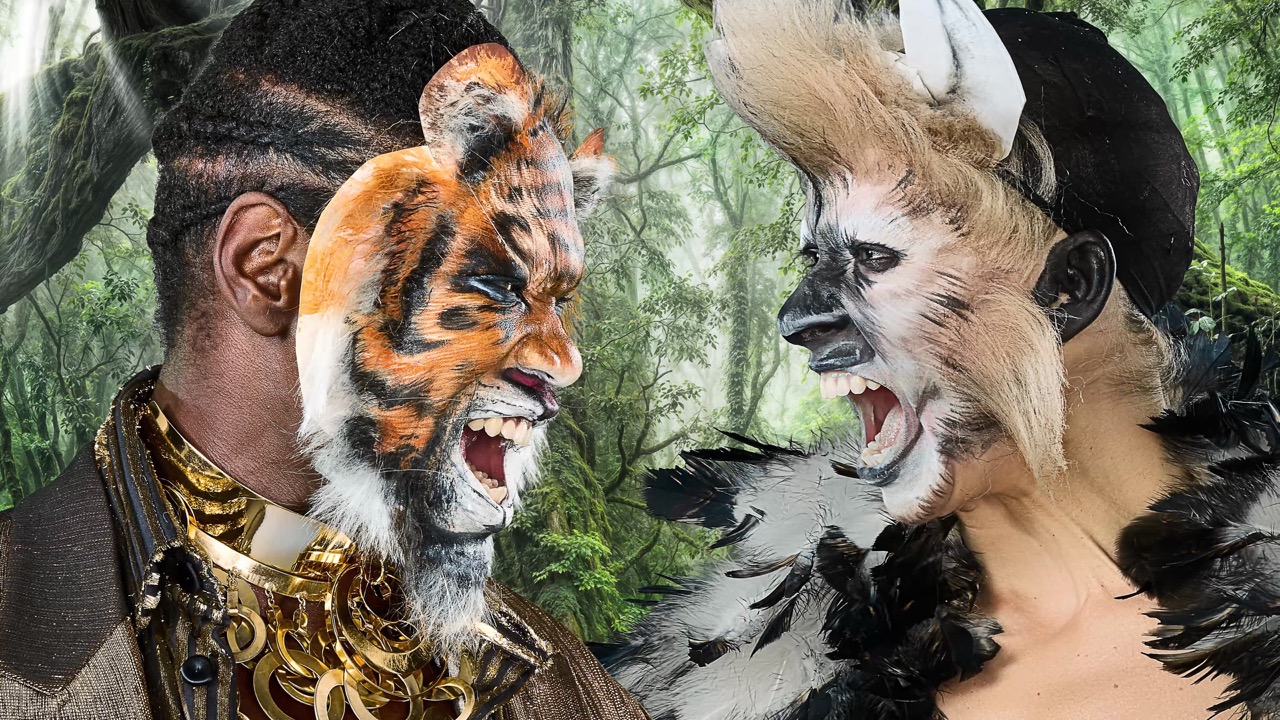
At One Bangkok, the Russian art collective AES+F takes visitors into a different kind of unsettled landscape. Digital Safari: Fables of the Jungle (2025) is a single-channel 4K video installation set in a digitally saturated rainforest. Six young performers appear as animal-human hybrids: three male figures embodying the Wolf, Tiger and Vulture, and three female figures representing the Black Jaguar, Pallas’s Cat and Hyena.
Their elaborate, couture-like costumes and ritual masks occupy a space between ceremony and spectacle. The figures can appear tender and threatening, innocent and predatory. Their identities are neither entirely human nor entirely animal. The soundtrack adds to the sense of disquiet. Mozart’s Lacrimosa, reimagined by composer Vladimir Rannev as fragile, mechanical music-box music, gives the work the quality of a requiem masquerade.
The installation is visually seductive, but its beauty is uneasy. It raises questions about ecological anxiety, the instability of the natural world and the increasingly blurred relationship between humans, animals and digital representations. In this jungle, the mask does not necessarily conceal a true identity; it may be the only identity available.
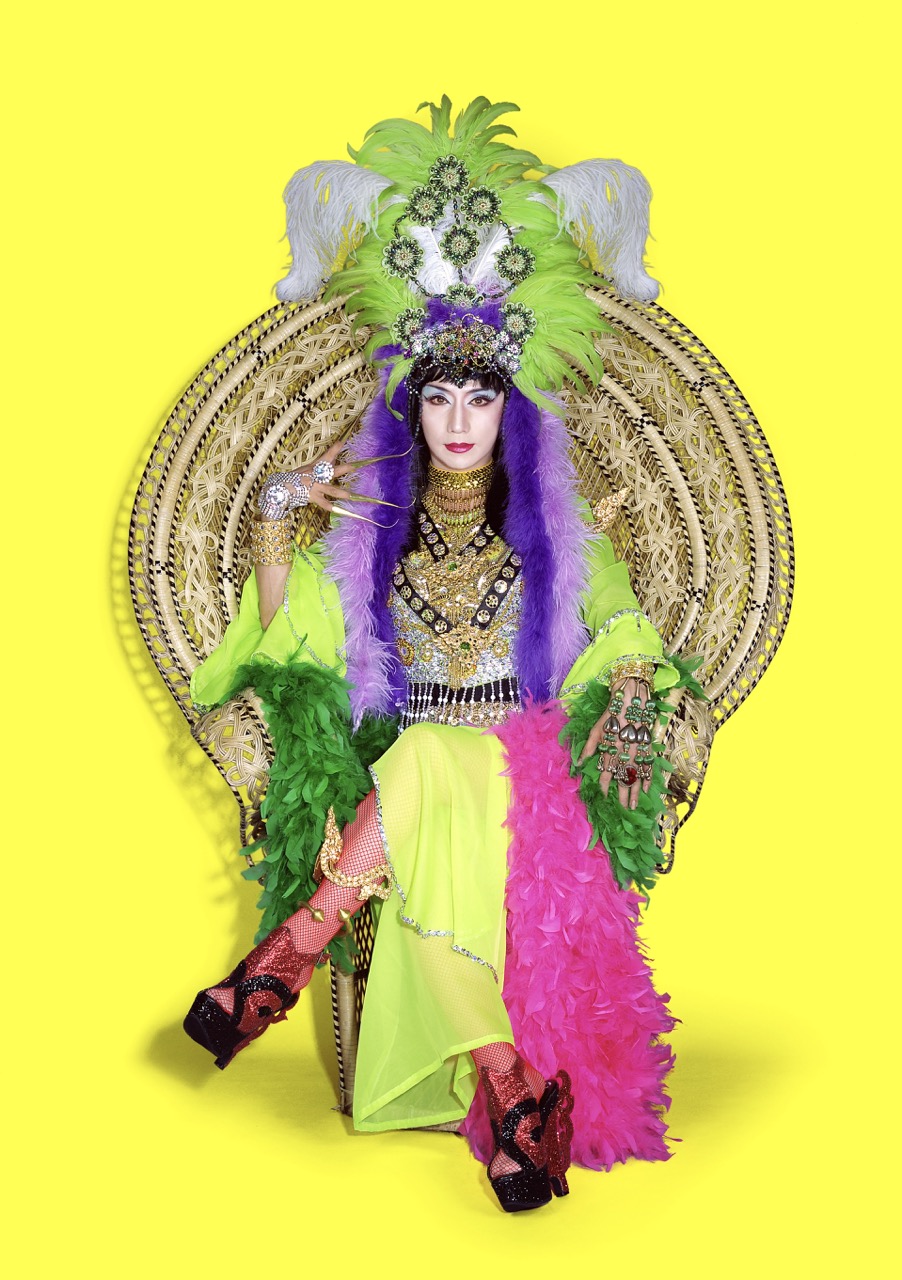
Elsewhere, Japanese artist Yasumasa Morimura explores the construction of identity through photographic self-transformation. Known for his meticulous acts of masquerade and mimicry, Morimura occupies both sides of the camera, acting as poser and photographer. Hundreds of Polaroid portraits reveal and conceal personas through makeup, gesture and theatrical transformation.
His work, including Quoi? – L’Éternité 04 (Yellow Magic) (2003/2006), draws attention to the instability of the image and the many ways a person can be represented. The portraits move between the angelic, the mysterious and the majestic, but never settle into a single identity. In a Biennale concerned with the performance of virtue and the presence of darker impulses, Morimura’s shifting personas suggest that identity itself may be a kind of theatre.

Several artists turn to the body as a place where social expectations, inherited beliefs and personal agency meet. At the Bangkok Art and Culture Centre (BACC), Arahmaiani’s Flag Project Thailand (2022) transforms the familiar national symbol into something more intimate and collective.
The project began after the 2006 Yogyakarta earthquake, when the artist worked with participants from the Amumarta Islamic Boarding School. Together, they hand-stitched words in Jawi onto fabric flags, expressing feelings of fear and despair. Since then, the project has travelled through communities in Germany, Singapore, Australia, Canada, Japan, Tibet, the Netherlands, the United States, Turkey and Belgium. The Tibetan iteration in 2010 developed into wider environmental programmes involving water and waste management, renewable energy, tree planting and organic farming.
Rather than treating a flag as a fixed symbol of national identity or political power, Arahmaiani uses it as a vehicle for shared experience, local heritage and community participation. The work suggests that collective identity can be built through care and collaboration rather than imposed from above.
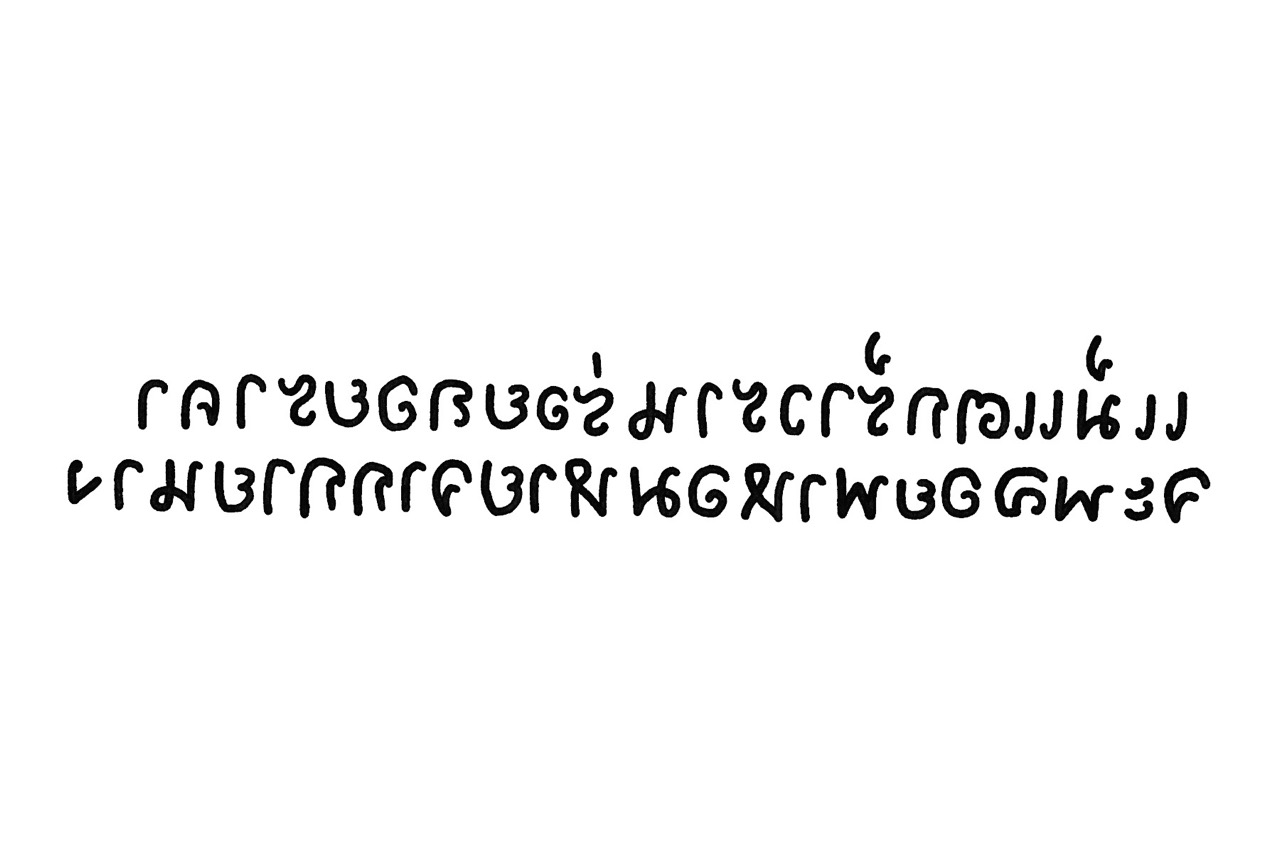
Chomphunut Phuttha’s WOMARA approaches the body through language and performance. The artist tattoos consenting participants with reversed texts drawn from traditional didactic proverbs for women. The durational performance challenges the gendered histories of tattooing and the social expectations embedded in the words traditionally used to instruct women. By placing those words onto the body in an altered form, the work raises questions about who has the authority to define femininity, and who gets to decide what a woman’s body should represent.
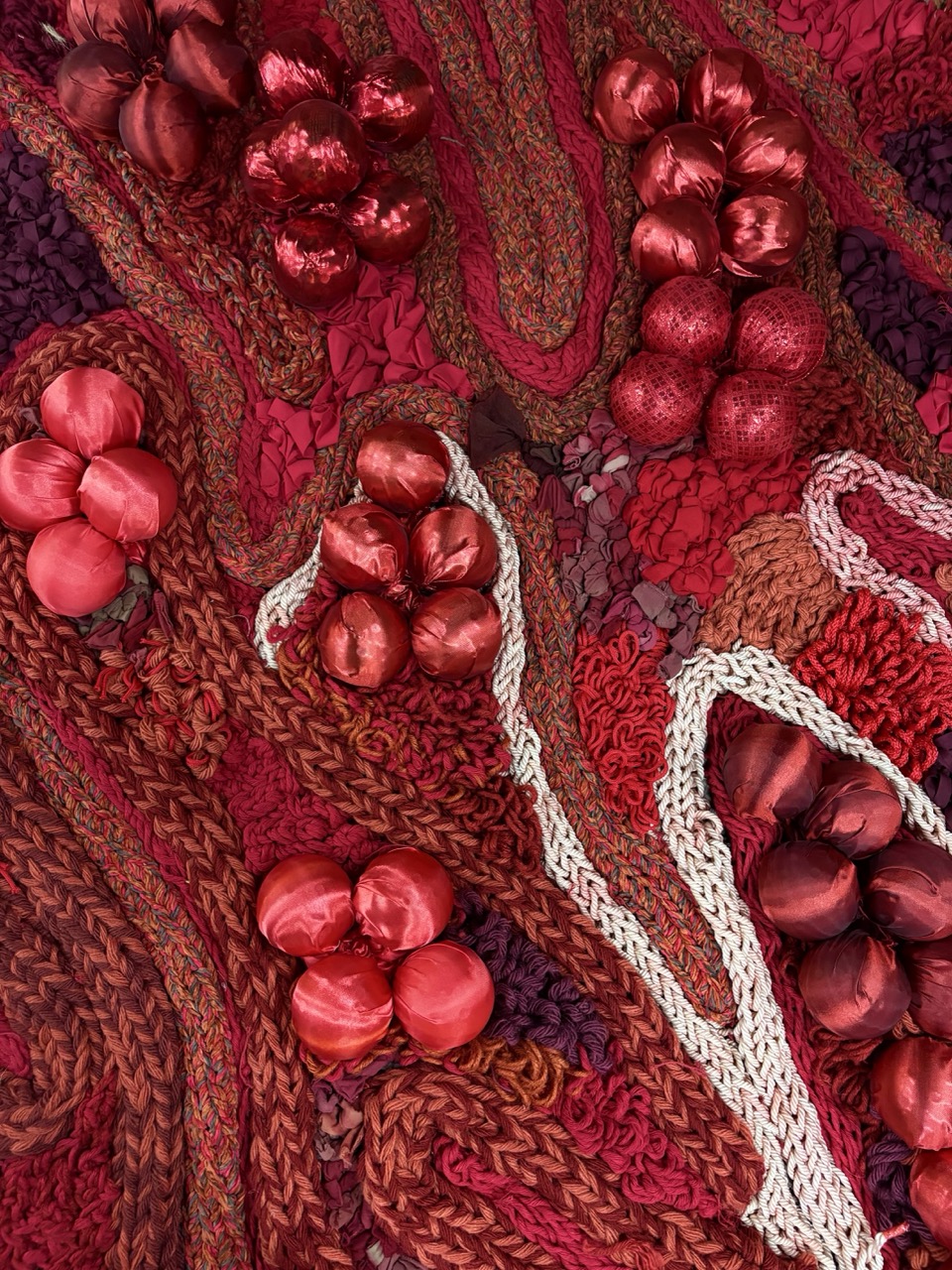
Ploenchan Vinyaratn’s Vestibule offers a more tactile encounter. Made from surplus yarn, fabric scraps, cardboard and broken pickleballs, the woven passage invites visitors to enter one at a time. It is both a physical threshold and a metaphorical space of transition, where discarded materials are transformed into something that can be experienced collectively. The work asks visitors to move through rather than simply look at it. Its materials carry traces of previous uses, while the act of entering suggests the possibility of becoming something else.
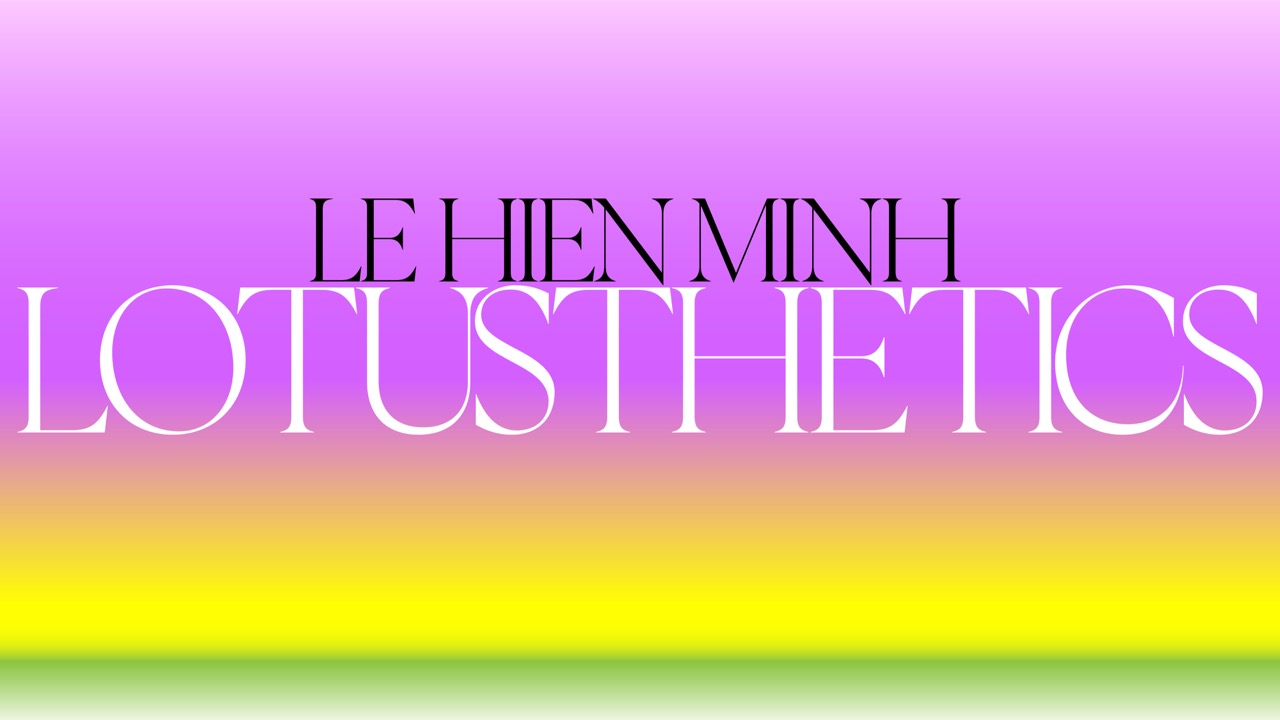
Lê Hiền Minh’s Lotusthetics (2026) examines the images through which Asian women have been represented. The moving-image collage draws on hundreds of images from Hollywood, news media, historical archives, celebrity culture and spiritual iconography. Rapid juxtapositions transform the meanings of the original material, creating a sequence that is at once hypnotic, unsettling and poignant.
The work challenges representations shaped by Orientalism, Ornamentalism and colonial histories, seeking to recentre female power through a matriarchal framework. It is another reminder that images are never neutral: they carry histories of looking, categorising and controlling.

One of the defining characteristics of the Bangkok Art Biennale is its relationship with the city itself. Rather than concentrating all the works in a single exhibition hall, the Biennale spreads across locations with very different histories, functions and audiences.
Temples bring contemporary art into dialogue with religious architecture and living traditions. Museums provide encounters with historical collections and national narratives. Commercial developments and public-facing spaces introduce art to visitors who may not have set out to visit an exhibition at all.
This geographical spread is central to the experience. Moving between venues means moving through Bangkok: crossing neighbourhoods, encountering different rhythms of city life and seeing how artworks change in relation to their surroundings.

The Biennale’s main venues include Wat Arun, Wat Pho, Wat Prayoon, Museum Siam, BACC, One Bangkok, centralwOrld, Siam Paragon, the National Museum Bangkok, the Art Centre at Silpakorn University and Alliance Française Bangkok.
The wider programme extends through BAB Plus, which includes One Bangkok Art & Culture Space, 100 Tonson Foundation, BANGKOK CITYCITY GALLERY, DIB 26 and Jim Thompson Art Center. BAB Fringe adds further independent and alternative spaces, including Rongsi 1984+1 Gallery, HELU-TRANS (THAILAND) and Warin Lab Nomad.
This network creates a Biennale that is not limited to the traditional art audience. Visitors may encounter a work while visiting a temple, exploring a museum or spending time in a shopping district. Art becomes part of the city’s everyday geography.
It also reflects a wider ambition: to bring international and Thai artists into conversation with local histories, communities and audiences, while contributing to Bangkok’s cultural life and creative economy.

With so many venues spread across the city, it is worth approaching the Biennale as a series of journeys rather than trying to see everything in one day. A few thematic routes can help make the experience more coherent.
Start at the National Museum Bangkok, where Sun Yuan and Peng Yu’s Angel and Liu Jianhua’s Square (Siamese Triangle) place contemporary art in conversation with Thai cultural history. Continue to Wat Pho for Leiko Ikemura’s Memento Mori, Wu-san and Ma-san. The movement between these sites offers a powerful introduction to the Biennale’s spiritual and philosophical concerns.
At Museum Siam’s Discovery Museum, see Udom Taephanich’s THE TENANTS OF MY MIND alongside Htein Lin’s works. Together, they explore the contradictions within individual identity and the relationship between personal experience and political power.

At One Bangkok, AES+F’s Digital Safari: Fables of the Jungle offers an immersive encounter with a world of animal-human hybrids, theatrical masks and ecological unease. Allow time to take in the video and its soundscape rather than treating it as a work to pass quickly.
Visit BACC for Arahmaiani’s Flag Project Thailand and Chomphunut Phuttha’s WOMARA. These works offer different perspectives on community, gender, identity and the body as a site of social meaning. Ploenchan Vinyaratn’s Vestibule adds a physical encounter with transformation and material reuse.

The BAB Plus and BAB Fringe programmes offer opportunities to explore the wider contemporary art scene. Spaces such as 100 Tonson Foundation, BANGKOK CITYCITY GALLERY, DIB 26 and Jim Thompson Art Center extend the Biennale beyond its central locations. The fringe programme brings independent galleries and alternative spaces into the picture.
Before setting out, check the Biennale’s official website for the latest venue information, opening hours, access arrangements and any performance schedules. Some works may require more time than others, and the distances between venues make it sensible to group visits by area.

The Bangkok Art Biennale 2026 does not offer a simple moral map. Its angels are not always benevolent, its demons are not always easy to identify, and its human figures rarely fit neatly into either category.
That uncertainty is the point. In a world marked by conflict, environmental instability, political distrust and competing claims to truth, the familiar distinctions between good and evil can become inadequate. The Biennale asks us to look again at the forces shaping our lives, including those that operate within ourselves.

There is also something fitting about bringing this conversation to Bangkok. A city named for angels, and shaped by layers of spiritual tradition, political change and rapid urban development, offers a rich setting for an exhibition that refuses to separate the sacred from the everyday.
The fallen figure at the National Museum may be the Biennale’s most memorable image, but it is not necessarily its most despairing. Its exhausted body invites laughter, discomfort and sympathy in equal measure. Perhaps even angels are subject to the same vulnerabilities as the rest of us.

Across temples, museums, galleries and public spaces, ANGELS & MARA creates room for these contradictions to coexist. It asks visitors not simply to identify the angels and demons around them, but to consider how readily one can become the other.
And as Bangkok becomes the stage for this encounter, the question lingers long after the artworks have been seen: when angels and Mara descend upon the City of Angels, whose side are we on?
Photos courtesy of Bangkok Art Biennale
Bangkok Art Biennale 2026: ANGELS & MARA runs from 29th October 2026 to 28th February 2027. More information available here

