
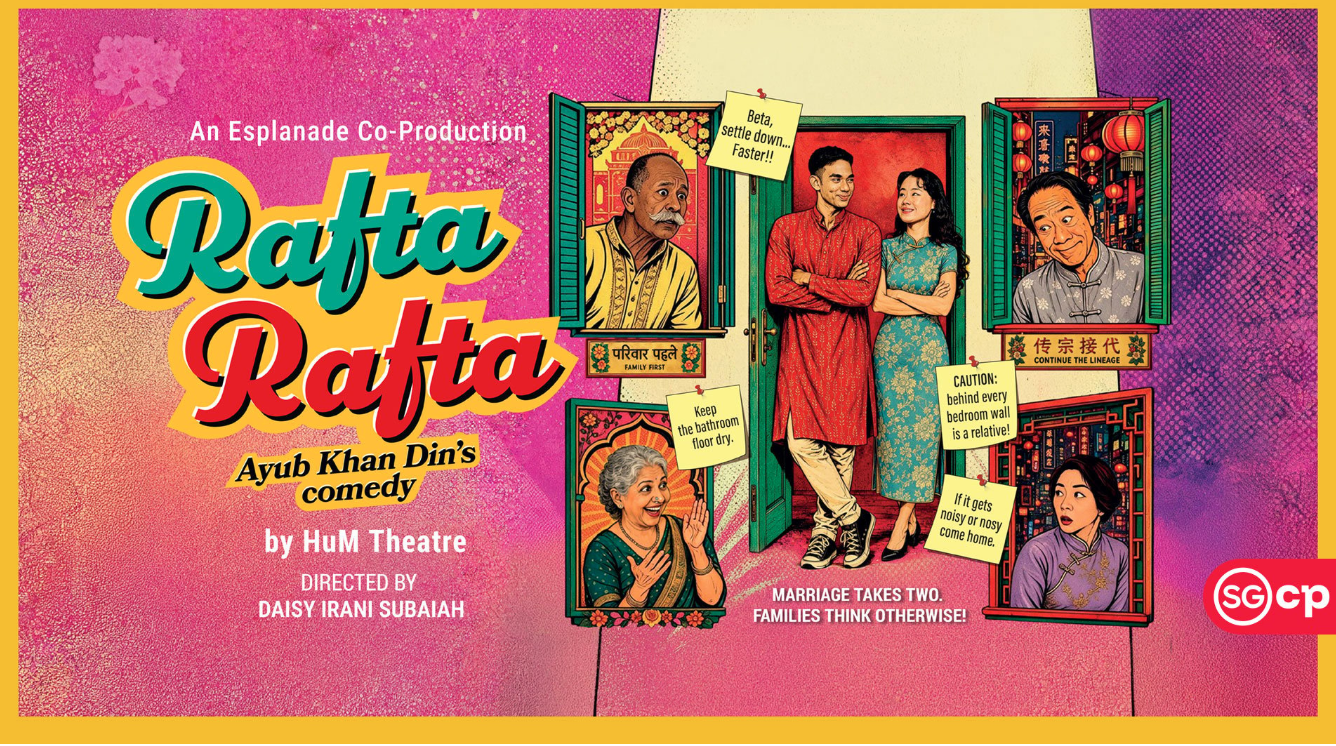
Nearly twenty years on, HUM Theatre returns to a story about marriage, family and the delicate business of making room for one another. Through the comedy of everyday tensions, Rafta Rafta finds new resonance in a Singapore shaped by changing relationships, generational expectations and the pressures of modern life.
There is a particular kind of chaos that comes with starting a marriage: the discovery that love may be between two people, but a life together rarely is. Parents have opinions, families have expectations, and even the most ordinary decisions can become negotiations involving people who may not entirely agree on how a young couple ought to live. In HuM Theatre’s new staging of Rafta Rafta, Atul and Wei Lin are newly married and trying to establish a home of their own, only to find that the world surrounding them has rather different ideas about how that home should work. It is a familiar predicament, especially in Singapore, where family obligations, cultural traditions and the pursuit of a more independent life can sit uneasily alongside one another. Yet for HuM Theatre, the pleasure of telling this story lies not in treating these tensions as grand social problems to be solved, but in recognising the comedy of people trying, and sometimes failing, to get along.
“ I just saw it as a comedy,” says Subin Subaiah, HuM Theatre co-founder and script adaptor. “It’s a comedy of people thrown into situations, and in Singapore, those situations generally cause a great deal of anxiety. You’ll find you know people like this.” For Subaiah, that familiarity is precisely the point. There is no need to make the characters extraordinary when the ordinary business of family life already provides so much material. Their anxieties, misunderstandings and conflicting ideas of what is best for one another are funny because they are recognisable. And while the play’s circumstances may be heightened for the stage, the emotional truths beneath them are not unfamiliar: the desire to be accepted, the struggle to establish independence, and the difficulty of telling people you love that they might be making your life a little harder.
The title, Rafta Rafta, meaning “slowly, slowly”, offers a clue to what lies beneath the comedy. In a culture that often measures progress through milestones; the right job, the right home, the right relationship, achieved at the right time, the play invites us to consider what happens when life refuses to proceed according to plan. Daisy Irani, who was also involved in HuM Theatre’s earlier Singapore staging of the work, sees the title as especially pertinent to the pressures facing younger people today. “I have noticed how stressed the younger generation is. Everything needs to be immediate, including relationships, which can break very quickly. There is the stress of living, of having to reach these goals, and of being judged all the time because of social media and cancel culture. The idea of slowness is something I would really like the younger generation to imbibe. It is time to smell the roses, slowly, slowly.” Her observation gives the play’s domestic comedy a contemporary edge: Atul and Wei Lin may be negotiating the expectations of their families, but they are also trying to work out what kind of life they want, and how much room they are allowed to take up within it.
HuM Theatre first staged Rafta Rafta in Singapore in 2010. The work, written by Ayub Khan-Din and adapted from Bill Naughton’s All in Good Time, follows an Indian family in Bolton, England. For the Singapore production, the story takes on a different cultural texture through Atul and Wei Lin’s marriage, bringing Indian and Chinese families into close contact. Returning to a play after so many years inevitably raises questions about what has changed, but Irani is clear that the endurance of the story is part of its appeal. “Some stories just don’t die on us. Some things remain the same: the sentiments and emotions of human beings. Shakespeare hasn’t changed in hundreds of years. Stories travel with different costumes and disguises, but they don’t die because they have to do with human emotions, conflicts and the things that connect us.” What changes, she suggests, is the world through which those emotions are understood. Conversations around intimacy, sexuality and identity have become more nuanced, while social media has introduced new forms of scrutiny and pressure. Young people may have different language for their experiences, and greater freedom to discuss aspects of identity that previous generations might have left unspoken, but they still face the difficult work of reconciling personal desires with the expectations placed upon them.
For Irani, adapting to those changes is not simply a matter of updating references or making the dialogue sound contemporary. It involves looking again at the characters and asking how their concerns might be understood now. She admires Khan-Din’s ability to create distinct characters whose voices and habits make them feel like people we might know, and sees humour as a way of bringing the play’s deeper questions to the surface. “I really admire Ayub Khan-Din’s writing, the way he does the characters and their voices. You feel you know the father, the relatives, the different people in the family. When you pick up these subjects today, you can look at them through a different lens, and there are so many things you can put out there under the guise of humour. The character humour doesn’t change. It is still about the person underneath, and about the connections between people.” The production’s challenge, then, is to preserve the character-driven comedy while allowing contemporary audiences to recognise their own concerns in it.

The multicultural setting also makes the story especially relevant to Singapore. Rishi Vadrevu, who plays Atul, points out that the relationship at the centre of the play brings two families from different cultural backgrounds together. That changes the context of the original story, creating opportunities to explore the assumptions each family makes about the other. Irani observes that attitudes towards interracial marriage and the practical realities surrounding it have evolved over the years. Cultural differences may attract attention, but concerns about financial security, family responsibilities and a child’s future can be just as important. The result is not a simple contrast between two sets of stereotypes, but a more layered picture of how families negotiate difference.
Vanessa Kee, who plays Wei Lin, says she did not initially approach the production by focusing on the cultural divide between the characters. Instead, she found herself immersed in a welcoming rehearsal room and gradually became more familiar with the specific rhythms of the families. “I came into the process and didn’t really see the cultural difference at all. It was such a welcoming environment, full of brilliant actors. I wasn’t thinking of it as an Indian family and a Chinese family so much as being immersed in the world of the play. As we went along, I learnt about the little idiosyncrasies that might be different between a more stringent Chinese family and a more boisterous Indian family. Of course, there are stereotypes, and some of them overlap, but it has been a lovely process of getting to know the play and the people in it.” Her experience reflects the production’s wider ambition: to acknowledge cultural particularities without allowing them to become barriers to the audience’s understanding. The characters may have different habits and expectations, but the underlying questions such as how to care for one another, how to disagree, and how to make space for a new generation, travel across those differences.
For Irani, reaching audiences beyond those who might already be drawn to an Indian family story is an important part of the production’s purpose. She hopes Chinese and English-speaking theatregoers will come to see the work not as something culturally distant, but as a well-crafted comedy about people and relationships. Subaiah shares that desire. HuM Theatre has worked across a range of subjects, from the historical upheaval of Train to Pakistan to the technological and ethical questions raised by The Nether. Rather than pursuing a single narrow agenda, the company remains interested in stories connected to the Indian experience and diaspora, while looking for ways to bring those stories to a wider public. For Subaiah, whether audiences from different backgrounds will come and recognise themselves in a production is a meaningful test of how successfully a story has been shared.
If Atul and Wei Lin must learn how to trust one another, the actors playing them have had to establish that trust in the rehearsal room. Rishi recalls that he auditioned after hearing that Irani was looking for cast members. Their first meeting in person came with an unexpected advantage: Irani, not being particularly confident with technology, sent him the entire script instead of just the audition extract. He was therefore able to prepare with a much fuller understanding of the play. Vanessa’s experience was more direct: after her audition, she met Rishi for a chemistry test, and the two began the process of discovering how their characters might work together. The initial chemistry was encouraging, but both actors stress that a convincing relationship requires sustained work. As Vanessa puts it, “There was great chemistry from the audition, but the process has also been about building a lot of trust in each other’s abilities and in each other’s safety. We had to do quite a bit of preparation around intimacy, and we needed to communicate with each other from the beginning so that we could lean on one another.”
That preparation included an intimacy workshop they decided to attend together. Rather than treating it as an obstacle to be negotiated, they approached it as an opportunity to develop a skill that could be useful in future productions as well. Vanessa is quick to acknowledge the value of having an intimacy coach to guide the process, while Rishi emphasises how important it was to establish clear communication early on. There is a parallel here with the story they are telling: just as Atul and Wei Lin have to find ways of navigating unfamiliar territory together, the actors must create the conditions in which they can explore their characters with confidence and care. For Irani, the presence of an intimacy coach also highlights how much the theatre industry’s understanding of performance has changed. “When we did the earlier production, I don’t think anyone even thought about intimacy in that way. This time, we had an intimacy coach, and it was interesting to see that change.” The difference speaks not only to changing professional practices, but also to a broader willingness to recognise the boundaries, communication and trust that underpin intimate performance.

The cast’s relationships have developed well beyond the mechanics of rehearsal. Rishi says that the production is particularly well cast, and that stepping into the rehearsal space makes it easy for him to believe in the family relationships around him. “When I’m in the space, I have no trouble believing that Daisy is my mum and Subin is my dad. It all fits, and being in that space helps you get into the character. You develop individual relationships between each character, and all these different threads start to come together. That’s when the magic happens.” For Subaiah, the same process has been a source of unexpected companionship. Having not known Vanessa or Rishi before the production, he has found that the intensity of working together has brought the cast close in a short time. He jokes that he comes to rehearsals like a vampire, feeding off the younger performers’ energy, before adding that the absence of a cast member is felt when they are not there. It is a warm, slightly bittersweet observation about the temporary community that forms around a production: the actors spend weeks building a family onstage, while also creating a smaller, real-life family of their own.
The role has also offered Vanessa an opportunity to explore a different kind of acting. Best known for her work in musical theatre such as the critically-acclaimed Legally Blonde, she has experience in straight plays, including Shakespeare, but describes Rafta Rafta as a particularly refreshing encounter with contemporary naturalism. “I’ve always had something to sing, and musical theatre requires a very particular set of skills. With this play, it has been so refreshing to work in a naturalistic, realistic setting. It feels like a different world, and it’s liberating not to have to think about my voice that day or whether I’m going to hit a high E. Instead, I can delve much deeper into Wei Lin, into her little habits and the reasons she does what she does. Both musical theatre and straight plays demand discipline, but they ask for different kinds of discipline. I love them both, and learning a new skill gives you that burst of energy.” Her focus on Wei Lin’s small habits is apt for a play whose comedy depends on the details of how people behave around one another: the things they say, the things they leave unsaid, and the assumptions that turn minor disagreements into major domestic events.
For Rishi, Atul has been a different kind of challenge. The actor describes himself as someone with a big, loud energy, whereas Atul is more inward, introverted and emotionally bound up. The distance between his own temperament and that of the character has made the role especially rewarding. “This character is quite new for me. Aside from the singing, Atul is a lot more closed off than I am. He is introverted and bound up, and that’s what makes him such an interesting character to take on. It’s beautiful to be trusted with a character who isn’t like you, but still be trusted to get there.” The part also involves some singing, which gives him another way to stretch himself. Yet what stands out most in his account is the privilege of being allowed to approach a character without having to make him an extension of himself. In a play about the demands placed on people by their families, the actor’s task is to find the humanity beneath those demands, even when that humanity looks nothing like his own.
For all the cultural and generational tensions that run through Rafta Rafta, Subaiah is keen to resist the idea that the production needs to be treated as a lesson or an exercise in problem-solving. He sees the play as a chance to make room for laughter, particularly in a theatre landscape where comedy can sometimes be regarded as a less serious form than work that addresses difficult subjects in darker or more direct ways. “We have made a conscious decision to do this play because there is an appetite for looking at life in Singapore and thinking that it is worth a laugh or a chuckle. Levity is not necessarily the answer to every problem, but it is one way of exploring it. Sometimes humour makes people comfortable enough to look at a problem from a different angle. The fundamental reason we do theatre is to communicate and entertain, and entertainment is a fundamental part of the art form.” The play’s comedy does not mean that its characters’ concerns are trivial. Rather, laughter offers a way to approach the familiar anxieties of marriage, family and social expectation without reducing them to a set of arguments.
That balance is also what gives the production its generational dimension. Vanessa sees Wei Lin as someone trying to understand her worth through the roles she is expected to fulfil: a good wife, perhaps a future mother, and a person who knows how to behave within her society. Yet the process of growing into those roles also involves discovering what she wants for herself. Subaiah recognises that tension as something that can recur between parents and children even when their values seem broadly aligned. A parent may be liberal in many respects but still have a line they are unwilling to cross; a younger person may understand the reasoning behind a parent’s position while finding it difficult to accept. The conflict is not simply a contest between right and wrong. It is a negotiation between different ideas of responsibility, independence and love. Irani adds that the actors themselves bring their own experiences and perspectives into the production, so the play inevitably acquires new nuances with each staging. Society changes, the way people live changes, and the cast brings those changes into the rehearsal room, often without even realising it.
Rishi sees Atul’s struggles as a reminder of the pressure young men can feel to live up to other people’s expectations as well as their own. The character’s reserve can be understood as part of the difficulty of carrying that weight, particularly when the people around him may not recognise how much he is struggling. “A lot of young men go through what Atul goes through. There are so many expectations from other people, and from yourself, and the weight of all that can get to you. I think the play is a reminder to be gentle with yourself and with your relationships, to be open to change, and to treat things slowly and carefully — including yourself.” In this sense, the title becomes an invitation to extend patience not only to a partner or a family member, but also to oneself. People grow at different speeds; they make mistakes, change their minds and sometimes need time to find the words for what they feel.

For HUM Theatre, the production also sits within a continuing interest in stories that can connect audiences across cultural backgrounds. Subaiah says the company does not necessarily have a rigid agenda, but remains anchored in stories related to the Indian ethos and diaspora. The range of work it has presented reflects that breadth, from historical and political material to contemporary questions about technology and society. What matters is finding a story worth telling, and telling it in a way that gives audiences a reason to stay engaged. “I don’t think any theatre group necessarily has one razor-sharp focus. We want to do good theatre, and we don’t want to lose sight of stories that, in some context, involve the Indian ethos and diaspora. That diaspora is growing, and there is an appetite for good theatre, whether it is comedy, political work, history or folklore. One measure for us is whether we can get Chinese audiences to come and watch, because that changes the agenda quite dramatically. It becomes about shared stories and how we listen to one another.” The hope is not to erase cultural difference, but to create a space in which it becomes part of a larger conversation.
Irani is equally emphatic about the audience’s experience. She wants people to come into the theatre and be absorbed by the performance, regardless of whether they immediately recognise the cultural context. “When you pick up a play, whether it is interracial or intercultural, the audience should still be able to come in and have the experience they are looking for. I feel strongly that when people walk into the theatre, the time they give us should be worth it. They should not need to touch their phones; they should be engaged, and when they leave, they should feel that they have seen something fabulous. As a director, I believe entertainment comes first. It is becoming harder to make theatre, with the costs and all the practical challenges, so you have to remind yourself why you do it: because you love it, because you want to stand onstage and feel that the audience is looking at you.” Her words are both an artistic principle and an acknowledgement of the precariousness of making live work. The commitment has to be renewed with every production, and the audience’s attention can never be taken for granted.
That attention is increasingly precious in a world full of streaming platforms, endless content and the temptation to divide our focus among several things at once. Subaiah recalls meeting an older theatregoer after a performance in the United Kingdom and talking about the pleasure of seeing full matinees and younger audiences returning to live events. He calls it “Netflix fatigue”: the sense that, after so much time spent consuming content on demand, there is renewed value in going somewhere and experiencing something that exists only in that moment. For Vanessa, that immediacy is especially meaningful. “There is something visceral about being in a theatre and experiencing the energy of the people onstage. As someone from a younger generation, I think there is real value in being present, in not trying to do five hundred things at once, and in focusing on what is right in front of you. There is something beautiful about being in that moment and experiencing what is happening onstage.” Irani describes the emotional force of live performance as something that can move an audience to tears, not only because of what is being presented but because of the collective effort behind it. Subaiah, meanwhile, sees live storytelling as part of a long human tradition, from people sharing stories around a fire to the communal experience of music, dance and theatre.
For a play centred on the work of making a home, this belief in shared experience feels particularly fitting. Rafta Rafta asks its characters to negotiate space, to recognise one another’s vulnerabilities and to accept that a life together cannot be built entirely according to one person’s timetable. The same patience is required of the audience: to sit together, follow a story and allow its small observations to gather meaning. The play may offer no grand solution to the pressures of family life, nor does it pretend that love can resolve every disagreement. What it offers instead is the pleasure of recognising ourselves in other people, and the possibility that laughter might help us approach our differences with a little more generosity.
Sometimes, the way forward is not to hurry towards a perfect answer, but to give one another the time to get there. Slowly, slowly.
Photos courtesy of Esplanade – Theatres by the Bay
Rafta Rafta plays from 18th to 22nd November 2026 at the Esplanade Theatre Studio. Tickets available here
Kalaa Utsavam – Indian Festival of Arts 2026 runs from 20th to 29th November 2025 at Esplanade – Theatres on the Bay. Full lineup available here

