

HuM Theatre’s lively family comedy-drama finds plenty of humour and heart in the indignities of a multigenerational family living under one roof.
Duration: 135 minutes, including a 15 minute interval
“You only need a very small space to have sex,” politician Josephine Teo once famously observed. It is a line that might seem particularly pertinent to HuM Theatre’s Rafta Rafta, a family comedy about a newly married couple who discover that having a home is not quite the same as having a home of their own. After all, when you are sharing a roof with your parents, finding a little privacy can be considerably harder than finding a place to live.
Playing as part of the 2026 Kalaa Utsavam Indian Festival of Arts, the production makes a rather charming start by bringing its wedding celebrations beyond the theatre itself. Members of the ensemble pop out into the foyer, offering guests nuts and thanking them for attending the wedding. It is an affectionate, slightly mischievous invitation into the world of the play, and one that sets up the festive atmosphere of the opening scenes. We are not merely watching a family wedding; for a moment, we are part of the guest list.
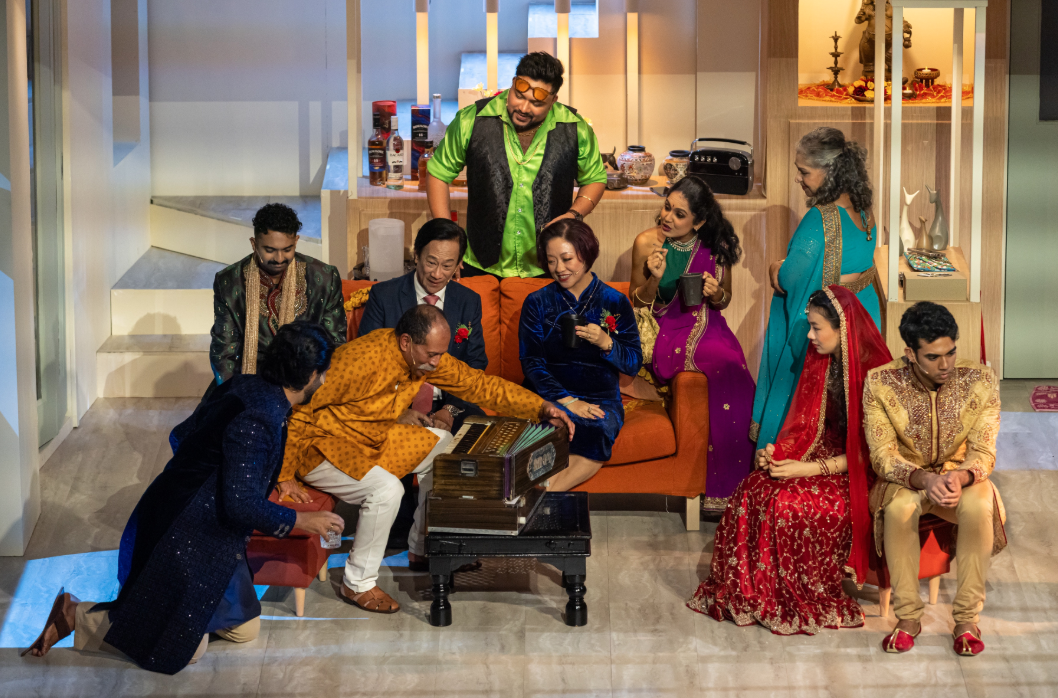
The celebrations continue inside, before the newlyweds and their families return to the Dutt household for an after-party. Set at 56 Stirling Road, the family home is a two-storey HDB flat, with a living room and kitchen downstairs and two bedrooms upstairs. Wong Chee Wai’s set design is one of the production’s most appealing features. There is a pleasing specificity to the space, from the shrine to the paintings and other personal touches that make it feel like a home accumulated over years of family life. It is neat and carefully arranged without feeling sterile, lived-in without becoming cluttered. The layout also gives the audience a clear sense of the household’s domestic geography, which becomes increasingly important as the newlyweds discover just how difficult it is to find a moment alone.
Aparna Temurnikar’s costumes deserve similar recognition. The wedding outfits are gorgeous, but the costuming is not limited to a single celebratory look. There are several changes throughout the show, with cleverly constructed garments that allow the actors to move between outfits with ease. Some pieces are more practical than they first appear, such as trousers that look semi-formal but are actually drawstring. These are small details, but they speak to the thought that has gone into making the production both visually appealing and functional.
The opening is raucous and energetic, with the ensemble establishing the family’s personalities through a series of lively interactions during the afterparty, filled with alcohol and party games. There is already a noticeable tension between Atul and his father, Eeshwar, as the younger man struggles to negotiate his place in a household where his father’s opinions tend to carry considerable weight. Rishi Vadrevu, as Atul, also gets to show off some impressive vocal chops in the opening number, a welcome surprise given the more reserved character he goes on to portray. Even his decision to let his father win an arm-wrestling contest hints at the complicated relationship between the two: Atul may be grown up and married, but he is still wary of upsetting the man who raised him.

The problem begins once the guests leave and the newlyweds are finally expected to enjoy their first night together. Between the awkwardness of living with the family and a series of unfortunate interruptions, Atul finds himself unable to consummate the marriage. Six weeks later, the couple are still keeping their predicament a secret, embarrassed by what they perceive as a deeply personal failure. What ought to be a private matter gradually becomes a family-wide crisis, particularly when Wei Lin’s mother Doris arrives unexpectedly and the truth comes spilling out.
There is an amusing premise here, and plenty of potential for domestic farce. But the first act takes a little too long to establish the difficulties of living in such close quarters, while the opening group scenes could also do with some trimming. The central problem is stretched rather thinly, with the couple’s embarrassment becoming an increasingly disproportionate source of anxiety. The production also makes an uneasy transition from comedy to melodrama. Wei Lin’s confrontation with her mother, which culminates in a breakdown and a slap, is intended to carry genuine emotional weight, but it takes a moment for both the actors and the audience to adjust to the change in register. The emotions do eventually come through; the difficulty lies in getting there.
The second act is considerably tighter. When the Lims come over to speak with the Dutts over the predicament, the conversation moves beyond the immediate problem and begins to uncover the tensions that have been simmering beneath the surface for years, such as Eeshwar’s tendency to assume the worst of Atul, and the Lims’ own frustrations with their relationship over Wei Lin. Both of these emerge as part of a larger pattern of miscommunication within the family, with the parents having their own expectations of what their children should be, while the children are struggling to assert themselves without causing further disappointment. Everyone is so accustomed to making assumptions about one another that nobody seems particularly good at asking what the other person actually feels.
The comedy is often very well executed, particularly when the actors are given room to play off one another. The audience often responded warmly, with laughter building as the characters and their quirks became more familiar. Some jokes were even anticipated before they arrived, a testament to how recognisable these family dynamics are. Not every larger comic set piece landed quite as well, however. A Hindi song-and-dance sequence between Atul and Etash at work, for instance, while fun, felt less warmly received than the more intimate exchanges elsewhere. The production is strongest when it trusts its characters and their everyday absurdities rather than reaching for a bigger spectacle or one-off laughs.

Much of that success rests on Daisy Irani Subaiah and Subin Subaiah as Lopa and Eeshwar Dutt. Their familiarity with one another, both onstage and in real life, lends their bickering a natural rhythm. Daisy is a wonderfully recognisable Indian aunty, forever fretting over her son, scolding her husband and keeping the household in order. She brings a strong presence to the role, making Lopa’s affection and exasperation feel like two sides of the same coin. Even the more ridiculous moments, such as the family’s increasingly elaborate attempts to find euphemisms for sex, benefit from her comic instincts and timing.
Subin, meanwhile, is a comic powerhouse. He makes excellent use of repetition, vocal inflection and physicality, turning Eeshwar’s bluster and ignorance into a steady stream of laughs. His dad jokes and elaborate arm-wrestling strategies are amusing enough, but there is also something rather endearing about the way he struggles to speak to his son, only to disguise his discomfort as frustration when the conversation goes nowhere. Beneath the familiar Asian-father bravado is a man who wants to connect with his child but has little idea how to go about it.
Rishi’s performance as Atul gives this father-son relationship its emotional weight. He plays the character as a fundamentally insecure young man, often hesitant and awkward in the presence of his father. His voice shifts with the circumstances, betraying the fear and shame that Atul would rather conceal. The tension between the two is clear even in their more casual exchanges, making their eventual embrace particularly satisfying. Rishi is equally convincing as the straight man amid the household’s more colourful personalities, grounding the comedy without losing the character’s vulnerability.
Opposite him, Vanessa Kee brings a youthful sincerity to Wei Lin. Although she is better known for musical theatre, she settles comfortably into the role, giving the character a sweetness that goes beyond simply playing the innocent young bride. Small details, such singing Pussycat Dolls’ ‘Dontcha’ to herself in the mirror to feel sexier, or the little mannerisms that suggest someone still rather childlike at heart, and help make Wei Lin feel like a young woman still discovering what adulthood and marriage might mean. She and Rishi also have an easy chemistry, making it believable that this is a couple who genuinely love one another, even if they have yet to work out how to live together.

Despite being hospitaised prior to production, Eleanor Tan bravely takes on the production even while wheelchair-bound, and gives Doris an imposing presence, with her purple hair and imperious appearance reinforcing the character’s formidable mother-in-law energy. Her protectiveness towards Wei Lin often tips into suffocation, and Eleanor brings a certain gravitas to her appearances. Gerald Chew’s Kock Leong complements her, though in a much less prominent role, while the remaining ensemble members provide support to the family scenes and the production’s broader comic rhythm.
What makes Rafta Rafta so interesting is its refusal to make the interracial marriage itself the problem, which a lesser production might have gone for as the obvious conflict. Atul and Wei Lin’s different backgrounds are part of their shared life, but the production does not treat them as an inevitable source of conflict, almost recognising its increasing normalcy in multiracial Singapore. Instead, it locates the difficulties of marriage in the everyday business of sharing space, negotiating family expectations and learning to communicate with someone whose habits and insecurities are not always immediately apparent. In Singapore, where the exorbitant cost of housing means that many couples cannot simply move into a home of their own after getting married, the desire for privacy, independence and intimacy must often be negotiated alongside filial obligations and the practical realities of multigenerational living. Rafta Rafta finds comedy in these tensions, and its occasional local references, including a timely nod to CDC vouchers, help situate its domestic world firmly in Singapore.
But beneath the bedroom farce, the production is ultimately concerned with a different kind of intimacy: that between parents and their children, and the difficult process of learning when to step back. Its final moments are particularly telling. As the rest of the family leaves the Dutt household, Eeshwar is overcome by emotion at the realisation that Atul has finally grown up. His tears are not simply those of a father who is proud of his son, but perhaps of one who is beginning to understand that he no longer needs to keep criticising, correcting or worrying over him. It cements how much of what passes for parental love in Asian families is expressed through admonishment, high expectations and a seemingly inexhaustible supply of advice. The desire to protect one’s children can become so entangled with the desire to direct their lives that it leaves little room for them to make their own decisions, or even their own mistakes. In this sense, Eeshwar’s realisation is as much about his own growing up as Atul’s.
Rafta Rafta, translating to ‘slowly slowly’, is perhaps that is the key lesson this production leaves us with. Children grow up, parents learn to let go, and families must find new ways of loving one another as the relationships between them change. In a Singapore where the pressures of housing, financial security and familial expectations often bring generations under one roof, the need to make room for one another is both a practical and an emotional necessity. The production may take a little long to arrive at its destination, and its shifts between farce and melodrama are not always convincing. But its affection for these imperfect families is unmistakable. Sometimes, growing up means finding a place of your own. And sometimes, it means learning to trust that the people you love are going to be just fine, with a little moral support.
Photos courtesy of Esplanade – Theatres by the Bay
Rafta Rafta played from 18th to 22nd November 2026 at the Esplanade Theatre Studio. More informationavailable here
Kalaa Utsavam – Indian Festival of Arts 2026 runs from 20th to 29th November 2025 at Esplanade – Theatres on the Bay. Full lineup available here
Production Credits
| Playwright Ayub Khan-Din Director Daisy Irani Subaiah Dramaturg & Adaptation Subin Subaiah Cast Daisy Irani Subaiah, Subin Subaiah as Eeshwar, Gerald Chew, Eleanor Tan, Rishi Vadrevu, Vanessa Kee, Kishore Kumar, Karthik Somasundaram, Ashie Singh, Shaikh Yasin Assistant Director Ashie Singh Set Designer Wong Chee Wai Lighting Designer Alberta Wileo Costume Designer Aparna Temurnikar Hair & Make-Up Coordinator Norehan Fong Production Manager Charlinda Pereira Stage Manager Keira Lee Assistant Stage Manager Simran Punjabi, Roger Ong Wardrobe Assistant Kelly Pereira |

