
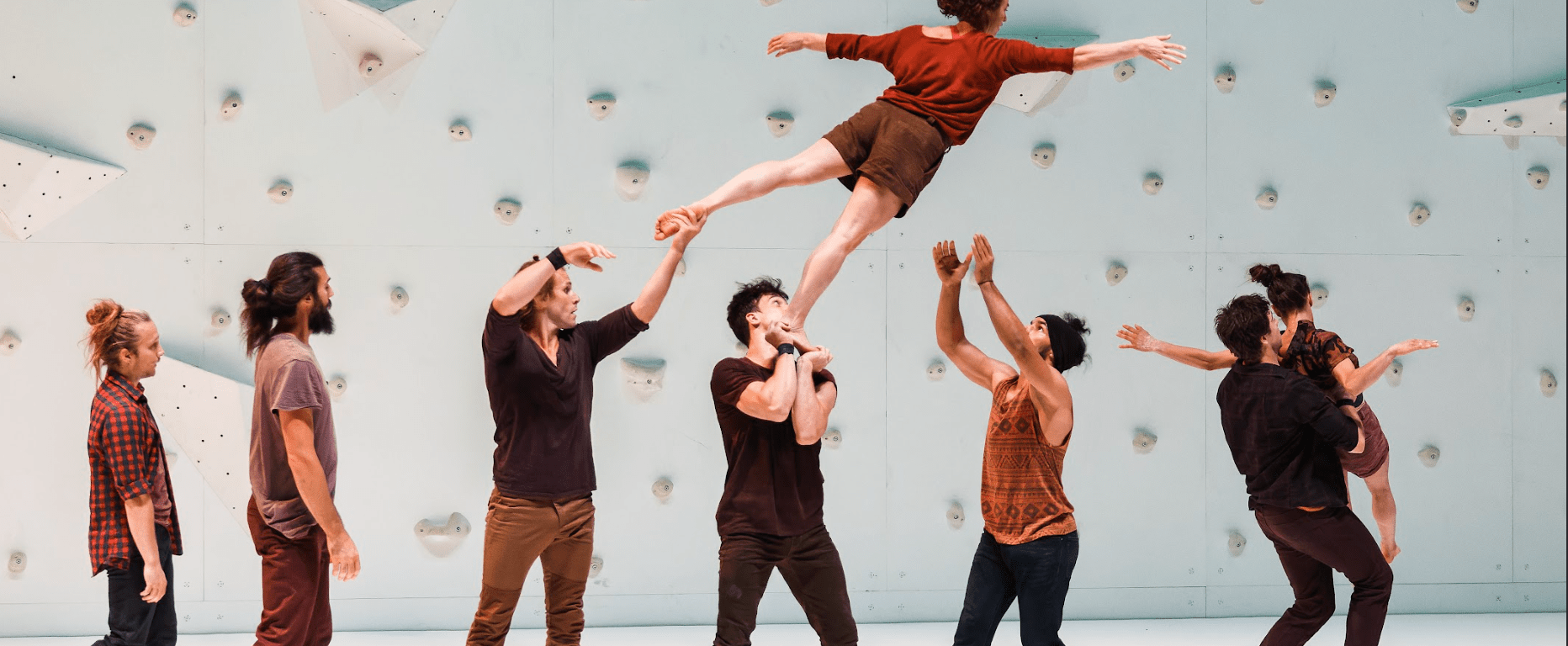

In a feature article on French choreographer Rachid Ouramdane, New York Times arts critic Gia Kourlas described him as ‘the choreographer bringing hope to the stage and beyond’. It’s a big title to live up to, but one that Rachid lives up to and carries well, particularly with his work Corps extrêmes. Playing at the Esplanade this weekend as part of their da:ns focus – Out of Site programme, Corps extrêmes takes on a rather unusual premise and inspiration – extreme sports, brought to the Esplanade Theatre.
“I grew up in the French Alps, and watched people frequently engage in extreme sports in my childhood, surrounded by nature and these people who practiced such sports every day. There are so many misconceptions of extreme sports, where people think that these are totally crazy people playing with death. But in reality, these are people who do it not just for the adrenaline rush, but also because they want to get closer to nature, to rediscover that sensitivity and reconnect with the natural world around them,” says Rachid. “To them, this has become second nature, and I think for many of us, having lived in urban spaces for so long, we forget what it’s like to constantly try to push ourselves beyond our limits, to take risks and go beyond the ordinary – and I saw that as the link between extreme sports and the arts.”

Created with two extreme sports athletes—the French highline world record holder Nathan Paulin, and Swiss climbing champion Nina Caprez—alongside eight acrobats, Corps extrêmes becomes a breathtaking meditation on the human condition, and what it means to test the limits of the body itself, and a magnificent sense of awe when faced with the spectacle of nature. “This is a work that’s not necessarily about showcasing extreme bodies and superhumans, and not about breaking world records, but about hypersensitivity and what it means to develop sensitivity for the world around you,” says Rachid. “It’s to become more in touch with your body and the world around you when say you jump into the air, and feeling it.”
An issue that arises is how Rachid intends to bring the majesty of wide, natural landscapes to the confined space of a theatre. Interestingly, when the project was in its initial stagings, when the world had begun to re-open after the pandemic, there was a version of it that saw them experimenting in open spaces, developing audio tracks to help audience better immerse into the world and appreciate the environment while performers executed these feats. “We were aware that when we brought it back to the theatres, we had to retain that sense of immersion, to use technology and imagination to recreate that natural sensorial reactions,” says Rachid. “The stage for me is not a box to close you in, but a window of opportunity to frame things differently. So speaking with my collaborators, we decided to use a white rock climbing wall onstage that doubles as a screen for which to project images onto, allowing us to reproduce the mountains onstage and create this sense of adventure, where we are having a dialogue with nature itself, and hopefully, giving audiences the sense of climbing alongside them.”

Rachid is a choreographer who sees possibility rather than limitation, not just in terms of space but even in his performers, where he sees it all as a matter of perspective, rather than necessitating a set of high, virtuosic standards for every production, adapting accordingly to each group he works with. “There’s a Japanese filmmaker that once talked about how if the shot doesn’t work, don’t blame the people in the frame, but instead, the director has to adapt to find and get the most out of what’s available. I’ve done projects with seniors and children, and for me, I see that we all have the potential for a form of expression within our bodies, and I cannot force non-dancers to transform their movement, unlike with professionals,” says Rachid.
“With this work, I appreciate the very different kind of training that goes into sports, and see the expressive potential beauty in it, especially in how they find solutions in overcoming difficulty through movement,” he adds. “I do appreciate work where a lot of choreography goes into it, but sometimes I also like to strip things back and pay attention to the simplicity of everyday movements. There are times you have to take on different perspectives, and see that there is choreography all around us; you see the choreography of the city in the way the cars move, or the way children play at a kindergarten. It isn’t always something you compose, but sometimes comes from the way you watch things, which we forget because we’re distracted by the hubbub of daily life. In small moments, you look to the sky and see birds migrating and forming a pattern, and when you take that time, you see choreography.”

It is this natural penchant for observation and seeing the beauty in the everyday that has always driven Rachid to produce work, often with a purpose in mind. “I remember coming to Singapore years ago, when Ong Keng Seng invited me to The Flying Circus Project, which was a very important experience for me, this opportunity to meet interesting people from all over the world to exchange ideas and art,” says Rachid. “I think it’s always important to keep an open mind and take time to listen to all these different perspectives, without always imposing your own vision of things, and it’s always been a privilege and pleasure to do international collaborations in places like Brazil, Russia and Vietnam.”
“To be frank, my earlier work was almost always driven by anger from outrage at certain global issues, such as child refugees who suffered, or soldiers dealing with trauma after the war. I was angry at the damage that people had undergone through circumstances outside of their control, and wanted to shed light on them. To me, my responsibility as an artist was to present these situations in a way I could, to produce avenues to find solutions, and provide hope that people can carry on, and keep going on,” says Rachid. “It’s certainly easier to connect to a work that has a clear socio-political slant to it, but perhaps in its own way, Corps extrêmes take sa different approach to that, where they are pushing humanity forward.”

“I don’t mean creating an intellectual revolution or developing new philosophies or scientific concepts, but simply as a reminder that we can go further than where we currently are, our bodies can fly, to travel beyond the confines of what we previously thought was impossible. they remind us we can go further than what we thought so far, our body can fly, can go into the space we thought was forbidden for the human body. And that, I think is what I would like this project to do – to leave audiences with a contemplative attitude, surrounding the simple idea that we can survive, that the human spirit is insurmountable, and we can transform our own lives and go a step further every day.”
Photo Credit: Pascale Choulette
Corps extrêmes plays from 6th to 7th December 2024 at the Esplanade Theatre. Tickets available here.
da:ns focus – Out of Site runs from 6th to 8th December 2024 at the Esplanade. Tickets and full programme available here
 Bakchormeeboy