
More than just a showcase of accessibility, Stopgap Dance Company elevates inclusivity to an artform of the future.
For years, accessibility in the performing arts has too often carried an unfortunate association with charity—where the presence of disabled artists on stage is seen as a benevolent gesture rather than a celebration of creative excellence, where artists and companies are assumed to be platforming disabled artists because they would not get a platform otherwise. Such shows risk becoming vehicles for non-disabled audiences to feel virtuous, rather than truly engaging with disability as a powerful lens through which to view and expand the possibilities of art.

But with the Esplanade’s recent third edition of inclusive dance programme da:ns focus – EveryBody, UK-based Stopgap Dance Company came to Singapore to buck the trend, and use a combination of workshops, tours and performance to prove that inclusivity and accessibility in arts isn’t about lowering standards, but about creating and innovating something new that elevates the very notion of art itself. Devised and written with Stopgap’s Deaf, Disabled, neurodivergent and non-disabled creatives, as conceived and facilitated by Stopgap’s Co-Artistic Director Lucy Bennett, Lived Fiction is atmospheric, multisensory work that blends sensual choreography with innovative sound and visual design. It’s hard to classify Lived Fiction strictly as dance; it’s so much more than that, involving not only movement, but also a vivid script, performance poetry, theatrical experience, and philosophical provocation rolled into one production.

Before the dancers even hit the floor, surtitles flash across the screen, seemingly typed live by ‘DAN’ (voiced by Dan Watson). While initially innocuous enough, playing acknowledgements and credits, a new complexity emerges when time goes backwards, and things are reset, and DAN seems to gain some form of sentience, incorporating memories of the real Dan Watson into these onscreen creative captions. In real life, audio describer and co-writer Lily Norton (who identifies as autistic) is seated behind a desk, and banters with DAN, raising new possibilities, and alternative takes on what is happening onstage. Lily’s spoken word takes are often rich, imaginative live descriptions, creating an entire world in our minds, likening the dancers to sea anemone, tendrils reaching out to each other, pure poetry. The two voices end up in conversation, questioning the status quo and the norm, and in time, develop a way to communicate with each other while respecting their differences, allowing each other the space to express themselves and experiment; as the two voices converse, they model a respectful exchange of perspectives, allowing for multiplicity and divergence without dissonance.

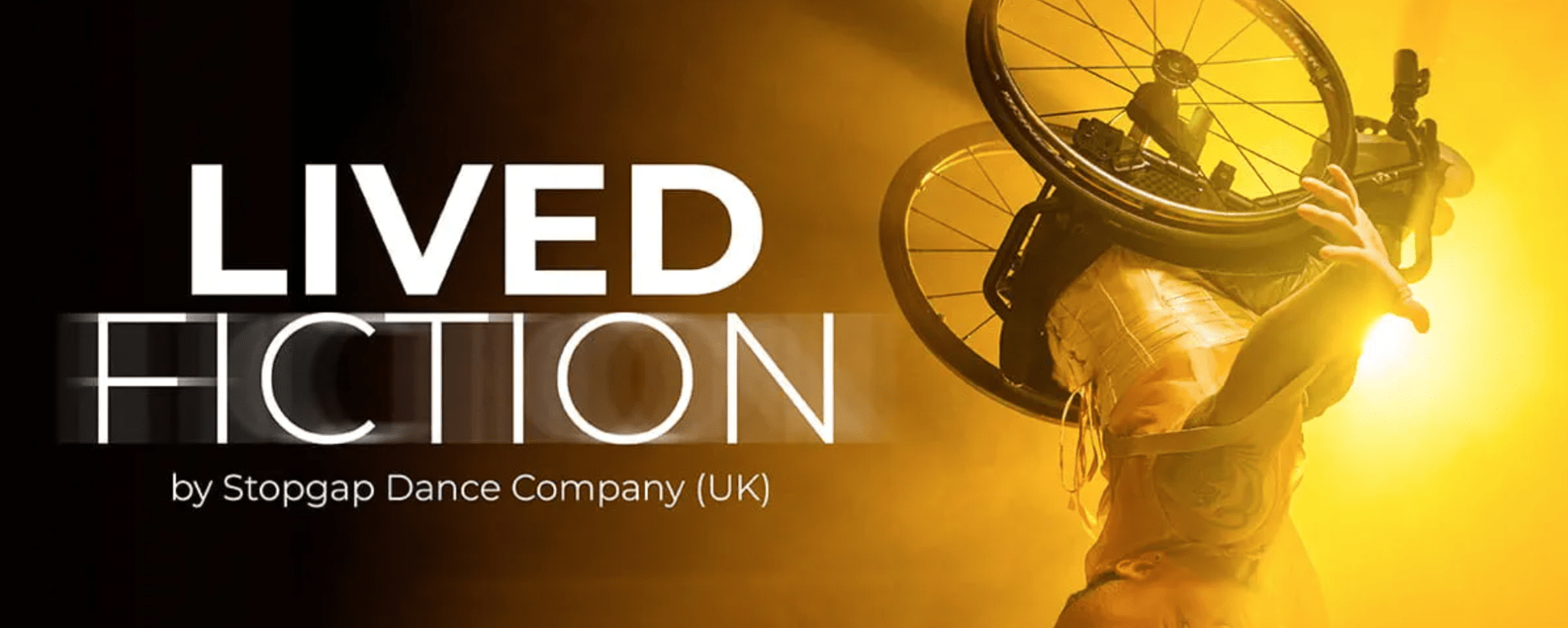
The dancers themselves are impressive, and are always present onstage, whether performing, or seated in chairs, watching their fellow performers in motion. This creates an intimate atmosphere of mutual trust and presence, where their connection is palpable, and their collective energy becomes a grounding force for the audience, where all of them have worked together so long, they feel that synchronisation with each other. Over the course of the show, the dancers perform a combination of solos, duets, and more. One of the first dancers to receive a solo is Nadenh Poan, who performs impressive feats of strength while strapped to his wheelchair, raising it above his body, balancing and turning with grace. But then, Nadenh is joined by non-disabled dancer Emily Lue-Fong, and it becomes something else altogether. What begins as curiosity—two bodies learning each other’s rhythms—develops into something intimate and profound. Their movements merge into a tender exploration of connection, mutual respect, and discovery. Slowly, it increases in intimacy, where the two begin to grow closer, finding ways to adjust and navigate each other’s bodies, the centre of attention, a beautiful image of two people discovering the wonder of mutual connection and play. All this culminates in a poignant moment of stillness, frozen in touch beneath a soft spotlight.

When Christian Brinklow takes to the stage, his costume billows, flying up and obscuring his face as he leaps. It is a temporary obstacle as he continues to move, confident and lithe. When the solo becomes a duet with Monique ‘Mo’ Dior Jarrett though, he is no longer the centre of attention, instead becoming a living prop and set piece, a landscape in motion. Mo leaves her wheelchair, supporting herself with her hands, as she ambles over to Christian, laying on him, sheltering under him, cradled by him; he is protecting her, while she is an intrepid adventurer, letting nothing stop her discovery of this world around her, always under the watch of an invisible guardian. It is gentle, it is powerful, it speaks of the care we should be putting out into this world for all of us to reach our fullest potential, here to support each other in any way we can.

In the next duet, Hannah Sampson comes onstage, dressed in a costume that jangles as she moves. Her specialty, as described, is her hip movements, and with pride, she shakes. Almost like a signal, Jannick Moth suddenly appears in the audience, keys attached to his coveralls, and jangles in response. He runs to her onstage, and the two begin to ‘speak’ to each other in jangles and their bodies, in a playful, private language that emerges between them—one spoken in rhythm and vibration. But just because we don’t speak it doesn’t mean we do not comprehend it, and it is clear how the two of them are engaged in some form of flirting or play, with Hannah the one taking control of the dance, and Jannick bowing to her lead. This is not fight for power, but a relationship of give and take, Hannah as master ensuring that she does all this safely, while Jannick as loyal follower goes along and places his complete trust in her. As Lily and DAN continue to comment, Hannah suddenly breaks away from it all, and picks up a microphone herself, speaking using her own voice instead and taking control of the narrative. She is in charge, she is powerful, she is the moment as the lights fade down on her.

In the business for almost 30 years, it really shouldn’t come as a surprise that with its world-class status, Stopgap has honed their artistry to such a fine point, where the work speaks for itself, pushing for diversity and impressing all who witness them in action. It’s clear that every aspect of the performance has been thought out, whether music or costume, choreography or live audio description, and it results in a work that shows diversity and inclusivity has the potential to go past tokenism, and lead to a completely new way of interacting, devising and communicating that transforms the art form into something even more powerful. In the final sequence of the night, Nadenh returns to move across the stage once again, while the other dancers follow, each in their own unique style of movement. They begin to sync up, catching the beats and moving together as one, in spite of their differences, and you feel them as a single unit. Balancing a touch of humour with a hint of darkness, and a whole lot of hope, Lived Fiction is a manifesto for what performance can become when freed from conventional frameworks. Its creators demand you bear witness to all this beauty, to discover alongside them the limitless possibilities of art when you unshackle yourself from preconceived notions, and how all it takes, is a little adjustment to make a huge change and uncover a world of meaning.
Photo Credit: Christopher Parkes
Lived Fiction ran from 11th to 13th April 2025 at the Esplanade as part of their da:ns focus – EveryBody programme. Full programme available here
Production Credits:
| Cast and Creatives Christian Brinklow, Monique Dior Jarrett, Emily Lue-Fong, Jannick Moth, Lily Norton (Audio Describer), Nadenh Poan, Hannah Sampson and Dan Watson (Voice of DAN) Director & Co-Writer Lucy Bennett Access Artist & Co-Writer Lily Norton Rehearsal Director Amy Butler Composer & Sound Designer Dougie Evans Digital Artist & Creative Captions Ben Glover Lighting Design Jackie Shemesh Costume Design Ryan Dawson Laight Props Designer and Builder Colin Holden Access Guides Lauren Trim, Mignon Riggs Production & Stage Manager Ethan Duffy Technical Stage Manager Stella Kailides Production Manager Emma Henderson Technical Manager Francois Langton Lighting Associate Joe Hornsby Costume Associate Rosie Whiting Project Manager James Greenhalgh Access Workers Abbie Thompson, Laurel Flatley Executive Producers Sho Shibata & Lucy Glover Feedback and Focus Group Support for Creative Access Kelsie Acton (Battersea Arts Centre), Angela Bettoni, Lucy Clark, Martin Glover, Andrew Loretto, Anne McCarthy, Lesta Woo, Sofia Young-Santamaria, Ada Eravama Supporters Lived Fiction was developed as part of the research project “DANCING: Protecting the Right to Culture of Persons with Disabilities and Enhancing Cultural Diversity through European Union Law: Exploring New Paths” led by Delia Ferri, Professor of Law at Maynooth University, Ireland. The project received funding from the European Research Council under the European Union’s Horizon 2020 Research and Innovation programme (grant agreement number 864182). Lived Fiction was created with additional support from: Arts Council England, DanceEast, Dance Ireland, Leche Trust, The Point – Eastleigh, University of Surrey. |
 Bakchormeeboy