
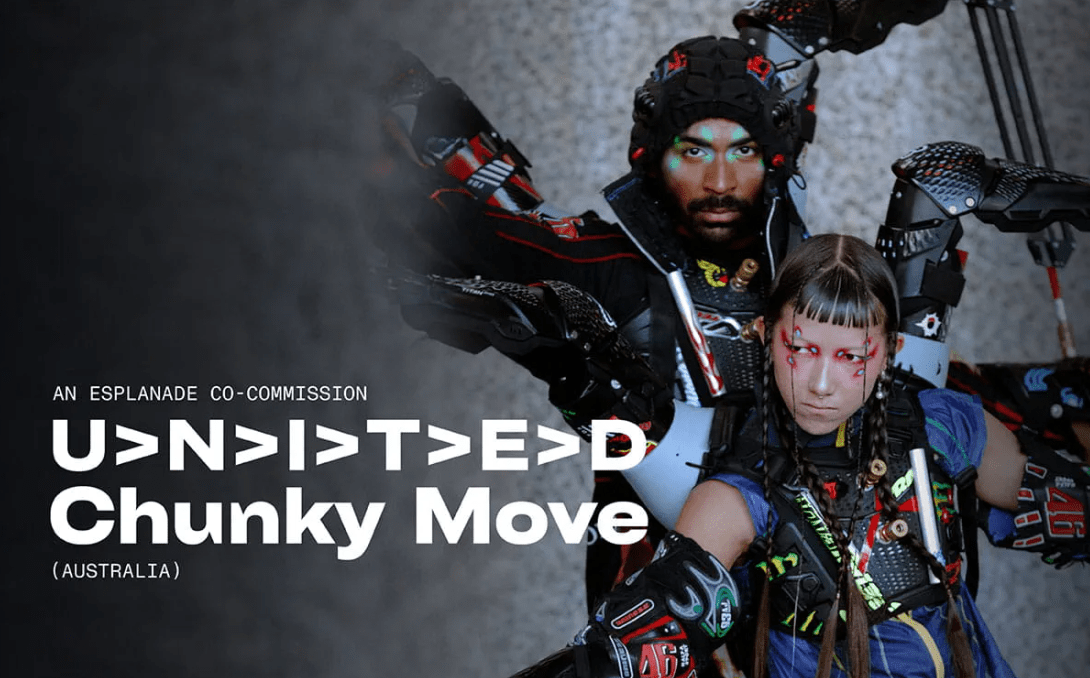
When audiences step into U>N>I>T>E>D, the latest work from Melbourne-based company Chunky Move, they can expect to enter an entirely different world and an unfamiliar dimension. Think of a machine-mystical landscape where human bodies become mythic creatures, animatronic forms pulse with uncanny life, and the air vibrates with the furious ritual of Balinese noise-duo Gabber Modus Operandi. It’s dance, but something entirely different from how you know it.
This is Antony Hamilton’s vision. Since becoming Artistic Director and co-CEO of Chunky Move in 2019, Hamilton has guided the company into what he calls a “speculative future” of performance, following his acclaimed works Token Armies (2019) and Yung Lung (2022). With U>N>I>T>E>D, which premiered earlier this year at Asia-Pacific Triennial of Performing Arts (Asia TOPA), and later staged during the Venice Biennale, Hamilton pushes further into the intersection of choreography, design, and myth.
But for Hamilton, the piece begins with a simple symbol: “>”. “The greater than symbol comes from mathematics, to signify progression,” he says. “But to me it’s a nice play on symbols and language, representing something beyond the literal. It symbolises the idea that maybe there’s a ‘greater than’ notion of human beings being more interconnected with our environment. It’s a graphical relationship with the title. I’m often interested in destabilising our sense of meaning in the everyday.”
That destabilisation, making the familiar strange, the symbolic concrete, the everyday ritual mythic, is at the heart of U>N>I>T>E>D. Like many of Chunky Move’s works, U>N>I>T>E>D is a convergence of diverse collaborators, more than a singular vision led by Hamilton to become greater than the sum of its parts.

From Indonesia comes Gabber Modus Operandi, the Denpasar-born duo of Kasimyn and Ican Harem. Known for fusing gabber, dangdut koplo, grindcore, noise, Chicago footwork, and the Javanese trance-dance jathilan, their live shows blur the line between humour, chaos, and ritual. “It goes a lot into a conversation with Gabber Modus Operandi,” Hamilton recalls. “They believe that the material elements human beings create are imbued with spirit. Our experience in the world shapes these things so they carry an essence of the human spirit. We wanted to draw out that idea, that objects aren’t strictly functional, but much more than that. They’re representations of self-awareness and presence in the world.”
Also hailing from Bali is Future Loundry, the radical street-fashion label founded by Harem and Manda Pinkygurl. Their practice of upcycling, stitching together discarded garments from punk, metal, disco, and beyond, resonates deeply with Hamilton’s preoccupation with materiality. “I was very inspired by Future Loundry,” Hamilton says. “They take things people have discarded and transform them into something else. It’s about working with what we have, not constantly demanding new materials. If we talk about materiality in a three-dimensional world, what’s the opposite? Maybe AI text or AI imagery. But even those are grounded in human imagination. They don’t go beyond it—they reflect it.”
The work also harnesses cutting-edge animatronics from Creature Technology Co., the Melbourne company that revolutionised arena-scale performance with Walking with Dinosaurs – The Arena Spectacular. Their machines lend U>N>I>T>E>D its hybrid energy, merging the organic with the mechanical. Meanwhile, lighting designer Benjamin Cisterne, celebrated for his sculptural, atmospheric work in both theatre and museums, creates a visual world where shadows become as alive as bodies. Together, these collaborators allow Hamilton to craft an experience that’s both futuristic and ancient, mechanical and spiritual.

There’s something philosophical about how Hamilton grounded this work in the idea of materiality, how humans relate to the things they create, and how those things shape us in turn. “There’s this arc of materiality, between what we perceive as the natural world and the constructed world, the artificial world,” he says. “I’m interested in the boundary where the two overlap. The materials we use to construct things also come from the natural world. There’s a messy dialogue with these elements.”
In rehearsal, that dialogue manifests in choreography that transforms dancers into hybrid creatures. “Sometimes there’s a scene where five dancers are together, with lots of arms, like a centipede, or a scorpion, or a dragon,” Hamilton describes. “They face off against a single dancer who’s like another monster. It creates these strange relationships, like onstage you could imagine a child only a mother could love. Family dynamics often come up, lineages, leaders and followers. Performers sometimes become god-like figures, while others are followers, and then with dramaturgy, it goes from just choreographing ‘machines’ into creating entire mythologies and relationships between these imagined creatures onstage, completely unexpected.”
This gravitation toward myth and ritual, he suggests, isn’t just aesthetic, but elemental. “A lot of these ideas we come up with end up universal and time immemorial, rather than being of the present or future. There’s something about mythology, gods, our relationship to the machine world, and the constructed environment that’s dormant in our minds, and cuts across cultures. We take for granted the natural environment all around us, even something as simple as turning a door handle, brushing our teeth, which have become almost automatic, subconscious behaviours. But when you recontextualise them, you see how extraordinary they are – we want to make something seemingly ordinary, extraordinary again, and imbue audiences with that sense of wonder.”

Chunky Move’s works often sit between spectacle and speculation, grand in scale yet philosophically probing. Hamilton’s aesthetic is less about linear narrative than about reimagining the present through live bodies. “The process is about transporting audiences, giving them a vision of the fantastic, a world that’s unfamiliar,” he says. “What’s interesting in live performance is that everything is real, with real people in a real space. Even though we sometimes call the work speculative fiction or futuristic, really, it’s about reimagining the present, and restructuring what we see in the world.”
This reimagining is tangible in the staging. At Asia TOPA, the low ceilings made the experience intimate; the sound system was placed on the floor, so bass seemed to rise from the earth itself, while the entryway was redesigned as a spaceship dock. “We wanted audiences to feel close to the work,” Hamilton says. “With Gabber Modus Operandi’s overture, people could look at the materiality a bit longer. It’s about controlling the venue so audiences already feel immersed before it begins.”
Founded in 1995, Chunky Move has long been Australia’s leading contemporary dance company. Known for bold, experimental works staged in unconventional spaces, it has performed in over 134 cities worldwide. Under Hamilton and co-CEO Kristy Ayre, the company continues to balance legacy and innovation. “Chunky Move has a legacy of being experimental, working in unconventional spaces, recontextualising what it means to come to a live performance,” Hamilton says. “When I joined, I wanted to preserve that, but also expand participation. For me, the vision is about making major works with professional artists, while also opening the door for everyone to experience dance. We’ve invested a lot of energy into our public classes, accessibility programs, giving people the chance to dance, to have that embodied experience of their own bodies.”
That embodied experience, Hamilton insists, is transformative. “Dance really is fascinating isn’t it? Even when you’re working as a professional dancer, it feels like an endless quest, always refining, always shifting,” he reflects. “But my greatest experiences have been teaching, seeing people awaken who never thought of their own experience of the world in that way. That’s the pleasure of it.”
Hamilton is also candid about the challenges of sustaining dance in Australia. “Support for dance is still relatively low, federally and at the state level,” he says. “We spend a lot of time on advocacy, often talking to people already inside the community. The challenge is balancing time for advocacy with developing works that can speak to broader audiences. Like science, art can be so obscure that people don’t immediately see the value. But it fosters social cohesion, physical and mental health, self-reflection, joy. I want to work in a space where dance is recognised as vital to health and education, not just entertainment.”
Ultimately, U>N>I>T>E>D is less about machines or myths than about what happens when people come together, dancers, collaborators, audiences, united as one, in the same space. “It’s really a show that’s all about cohesion and unification,” Hamilton says. “When people and ideas and cultures come together with enthusiasm and energy, amazing things happen. I want people to come out of performances thinking, ‘I’ve never seen anything like that before.’ I want people to be amazed, and to remember it forever.”
Photo Credit: Giana Rizzo
U>N>I>T>E>D plays from 26th to 28th September 2025 at the Singtel Waterfront Theatre. Tickets available here
da:ns focus – Connect Asia Now (CAN) taking place from 25th to 28th September 2025 at the Esplanade. Tickets and full programme available here
 Bakchormeeboy