
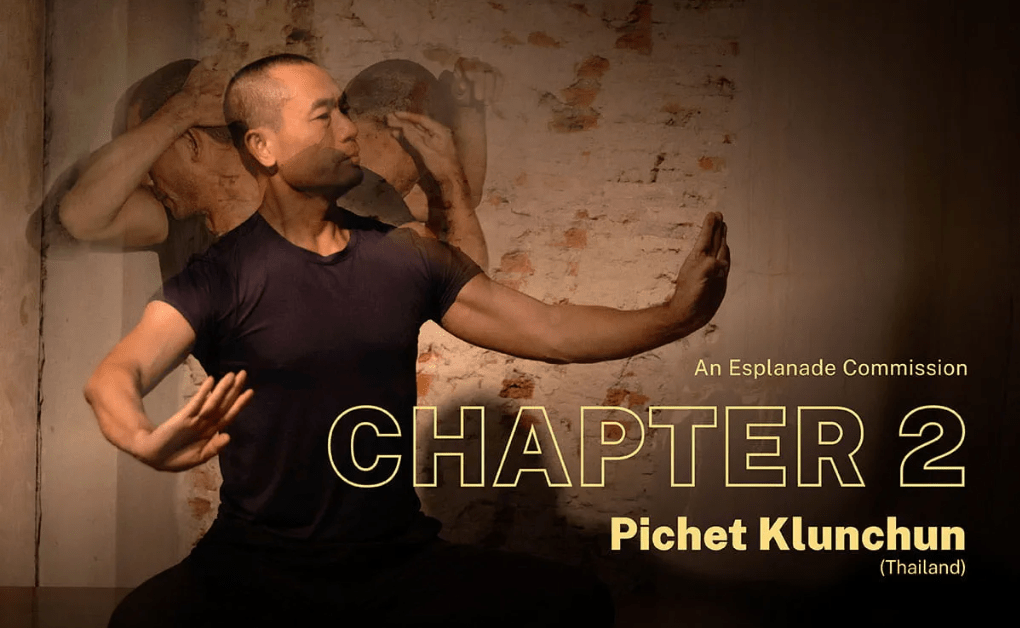
ChatGPT becomes a conversation partner, co-creator and dramaturg in Pichet Klunchun’s new show.
Artificial Intelligence (AI) has rapidly developed to the point where it can hold conversations, generate images, and even craft videos. But as it increasingly encroaches on the arts, one question lingers: can AI dance?
For Thai dancer, choreographer and khon master Pichet Klunchun, the answer is a tentative yes. In his newest work, Chapter 2, part of the 2025 edition of the Esplanade’s da:ns focus: Connect Asia Now (CAN) programme, AI is not just a tool but an integral co-creator and performer. A spiritual sequel to his earlier solo work I AM A DEMON from 20 years ago, Chapter 2 reflects on the evolution of his craft, his limitations, and the passage of time.
The staging at the Esplanade Annexe Studio is simple: Pichet sits barefoot at a desk, humbly dressed in a dark T-shirt and pants. He opens his MacBook, eyes fixed on the screen rather than the audience. Behind him, a projector flares to life, revealing a familiar interface: ChatGPT, as Pichet begins a live dialogue with the AI.
The performance is markedly experimental and almost feels improvised. Pichet types in real time and waits for ChatGPT’s replies. Technical hiccups occasionally intrude; missed translations, breaking character during role-play, but the pauses and glitches become part of the rhythm. Much of the audience’s time is spent reading the text onscreen, yet this might mirror our own everyday entanglement with AI: the prompting, the waiting, the scanning for meaning.
Pichet plays with tone, initially instructing ChatGPT to speak in Gen Z slang to welcome us into the space. Later, he prompts it to guide the audience on how to appreciate contemporary dance, not through analysis but through attention to emotion and resonance. Personal traces emerge too, as he asks the AI to interpret a recurring dream about his late master, seeking answers that remain elusive. ChatGPT does not dictate meaning but offers possibilities, much like dance itself, an abstract form that resists easy definition.
Three distinct segments structure Chapter 2, all derived from the khon art form. In the first, Pichet stays seated, moving only his arms and hands with exquisite precision. In the second, he invites ChatGPT into role-play as characters from the Ramayana: King Ravana (Pichet) and his younger brother Phipek (ChatGPT). As Phipek advises Ravana on an ominous dream to release Sita and accept his limits, Pichet rises, embodying desire and restraint in controlled, expressive movement against the backdrop of an AI-generated image of Sita, to express a love that has mutated into possession.
The final segment though, is the most affecting. Ravana prepares for war while Phipek pleads for peace but offers his prayers nonetheless. As Pichet tries to generate an image of Ravana leading an army, the network briefly fails, halting the image mid-render. Whether accidental or not, it feels like ChatGPT itself, still roleplaying as Phipek, struggling to hold Ravana back from violence and doom.
Here, Pichet’s movement grows more contemporary, more intense, even desperate. At one point he collapses to the ground, crawling toward the laptop to confess a real-life spinal injury. ChatGPT breaks character to urge him to seek medical care. Pichet returns to “battle” as the AI can only watch, an uncanny moment where the digital collaborator resembles a concerned sibling.
By the end, Pichet is visibly exhausted. He asks ChatGPT to close the role-play and address the audience. It obliges, inviting us to send him energy and encouragement. We applaud; he relays this to the AI, which expresses gratitude. In that exchange, artist, machine, and audience locked in a feedback loop, and articulates what has been at stake all along: Pichet is not simply ‘dancing’ with AI, but using it as a mirror to examine dreams, limitation, and possibilities for renewal.
Chapter 2 ends with ChatGPT bidding us goodbye, almost like Pichet treats it as a human performer and co-creator alongside him. As much as AI is no substitute for human connection or original art, Pichet has found a way to evoke something genuinely tender from it, having it be his witness, sounding board, and a means to help him make sense of his current state, and where he goes from here. Chapter 2 isn’t necessarily about proving that AI can dance, but more of showing how an artist might use it to keep moving forward – another tool in our increasing kit, but one that allows us to find new ways of processing to refine our thoughts and art.
Chapter 2 played from 27th to 28th September 2025 at the Esplanade Annexe Studio. More information available here
da:ns focus – Connect Asia Now (CAN) took place from 25th to 28th September 2025 at the Esplanade. Full programme available here
Production Credits
| Choreographer and performer Pichet Klunchun Set and Lighting design Pichet Klunchun Dramaturg Fu Kuen Tang Stage Manager Kornkarn Rungsawang Producer Sojirat Singholka |
 Bakchormeeboy