
Choy Ka Fai reunites five artists to reflect on change, growth, and their relationship to body and the world.
The world in 2015 was a very different place. Since then, politics, pandemics, technology, and society at large have shifted dramatically, but so have each of us, for better or worse. Yet one thing remains constant: our individuality and the human drive to innovate. This is the essence of Softmachine: The Return, where Singaporean artist Choy Ka Fai documents and interweaves the stories and practices of five artists with whom he shares a decade-long friendship and collaboration.
Presented as part of Esplanade’s 2025 edition of da:ns focus – Connect Asia Now (CAN), Softmachine: The Return directly follows the 2015 showcase Softmachine, also at the Esplanade. That earlier programme brought together five artists: Rianto (Banyumas, Indonesia), Surjit Nongmeikapam (Manipur, India), Xiao Ke × Zihan (Shanghai, China), and Yuya Tsukahara (Osaka, Japan), to present individual works that highlighted their distinct practices across Asia. Originating in 2012 as Choy’s independent survey of Asian choreography and contemporary dance production, SoftMachine has since grown into a long-term project.
This 2025 “return” serves as both sequel and reunion, where each of the original artists revisits and re-presents their practice as it has evolved over the past decade. But Softmachine: The Return is more than performance. Choy, both as curator and friend, layers documentary footage, interviews, and personal encounters into the show, illuminating the personal and artistic contexts that shape each performer’s work.

Nowhere is this more evident than in the opening segment with Yuya Tsukahara’s company contact Gonzo. Although Yuya himself could not appear live, Choy steps into his shoes, attempting to learn and perform contact Gonzo’s signature style. Distilling their ethos into 20 notations, the exercise borders on absurd, given that contact Gonzo thrives on improvisational, guerrilla “contact”, often involving actual punches, wrestling, and physical collisions. As Yuya’s proxy, Choy explains the group’s philosophy, shares footage of their MoMA New York performance, and brings us back to Japan to see Yuya at home with his wife and child, playfully dragging his daughter across the floor with delight.
Onstage, Choy and contact Gonzo members Keigo Mikajiri and Ryu Mieno, clad in protective gear, demonstrate the notations. With guest performer Pat Toh reading the list aloud against a digital AR-style backdrop, the trio stretches, punches, and even body-surfs across one another, occasionally toppling the cardboard towers around them. The performance teeters between comedy and danger; do we laugh or gasp? It becomes an exploration of intimacy, risk, and trust through physical contact. As they close in an improvised freestyle, with Pat leaping into the men’s arms, the piece captures a raw, freeing sense of movement unburdened by convention.

The stage then clears for Xiao Ke × Zihan. Their documentary recounts a decade of touring in China, balancing commercial projects with independent productions. Yet tension soon surfaces: voice notes reveal their disappointment at being unable to travel 10 days by train to Singapore as an eco-activist gesture, a dream curtailed by financial impracticalities and competing commercial demands. This raises pressing questions about the sustainability of art, environmentally, economically, and personally.
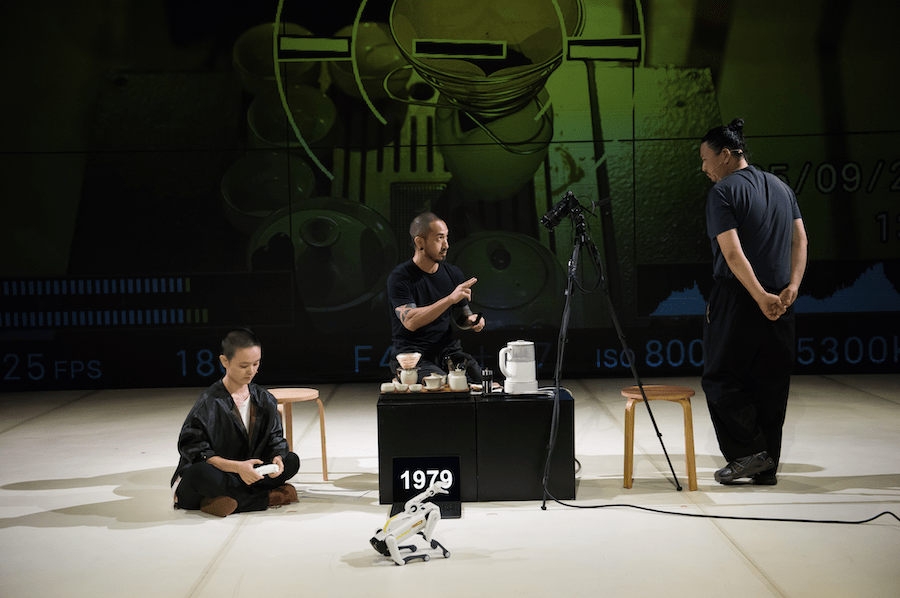
Their live performance blurs lines between staged and real. Seated at a small table with Choy filming beside them, they interact with a toy robot dog and an AI kettle as a 1888-second countdown begins. Projected close-ups of their faces accompany candid conversation, including a two-year silence with Choy due to personal conflicts, and their own romantic breakup after years as artistic partners. Their bond now persists in collaboration, even if no longer necessarily romantic.
Rather than a conventional piece, this segment becomes a meditation on memory, relationships, and trust. Xiao Ke and Zihan teach Choy a “Chinese yoga” practice before showing a montage of their past productions, emphasizing participation and interaction. When the house lights rise, they ask the audience direct questions about belonging and identity, provoking applause and foot-stomps in response. Slowly, their stoicism softens, culminating in Xiaoke’s improvised solo, a reminder that, even after decades, the body remains a wellspring of inspiration.

After intermission, the focus turns to Surjit Nongmeikapam. Veiled and holding a massive bamboo pole releasing incense, he begins with quiet intensity before his documentary dives into Manipur’s fraught colonial history and recent violent conflicts (2023–2025). Onscreen, suspended by ropes in one striking image, Surjit embodies paralysis and powerlessness, contextualized by haunting folk songs.
Yet he also highlights resilience: how Manipuri dance traditions persist, from ancestral rituals to viral TikTok clips, and his own initiatives in founding an artist commune as a sanctuary amid unrest. His live performance, dragging himself across the stage with rope around his waist, resonates as both personal burden and political protest. Unlike earlier segments’ freedom and play, Surjit’s is a testament to art as necessity, resistance, and cultural survival.

The final segment belongs to Indonesian dancer Rianto, who takes near-complete control of his presentation. A master of Lengger cross-gender dance, Rianto’s performance is both sensual and dignified, embodying feminine grace and masculine strength with equal ease. He even invites an audience member to learn a few steps, sharing his craft with warmth.
Through masked dances, Rianto shifts effortlessly between characters: the teasing Putri princess, the fierce male warrior. His documentary reveals his journey from rural village life to university study, the only viable path to professional dance in Indonesia, as well as glimpses of his personal life across gender and cultural boundaries, from ancestral rituals to nights in Tokyo’s Shinjuku. His closing performance strips away costume and makeup, leaving him in a bodysuit and heels as he bares his most vulnerable self. Dancing to an Indonesian love song, he radiates mastery, pride, and raw emotion, leaving the audience deeply moved.
In many ways, Softmachine: The Return epitomizes the spirit of CAN: friendship, connection, and cultural exchange. It is as much about art as about the human relationships that sustain it. Whether predicting Yuya’s rise as contact Gonzo’s artistic director, navigating personal entanglements with Xiao Ke and Zihan, or stepping back as Surjit and Rianto narrate their own stories, Choy positions himself as both documentarian and friend, deeply invested in the lives of these artists.
What makes Softmachine: The Return significant is not its polish or “completeness” but its embrace of fragility and unfinishedness as a form of resistance. It stages traces rather than conclusions, allowing each portrait to remain porous and provisional, much like the friendships that anchor it. In a global circuit where difference can be commodified, the work insists on proximity without assimilation, on rehearsing another’s rhythms while accepting dissonance. It is a reminder to all that contemporary dance in Asia is not a static archive but a living, breathing body, one that falters, changes, and endures.
For Singapore, where experimental, durational dance of this scale is rare, Softmachine: The Return felt like a gift: three hours to witness artists thinking and moving together, not as a finished product but as an ongoing practice. Choy’s project resists easy closure, inviting us instead to sit with vulnerability, to value the labour of friendship and the act of returning to the body as a site of knowledge. For these reasons, Softmachine: The Return may not be perfect, but it is vital, a rare and resonant experience in Singapore’s dance landscape.
Photo Credit: Law Kian Yan
Softmachine: The Return played from 26th to 28th September 2025 at the Esplanade Theatre Studio. More information available here
da:ns focus – Connect Asia Now (CAN) took place from 25th to 28th September 2025 at the Esplanade. Full programme available here
Production Credits
| Concept, Visual Design, Direction and Documentary Choy Ka Fai (Singapore/Germany) In collaboration with Rianto (Indonesia), Surjit Nongmeikapam (India), Xiao Ke x Zihan (China) & Yuya Tsukahara (Japan) Guest Performance by contact Gonzo Keigo Mikajiri (Japan) & Ryu Mieno (Japan) Guest Performer Pat Toh 3D Visual Design and Programming Lisa Kaschubat Scenography, Lighting Design and Technical Direction Ray Tseng Music and Sound Design Zihan, Mo’ong Santoso Pribadi, Nova Ruth, Chaoba Thiyam Stage Manager Ng Hui Ling Project Manager CIRCUS PROJECTS Residency Support Studio Plesungan (Indonesia, Melati Suryodarmo), Dance Nucleus (Singapore, Daniel Kok) |
 Bakchormeeboy