

A multiplicity of riotous stories exuberantly told, even if they don’t quite add up.
Tall Tales: Bananas & Ang Ku Kuehs holds a delectable premise: a Singapore–Taiwan puppet theatre collaboration drawing on the storytelling spirit of The Decameron, where tales of love, jealousy, greed and mischief multiply across cultures and generations. Directed by Oliver Chong of The Finger Players and Wang Chia-Ming of Shakespeare’s Wild Sisters Group, the production promises a cross-cultural tapestry in which Southeast Asian folklore intertwines with the playful narrative architecture of Giovanni Boccaccio’s 14th-century classic. In The Decameron, ten young people escaping the Black Death pass the time by telling one another stories, a structure that celebrates the unruly vitality of storytelling itself. Tall Tales clearly embraces that spirit of abundance: humans morph into animals, objects remember human voices, and myths travel between islands like migrating creatures. The result is a work brimming with imagination, even if its flood of ideas occasionally threatens to outrun the story it is trying to tell.

The performance begins intriguingly enough. Beneath a chandelier suspended above a stage littered with black plastic bags, a man appears and immediately disturbs the landscape by plucking a flower from the domain of a serpent king. The moment carries unmistakable echoes of Adam and Eve and the forbidden fruit: an act of curiosity that triggers punishment. The serpent demands payment for the theft, noticing the ang ku kuehs the man is carrying and placing a curse upon two of them. Whoever eats the pastries will be compelled to come to the serpent king; if no one does, he will claim the man’s daughter himself. It is a clean narrative hook, a father forced into a moral gamble to save his family, and for a brief moment the show seems poised to unfold like a dark folktale about sacrifice, desire and consequence.

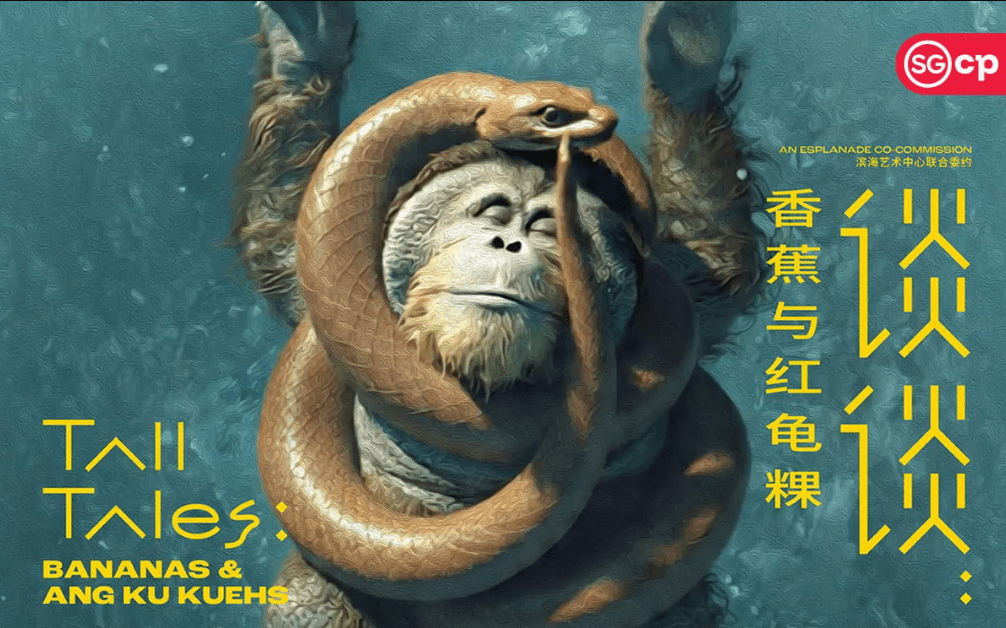
Yet the story soon branches outward into a lively series of digressions. The cursed ang ku kuehs are accidentally eaten by the daughter, Cui Er, who remains blissfully unaware of her fate as her father, suddenly overcome with guilt, begins treating her with exaggerated affection, presenting her with gifts originally meant for his wife. Around this central plot swirl other characters and subplots: Lan Lan, who transforms into an orang-utan whenever she doubts herself, perches atop a ladder that doubles as a tree while waves crash softly in the background; Pan Pan, a puppet suitor whose grounded physicality offers a moment of visual clarity; and Bang Su, the romantic interest whose presence triggers a chain of jealousies and rivalries. The orang-utan sequences, delivered partly through voice and partly through song, carry an intentionally awkward charm, emphasising the creature’s uneasy position between human and animal.

This abundance of storytelling appears to be the point. Like The Decameron, the show delights in stories nested within stories, constantly shifting tone and form. Characters transform with gleeful abandon: despair sends one lover plunging into the sea, only for him to reappear moments later as a fish projected on a screen; Cui Er herself becomes first a bird escaping her murderous mother, then a bamboo pole that is chopped apart and fashioned into a stool. The jealous mother, seduced by the jewels and dowry left behind by the serpent king, plots to eliminate her daughter in order to claim the riches and the marriage for herself. At one point she poisons her child with a forbidden fruit disguised as soup; at another she pursues the transformed bird across the archipelago in a boat, a sequence rendered through shadow puppetry that traces the geography of island Southeast Asia. These moments reveal the production at its most inventive, with cardboard props, improvised objects and shadow imagery conjuring an entire mythological landscape from the detritus scattered across the stage.

The performers throw themselves into this world with gusto, accompanied by bursts of techno music that periodically transform the stage into something resembling a surreal folk rave. The effect is deliberately strange: royal scenes are marked by the sudden illumination of the chandelier, while costume changes happen openly as actors shed one persona and assume another. At times the energy spills over, where musical interludes occasionally linger longer than necessary, and Bang Su’s distant lament from a boat stretches into an extended moment of melancholy. Yet even in these stretches, the production maintains a sense of playful theatricality, embracing the messy exuberance of storytelling rather than striving for neat narrative order.
What holds this swirling theatrical ecosystem together is the commitment of the performers, who navigate the production’s rapid tonal and narrative shifts with impressive dexterity. As Lan Lan and the voice behind the orang-utan, Ellison Tan delivers one of the evening’s most memorable performances, moving fluidly between human vulnerability and animalised physicality. Perched high on the ladder-tree, Tan gives the lonely creature a surprising emotional weight, whether through the deliberately awkward singing or the hesitant movements that suggest a woman trapped inside a body she no longer fully controls. The transformation never feels merely comic; there is a quiet melancholy beneath the absurdity that grounds the character. Elsewhere, the ensemble prove equally agile, shifting between puppeteers, narrators and characters while manipulating props and figures with the precision that has become a hallmark of The Finger Players’ work. In a production where people become animals, animals become objects and objects become stories, the performers provide the vital connective tissue, ensuring the stage never loses its sense of play.

Boccaccio’s The Decameron may be riotous, but it is also carefully structured, with each tale building toward a decisive conclusion. Tall Tales is less interested in tidy endings than in the act of storytelling itself. The result is a performance that constantly opens new narrative doors just as another begins to close. By the time the serpent king returns from his pilgrimage to claim Cui Er, only to discover the mother’s treachery and swallow her whole before reluctantly sparing her life, the story has travelled through a labyrinth of transformations, jealousies and improbable reversals.

It is the production’s imagination that remains its greatest strength. There are striking images throughout: the lonely orang-utan balanced on her ladder-tree, the shadow map of the archipelago, the improvised boat sliding across the stage. The creators describe Tall Tales as a meditation on how stories migrate between cultures, adapting and transforming along the way. Seen in that light, the show’s restless narrative energy begins to feel intentional. Like the folktales it draws upon, these stories twist, wander and mutate as they travel, sometimes untidy, occasionally overwhelming, but undeniably alive.
By the end of the evening, Tall Tales: Bananas & Ang Ku Kuehs may feel less like a single story than a teeming ecosystem of them. Not every strand lands with equal clarity, but the theatrical imagination on display is hard to deny. In a cultural moment where borders feel increasingly fixed, this playful collision of myths from two islands offers something rare: a reminder that stories, like people, are always moving.
Photos by Crispian Chan, courtesy of The Finger Players
Tall Tales: Bananas and Ang Ku Kueh played from 6th to 8th March 2026 at the Esplanade Theatre Studio. More information available here
Huayi – Chinese Festival of Arts 2026 ran from 27th February to 8th March 2026 at the Esplanade. Full programme available here
Production Credits
| Co-Directors & Co-Playwrights Oliver Chong,Wang Chia-ming 王嘉明 Co-Producers Myra Loke, Nitta Yukio Producing Executive Lu Lin Set Designer Oliver Chong Costume Designer Jeffy Cheah Lighting Designer Wang Tien-hung Sound Designer Wang Chia-ming Music Composer Blaire Ko System Designer & Engineer Jeffrey Yue Puppet Designer Daniel Sim Puppet Fabricator Prop-erly Puppet Master Beverly Liang Props Master Loo An Ni Performers & Puppeteers Ellison Tan, Myra Loke, Ric Liu, FA, Hsueh Mei-hua, Chen Chia-hao Production Manager Cindy Yeong, Stage Manager, Tennie Su Assistant Stage Managers Cristabel Ng, Natalie Wong Set Coordinator Marc Andre Lighting Coordinator Joanne Ng, Sound Operator, Xena Giam Script Translation to English Ellison Tan, Oliver Chong Surtitle Operator Teo Pei Si |
 Bakchormeeboy